A young man appeared virtually out of nowhere in Nuremberg, Germany, in May 1828, and his arrival would go on to spark one of the most bizarre and enduring mysteries in European history. The teenager, who appeared to be around 16 years old, was found in a disheveled state, wearing distressed clothing and carrying only two handwritten letters. When a local shoemaker discovered him, the young man could offer little explanation for who he was or where he had come from. One of the letters was addressed to an unidentified caretaker from the boy’s mother.
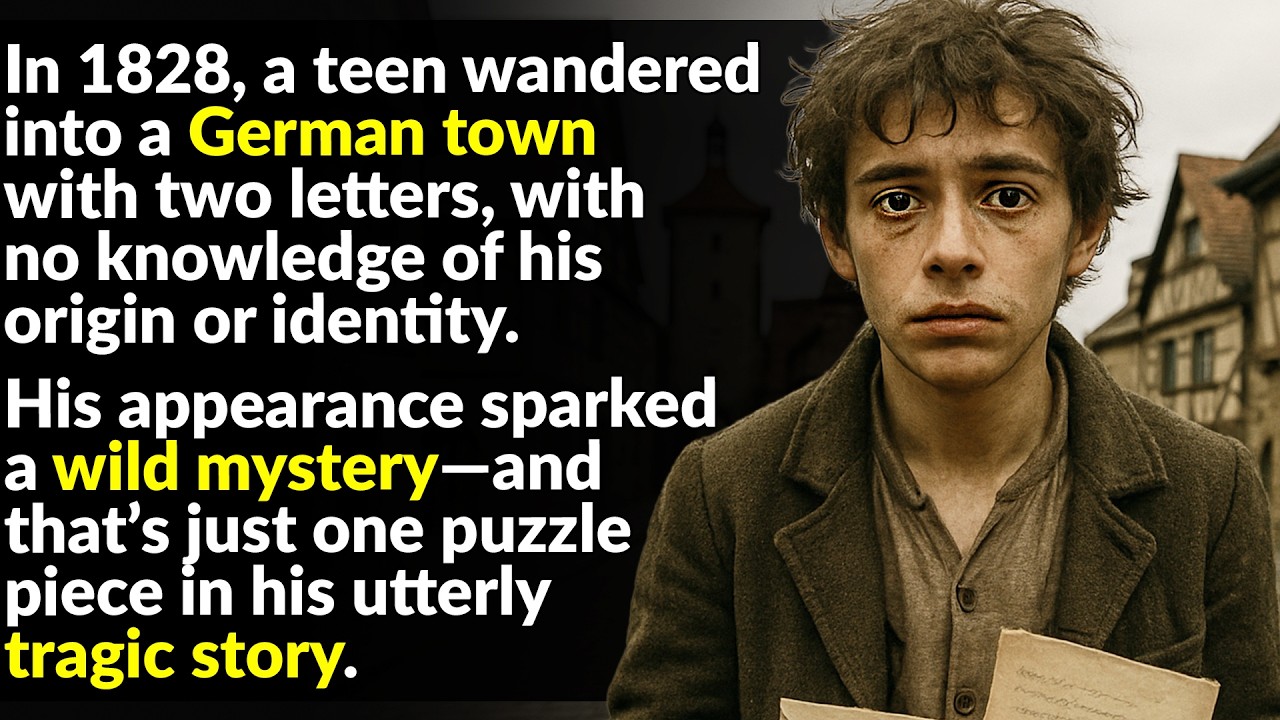
In it, she named her son and explained that his father, a former cavalryman, had passed away. The second letter, written by the caretaker, claimed the man had raised the boy and taught him the Bible. It stated that the youth wished to become a cavalryman, and the caretaker instructed the recipient to either take him in or hang him. When brought before the captain of the cavalry, the boy reportedly repeated only one phrase: “I want to be a cavalry man like my father was.
” When officials pressed him for more details about his origins, he became frustrated and tearful, responding only with “Don’t know. ”
Unable to determine where he came from or who he was, authorities placed the boy, who became known as Kaspar Hauser, under the guardianship of a jailer named Andreas Hilt. After two months of observation, Hilt deemed him physically healthy for his presumed age, though the boy initially appeared mentally delayed. That assessment changed quickly.
The local mayor took an interest in Hauser and reported that the boy had an exceptional memory and could acquire new skills with surprising ease. As word spread, the townspeople grew fascinated, and increasingly elaborate theories about his true identity began to circulate. One popular theory claimed Hauser was of royal blood. According to this version of events, he was the child of Charles, Grand Duke of Baden, and the adopted daughter of Napoleon, born in 1812.
Records showed that an infant heir had died that year, but the theory suggested a switch had occurred. Hauser’s supporters claimed a countess had swapped the living heir with a dying baby in order to secure the throne for her own son. The story gained significant traction, though no evidence ever supported it. Another theory suggested Hauser was a “wolf child,” someone who had been raised in complete isolation.
This idea seemed to fit his sudden appearance and initial mental limitations. Hauser himself eventually began to share his own account of his past. He claimed to have spent his early years locked alone in a tiny, dark cell. The room contained a small straw bed and a few wooden toys.
His food, always simple bread and water, appeared near his bed each morning. He never saw the person who cared for him. He recalled occasionally tasting something strange in his water, which caused him to fall into a deep sleep. When he woke, he found his bed had been changed and his hair had been cut.
Eventually, he said, the same man brought him to Nuremberg and left him there. While many pitied him, others were skeptical. Hauser, who reportedly could barely speak when he arrived, was soon able to write his autobiography. His story attracted both sympathy and suspicion in equal measure.
The community officially took responsibility for Hauser. A schoolmaster named Friedrich Daumer took him in with financial assistance from the town and began educating him. Hauser proved an eager student and progressed quickly. Daumer, who had an interest in scientific study, reportedly used Hauser as a subject for experiments involving magnets and homeopathic medicine.
In October 1829, Daumer discovered Hauser in the cellar, bleeding from a wound on his forehead. Hauser claimed a hooded man had attacked him while he was using the bathroom. He said he had not seen the attacker’s face but recognized his voice as the same man who had imprisoned him as a child. The wild claim only fueled the royal origin theories.
But the physical evidence told a different story. A trail of blood led from the ground floor to Hauser’s bedroom and then to the cellar. There was no blood in the bathroom. Critics argued that Hauser had staged the attack, inflicting the wound on himself and arranging the scene to make it look like an assault.
Other circumstances added to the suspicion. Daumer and Hauser had reportedly argued bitterly shortly before the incident, and the schoolmaster had accused Hauser of habitual lying. Many believed the incident was an attempt to find a new guardian. Despite the doubts, authorities decided to move Hauser to a new location for his safety.
He was placed in the care of a local official named Johann Bieberbach. The peace did not last. One day, a gunshot rang out in Hauser’s new home. His caretaker found him bloody again, this time with a wound on his head.
Hauser offered an explanation that raised eyebrows: he claimed he had accidentally grabbed a pistol from the wall while using a chair to reach an object. According to his account, the weapon discharged and grazed him. Bieberbach soon formed the same opinion as his predecessor. He described Hauser as a terrible liar and accused him of being full of vanity and spite.
The pattern was becoming clear: Hauser grew difficult to manage under each successive guardian, and each time, his situation changed. In 1831, a British nobleman named Lord Stanhope took an interest in Hauser with a focused mission. He wanted to uncover the truth of Hauser’s origins. Stanhope spent considerable time with the young man, hoping to revive his memory.
During their conversations, Hauser let a few Hungarian words slip and reportedly claimed his mother was a Hungarian countess. Excited by the possibility, Stanhope took Hauser to Hungary twice, believing the physical surroundings might trigger buried memories. The trips produced nothing. Hauser recognized no people, places, or anything else.
Stanhope’s efforts ultimately failed, and by the end of the year, Hauser was placed in the care of another schoolmaster, Johann Georg Meyer. Stanhope continued to provide financial support for a time but eventually stopped visiting altogether and abandoned his promise to take Hauser to England. The pattern repeated once more. Meyer soon found himself frustrated with Hauser’s tendency to lie and make excuses for his behavior.
Hauser’s financial supporter and father figure, a man named Von Feuerbach, passed away in 1833, leaving him increasingly isolated. In December 1833, Hauser arrived back at Meyer’s home bleeding heavily. He claimed an unrecognized stranger had attacked him while trying to give him a bag. When authorities went to the scene, they found the bag.
Inside was a note written in German, in which the supposed attacker identified himself and stated his origins. Further analysis revealed disturbing inconsistencies. The letters Hauser had carried when he first appeared in Nuremberg were now discovered to be written in the same handwriting. One of them was addressed to a captain who had not been stationed in the area at the time the letter was supposedly written.
The note found at the scene of the alleged attack was folded in a distinctive triangular method that Hauser used himself. The writing contained grammatical errors consistent with Hauser’s typical mistakes. There was only one set of footprints in the snow at the scene. Investigators concluded that Hauser had inflicted the wound on himself, this time cutting too deeply.
Hauser died three days later. He was buried in Ansbach, Germany, with a headstone that read: “Here lies Kaspar Hauser, riddle of his time. ”
His death did not end the mystery. Shortly after his passing, several people who had known him came forward with admissions.
Lord Stanhope authored a book discrediting Hauser’s stories, writing that he felt it his duty to confess that he had been deceived. Doctors examined Hauser’s brain after his death, seeking a scientific explanation for his behavior. One suggested it was smaller than usual and speculated he might have been epileptic. Another declared him completely normal.
Psychologists studied his case extensively. Many considered his claimed isolation in a tiny cell nearly impossible, arguing that someone locked away for that long would be far more mentally underdeveloped. Others theorized he suffered from a personality disorder marked by deep paranoia, which could explain his dramatic behavior and his apparent need for pity and attention. Whatever the cause, Hauser’s deception had become one of the most famous mysteries in European history.
A statue of him still stands in Ansbach today, erected in the 1940s. It refers to him as the “Child of Europe. ”
His story has inspired works by authors such as Herman Melville and has been featured in films and television episodes.
More than a century and a half later, the truth about who he was and why he lied remains unknown.