On the afternoon of October 14, 1947, a 42-year-old Black man from Harlem was driving a dark blue Cadillac through a residential neighborhood just past the Queens line when the engine overheated and died. He pulled onto the shoulder and walked to a service station at the corner, intending to pay for a tow and a repair. He had the exact size of the needed fan belt written down, and he made clear he could cover both the tow and the work. The proprietor told him they were not taking any more work that day, though minutes later a white customer was served at the pumps and at the garage bay.
The proprietor then read out a rule to the man: this was not that kind of neighborhood, and there was no call for his kind of trade out here. The man repeatedly offered to pay extra—double for the inconvenience, if necessary—but was turned away. He walked to a candy store with a pay phone and called two towing companies. The first never stopped; the second stopped, looked at the location, said it did not cover that stretch, and left.
A patrol car arrived after dark. Two officers asked where he was coming from and going, and told him the vehicle could not remain on the roadway after dark—then left without offering help. A young laundry delivery driver pulled over anyway and helped him push the Cadillac off the road crown,, and the man told him courteously to finish his route. He waited for three hours in his overcoat, never raising his voice.
Instead, by the light of matches and the candy store window, he took out a small notebook and began writing down what he had seen: the name of the station, the brand on the sign, the license plates of the truck on the lift and the patrol car, the hours the station had served a white customer, the times each towing company had refused, andthe price of regular gasoline. He was not making a list of enemies. He was starting a set of books. That afternoon, the man understood, was not one man’s rudeness.
The station owner was occupying a position inside a structure. Behind him stood an oil company franchise, a regional distributor, and a bank that used appraisal maps with colors on them. Every point of contact in the automobile business in New York in 1947 was arranged so that a Black man paid more and received less: more for the car, more for insurance based on address, more for parts and repairs, and no road service. The refusal was personal only in its delivery.
He saw that the scale of what Harlem’s drivers spent was a number that had never been calculated, and a number that has never been calculated cannot be threatened. But a number that has been calculated, written down, and demonstrated to move is the most persuasive object in commerce. He also understood that he could not be the face of the campaign. His name in Harlem carried weight, but a portion of that weight came from a police record,, which the other side would use to dismiss the effort as a shakedown.
So he made a decision: he would put in money, organization, patience, and judgment—but not his name. He would not appear in photographs, sign letters, or be quoted. Other people would stand in front. He would work out the sequence.
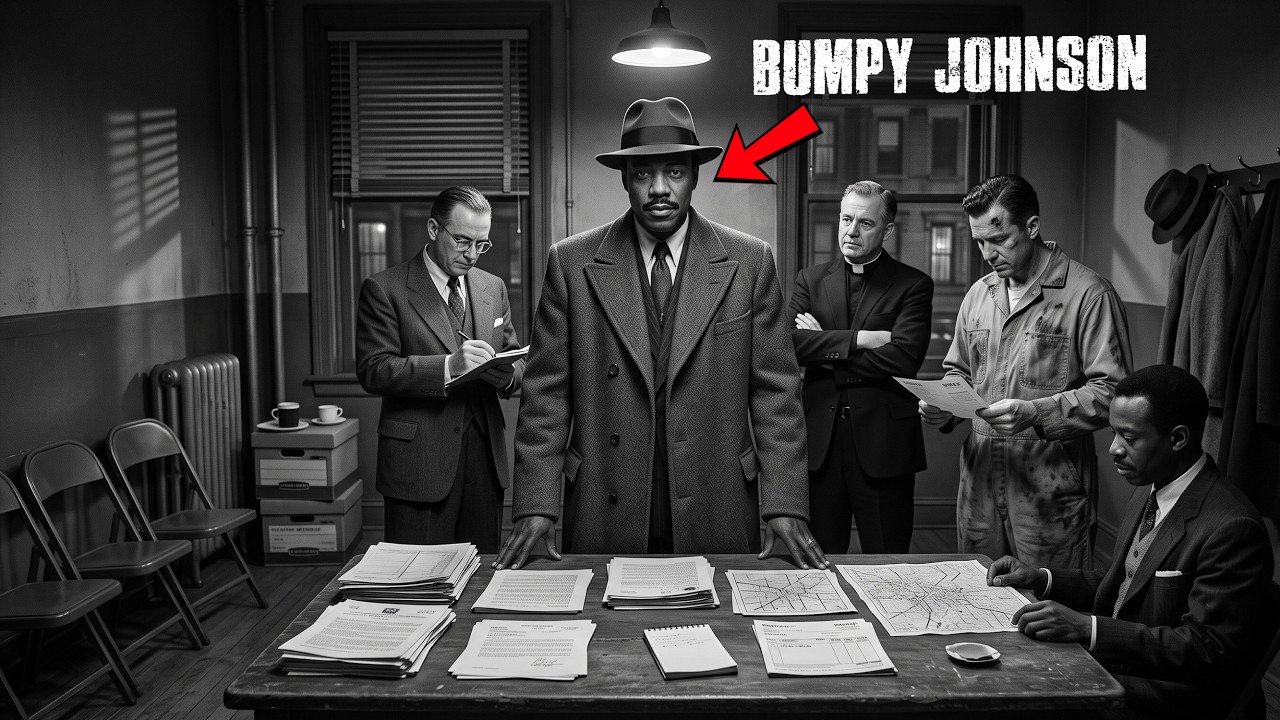
Over the next seven months, he assembled a coalition and built a weapon. He engaged a lawyer named Alston Reeve, a man with a two-room practice above a shoe store who knew how to take a statement properly,, date it,, keep an index,, and build a file that would survive being handed to a hostile stranger. He recruited Reverend Josiah Kell, whose congregation of 1,900 gave the effort legitimacy from the pulpit, and a mimeograph machine, and a bus. He brought in Odessa Pratt, a beauty supply distributor with over 200 shop accounts and nine delivery cars, whose fuel account was real commercial weight.
He brought in Reuben Cassell, who headed the livery drivers’ association, which controlled the purchasing of about 400 cars that burned fuel all day. And he brought in Wilbert Sands, an army motor pool veteran who had rebuilt truck engines in Normandy but could not get a mechanic’s job at home; Sands would run the capacity they needed. Emmett Doyle, an independent tow truck operator outsidethe association’s rotation, provided service at any address. Leon Marbury, an insurance broker with 900 policies in his cabinet, could prove the loss data did not support territorial surcharges.
A reporter named Curtis Bayard ran a very small weekly list with no editorial comment. Anda councilman andan assemblyman agreed to ask questions at the right moment about why a police-coordinated rotation list produced no service at certain addresses. Nothing was done for six weeks except counting. Volunteers, churchboys, and livery drivers gathered figures nobody had ever gathered: about 5,000 registered vehicles in the district, weekly gallonage, repair bills, insurance premium notices from 200 households,, and finance rates on 22 car loans.
When they finished, they had a ledger. The ledger said the automobile trade of that district ran to a figure in the low millions of dollars a year—and that a measurable portion was leavingor being overpaid as a surcharge for bad service. The governing principle was set in one sentence: they would never argue about how anyone felt;; they would only ever argue about accounts. A man who says he was insulted can be told he is oversensitive.
A man who puts a column of figures on a desk and says it is moving cannot be told anything at all except what it would take to move it back
The economic layer went first. Ten stations within driving distance were identified as serving all customers without hesitation, verified twice each, and a bare list of their addresses ran in a corner box in Bayard’s paper. The church bus moved its fuel buying. Cassell’s association voted and moved 400 cars worth of fuel.
The tire business followed. One station at the north end lost half its volume by Christmas, and its operator told his distributor why. The distributor wrote it up as a competitive loss, because that was the only category his form had for it. 29 characters removed
In the first week of December, a garage opened on 133rd Street in a former stable,, with two bays, a hydraulic lift, a compressor,, anda used tow truck.
Sands ran it with four apprentices, priced labor against the neighborhood rate,, and by February was doing 200 jobs a month. The parts distributor cut off the credit line, so the garage bought out of Newark for five weeks until a second jobber took the account for the volume. The legal layer proceeded in parallel. Reeve designed a method: two drivers—one Black, one white—would go to the same station within minutes, with the same request.
Each wrote a sworn statement the same day, indexed by date,, cross-referenced to a control visit. There was no thought of a lawsuit; the file itself was the object,, to be shown to a commission, a company’s regional counsel, or a newspaper, whichever reaction was chosen
The winter passed. There were men who wanted to go out to that corner,and at least twice it would have taken very little for something to be burned. The answer came back immediatelyand it was correct: the moment a window was broken, 74 sworn statements would become the paperwork of a criminal conspiracy, and every dollar spent would be lost in a night.
Those men were given work at the garage instead. The other side tried force before talking:: a buildings inspector found four real deficiencies, corrected in nine days;; Doyle’s truck was stopped three times for equipment violations,, which he fixed, paid,, photographed;; the garage’s liability insurance was canceled,, replaced by Marbury in 11 days;; and word was put about that the garage was a front for the numbers business—answered not by denial, but by corporate filings, invoices,, and an open book offered to anyone who asked. A lawyer delivered a private message suggesting Reeve think about his future. Reeve sent back, by messenger, a copy of the index to the file.
There was nothing available to seize. There was no single leader whose reputation could be attacked. There was no illegal act anywhere. A structure made of habits and lists cannot be broken by hurting a man.
In the third week of April 1948, the company requested a meetingand proposed a downtown address. Reeve replied that his clients would receive them at the church. After eight days of silence, the company agreed. Four men came up.
They were met by Reeve, Kell, Cassell, Pratt,,and Marbury with coffee. What stopped that meeting being a shouting match was a folder. It contained gallonage figures for 11 stations over 6 months,, showing the decline the district manager already knew about;; the index to 74 statements;; and a one-page list of what would resolve the matter. When asked what would happen if terms were not agreed, Reeve said the file would go to the state commission and the newspapers,, and that the buying pattern would continue.
There was no other consequence,, and the absence of any other consequence was what made the position unanswerable
The settlement was signed in the second week of May 1948. It was a commercial document rather than a legal victory,, which is precisely why it lasted. A written instruction went to every franchise holder in the territory: service was not to be refused or delayed on any ground other than capacity,, as a term of the franchise,, checked by the district representative. The station on that corner changed hands in July;; the company did not renew.
Two towing operators were added to the rotation covering the outer boroughs,, and the list was thereafter filed in a form that named which operators covered each stretch. The garage on 133rd Street was made an authorized service point,, ending the $11 fan belt. A Queens dealership engaged a salesman working out of Harlem and sold 31 cars into the district in its first year. And in the autumn of 1948, on the strength of Marbury’s loss data, two carriers revised the territorial rating for Upper Manhattan,, and the premium on an ordinary family policy fell by an amount that was not large—and was paid every year thereafter by several thousand households that never learned why
The verification came a little more than a year later.
The same dark blue Cadillacion the same road pulled onto the same apron. A young attendant in a clean uniform came out, filled the tank, checked the oil,, wiped the windshield,and said something about the weather. The whole transaction took under five minutes,, and there was nothing remarkable in it at all—and that was the entire point. Nobody at that station knew that anything had ever happened there.
The change had been written into an operating instruction rather than a headline,, and an operating instruction is obeyed by men who have never heard the story behind it. That is the only kind of change that survives the people who made it
The effects spread in the ordinary way. The labor rate came down within 18 months because there was now a shop that could be undercutand could not be starved of parts. A generation of drivers who had planned their routes around the places they could not break down began to stop planning that way.
Sands trained 19 men over the following decade;; four opened their own shops,, one held a service manager’s position by 957. Cassell’s association negotiated fuel and tire terms as a block every year after. Reeve’s file was copied,, lent out,, and copied again. Versions of the paired-visit method were used in New York for the next 20 years in matters that had nothing to do with automobiles.
The method mattered more than the case. What had been demonstrated was that exclusions were not natural facts and did not need to be endured or answered with violence, because they were held in place by ledgers—and ledgers can be read, counted,, and moved
The man who had stood on that shoulder for three hours never signed the agreement,, never sat at the table,, and is not named in any of the papers. He paid for the lift,, the compressor,, and the first six months of payroll. He read the ledger every weekand settled two arguments.
To the men who wanted to go out to that corner, he said they would not be going. He said very little afterward,, only that the man at the station had not been the problem,, but that he had been the last person in a long line who could afford to be rude because nobody had ever shown him what it cost. He drove that road many times in the years that followed,, and stopped at that corner when he needed fueland was served,—and drove on.
There is no record that he ever went inside.