On the night of July 17, 1918, in the forests of the Ural Mountains, a woman was thrown alive into a mine shaft sixty meters deep. She was fifty-three years old. She had survived a revolution, a world war, and the bomb that killed her husband before her eyes. An escape route was offered to her—a train, money, safe passage out of Russia—and she refused it.
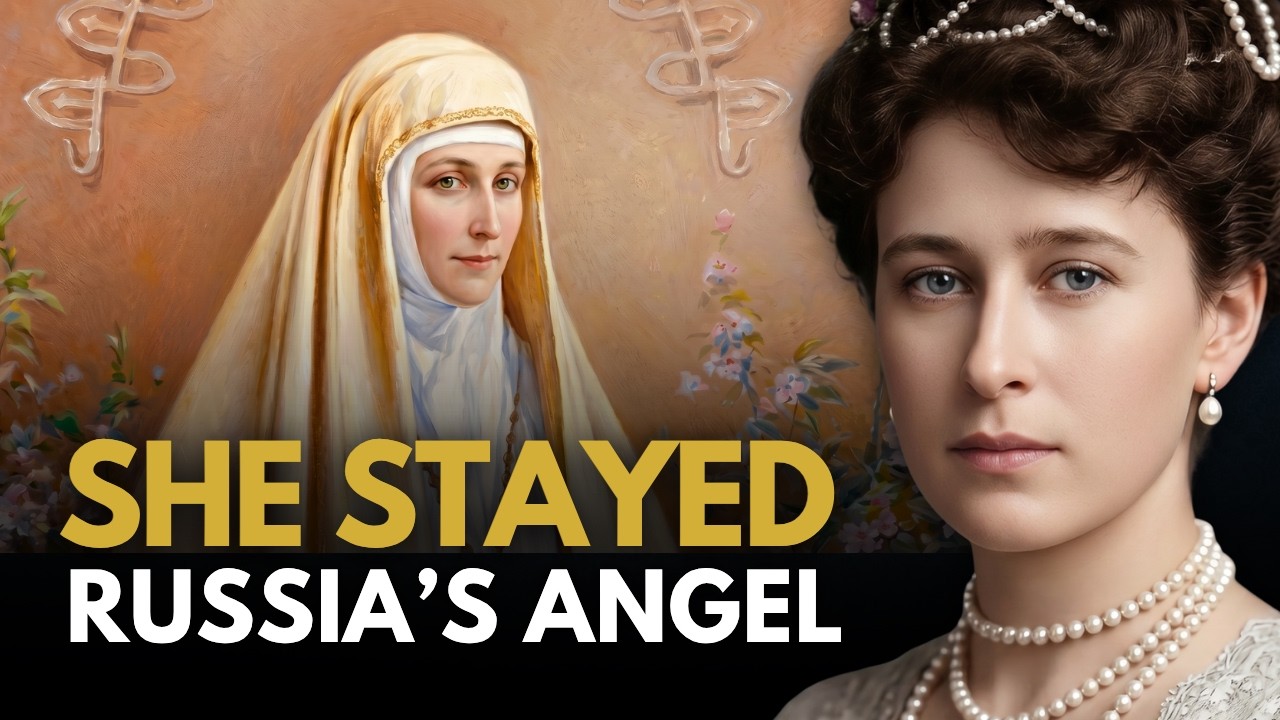
She was not a soldier or a political figure. She was a princess. According to a peasant who witnessed the scene from the edge of the forest, she said as she fell: “Lord, forgive them, for they do not know what they do. ” After all the victims were thrown into the shaft, the executioners dropped grenades into the pit.
Silence did not follow. They piled brushwood over the opening and set it on fire. Through the smoke—from sixty meters underground—witnesses heard singing. A hymn.
Rising from beneath the earth. To understand why it ended that way, it is necessary to go back sixty years, to a small palace in Germany, and to a little girl named Ella. Elisabeth Alexandra Louise Alice was born on November 1, 1864, in the Grand Duchy of Hesse-Darmstadt. Her father was Grand Duke Ludwig IV, and her mother was Princess Alice, daughter of Queen Victoria herself.
On the surface, this was a life of luxury. In reality, Ella’s childhood was shaped by something rare in royal households of that era: a mother who firmly believed the suffering of others was her own concern. Princess Alice personally walked the hospital wards. Every Saturday, she took her daughters to the Darmstadt hospital, not for formal visits, but to sit with patients, talk to them, and bring them flowers.
They were daughters of a ruling family and could have spent their Saturdays learning embroidery. Instead, they learned that pain is not limited to the poor. Ella was the second of seven children, and by all accounts she was the peacemaker, the one who would instinctively step between quarreling siblings and somehow end the conflict. She loved flowers, classical music, and painting.
Her voice was deep and sweet. But what people remembered about the young Ella was not her striking beauty, but her concern for others and how she made them feel truly seen. Then disaster came, and it did not stop. Her three-year-old brother Friedrich fell from a window in front of their mother.
Diphtheria swept through the house, and her younger sister Maria died at age four. In 1878, Princess Alice herself died of the same disease at thirty-five, after nursing her sick children and catching it herself. Ella was fourteen. She wrote to her grandmother Queen Victoria, not about her own grief, but to comfort the old woman on losing her daughter.
She wrote about what she imagined the afterlife to be like, and how her mother might now be at peace. At fourteen, her instinct already turned outward. By the early 1880s, Ella had become one of the most admired young women in Europe. The future Kaiser Wilhelm II pursued her with his characteristic aggression, but she refused him.
She found him rude and selfish, and the historical record supports that judgment on both counts. Her interest lay elsewhere: Grand Duke Sergei Alexandrovich, fifth son of Russian Emperor Alexander II. They had known each other since childhood, as their mothers were both Hessian princesses. Queen Victoria opposed the marriage.
Russia was dangerous—the Tsar had just been assassinated by revolutionaries. But Ella was determined, writing to her grandmother that everyone who knew Sergei described him as an honest and noble man. They married on June 3, 1884, in St. Petersburg, in a wedding that was spectacular even by the standards of the Russian Empire.
Ella arrived in Russia as a Lutheran. No one forced her to convert—not the law, not Sergei, who wished for it deeply but never pressured her. For seven years, she watched. She attended Orthodox services, studied theology, and observed how the Russian people lived within their faith.
Something moved inside her that she could not ignore. Seven years after arriving in Russia, Ella wrote to her father announcing her intention to convert to Orthodoxy. The letter is considered one of the most remarkable documents in royal religious conversion, containing no diplomatic language, no political calculation, no concern for anyone’s expectations. She wrote: “It would be a lie to remain as I am.
I take this step from deep conviction. ” On April 13, 1891, Palm Sunday, Elizabeth Feodorovna joined the Orthodox Church. Sergei stood beside her, nearly in tears. She kept the name Elizabeth but chose a new patron saint: Righteous Elizabeth, mother of John the Baptist, a woman celebrated in the Gospels for rejoicing in a miracle that was not her own as if it were hers.
That day, she received a small icon of Christ with the date carved on the back. She carried it for twenty-seven years. It was found on her body at the bottom of a mine shaft. In 1891, Sergei was appointed Governor-General of Moscow.
Ella became, in effect, the first lady of Russia’s second most important city. The position came with lavish receptions and formal appearances, none of which interested her particularly. What interested her was what she saw from the palace windows. Hundreds of churches with destitute people sleeping on their steps.
Hospitals chronically short-staffed. Orphanages. Prisons. And Khitrovka—the city’s notorious slum, where Moscow sent the people it preferred not to think about.
She began going there. Without announcement. She brought food and clothing, visited prisoners, and walked through Khitrovka at night when police advised her not to. Almost no one knew.
She deliberately kept her personal work secret. She had no objection to visible charity. What happened in Khitrovka at midnight was between her and those who were with her. She told her brother Ernest that her ideal was to be a perfect woman—and that this was the hardest thing, because it meant learning to forgive everything.
That was not mere talk. She meant it completely. Ella and Sergei had no biological children. When Sergei’s brother, Grand Duke Pavel, lost his wife in childbirth, they took in his two orphaned children—Dmitri and Maria—and raised them as their own.
By 1905, Russia was on the edge of collapse. The Russo-Japanese War had ended in humiliating defeat. Bloody Sunday had just occurred. Revolutionary cells were active across the country, and Grand Duke Sergei’s name was on target lists.
He had already begun traveling without his aide—unwilling to put anyone else’s life at risk. On February 18, shortly after noon, his carriage left Nicholas Palace for a meeting at the governor’s office. Ella was in her studio, working on embroidery to be sold at a charity auction. Then came the explosion.
The blast was powerful enough to shake windows hundreds of meters away and rattle chandeliers in the palace. Servants froze in the corridors. Elizabeth understood immediately. She ran down the stairs without a hat or coat—someone threw a cloak over her shoulders at the door—and directed her sleigh toward the sound.
What she found at the blast site is difficult to describe. The force of the bomb had scattered her husband’s remains across a wide expanse of snow-covered ground. Only his face was intact. Two women rushed from the crowd to block her view and pull her away.
She walked past them as if they did not exist. She knelt in the snow and, with her own hands, began gathering what remained of her husband and placing it on a stretcher brought by nearby soldiers. Quietly. Without screaming.
Without tears. She found the small icons he always wore on a chain around his neck—scattered among the wreckage—and held them in her fist. She later told her sister Victoria that throughout it all she thought only of one thing: that she needed to move quickly, because “Sergei always hated mess and blood. ”
After the funeral service, she walked on foot behind the coffin to the nearby Chudov Monastery.
Inside, she knelt at the coffin and did not move for the duration of the burial. Her blue dress was stained with dried blood, her face pale as paper. Her adopted children, Dmitri and Maria, were waiting for her when she came out. She embraced them and kept repeating that their father had loved them very much.
Three days after her husband was killed, Elizabeth Feodorovna asked to be taken to the prison where Ivan Kalyayev—the man who had thrown the bomb—was being held. No one around her understood why. Many tried to dissuade her. She gave no explanation.
She went. She spent nearly two hours in Kalyayev’s cell. She told him she had come to offer forgiveness on behalf of Sergei. She asked him to repent.
She left him a Gospel and a small icon. Then she wrote to the Emperor, requesting clemency for Kalyayev. Kalyayev refused to repent. Her request was denied.
He was executed months later. But one detail stayed with her. A prison guard reported that after she left, Kalyayev placed her icon on the pillow beside his head. That was enough for her.
That small gesture—an icon on a pillow—allowed her the first faint smile anyone had seen on her face since the explosion. Grand Duke Alexander Mikhailovich, Sergei’s cousin, wrote about the visit years later: “It was not mere acting or performance, but true mercy that drove her to visit her husband’s killer in his cell. ”
After her husband’s death, the expected path was clear: mourning, gradual return to society, the quiet dignity of a widowed grand duchess. Ella chose a different path.
She sold her jewelry and gave away her clothes, keeping only what Sergei had personally given her. With the proceeds, she built something. In 1909, in the Zamoskvorechye district of Moscow, the Martha and Mary Convent of Mercy opened. It was not a traditional convent.
The sisters took vows, but they were not permanent. They lived in the world and worked directly with the poor, the sick, and the imprisoned. A hospital. A free clinic and pharmacy.
An orphanage for girls. A shelter for women released from prison. A Sunday school. A library.
Ella slept only a few hours a night. She walked the hospital wards after midnight, changing bandages, sitting with the dying. On weekends, she returned to Khitrovka and spoke with people the rest of Moscow avoided. By any objective measure, she was one of the most respected women in Russia.
She also spent her nights in a slum, talking to people no one dared approach. Her lady-in-waiting, Nonna Grindon, wrote years later that an atmosphere of calm always surrounded Elizabeth—not a passive calm, but the calm of organized work and genuine compassion. She added that Elizabeth “radiated peace and love”—and possessed a wonderful sense of humor that made ordinary people love her for it. The common people of Moscow—the poor, the widows, the former prisoners she had helped—called her a saint.
While she was still alive. When World War I broke out in 1914, Elizabeth Feodorovna’s position became extremely complicated. Russia was at war with Germany. She was a German princess.
Condemnation came almost immediately. By 1915, anti-German sentiment in Moscow had turned violent, with shops bearing German names looted, and her brother Ernest, visiting from Darmstadt, caught in the turmoil. The convent kept working. In February 1917, the Tsar abdicated.
The convent kept working. In October 1917, the Bolsheviks seized power. The convent kept working. The offer that could have saved her life came through a Swedish minister working through diplomatic channels: a way out of Russia, arranged and ready.
Her sister Victoria begged her to go. Ella refused. She said she knew the Russian people well enough not to fear them. In April 1918, during Holy Week, while Easter services were being held at the convent, two officers from the Cheka arrived at the gate.
They had come to take the mother superior. She said goodbye to each sister individually, blessed her, and left. She was taken to Alapayevsk, a small town in the Ural Mountains, where she was held with several other Romanov family members. Sister Barbara refused to leave Ella and insisted on being arrested with her.
For several weeks, conditions were bearable—they could go to church, work in the garden, and read. Then, on the night of July 17, 1918, the night after the Tsar and his family were shot in Yekaterinburg, guards woke the prisoners, loaded them onto carts, and drove them eighteen kilometers into the forest. At the abandoned Nizhnyaya Selimskaya mine, the executioners pushed their victims alive into a shaft sixty meters deep. Elizabeth Feodorovna was the first to be thrown.
A peasant witness, hiding among the trees, reported hearing her speak as she fell—words of forgiveness from the Gospel of Luke, the same words spoken at the Crucifixion. After everyone was thrown into the shaft, grenades were dropped in. When silence did not come, the executioners piled brushwood over the opening and set it on fire. The witness said he could still hear singing through the smoke.
A hymn. Rising from sixty meters underground. The executioners left. When White Army forces recovered the bodies months later, the medical examination revealed what had happened.
Ella had not fallen to the bottom. She had landed on a rocky ledge fifteen meters down. Beside her lay Prince John Konstantinovich—his head wrapped in a strip of cloth torn from her veil. In total darkness, after falling, she had found him and bandaged his wounds.
The icon of Christ, given to her on the day of her conversion to Orthodoxy, lay on her chest. The fingers of her right hand were formed in the Orthodox sign of the cross. Her body was transported from Siberia through China and Egypt to Jerusalem, where she was buried in the Church of Mary Magdalene in the Garden of Gethsemane—the church she had visited on a pilgrimage years earlier, where she had casually mentioned she would like to be buried one day. In 1981, the Russian Orthodox Church Abroad canonized her.
In 1992, the Russian Orthodox Church in Russia did the same. Her relics remain in that church today, above the Garden of Gethsemane. Grand Duke Alexander Mikhailovich wrote that she left the imprint of her image on the blood-stained pages of Russian history. Nonna Grindon, who had known emperors and prime ministers, wrote simply at the end of her memoirs: “Human nature rarely approached perfection as closely as this.
” A German princess who became more Russian than most Russians. A grand duchess who preferred a hospital in a poor district to a palace. A widow who forgave her husband’s killer. A woman who, in the darkness of a mine, with broken bones, found someone worse off and treated his wounds.
Her name was Ella. At every step, she chose it herself.