President Donald Trump invoked the 1823 Monroe Doctrine last week to justify a military attack on Venezuela and the abduction of its president, Nicolás Maduro. Trump publicly argued that under Maduro, Venezuela had increasingly hosted foreign adversaries in the region and acquired menacing offensive weapons that could threaten U. S. interests, actions he described as a gross violation of core principles of American foreign policy dating back more than two centuries.
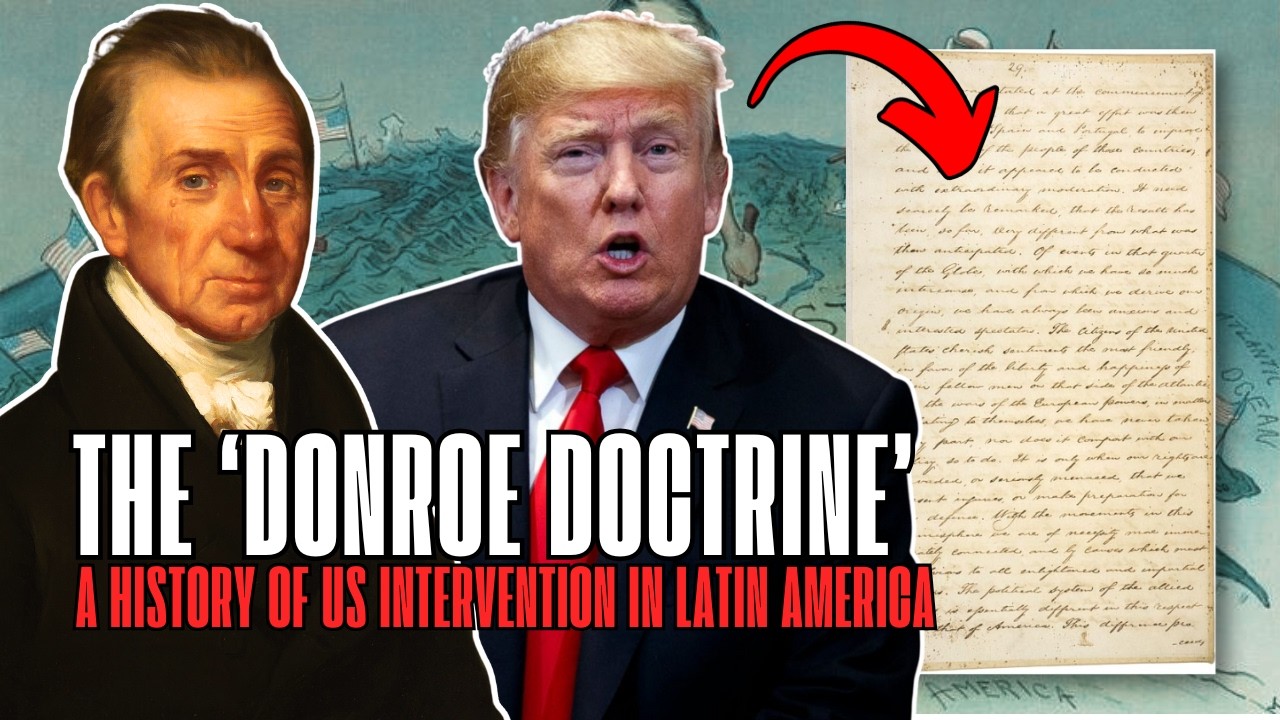
With characteristic humility, Trump added that while the Monroe Doctrine is a big deal, they now call it the “Donro” document. The Monroe Doctrine is a foreign policy position that Washington has used to protect its dominance in the Western Hemisphere since it was first articulated by President James Monroe during his seventh annual State of the Union address in 1823. It emerged against the backdrop of the Spanish-American Wars of Independence, which would eventually lead to the dissolution of Spain’s empire, with the U. S.
seeking to deter future efforts by European powers to take advantage of the newly independent South American nations. Written primarily by then-Secretary of State John Quincy Adams, the document that makes up the Monroe Doctrine essentially asserted that the Americas would no longer be subject to European colonization. Although the document clarified that Washington would remain neutral toward existing European colonies in the region, such as the British in Canada, the Spanish in Cuba and Puerto Rico, and the French in Martinique and Guadeloupe, it declared that any attempt by Europe to extend their system to any portion of this hemisphere would be considered dangerous to U. S.
peace and safety. The so-called New World and the Old World would be entirely separate spheres of influence. At first, the Monroe Doctrine was received relatively favorably by Latin America, though that was before it became clear that instead of preventing colonization, Washington was essentially replacing it. Because Monroe’s initial address did not include a comprehensive foreign policy, its content was largely overlooked for decades afterward.
It seemed to have been ignored when Britain reasserted its control over the Falkland Islands in 1833, and again when the French and then the British Navy blockaded the Río de la Plata in Argentina for years. President John Tyler invoked the Monroe Doctrine for one of the first times to dissuade Britain from interfering in Hawaii, beginning the process of the territory’s annexation by the U. S. In 1865, the doctrine was invoked again when Washington diplomatically and militarily supported Benito Juárez’s revolt against Austrian Archduke Maximilian, who had been installed as Mexico’s emperor by Napoleonic France.
Secretary of State William H. Seward commented in 1868 that the Monroe Doctrine, which eight years ago was merely a theory, was now an irreversible fact. After the 1898 Spanish-American War, when the U. S.
acquired sovereignty over Puerto Rico, Guam, and the Philippines, and established a protectorate over Cuba, interpretations of the Monroe Doctrine were dramatically transformed. In 1904, President Theodore Roosevelt extended the doctrine to assert that chronic wrongdoing in the Americas might require intervention by some civilized nation, and that under the Monroe Doctrine, the U. S. might be forced, however reluctantly, to exercise an international police power in flagrant cases of such wrongdoing or impotence.
Underpinned by his Big Stick policy, Roosevelt claimed the Monroe Doctrine allowed the U. S. to freely intervene in supposedly unstable Latin American countries. It was Roosevelt’s reinterpretation in particular that made the irony of the doctrine unmistakably clear.
Despite being established to ward off European colonization, the doctrine had forcibly bolstered Washington’s ideological imperialism. Roosevelt’s expansion of the doctrine’s parameters went on to serve as justification for the Bay of Pigs invasion in 1961, Ronald Reagan’s opposition to the left-wing Sandinista government in Nicaragua in 1981, George H. W. Bush’s invasion of Panama in 1989, and now Trump’s attack on Venezuela.
To be clear, the Monroe Doctrine has never been part of the Constitution. It is not a law passed by Congress. It is merely a principle first uttered during a State of the Union address more than 200 years ago, one that Washington still blatantly invokes to justify military intervention and the illegal overthrow of a sovereign government. Trump admitted after Maduro had been captured that the U.
S. wants to surround itself with good neighbors, stability, and energy. He noted the country has tremendous energy and said it is very important that the U. S.
protect it. “We need that for ourselves. We need that for the world. ”
Washington’s foreign policy has never been about simply protecting U.
S. sovereignty. The Trump administration likely does not care at all about Maduro’s authoritarianism, nor about Venezuelan drug trafficking.
The “Donro” doctrine wants Venezuelan oil, and it will do whatever it needs to get it.