In February 1903, within the gilded halls of the Winter Palace in St. Petersburg, roughly 400 members of the Russian aristocracy gathered for what would become known as the last great royal ball in Europe. This was not merely another lavish reception; it was a meticulously staged costume ball designed to resurrect the golden age of 17th-century Russia. The event, conceived by Empress Alexandra Feodorovna, was intended as a tribute to the 290 years of Romanov rule, but it unwittingly became a dazzling final act for the imperial world it sought to celebrate.
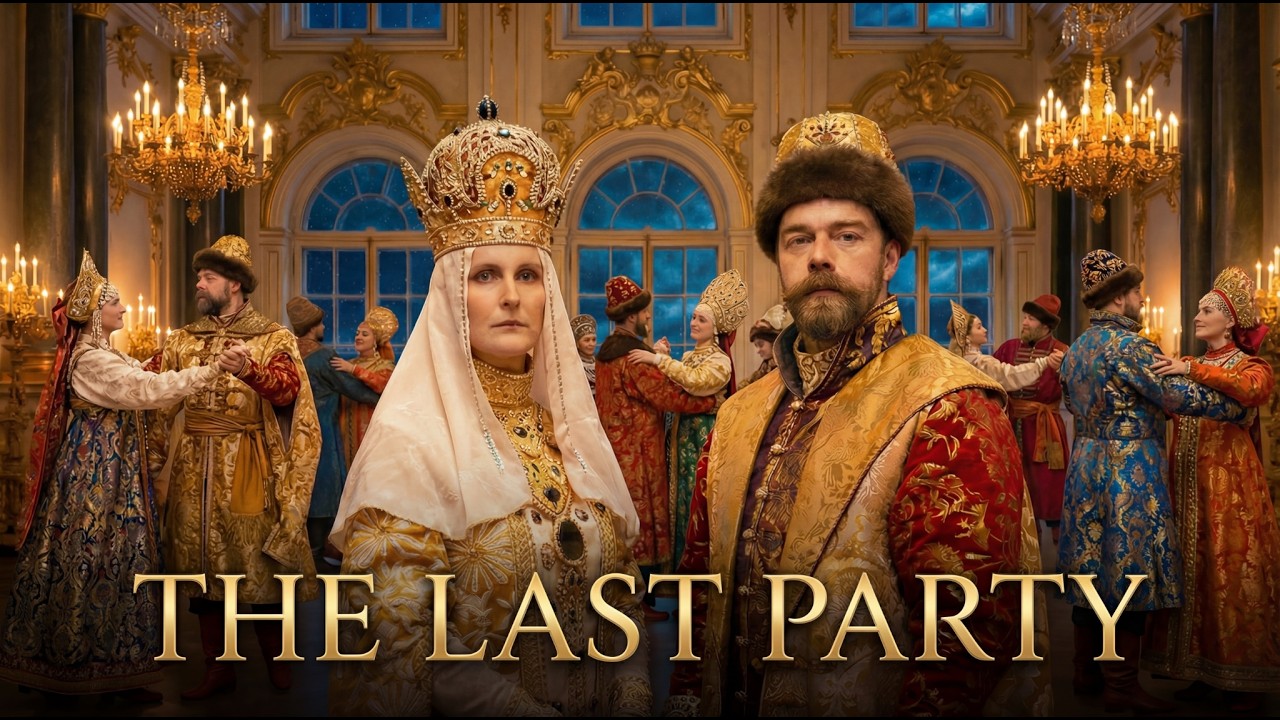
The ball was steeped in symbolic meaning. At the dawn of the 20th century, a wave of Russian nationalism had swept through the artistic and intellectual elite, who looked back longingly at the era before Peter the Great’s westernizing reforms. Emperor Nicholas II and his wife championed this revivalist spirit, viewing the grand fête as a way to reconnect with what they imagined as a purer, more authentic Russian past—a stark contrast to the fragile political landscape of their own time. To ensure authenticity, guests were instructed to wear opulent costumes designed according to strict 17th-century patterns.
The city’s leading fashion designers were flooded with commissions, and historical experts were consulted for every detail. The results were masterpieces of heavy brocade, lustrous silk, and luxurious velvet, all heavily embellished with gold embroidery and precious stones. The women donned jewel-encrusted headdresses known as kokoshniks and traditional gowns, while the men wore the fur-trimmed attire of boyars and tsarist falconers. Many of these ensembles were adorned with the families’ most priceless heirlooms, making them not just costumes but spectacular displays of wealth and artistry.
At the center of this spectacle stood the imperial couple. Nicholas II chose to embody his favorite ancestor, Tsar Alexei Mikhailovich, the second Romanov ruler. His costume, known as the Lower Tsar’s Robe, was designed by Ivan Kafi, a costume designer for the imperial theaters, and featured gold brocade, sable fur, and a genuine 17th-century royal scepter. He also wore the necklace of Tsarevich Peter Alexeevich, one of 38 priceless historical pieces transported from the Kremlin Armory in Moscow to guarantee authenticity.
The ensemble was even finished with details mimicking the pearl-beaded bracelets worn by a son of Ivan the Terrible. Empress Alexandra wore an elaborate recreation of the gown of Tsarina Maria Ilyinichna, wife of Tsar Alexei Mikhailovich. According to Baroness Sophie Buxhoeveden, a lady-in-waiting, theat headdress was so heavy that Alexandra could not bend down to eat her dinner that evening. The entire costume, embroidered with pearls, emeralds, and diamonds—including a central emerald the size of a palm—was designed to replicate the Tsarina’s image from a historical icon.
Few of the costumes from that night have survived, but those that have offer a tangible connection to its splendor. One of the most striking belongs to Princess Zenaida Yusupova, who commissioned the jeweler Cartier to create her ensemble. Her outfit consisted of a kokoshnik and a dress studded with precious stones, and she notably designed two different kokoshniks and sleeve styles for her various appearances, a departure from classical tailoring. While her original velvet coat and one headdress are lost, a similar style kokoshnik typical of central Russian provinces is held in the State Historical Museum, and her original sarafan dress is part of the collection at the State Hermitage Museum.
Another version of her headdress, the venets, a type of maiden’s crown from Novgorod Province, can be found in permanent exhibitions at both the State Historical Museum and the Metropolitan Museum of Art. Among the most celebrated surviving ensembles is that of Grand Duchess Xenia Alexandrovna, the Tsar’s sister. Crafted from heavy gold brocade, it featured a traditional letnik with wide, flaring sleeves trimmed in lustrous white fur. This masterpiece was a collaborative effort involving Yevgeny Fabergé, the eldest son of the famed jeweler Peter Carl Fabergé, who personally oversaw the selection of gems and decorative elements.
The fabric shimmered with an abundance of pearls, emeralds, and diamonds arranged in intricate antique floral patterns. The centerpiece was a magnificent high kokoshnik adorned with a pearl tassel, large precious stones, anda cascading diaphanous veil. For decades, this artifact was officially considered lost amid the turmoil of revolution. However, in 2022, researchers were stunned to identify the priceless kokoshnik within the collections of the Omsk State Museum of Regional History in Siberia, where it had arrived as early as 1927 but remained unidentified for nearly a century.
Experts confirmed its provenance through meticulous comparison with archival photographs from the studio of Levitsky & Son, establishing it as a surviving testament to the Fabergé firm’s extraordinary craft and the final gleam of imperial grandeur. Another exceptionally preserved costume from the ball is that worn by Princess Maria of Greece and Denmark, who embodied a wealthy 17th-century merchant’s wife. Her ensemble consisted of a pale green satin dress embroidered with silver, paired with a gold brocade blouse and a short white velvet jacket decorated with gold. Her towering gold kokoshnik featured seven stars, each set with a large diamond, and was bordered with delicate diamond threads.
A net of fine river pearls adorned her forehead, while heavy pearl strands hung beneath her chin, completing a look finished with gold brocade shoes featuring upturned toes and double-headed eagles crafted from pearls. Prince Dmitri Borisovich Golitsyn likewise made a lasting impression, portraying a 17th-century Imperial Master of the Hunt. His vivid red velvet costume, embossed with a large double-headed eagle embroidered in gold on both chest and back, became one of the ball’s most iconic images. His high collar and cuffs were richly decorated with pearl patterns and fine gold embroidery, and his head was crowned with a striking red hat trimmed with sable fur.
Countess Natalia Feodorovna Karlova also appeared in a magnificent ensemble of violet velvet and gold brocade, featuring bold floral motifs, wide embroidered sleeves, and a cylindrical kokoshnik embroidered with silver, precious stones, and a fine pearl net. This costume, preserved in excellent condition, now resides atthe State Hermitage Museum. The legacy of the ball, however, would extend far beyond museum walls. A few years later, for the 300th anniversary of Romanov rule, a famous deck of playing cards titled “Russian Style” was issued.
The prototypes for all the cards were actual participants in the 1903 costume ball. Artists drew inspiration from souvenir albums of archival photographs, translating the luxurious fabrics and antique designs onto paper. Tsar Nicholas II appeared as the King of Hearts, his likeness faithfully reproducing his costume as Tsar Alexei Mikhailovich. Interestingly, theat deck did not feature the Empress Alexandra, but instead included a card styled on her elder sister, Grand Duchess Elizabeth Feodorovna.
The beautiful Princess Zinaida Yusupova, who captivated guests with her Russian dance, was featured asthe Queen of Spades, while Grand Duchess Xenia Alexandrovna served asthe model for the Queen of Clubs. The Tsar’s younger brother, Grand Duke Michael Alexandrovich, was the King of Spades, and Grand Duke Andrei Vladimirovich, dressed asa falconer, was easily recognizable asthe Jack of Diamonds. This deck became extraordinarily popular, remaining in print even during the Soviet era, thereby cementing the images of these imperial costumes in the collective memory of millions and transforming the last court ball into a lasting piece of Russian cultural heritage. Yet, beneath this glittering surface lay the inescapable shadow of history.
Fort many attendees, that evening proved to be their last joyful memory specter of impending catastrophe. The irony of their opulent masquerade was cruel. Emperor Nicholas II, Empress Alexandra Feodorovna, and Grand Duchess Elizabeth Feodorovna, whose images were immortalized on playing cards, met violent deaths just 15 years later—in the basement of the Ipatiev House in Yekaterinburg and atthe Alapayevsk mines, respectively. Prince Dmitri Borisovich Golitsyn, the “Master of the Hunt,” ended his days in exile, as did Grand Duchess Xenia Alexandrovna and Princess Yusupova.
They fled Russia forever, carrying with them scraps of memory off golden brocade and diamonds, while many of their treasures were confiscated or sold for a pittance just to survive on foreign soil. The world they had sought to revive for a single night in 1903 had turned to ashes. Costumes designed for immortality became museum exhibits, or were torn to rags by revolutionary sailors. The 1903 ball remains etched in history as a brilliant sunset for an empire.
It was the final, magnificent bow of a great civilization—a last grasp at a fading glory. We see the faces of people who danced on the edge of an abyss, unaware that their silks would soon be stained with blood, and their palaces would become monuments to their own demise. It was beauty flourishing on the rim of a volcano, a flash of light that vanished, leaving behind an enduring enigma that we still strive to decipher.
The last Romanov ball has become more than a celebration; it is now an eternal elegy for a lost world, leaving ust only its shadows in brocade and silver.