August Palmisano’s body turned up on a cold Milwaukee night in 1973. For nearly a decade, the case went cold, and the city that prided itself on being a clean, workingman’s town looked the other way. But that single death, and the word that Frank Balistrieri had ordered it, would eventually help dismantle the most powerful organized crime operation Wisconsin had ever produced. Francesco Mario Balistrieri was born in Milwaukee in 1918 to Sicilian immigrant parents.
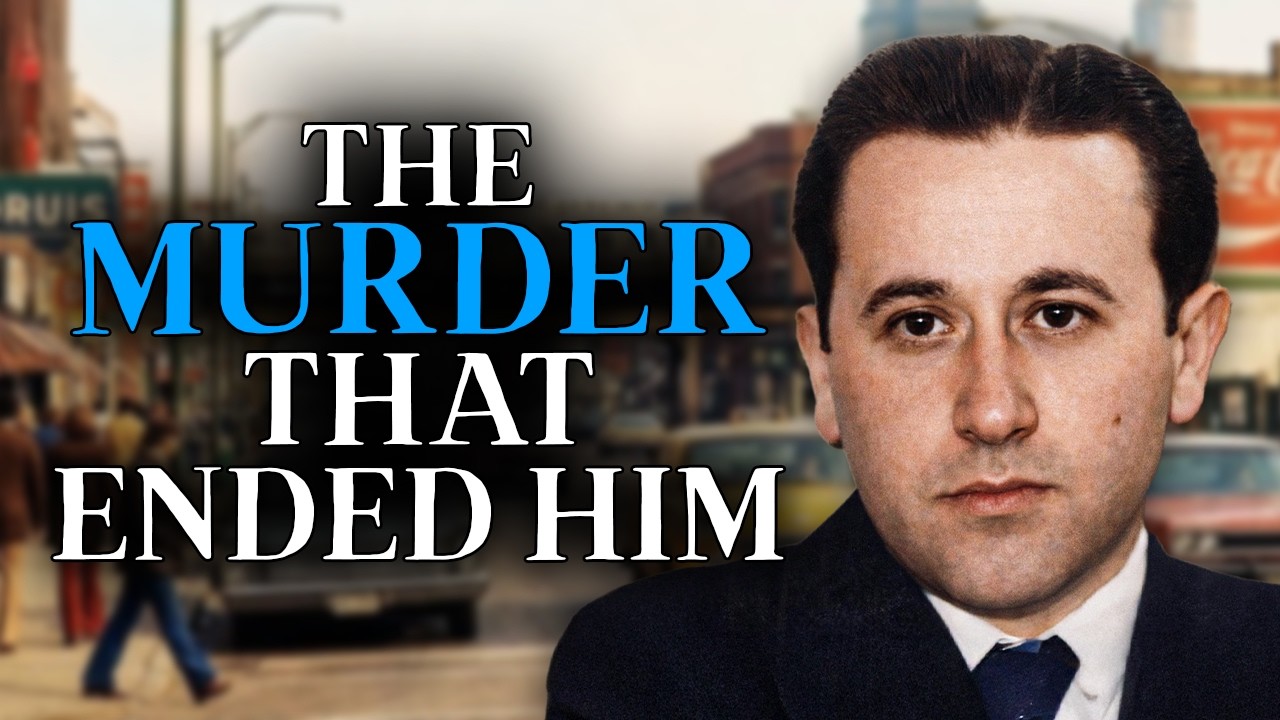
His father was connected to the local underworld, and Frank grew up inside that world. He absorbed its rules and its brutal logic, and by the time he was a young man, he was deeply embedded in the city’s criminal infrastructure. He was not the bull-necked stereotype of a mob enforcer. Frank Balistrieri was slight and quiet.
He graduated from Marquette University with a law degree, and he used that knowledge with precision. His associates called him Mr. Big. It was not because of his physical size, but because of what he represented: the man whose permission you needed before doing anything that generated money on the street.
Frank took control of the Milwaukee family in the early 1960s. Under his leadership, the operation expanded while remaining quiet. He controlled gambling, loan sharking, labor unions, and the taverns. If you ran a bar in Milwaukee, there was a good chance someone connected to Frank had a piece of it.
He was also paranoid. Every morning, he swept his restaurant, Snugs, for listening devices before the espresso was poured. His crew thought he was excessive. The FBI thought he was impressive.
As it turned out, his fear was justified. Milwaukee was an affiliate of the Chicago outfit, not an independent operation. The money flowed upward to Chicago, and the orders flowed downward. Frank, despite his local power, was ultimately an employee who paid tribute to the corporate office.
By the 1970s, the mob’s most profitable venture was skimming from Las Vegas casinos. Chicago, Kansas City, Cleveland, and Milwaukee all had pieces of operations like the Stardust, the Fremont, and the Hacienda. Cash was taken directly from the counting rooms and divided among the families. Milwaukee’s cut came through Frank, and Chicago trusted him to deliver.
The killing of August Palmisano is where the story turns darker. Palmisano was a Milwaukee man connected to the edges of Frank’s world. For reasons never entirely clear in the public record, he became a problem. In Frank’s universe, disloyalty was the cardinal sin, and suspicion was enough.
The suspicion that Palmisano might be talking to law enforcement led to the conclusion that he had to go. Whether the suspicion was founded in reality or in Frank’s siege mentality is a question that haunted the legal proceedings. What is not in question is the outcome. Palmisano ended up dead in 1973, and according to evidence that would eventually emerge, the order came from the top.
The cruel irony is that the same paranoia that drove Frank to order violence also handed the FBI its opening. He could not stop talking about what he had done, not to the public, but in the one place he believed he was safe: his allegedly bug-free restaurant. He was wrong about the bugs. The FBI’s investigation did not begin with the murder.
It began with the Las Vegas skim money flowing through Milwaukee. By the late 1970s, federal agents had identified the major participants in the casino skimming operation. Building a case through conventional means was nearly impossible, so they needed to hear Frank give orders. Placing a bug in his world was not simple.
Frank’s morning sweep was a genuine security protocol. But the FBI was patient, and agents eventually managed to place listening devices that the sweep did not catch. The results were unambiguous. The FBI began to hear a man who could not entirely contain himself.
Frank Balistrieri needed his inner circle to know who he was and what he had done. That is the mob’s eternal contradiction. The code of silence demands you never speak of what you have done, but the ego of power demands an audience. Those moments when Frank’s discipline cracked are what the FBI was waiting for.
By the early 1980s, federal investigators had recorded evidence of the financial architecture of the operation, the tribute structure, and the connection between Milwaukee, Chicago, and Las Vegas. The Stardust skim and the Fremont skim were being assembled into a federal case of staggering scope. The casino skimming indictments were RICO charges, which treated the entire criminal enterprise as the crime. Prosecutors did not have to prove Frank personally touched the money.
They had to prove he ran the organization that touched the money. The surveillance tapes made that case. Then the Palmisano murder came back. The pressure of the casino investigation created cracks in Frank’s organization.
Federal indictments made people calculate the mathematics of their own prison sentences against the potential benefit of cooperation. It only takes one person to break the wall of silence. Frank did not go to trial alone. His two sons, Joseph and John, were indicted alongside him.
Frank had raised them inside the business. In his mind, he was building a dynasty. But when the federal government came for the company, it came for the whole family. The trial cracked Milwaukee wide open.
Frank’s own voice was on the tapes, along with conversations about money, power, and who answered to whom. The Las Vegas skim came in. The Chicago tribute came in. The Palmisano murder, cold for over a decade, came back to life in the courtroom.
The defense attacked witnesses and questioned the surveillance. It was not enough. Frank was convicted, and his sons were convicted. The organization that had quietly run the city for decades was decapitated in a single federal proceeding.
Frank Balistrieri was sentenced to 13 years in federal prison. He was in his mid-60s, and for a man of that age with his health, 13 years was effectively a life sentence. His sons received sentences of their own. The Milwaukee family did not survive his removal.
The prosecution destroyed the infrastructure. Cooperators had talked. Financial networks were exposed. The silence that held everything together had been broken in enough places that the structure became unstable.
Milwaukee’s operations contracted sharply. The tribute to Chicago became irregular. The gambling and loan sharking that had run like clockwork became fragmented and small-time. The city that had pretended it had no mob now had barely any mob to pretend about.
Frank Balistrieri was released from prison in 1991. His health was deteriorating. He died on February 7, 1993, at the age of 74. He died in Milwaukee, not from a bullet or a baseball bat, but at the end of a life that had been entirely his own.
But he died with the thing that mattered most to him already gone. The organization and the power he had built and maintained for three decades had been dismantled by the federal government and by the tapes recorded in the restaurant he swept every morning. The Family Secrets trial in Chicago later shed additional light on how Milwaukee fit into the broader outfit structure. Testimony about murders and operations provided context for Milwaukee’s place in the hierarchy.
Frank answered to Chicago, and that relationship shaped everything about how he operated and how the government built its case. The Wisconsin Department of Justice has described the Balistrieri era as the most significant organized crime period in the state’s history. There has not been anything like it before or since. After Frank, Milwaukee’s mob essentially became a footnote.
The restaurant Snugs, where Frank held court and swept for bugs every morning, is gone. The building still stands, but the invisible weight of what happened inside it is gone with Frank. The Las Vegas connection ended with the prosecutions of the mid-1980s, part of a larger unraveling as the casino industry was corporatized and regulators tightened scrutiny. Frank Balistrieri spent his entire adult life trying to control his environment.
He controlled his city and his operation. He was good at it for decades. Then he tried to control the truth of what he had ordered, and the conversations he had in the room he swept every morning. The FBI did not beat him with superior force.
They beat him with patience. They sat outside his world and listened, and eventually, Frank told them everything they needed to know. He never stopped the bugs from listening. He just never knew they were there.
Frank Balistrieri is buried in Milwaukee. The city has moved on. Somewhere in an FBI evidence archive, the tapes still exist, a record of everything he thought he had kept secret.