
German field commanders who matched wits against the Allied high command during World War II left behind a fragmented but revealing record of what they truly thought of their adversaries, a record that ranges from open admiration for General George S. Patton to withering contempt for cautious British leadership and a slow, painful reckoning with the fighting power of the Soviet Red Army.
Those assessments, scattered across memoirs, captured interrogations, and postwar debriefings, offer a rare window into the minds of the men who planned and fought the Wehrmacht’s campaigns from the sands of North Africa to the ruins of Berlin.
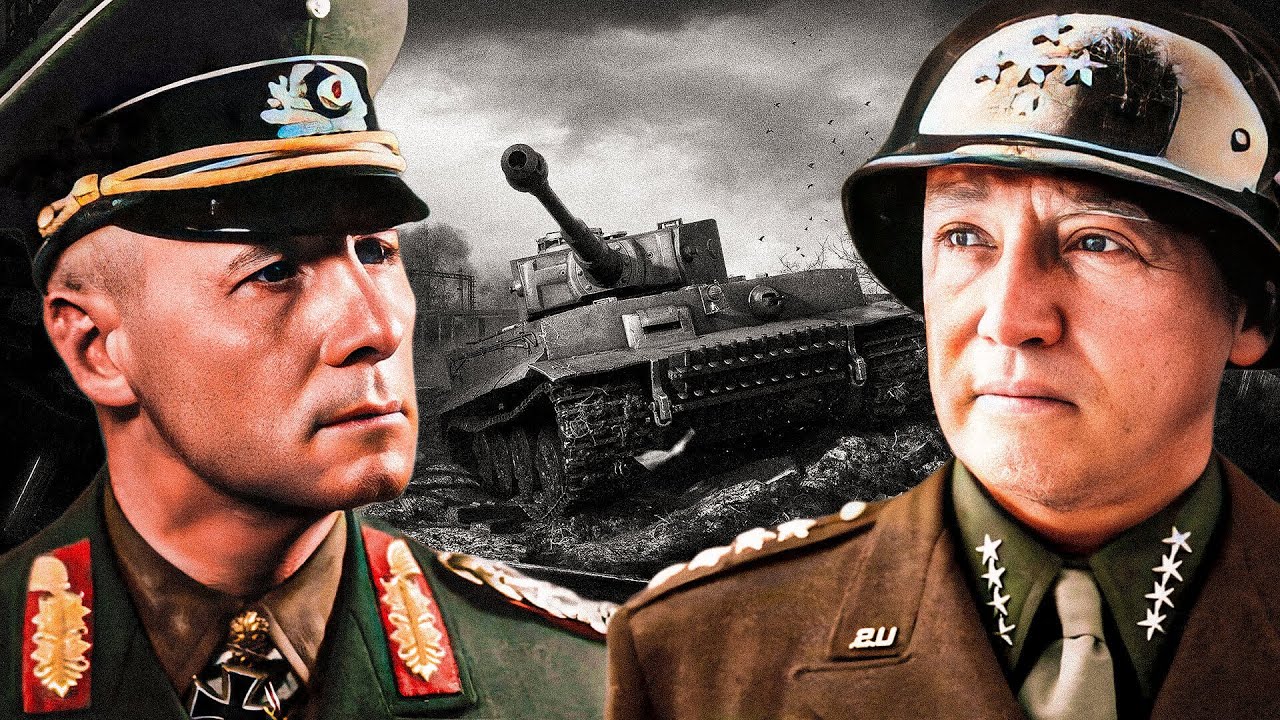
At the center of that record stands Patton, the flamboyant American armored commander whom German officers regarded with a mixture of recognition and unease, a general they often described as the most German of the Allied commanders.
General Alfred Jodl, one of Hitler’s closest operational advisers, once summed up the American general in a single phrase, calling him the American Garian, a reference to Heinz Guderian, the architect of Germany’s blitzkrieg doctrine.
Jodl noted that Patton was very bold and preferred large movements, taking big risks that produced big successes, a description German officers recognized as a mirror of their own approach to armored warfare.
Guderian himself, the mastermind behind the panzer tactics that tore through Poland and France, could not hide his professional admiration for the American, saying he had heard much about Patton and that he had conducted a good campaign from the standpoint of a tank specialist.
Guderian added that he must congratulate Patton on his victory, since he acted as Guderian himself would have done had he been in the American’s place, a remark that amounts to the highest compliment one armored commander can pay another.
General Günther Blumentritt, a key planner in the invasions of France and Poland, went further, describing Patton as the most aggressive panzer general of the Allies and noting that his operations impressed the German command enormously.
Blumentritt explained the reason for that impression with striking candor, saying Patton came closest to the German concept of the classical military commander, a soldier who valued movement, speed, and the seizure of initiative above all else.
Patton’s aversion to static warfare became legendary among the officers who studied him, and one anecdote in particular circulated widely, in which the general urinated into a slit trench and declared that the enemy should now try to use it.
That gesture, crude as it was, resonated with German commanders who had built their entire doctrine around mobility and who viewed fixed defensive positions as a slow form of surrender.
His command style also drew comparisons to the German concept of auftragstaktik, the mission-type order that gave subordinate commanders broad directives and trusted them to use their own initiative on the battlefield.
Patton articulated a similar philosophy when he said that one should never tell people how to do things, but tell them what to do, and they will surprise you with their ingenuity, a sentiment German officers found entirely familiar.

Yet the German view of Patton was never simple, and admiration came packaged with sharp criticism from officers who saw him as a tactical genius rather than a strategic mastermind.
Some commanders argued that his rapid advance in Sicily was driven more by personal glory than by strategic necessity, and military historian Harry Yeide described Patton’s rush to Messina as a display of empty glory.
German officers, products of a tradition of strict and unsentimental evaluation, were not easily impressed by a single campaign, no matter how spectacular, and their own deep pool of armored experience made them cautious about crowning any commander too quickly.
Some German military historians pointed out that Patton’s logistical achievements, while impressive, were overshadowed by the sheer scale of resources available to the Allies, feeding a perception that Allied victories owed more to material superiority than to individual skill.
The result was a paradox that fascinated his enemies, a German-style general in an American uniform, admired for his aggression and mobility but also seen as a beneficiary of America’s vast industrial might.
If Patton earned grudging respect, the German view of British leadership followed a very different path, one marked by deep admiration for the ordinary soldier and deep frustration with the men commanding him.
General Siegfried Westphal, a high-ranking German officer, once remarked that the hardest, toughest in attack and most persistent in defense were the British divisions, a judgment echoed across German military assessments.
Those assessments consistently highlighted the uniformity of British personnel and their remarkable absence of failures in key battles, evidence that German officers saw something special in the British fighting spirit.
Field Marshal Erwin Rommel, the famous Desert Fox, captured the contradiction at the heart of the German view when he addressed captured British officers after the siege of Tobruk, telling them they had fought like lions and been led by donkeys.
That line, one of the most quoted remarks of the desert war, reflected a widespread German belief that British troops were superb but that their commanders were overly cautious in the fast-paced world of mechanized warfare, where hesitation could be deadly.
Adolf Hitler’s own view of Britain was stranger still, shaped by ideology rather than battlefield experience, as he regarded the British as potential natural allies and fellow Aryans who should have been working with Germany rather than against it.
Hitler believed that Jews were manipulating the British and turning them against Germany, a bizarre worldview that allowed him to justify war against Britain while maintaining a twisted form of respect for the nation itself.

That attitude seeped into German strategy, as respect for British resilience meant commanders often prepared for tough, prolonged engagements, knowing that even an initial advantage would likely be met with dogged defense.
At the same time, the perception of cautious British leadership led German commanders to take risks, betting that their counterparts would react slowly, a gamble that sometimes paid off and sometimes backfired badly when British forces proved more skillful than expected.
Nowhere was German respect for British capability more evident than in the air war, where Hermann Göring, head of the Luftwaffe, grudgingly acknowledged British technological expertise.
Göring said it made him furious to see the Mosquito, the beautiful wooden aircraft the British knocked together, and to see the speed they had now increased yet again, an admiration that influenced German aircraft development throughout the war.
In the end, the German perspective on British forces was a blend of respect, frustration, and grudging admiration, a view that shaped strategy and tactics in ways that had profound effects on the course of the conflict.
The German view of the Soviet military, by contrast, underwent a transformation so dramatic that it stands as one of the great intelligence failures of the twentieth century, moving from outright dismissal to genuine fear.
At the start of Operation Barbarossa, many German commanders viewed the Soviet Union as an easy target, seeing the Red Army as poorly equipped, badly led, and incapable of standing up to Wehrmacht tactics and technology.
Nazi racial theories painted Slavic peoples as untermenschen, or subhumans, and this ideology led many German officers to believe that Soviet soldiers would simply crumble in the face of German strength.
The conflict itself shattered those illusions with brutal speed, as the Red Army, caught off guard initially, quickly proved its resilience and determination in defense after defense.
Field Marshal Paul Ludwig Ewald von Kleist, reflecting on the shift in perception, stated that from the very beginning the Russians proved themselves first-class warriors, and that early German success could be explained by better training.
Kleist added that having gained combat experience, the Russians became first-class soldiers who fought with exceptional perseverance and astounding endurance, a judgment that grew more common as the war dragged on.
The Battle of Stalingrad marked a turning point not just in the course of the war but in German perceptions of their enemy, as the Red Army’s ability to encircle and destroy an entire German army shattered any remaining illusions of Soviet inferiority.

As Soviet counteroffensives gained momentum, German commanders found themselves facing an opponent that was not only numerous but increasingly skilled and well equipped, and the fear that began to grip German forces was palpable.
They realized they were no longer facing an inferior enemy but a juggernaut growing stronger with each passing day, a realization that reshaped German operational thinking from the top of the command chain to the front line.
Franz Halder, a German general and chief of staff of the army high command, said of the Soviet Army that it seemed the enemy, on the initiative of the new command and perhaps under the influence of England, was making every effort to hold the front line and not allow the Germans to move further east.
Halder noted that Russian troops were fighting as before with the greatest tenacity and severity, a clinical assessment that concealed the growing alarm inside German headquarters.
The evolution in German thinking had profound strategic implications, as the confidence that characterized the early stages of Barbarossa gave way to a more cautious approach against an enemy they genuinely feared.
That shift was neither universal nor immediate, and some German officers clung to their ideological biases longer than others, but by the time Soviet forces were driving toward Berlin, even the most ardent believers in Nazi racial theories had to confront the reality of Soviet military power.
What makes these German assessments more than historical curiosity is their enduring influence, as the viewpoints recorded by German generals on Allied forces have not faded in the decades since the war.
Instead, they continue to shape present-day military strategy, with the insights collected from German commanders providing lessons that remain relevant to modern armies and their planners.
The admiration for British resilience, for example, has led many modern armies to prioritize troop morale and endurance, while worries about Soviet numerical strength drove NATO to invest heavily in technological advancements during the Cold War.
The effectiveness of Patton’s bold tactics left a lasting mark on mechanized warfare doctrine, influencing how armored commanders are trained and how aggressive maneuver is taught in military academies around the world.
Taken together, the German record offers a portrait of Allied leadership that is neither flattering nor dismissive, but complex, contested, and shaped by the brutal education of the battlefield itself.
It is a reminder that in war, the judgment of one’s enemies can be as revealing as the judgment of one’s friends, and that reputations forged under fire are rarely simple and never final.