Admiral Chester W. Nimitz, the commander of the Pacific Fleet, chose not to relieve Admiral William F. Halsey of command after the near-catastrophic decision at Leyte Gulf that left the San Bernardino Strait undefended and 𝓮𝔁𝓹𝓸𝓼𝓮𝓭 thousands of American sailors and soldiers to annihilation — a decision that historians have debated for more than seventy years and that remains one of the most consequential acts of restraint in American naval history.
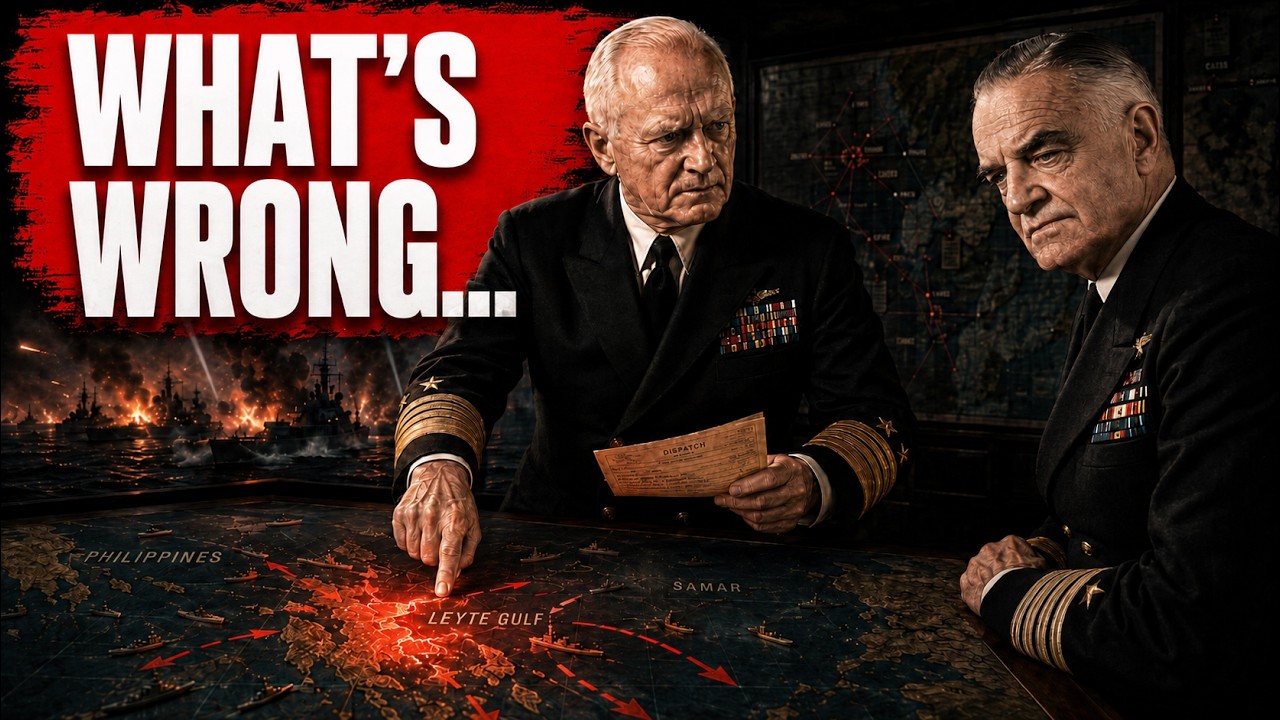
The story of why Nimitz never fired Halsey begins long before the morning of October 25, 1944, when the Japanese center force under Admiral Takeo Kurita emerged from the darkness east of Samar and fell upon a tiny American escort carrier group that had no business surviving the encounter.
It begins with the kind of commander Nimitz had deliberately built himself into over four decades of naval service. By the time President Roosevelt selected him to take command of the Pacific Fleet in the last days of December 1941, just weeks after the attack on Pearl Harbor, Nimitz was already known throughout the Navy as a man of unusual calm, a listener more than a talker, an officer who trusted the judgment of the men he appointed to combat command and rarely overrode them once battle had been joined.
That trust became the foundation of everything that followed. Victories at Midway and the Coral Sea, the long island-hopping campaign across the Central Pacific, were built as much on Nimitz’s willingness to let capable subordinates fight their own battles as on any tactical genius of his own.
Halsey was two years older, a 1904 graduate of the Naval Academy, a man whose entire professional identity ran in almost the opposite direction. Where Nimitz listened, Halsey acted. Where Nimitz weighed consequences carefully before committing, Halsey had built a reputation across four decades of service on aggression, on striking first and asking questions later.
By October 1944, Halsey commanded the same powerful collection of fast carriers and battleships that Admiral Raymond Spruance had commanded only months earlier during the invasion of the Mariana Islands. One fleet with two admirals who alternated command and even renamed it depending on who was in charge. The Fifth Fleet under Spruance, the Third Fleet under Halsey.
It was, by October 1944, the most powerful naval striking force ever assembled. Dozens of fast carriers and their escorts capable of a kind of offensive power no fleet in history had possessed before it.
On October 20, 1944, the invasion both men had spent months preparing for finally began. American forces came ashore on the island of Leyte in the central Philippines, the first step in fulfilling the promise General Douglas MacArthur had made on an Australian railway platform two and a half years earlier.
The Imperial Japanese Navy understood exactly what losing the Philippines would mean. It would cut the supply line connecting the home islands to the oil fields of the Dutch East Indies, the fuel that kept the entire Japanese war machine running.
To prevent that, Japanese commanders committed to a desperate, complicated plan known as Sho-Go, built around a single central gamble: that the greatest weakness in the American fleet was not its firepower, but the personality of the man commanding its most aggressive striking force.
The plan called for three separate Japanese naval forces to converge on the invasion beaches at Leyte Gulf from different directions at once. A southern force would approach through Surigao Strait. A powerful center force built around the battleships Yamato and Musashi would approach through San Bernardino Strait from the west.
And a third force built almost entirely around aircraft carriers that Japan could no longer afford to properly fill with trained pilots or aircraft would approach from the north as bait.
That third force sailed under Admiral Jisaburo Ozawa, a commander who understood precisely what role he had been assigned. His carriers were nearly empty of the aircraft that would normally make them dangerous. His mission was not to fight and win.
His mission was to be seen, to draw the most aggressive commander in the United States Navy away from the strait.
On October 24, American carrier aircraft found Kurita’s center force in the Sibuyan Sea and spent the day attacking it repeatedly. The great battleship Musashi absorbed an almost unbelievable number of bomb and torpedo hits before finally rolling over and sinking that evening.
For a time, Kurita’s force turned back westward, apparently retreating. Halsey and his staff concluded the center force had been badly enough damaged that it no longer posed a serious threat to the invasion beaches. A conclusion that would prove only partly true and dangerously premature.
That same evening, scout planes finally located what Halsey had been searching for since the campaign began. Ozawa’s carriers sailing several hundred miles to the north. For a commander built entirely around the instinct to attack, the discovery answered a question that had consumed him for days.

Nimitz’s own standing orders for the operation contained language Halsey had read and reread, instructions stating that if the opportunity arose to destroy a major portion of the Japanese fleet, that destruction became his primary task. To Halsey, reading those words in October 1944, the meaning seemed unambiguous.
Halsey did send one message earlier that day describing his intention to form a battle line designated Task Force 34 built around four fast battleships in case the center force should reappear. Officers aboard other ships who intercepted that message read it as confirmation that a powerful battle line was already standing guard at San Bernardino Strait. It was not.
By the time night fell on October 24, Halsey had made his decision. He would take his entire striking force north — carriers, battleships, cruisers, destroyers, every ship under his command — to hunt down and destroy Ozawa’s carriers before dawn. San Bernardino Strait, the narrow passage Kurita’s battered but still enormously powerful center force needed to reach the invasion beaches, was left entirely undefended.
No battleships, no cruisers, no picket destroyers standing watch in the darkness. Admiral Thomas Kinkaid, commanding the Seventh Fleet responsible for protecting the landing itself, assumed based on Halsey’s earlier message that Task Force 34 remained behind to guard the strait. MacArthur’s own headquarters ashore on Leyte assumed the same thing.
Nobody sent a message asking Halsey to confirm it because nobody imagined on the night of October 24 that the assumption could possibly be wrong.
Dawn broke over the waters east of Samar on October 25, 1944. The men of Task Unit 77. 4.
3, a small formation of escort carriers and their handful of destroyer escorts known by the radio call sign Taffy 3, were not expecting a fight. Their job was close air support for the troops ashore at Leyte.
Rear Admiral Clifton Sprague, commanding the six small escort carriers and their screen of three destroyers and four smaller destroyer escorts, had no battleships, no heavy cruisers, nothing built to survive a fight against the kind of force now approaching from the west.
At 6:58 that morning, lookouts aboard Sprague’s flagship spotted something on the northern horizon that should not have been there. Pagoda-shaped masts rising above the waterline. The unmistakable silhouette of Japanese battleships and cruisers closer than anyone believed possible.
Within minutes, the first shells began falling around the escort carriers, towering columns of colored water rising from the sea, dyed different colors so that gunnery officers aboard each Japanese ship could identify their own splashes.
Sprague’s response was immediate. He ordered his carriers to turn away and launch every aircraft they could get into the air, while ordering his handful of destroyers to counterattack a force many times their size and weight. A command relayed across the formation in four blunt words: “Small boys attack.”
What followed over the next two and a half hours was on paper a lopsided mismatch with almost no plausible good outcome for the American side, and in practice one of the most improbable outcomes in the history of naval warfare.
The destroyer Johnston, commanded by Commander Ernest Evans, turned directly toward the Japanese battle line without waiting for orders, laying smoke and closing the range to launch torpedoes at a heavy cruiser. Struck repeatedly by shells far too large for its own guns to answer in kind, Johnston kept fighting, kept maneuvering, kept firing, even as fires spread through its superstructure and its steering gear failed.
Men going over the side that morning found themselves in the same crowded, oil-slicked water as sailors from half a dozen other stricken ships, clinging to anything that floated while the battle continued to rage within sight of them. Sometime after 9:30 that morning, Johnston went down with Evans still aboard.
The destroyer Hoel and the destroyer escort Samuel B. Roberts followed similar paths. Small ships built to escort convoys and hunt submarines instead charged directly at battleships and heavy cruisers, launching torpedoes at point-blank range, absorbing shell hits that no vessel their size was ever designed to survive.

Aboard the escort carrier Gambier Bay, sailors watched Japanese cruisers close to point-blank range and open fire directly into the ship’s hull. The only American aircraft carrier lost to surface gunfire in the entire war, she sank within the hour.
In the sky above this desperate fight, American pilots launched from Sprague’s carriers with whatever bombs happened to be loaded that morning. Some, armed only with anti-personnel fragmentation bombs meant for targets ashore, some with no ordnance at all, continued making attack runs on the Japanese battle line simply to force enemy ships into evasive maneuvers.
Admiral Kinkaid, commanding the Seventh Fleet from his own flagship well to the south, received Sprague’s increasingly desperate reports and reacted with growing alarm of his own, sending urgent requests north to Halsey for the fast battleships of Task Force 34.
Those requests reached Halsey’s flagship hundreds of miles to the north, where his entire striking force was already engaged in the opening strikes of what would become the Battle of Cape Engano, launching wave after wave of carrier aircraft against Ozawa’s decoy fleet, exactly as the Japanese plan intended.
Halsey read Kinkaid’s messages, understood the danger they described, and did not turn south. Not yet. He believed based on the damage inflicted the previous day in the Sibuyan Sea that Kurita’s force could not possibly pose the threat Kinkaid’s increasingly frantic messages suggested.
At Pearl Harbor, seven time zones and roughly 5,000 miles from the fighting off Samar, Admiral Nimitz read the same stream of dispatches arriving through the night and into the morning, watching a picture assemble itself on paper that grew more alarming with each new report.
Escort carriers under fire from battleships. Destroyers sunk at point-blank range. An invasion beachhead theoretically protected by the most powerful fast battleship force in American naval history, and no confirmation anywhere in the traffic crossing his desk that those battleships were anywhere near the fight actually taking place.
Sometime around 10:00 that morning, Nimitz decided he needed an answer directly from Halsey himself. He drafted a short message phrased as a question rather than an order, careful in the particular way that reflected everything about how Nimitz had led throughout the war.
The operational heart of the message read simply: “Where is, repeat, where is Task Force 34.”
Naval communications procedure at this stage of the war called for padding phrases, meaningless strings of words added before and after the actual content of a coded message, specifically to frustrate enemy codebreakers. Radio operators drafting Nimitz’s message that morning added a nonsense phrase to the front of the transmission and, following the same routine procedure, a second nonsense phrase to the end.
This one, drawn whether as a private joke or simple careless habit nobody has ever fully confirmed, came from a line in Alfred Lord Tennyson’s poem about a doomed cavalry charge: “The world wonders.”
What Halsey received and what his own staff officer handed him minutes later read not as a simple question but as one continuous sentence: “Where is, repeat, where is Task Force 34? The world wonders.”
A message that appeared to every man who read it on that flag bridge to be Admiral Nimitz publicly and pointedly mocking Halsey in front of his own command staff at the exact moment his ships were sinking under enemy fire 600 miles away.
Officers present that morning described Halsey’s reaction as immediate and physical. A man struck as if by an open hand across the face. He reportedly flung his cap onto the deck of the flag bridge.
His chief of staff, Rear Admiral Robert Carney, moved quickly to calm him, reportedly telling him bluntly to stop, to pull himself together, that nothing productive came from raging over a message while men were still fighting and dying to the south.
 Halsey did not immediately reverse course. Precious time continued to pass while the battle off Samar raged on without him. It was only after roughly an hour had passed, close to 11:00 that morning, that Halsey finally gave the order to detach his fast battleships under Vice Admiral Willis Lee and turn them south toward San Bernardino Strait.
By the time that detachment was even underway, the crisis it was meant to answer had already begun resolving itself through a decision made entirely inside Kurita’s own flagship. Aboard the battleship Yamato, Kurita had spent the morning receiving a confusing, contradictory picture of the battle his own ships were fighting.
Smoke from Sprague’s destroyers obscured much of the American formation. Continuous air attacks forced his ships into repeated evasive turns. Radio silence from the southern force, destroyed hours earlier at Surigao Strait, left Kurita with no coordination from the second arm of the Japanese plan.
Uncertain whether he was fighting a small escort force or the leading edge of Halsey’s entire fleet, worried about running short on fuel and ammunition so far from any friendly base, Kurita made the decision that would define the entire battle. Shortly after 9 that morning, he ordered his scattered ships to break off the attack and withdraw back through San Bernardino Strait the way they came.
By early afternoon, the guns fell silent off Samar. Sprague’s surviving ships, battered, several of them sunk, their crews exhausted, had somehow held long enough for the threat to withdraw on its own terms rather than theirs.
In the days after the battle, official reports moved up the chain of command in the ordinary methodical way they always do. What did not happen in any of the surviving correspondence historians have since studied was a formal summons. Nimitz did not order Halsey to report to Pearl Harbor to explain himself.
He did not convene a board of inquiry. He did not relieve him of command.
Several intertwined reasons explain why. The most immediate was simple operational necessity. The Philippine campaign was nowhere near finished.
In late October 1944, Luzon, the main island housing Manila, had not yet been touched, and the Third Fleet under Halsey remained one of the two principal instruments the Navy intended to use to support that invasion in the months ahead.
The second reason ran deeper into the kind of commander Nimitz had always tried to be. Since the earliest weeks of the war, his entire approach to running the Pacific Fleet had rested on a simple, deliberately maintained principle: that once a combat commander is given a mission and the resources to carry it out, headquarters trusts that commander’s judgment in the moment rather than attempting to fight the battle by remote control from thousands of miles away.
To publicly and severely punish Halsey for making an aggressive judgment call, even one that turned out badly, risked teaching every other commander in the fleet a very different lesson: that boldness carries career-ending risk, while caution never does.
There was also the matter of what the American public already believed about William Halsey by October 1944. He was at this point in the war among the most recognizable and popular military figures in the country. A public court-martial or a conspicuous relief from command would not have stayed a quiet naval matter for long.
The restraint Nimitz showed in October 1944 was not an isolated act of personal loyalty toward a friend. Barely two months later, in December 1944, Halsey’s Third Fleet sailed directly into a Pacific typhoon while refueling operations at sea. A storm that capsized three destroyers and killed more than 700 sailors, one of the costliest weather-related disasters in the history of the United States Navy.
This time a formal court of inquiry did convene, and it found Halsey’s own decisions in positioning the fleet directly responsible for exposing his ships to the worst of the storm. Even faced with an official finding of fault this serious, Nimitz and King again chose not to relieve him of command, opting instead for a private censure delivered without public fanfare.
Halsey remained in command of the Third Fleet through the final campaigns of the war, present in Tokyo Bay aboard the battleship Missouri in September 1945 for the formal Japanese surrender. He retired from the Navy in 1947 still holding the rank of fleet admiral, one of only four officers in American history ever to hold that rank.
Nimitz, for his part, never wrote or spoke publicly with anything approaching bitterness about Halsey’s decision that morning, maintaining until his own death in 1966 the same careful, measured tone that characterized his handling of the entire episode when it happened.
The two men remained, by every surviving account, on cordial and respectful terms for the rest of their lives. Two admirals who understood perhaps better than anyone else could exactly how differently each of them was built to make decisions under the worst kind of pressure, and exactly why one of them chose in the aftermath of nearly losing an entire invasion fleet to say almost nothing at all.