
General Dwight D. Eisenhower, the Supreme Commander of Allied forces in Europe, drafted a message to the Combined Chiefs of Staff in early January 1945 that would have forced the most consequential choice of the Second World War: keep the American commander or keep Field Marshal Bernard Montgomery. One of them would have to go.
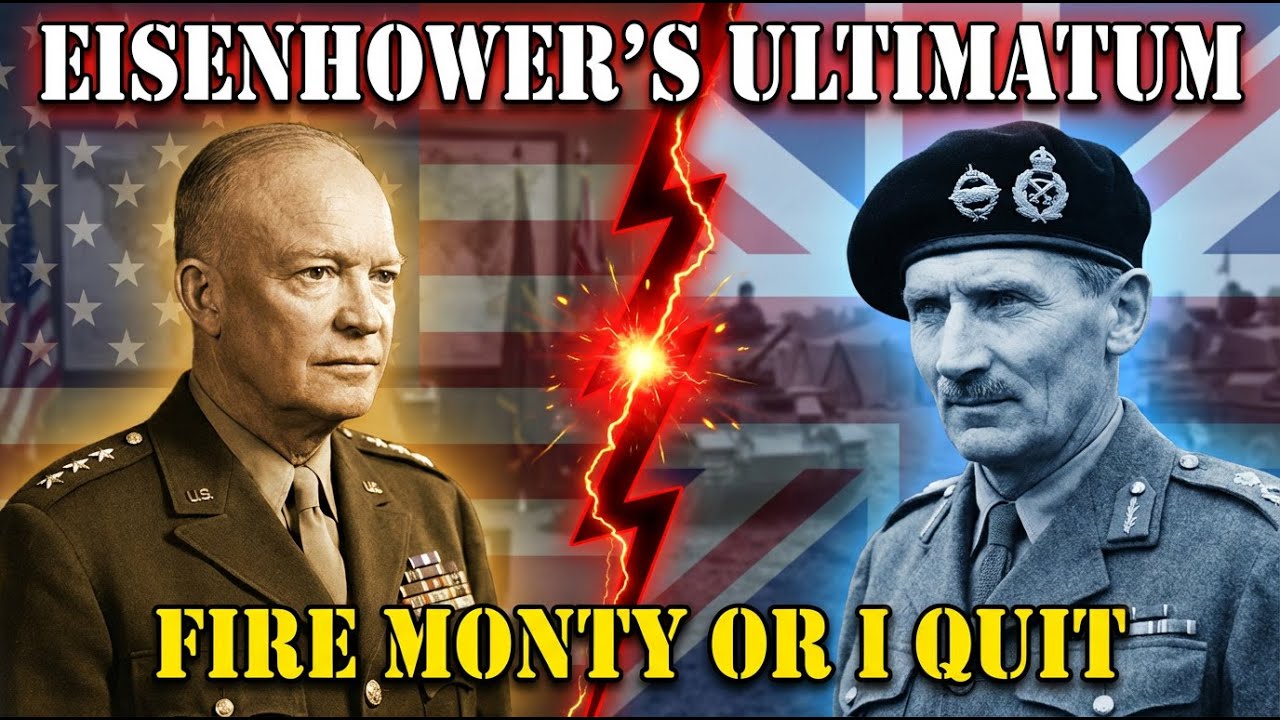
The ultimatum was never sent. But the fact that it was written at all reveals how close the Anglo-American alliance came to shattering not under German fire, but under the weight of two irreconcilable personalities locked in a command crisis that historians are still dissecting eight decades later.
The crisis came at the worst possible moment. The Battle of the Bulge, Germany’s last major offensive in the West, had just concluded after six weeks of savage fighting that cost the United States more than 80,000 casualties. American forces had borne the brunt of the German assault.
And Montgomery, who had been given temporary command of two American armies during the battle, was behaving as though he had saved the war single-handedly.
According to accounts preserved in the Eisenhower Presidential Library, Montgomery wrote to Eisenhower on December 29, 1944, demanding to be appointed Allied Land Forces Commander, a position that would have made him superior to General Omar Bradley and reduced Eisenhower to a figurehead. Eisenhower refused on December 31. The correspondence survives in the archives, catalogued and available for any historian to examine.
But Montgomery was not finished. In early January, he sent his chief of staff to Supreme Headquarters with word that he would delay a planned northern offensive until at least January 3. Eisenhower, according to multiple accounts, stormed about his office, convinced he had been deceived about the timing.
That was the breaking point. Eisenhower told his chief of staff, Lieutenant General Walter Bedell Smith, that he intended to send a telegram to the Joint Chiefs of Staff stating that he had trouble with Montgomery and that either they could relieve him or one of the two of them had to go. Air Chief Marshal Arthur Tedder, the British Deputy Supreme Commander, supported sending the ultimatum.
Had that message been sent, Montgomery’s career would have ended within days. Americans constituted the vast majority of forces in the European theater. The Combined Chiefs would almost certainly have chosen Eisenhower.
Montgomery would have been relieved and sent home in disgrace.
What saved him was the most unlikely intervention imaginable. Major General Francis de Guingand, known to everyone as Freddy, was Montgomery’s chief of staff. Unlike his boss, he was diplomatic, well-liked by the Americans, and keenly aware of the political realities Montgomery seemed blind to.
When de Guingand learned of Eisenhower’s ultimatum, he asked the Supreme Commander to hold the telegram until he could reach Montgomery. Eisenhower agreed. De Guingand then drove 200 treacherous miles through winter conditions to Montgomery’s headquarters at Zonhoven, Belgium.
When he arrived and explained the situation, Montgomery’s reaction revealed the fear beneath the arrogance. He asked, “What shall I do, Freddy? What shall I do?”
This was not the confident field marshal who had lectured Eisenhower about strategy and torn up his messages in front of him. This was a man who suddenly realized his career was about to end.
De Guingand had already drafted an apology letter with the exact wording Montgomery would need. He told Montgomery to sign it. Montgomery signed without argument.
The letter read: “Dear Ike, whatever your decision may be, you can rely on me 100% to make it work, and I know Brad will do the same. Very distressed that my letter may have upset you, and I would ask you to tear it up. Your very devoted subordinate, Monty.”

Eisenhower accepted the apology and did not send the ultimatum. Montgomery kept his command. But the damage was far from over.
On January 7, 1945, Montgomery held a press conference at his headquarters in Zonhoven. He spoke without notes for one hour, intending to praise the alliance and heal wounds. Instead, he created a firestorm that nearly destroyed what de Guingand had just saved.
Montgomery described American soldiers as “brave fighting men, steady under fire.” He called Eisenhower “the captain of our team” and said he was “absolutely devoted to Ike.” Taken individually, none of these statements was offensive.
The problem was what he did not say.
He did not mention any American general by name besides Eisenhower. No Bradley. No Patton.
No Hodges. He created the impression that he had saved the day and that American blundering had required his intervention to clean up the mess. His tone was described by contemporaries as “indecently exultant,” with a “what a good boy am I” self-regard that infuriated the Americans.
The British press ran with the story. The Daily Mail headline proclaimed: “Montgomery foresaw attack, acted on own to save day.” Then the Germans made everything worse by broadcasting a 𝒻𝒶𝓀𝑒 BBC news flash quoting Montgomery as describing Americans as “somewhat bewildered,” with the concluding line: “The Battle of the Ardennes can now be written off thanks to Field Marshal Montgomery.”
The American reaction was volcanic. Bradley told Eisenhower he could not serve under Montgomery and that if Montgomery were put in command of all ground forces, Eisenhower would have to send him home. Patton threatened the same resignation.
Eisenhower later wrote to Field Marshal Alan Brooke, the Chief of the Imperial General Staff, in what might be the understatement of the war: “No single incident that I have encountered throughout my experience as an Allied commander has been so difficult.”
On January 18, 1945, Winston Churchill came to the House of Commons in an attempt to repair the damage. He said, “Care must be taken in telling our proud tale not to claim for the British army an undue share of what is undoubtedly the greatest American battle of the war and will, I believe, be regarded as an ever-famous American victory.”
It helped calm the situation. But the wound went deep.
Montgomery later admitted something that showed he finally understood what he had done. “So great was the feeling against me on the part of the American generals that whatever I said was bound to be wrong,” he wrote. “I should therefore have said nothing.”
That might be the most self-aware statement Montgomery made during the entire war.

The question historians have debated for decades is why Eisenhower kept Montgomery at all. He had multiple opportunities and justifications to relieve him. The strategic disagreements, the failure of Operation Market Garden, the ultimatum crisis, the press conference disaster.
Any one of these could have ended a commander’s career.
Several reasons explain Eisenhower’s restraint. Sacking Montgomery would have caused political backlash in Britain against the Americans at a critical moment in the war. Montgomery commanded immense loyalty from British troops and the British public, who saw him as their greatest general.
Eisenhower acknowledged that Montgomery never once sustained a major defeat despite his personality flaws. And the strains of relieving him simply were not considered worth the damage it would cause to alliance cohesion.
The partnership continued through the final months of the war. Eisenhower gave Montgomery’s 21st Army Group priority for the main Rhine crossing, Operation Plunder, which involved 5,500 artillery pieces and 80,000 troops crossing on the first night. Patton crossed the Rhine first on March 22, 1945, at Oppenheim, doing it without orders and deliberately beating Montgomery.
It was revenge for Sicily, where Montgomery had relegated Patton to a supporting role.
On May 4, 1945, Montgomery accepted the unconditional surrender of German forces in the Netherlands, Northwest Germany, Denmark, and all naval vessels in those areas. The war in Europe was over. The alliance had held together despite the strains.
After the war, something surprising happened. Montgomery served as Deputy Supreme Commander Allied Forces Europe under Eisenhower from 1951 to 1952 during NATO’s formation. In spring 1952, Eisenhower painted a portrait of Montgomery and inscribed on the back: “To my friend Monty from Ike.”
In May 1957, Montgomery visited President Eisenhower at his Gettysburg farm, where they toured the Civil War battlefield together.
It seemed the relationship had survived. But appearances were deceiving.
In 1958, Montgomery published his memoirs. The book destroyed everything that had been rebuilt over the previous 13 years. Montgomery attacked Eisenhower’s Normandy strategy in detail, criticized the broad-front approach as fundamentally flawed, and implied that Eisenhower had been out of his depth as Supreme Commander.
He took credit for successes and distanced himself from failures.
Eisenhower’s fury was immediate and permanent. A January 1959 letter to Lord Ismay showed his true feelings: “I cannot forget how he was always ready to belittle associates at the critical moments when everybody’s cooperation was urgently needed.”
Later, speaking to historian Cornelius Ryan near the end of his life, Eisenhower let his true feelings show without restraint. “He’s a psychopath,” Eisenhower said. “Don’t forget that.
He is such an egocentric. He has never made a mistake in his life.”
A White House source was quoted as saying, “Monty won’t get invited up to Gettysburg again.” That understated the reality. All contacts between them were severed after 1958.

The friendship that had survived the pressures of coalition warfare in the most destructive conflict in human history could not survive Montgomery’s memoirs.
What makes the story so compelling is that both men were trying in their own way to win the war. Eisenhower through coalition management and logistically sound planning. Montgomery through tactical brilliance and aggressive offense.
Neither was simply wrong. Both had legitimate arguments based on their understanding of the situation.
The tragedy is that their personality differences made it impossible for them to find common ground except through crisis and intervention by others. Even de Guingand, the man who drove 200 miles through winter to save Montgomery’s job, opposed the narrow-front strategy. He concluded that Eisenhower was right when he decided he could not concentrate sufficient resources to allow one strong thrust deep into Germany.
On June 8, 1945, as the alliance was dissolving and everyone was going home, Montgomery wrote a letter to Eisenhower that revealed a side of himself that rarely appeared. “Now that everyone goes his own way, I want to inform you what honor and privilege it has been for me to serve under you,” he wrote. “I have much to thank you for.
I am well aware I have shortcomings and that I was not an easy subordinate. I do prefer to go my own way, but you have kept me on the right track in difficult and trying times and I learned a lot from you.”
Montgomery acknowledging his shortcomings. Montgomery thanking Eisenhower for keeping him on the right track. These were not things he said often or easily.
If only he had been able to maintain that humility. If only he had not published those memoirs 13 years later.
The story of Eisenhower’s ultimatum reveals something fundamental about leadership under pressure. Coalition warfare depends not only on shared objectives but on the ability of leaders to subordinate ego to mission. It requires patience to work with difficult personalities, wisdom to know when to confront and when to accommodate, and self-control to let slights pass when the larger cause demands it.
Eisenhower passed that test. Montgomery barely survived it, and only because his own chief of staff intervened at the critical moment. The phrase “shut up or get out” may be a colloquial summary rather than a verbatim quote from any document, but the sentiment was real and the crisis was genuine.
January 1945 saw Eisenhower reach his limit and prepare to force the Combined Chiefs to choose. Montgomery, for all his tactical brilliance, came within hours of losing everything. The relationship survived the war but collapsed afterward, which suggests the wounds never truly healed despite the portrait and the farm visit and the attempts at reconciliation.
In the end, the January 1945 crisis stands as a reminder that winning wars requires more than military genius. It requires the ability to work with people you may not like, to accept decisions you disagree with, and to subordinate personal ambition to collective success. Eisenhower understood that.
Montgomery never quite did.
And that difference, more than any strategic disagreement about broad fronts or narrow thrusts, explains why one man became president of the United States and NATO’s first supreme commander, while the other spent his final years writing bitter memoirs that destroyed the friendships he claimed to value.