
Gen. Dwight D. Eisenhower formally rejected Field Marshal Bernard Montgomery’s sweeping Sept.
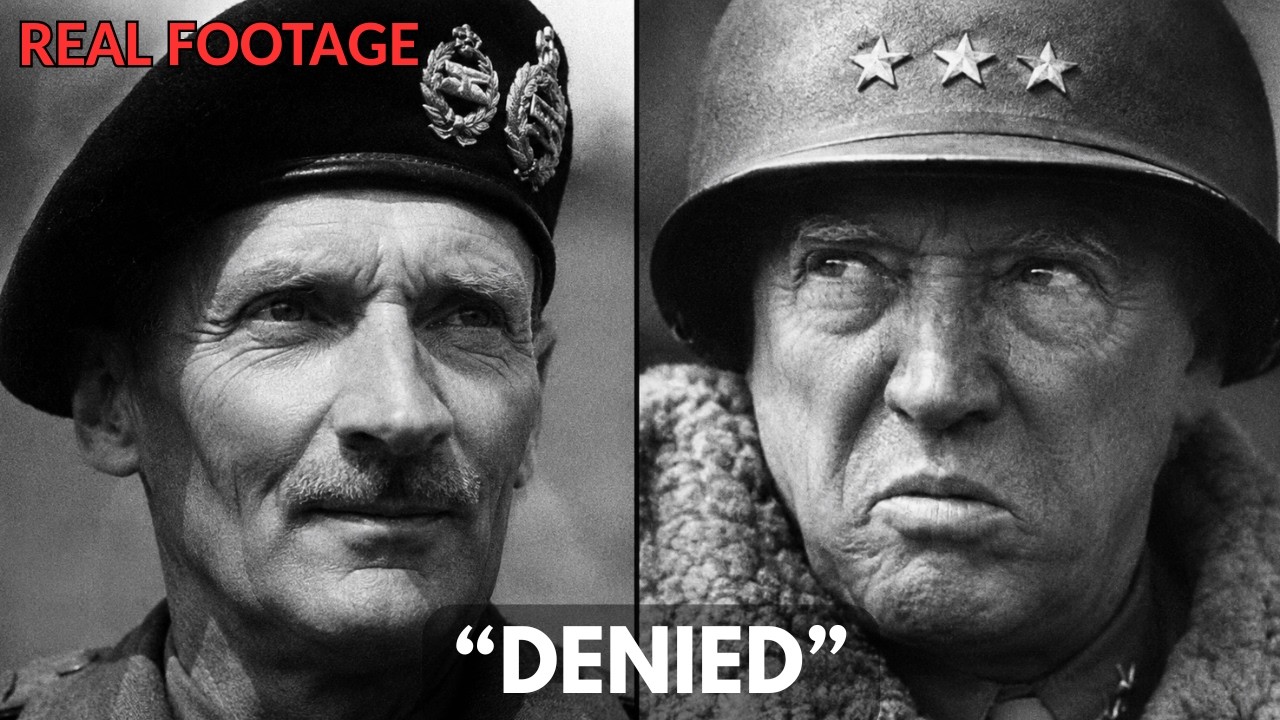 4, 1944 memorandum requesting command of a single 40-division Allied thrust into Germany, a decision delivered in writing within days that preserved the broad front strategy and kept Gen. George S. Patton’s Third Army advancing, according to the surviving archival record of one of the most consequential command disputes of World War II.
The rejection, delivered in language that left little room for misinterpretation, came after Montgomery asked Eisenhower to halt Patton’s army in its tracks and surrender its fuel and supplies to feed a rival drive to the north. Montgomery’s memorandum requested roughly 40 full divisions under his own personal authority, aimed at Germany’s industrial heartland.
Patton, on that exact same day, submitted his own competing proposal to Eisenhower, placing Third Army at the head of the drive into Germany instead. He described it in his private diary as the best strategic idea he had ever conceived in his entire military career.
The two rival proposals, submitted independently within hours of each other by commanders who had despised one another since Sicily, represented a direct collision between two fundamentally opposing visions of how the war should be won. Each required the other man’s army to step aside.
Omar Bradley, positioned between the two, added a third competing claim, insisting his own drive toward Frankfurt should form the center of gravity for all Allied operations. Eisenhower faced three mutually incompatible demands from three of his most strong-willed field commanders in a single week.
To understand why Montgomery believed he could ask for something so sweeping, one must grasp how dramatically the military situation had shifted after the Normandy breakout. The Allied pursuit across France had moved at a pace that surprised even the commanders directing it, let alone the logistics planners sustaining it.
German forces were in headlong retreat. Allied armored spearheads, Patton’s Third Army chief among them, had covered hundreds of miles in weeks, advancing far faster than supply lines built for a slower, more methodical campaign could sustain over any extended period.
By early September, that extraordinary pace had created a genuine crisis, not of German resistance, which had briefly collapsed, but of Allied logistics. There was simply not enough fuel, ammunition and general supply reaching the front to keep every advancing army moving at full strength simultaneously.
That specific crisis is the context that made Montgomery’s proposal seem, from his own perspective, like a reasonable solution rather than the sweeping power grab it represented in practice. If the Allies could not supply every army at once, he argued, they should concentrate everything behind a single decisive thrust.
And in Montgomery’s formal written proposal, submitted directly to Eisenhower without ambiguity, that single decisive thrust would naturally be his own to lead. The memorandum requested direct command of approximately 40 full divisions, a combined British and American formation operating entirely under his personal authority.
The scale of that request deserves careful attention, because the sheer size of what Montgomery sought has often been softened or oversimplified in popular retellings. Forty divisions represented an enormous concentration of Allied combat power, a figure historians have since noted was wildly beyond what the available supply infrastructure could sustain.
Supporting a force of that size would have required logistical resources that simply did not exist anywhere in the Allied supply chain at that moment, with the crucial deep-water port of Antwerp still firmly in German hands. Even setting aside what would happen to Patton’s army, the plan rested on a supply assumption Eisenhower’s own logistics staff considered unrealistic from the outset.
Montgomery was not asking for a reasonable share of resources for his sector. He was asking for a scale of concentrated logistical support that the entire Allied supply system likely could not have delivered, even if every other army had been reduced to complete immobility for weeks on end.

Patton’s reaction, recorded in his private diary and correspondence from that exact period, reflected the fury of a commander who understood immediately what Montgomery’s plan would mean. Third Army had already established itself as the fastest-moving Allied formation of the entire pursuit through France, driving deep into Lorraine and approaching the Moselle River.
Patton and many of his senior officers genuinely believed that advance could push directly into Germany before the retreating enemy could establish a coherent defensive line. Montgomery’s proposal, if approved in the form submitted, would have required Patton’s entire army to halt and surrender the fuel priority it desperately needed.
Eisenhower’s written response arrived within days and represents one of the clearest strategic rejections of the entire European campaign. He rejected the single thrust concept firmly and decisively in favor of what became formally and permanently known as the broad front strategy.
In his written communications from that period, preserved in the surviving archival record, Eisenhower articulated his reasoning directly and without diplomatic softening. His intended approach, he stated, would bring the full and complete strength of Allied forces against the enemy simultaneously across the entire front, all of it kept mobile and all of it contributing to the destruction of German field forces.
Rather than risking everything on a single narrow thrust that determined German reserves might contain, isolate or cut off entirely, Eisenhower’s later characterization of Montgomery’s proposal described it memorably as little more than a pencil thin thrust into the heart of Germany, a phrase capturing his considered assessment of the concept’s military viability.
This was emphatically not a diplomatic hedge or a face-saving compromise designed to let Montgomery down gently. It was a direct, substantive rejection of the core premise behind Montgomery’s entire proposal, delivered clearly in writing and grounded in Eisenhower’s own independent military judgment rather than any desire to avoid a difficult conversation.
The reasoning behind the rejection extended well beyond logistics into genuine strategic disagreement. Eisenhower and his planning staff believed a broad front advance measurably reduced the risk of any single overextended thrust being isolated, surrounded and destroyed by a determined German counterattack.
German forces, however battered by the pursuit across France, still retained meaningful capacity to concentrate reserves against a narrow and predictable penetration in a way that a broad simultaneous advance would have made considerably more difficult. Montgomery’s approach would have knowingly accepted that risk in exchange for the theoretical possibility of a faster breakthrough.
What happened to the available fuel in the immediate aftermath reveals an irony that complicates any simple narrative of Eisenhower’s rejection as a total defeat for Montgomery’s ambitions. Despite formally rejecting the 40-division single thrust, Eisenhower’s actual allocation of limited fuel in the following weeks continued to give meaningful priority to Montgomery’s 21st Army Group.
That priority supported the ambitious airborne operation soon to become Operation Market Garden, Montgomery’s bold attempt to seize a corridor of bridges through the Netherlands and cross the Rhine before year’s end. The decision, while far more limited in scope than the original request, came directly at Patton’s expense.
Patton’s Third Army, deprived of the fuel needed to sustain its rapid advance, came to a virtual standstill just short of the Moselle River, a thoroughly documented consequence of the resource decisions that followed Eisenhower’s formal rejection of the broader September proposal.
Patton, characteristically refusing to accept constraints imposed from above, continued pushing his forces forward with whatever limited fuel remained, apparently hoping sustained momentum on the ground might force Eisenhower’s hand and compel him to release additional supply toward Third Army’s sector.

This sequence reveals something often overlooked about how the rejection functioned in practice. Eisenhower had firmly rejected the concept of a single Montgomery-led thrust requiring every other army to halt indefinitely. He had not rejected the more limited idea of giving Montgomery priority when a time-sensitive opportunity seemed to justify it on its own operational merits.
The written rejection issued in September was real, substantive and consequential in narrowing what Montgomery could formally claim. It was not, however, a complete and permanent refusal of any resource priority for Montgomery’s forces in the weeks that followed, a distinction Patton and his staff understood with considerable and justified frustration.
The honest verdict on this episode requires holding several threads together rather than collapsing the story into a simple tale of ambition versus principled rejection. Montgomery’s memorandum was a serious attempt to secure sweeping personal command authority over the largest and most resource-intensive Allied operation remaining in the European war.
It would have required Patton’s rapidly advancing Third Army to halt entirely, surrendering its hard-won momentum to feed a plan led by a rival commander Patton had despised since their confrontation in Sicily the previous summer. This was not a modest request for slightly additional resources through ordinary channels.
It was a direct bid for command authority over roughly 40 divisions, a scale of concentrated combat force Eisenhower’s senior logistics staff had already independently considered fundamentally unrealistic, even before accounting for what such a decision would mean for every other Allied army along the remainder of the front.
Eisenhower’s rejection, delivered within days and grounded in substantive strategic reasoning rather than diplomatic deflection, represents a genuine exercise of his authority as supreme Allied commander, one that preserved the broad front strategy against a serious, formally documented challenge from one of his most senior and most decorated field commanders.
The specific language Eisenhower used, describing his approach in terms of bringing the full strength of Allied forces against the enemy simultaneously and pointedly characterizing Montgomery’s alternative as a pencil thin thrust into Germany, reflects considered strategic conviction rather than the careful management of a subordinate’s wounded ego.
At the same time, the fully honest record shows that Eisenhower’s formal rejection did not translate into genuinely equal treatment of Montgomery and Patton in the weeks that followed. The fuel allocation supporting Market Garden came directly at Patton’s expense, stalling his advance at precisely the moment it had generated celebrated momentum toward the German border.
Patton’s own officers believed that momentum could have carried them considerably further before winter set in. This outcome complicates any narrative in which the written rejection fully settled the underlying resource competition between the two commanders once and for all. The formal proposal was refused; the tension was not resolved.
It is worth adding a dimension most retellings leave out entirely: the broader personal history that made this clash feel less like an isolated policy disagreement and more like the latest chapter in a rivalry that had already defined much of the war.
Montgomery and Patton had despised each other’s approach to warfare since Sicily in the summer of 1943, when Patton defied his assigned secondary role and drove his forces to Messina hours ahead of Montgomery’s army. That clash established a pattern of mutual contempt that never meaningfully softened.
Patton considered Montgomery’s methodical, carefully prepared approach needlessly cautious and slow. Montgomery considered Patton’s aggressive, fast-moving style reckless and undisciplined. Neither man ever fully revised that assessment, and the September memorandum arrived directly on top of that substantial foundation of personal animosity.

This context explains why Patton’s reaction was so immediate and intense. He was not objecting to an abstract logistics decision from a distant headquarters. He was watching the specific rival he had spent a year competing against attempt to use a formal written request to secure official recognition that British forces and Montgomery personally deserved primary command authority over the war’s most important remaining operation.
There is a final piece worth understanding, one that complicates the episode in a way neither Montgomery’s ambition nor Eisenhower’s rejection fully anticipated. The broad front versus single thrust debate did not end with the September response. Montgomery continued advocating for a more concentrated approach for months afterward, right through the final drive into Germany the following spring.
Historians who have spent decades examining this controversy remain genuinely divided on its ultimate strategic merits, a division that has persisted since the earliest postwar military histories began grappling with the question directly.
Some, drawing on detailed logistics analysis conducted decades after the war, have concluded that Montgomery’s basic instinct about concentration was not entirely without merit, even if his specific proposal for a 40-division force vastly overestimated what the Allied supply chain could deliver at that moment.
Others have concluded that Eisenhower’s broad front approach, whatever its slower pace, ultimately reflected sounder strategic judgment, given the genuine risk German reserves posed to any narrow and 𝓮𝔁𝓹𝓸𝓼𝓮𝓭 thrust deep into contested territory.
This lack of settled consensus matters for understanding why the dispute has remained such a persistent subject of military history discussion for eight decades. It was never simply a case of one commander being obviously right and another obviously wrong.
It was a genuine and substantive disagreement between capable professional officers, each drawing on real military experience, each reaching different conclusions about how to balance speed against risk in the final and most consequential phase of the European war. That is the documented record.
The questions linger. Was Eisenhower’s broad front strategy genuinely the correct and principled decision that historians examining the full logistics picture have generally come to vindicate over the decades since? Or did Montgomery’s single thrust proposal, whatever its acknowledged flaws in scale and supply assumptions, represent a genuine missed opportunity to end the war months earlier?
And the harder question underneath all of it: if Eisenhower had rejected Montgomery’s September proposal completely and without exception, refusing any subsequent fuel priority whatsoever rather than still ultimately supporting Market Garden weeks later, does Patton’s Third Army actually reach the German border before the harsh winter weather sets in across the entire front?
Does the entire final year of the war in Europe genuinely unfold differently as a direct result of that single alternate decision? The written order was already signed. The answer to Montgomery was no.
What followed, and what might have followed, remains the subject of debate eight decades later.