MALTON, North Yorkshire — The last German prisoners walked out of Camp 83 in 1948, three full years after the war in Europe had ended, and when they were finally asked whether they wanted to go home, roughly 24,000 of them across Britain said no.
That single figure is the most startling fact to emerge from a re-examination of one of the least documented chapters of the Second World War: the story of how hundreds of thousands of German soldiers captured in Normandy were funneled into the British countryside, put to work on farms within walking distance of the families they had been fighting, and quietly absorbed into a nation that had every reason to want them gone.
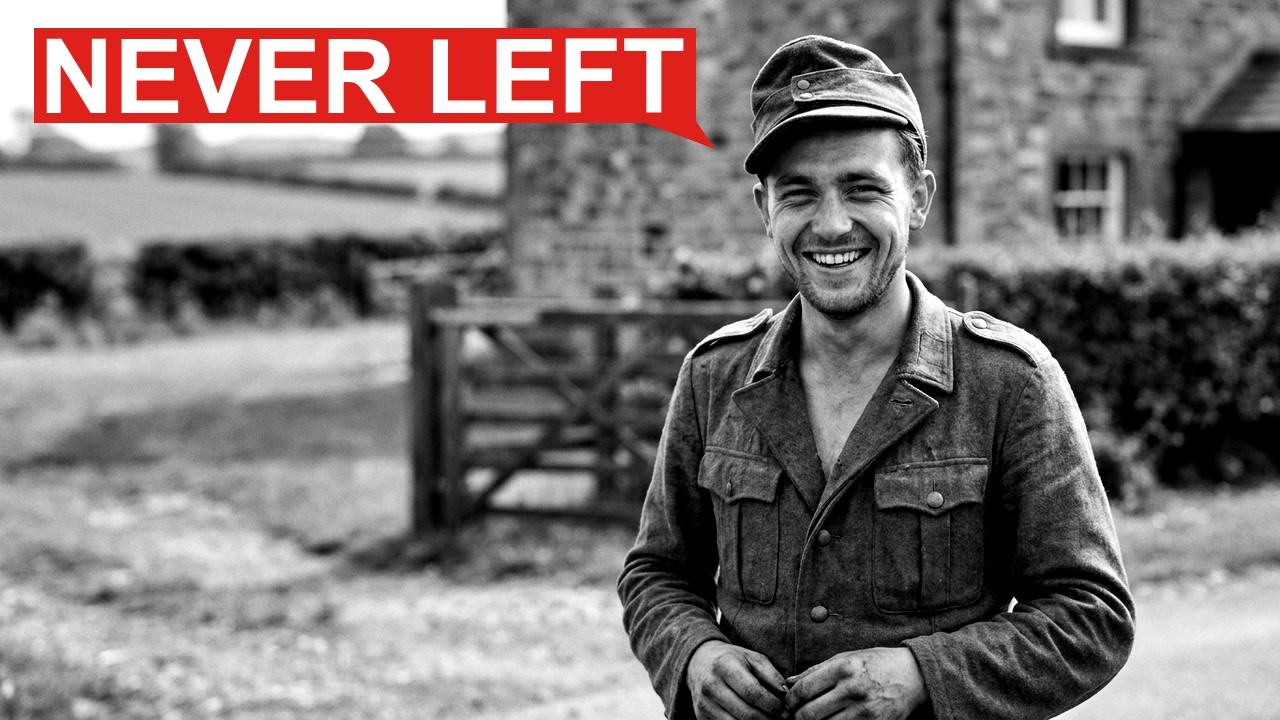 At its peak, at the end of 1946, Britain held 355,000 German prisoners of war — a population the size of a major city — spread across roughly 400 camps, most of them within walking distance of a village. By March 1945, some 70,000 German prisoners were already working in Britain. By 1946, 85 percent of them were working.
The arrangement was not designed on humanitarian grounds. It was arithmetic.
Britain had sent its farm laborers to war. Every young man who had worked a field in 1938 was in uniform somewhere by 1941, and a country that needed to feed itself under blockade had lost the people who fed it. The government had raised the Women’s Land Army and brought in school children at harvest, and it was still not enough.
There were 355,000 fit men sitting behind wire. The decision that followed was not sentimental.
The man at the center of this account is Unteroffizier Gerhard Pfeiffer, a 26-year-old non-commissioned officer who had been in uniform since he was 21. He was taken in Normandy in the collapse that followed the Allied breakout — a collapse that produced prisoners on a scale nobody had planned for. Whole formations gave up together, and the men who took them had a war to get on with and nowhere to put them.
What followed was not a journey so much as a queue. The man who surrendered was disarmed, searched, and walked to a field collection point, a roped-off square of mud with a few hundred other men in it and no shelter. He waited there sometimes for days.
Officers were separated from other ranks. Names were taken. Then lorries, and then the coast.
Britain had been running transit camps since 1940, and by the summer of 1944 they were the funnel through which every prisoner passed. Kempton Park Racecourse was one of them — a place where men had come to watch horses, now a cage with a processing office. A prisoner was interrogated there, cataloged and graded, and the grading decided where in Britain he went next.
Then the Channel, on whatever was going back empty. That is the detail that gets missed about the summer of 1944. The ships that carried the invasion across were coming home with room in them, and what went into the space was prisoners.
Men who had been fighting in Normandy in June were in the English countryside by August. They arrived faster than Britain could think what to do with them.
The initial official view was that employing them was more trouble than it was worth — a security problem, a supervision problem, and a legal problem under the Geneva Convention. That view lasted about six months.
Pfeiffer came through that funnel in the autumn of 1944, one man in a movement of hundreds of thousands, and was put on a lorry heading north because a form said he could be trusted on a farm. The camp he arrived at had been built two years earlier, and not by the British.
In 1942, 250 Italians taken in North Africa arrived at Malton railway station. They were formed up on the platform and marched through the town, past the shops, past the market square, past people who stopped on the pavement to look at them. Malton was a market town of a few thousand people.
Most of them had never seen an enemy soldier. Now there were 250 of them walking up the road in the rain.
There was no camp waiting at the other end. There was a field outside the town, some wire, and tents. The Italians built the rest themselves — 45 huts across eight acres, put up by the men who would live in them.
When it was finished, it could hold 1,200 prisoners, and it was one of 33 main camps in Yorkshire alone. Across Britain, there were around 400. It was given a number, Camp 83, and a name taken from the farm next door: Eden Camp.
The Italian story is the one nobody tells, and it sets up everything that follows. Around 157,000 Italians ended up in British hands, dispersed across Britain and Canada. They arrived first, they were held longest in some places, and they built a good deal of the infrastructure that later held the Germans.
Then, in September 1943, Italy changed sides, and the men in the huts at Malton woke up as citizens of a co-belligerent country while still being prisoners of war. Britain’s answer was to ask them to cooperate. Those who agreed were paid at the same rate as a British worker in tokens and fed three meals a day like any other man doing the same job.
By 1944, an Italian cooperator could hold a pass for a five-mile free area around his camp, which meant the shops in Malton, the post office, and the cinema. Men who had been taken prisoner in Libya were going to the pictures in a North Yorkshire market town while the war was still being fought in Europe. That is the arrangement the Germans inherited — not one invented for them, and not one anybody sat down and designed on humanitarian grounds.
The Italians were still there when Normandy fell. Then they went, and the huts began filling with Germans. Pfeiffer arrived into a system that was already running smoothly, and that fact matters more than anything else in this story.
Britain had been holding prisoners for four years. It had worked out what to do with them.
He was not one of a few hundred. He was one of hundreds of thousands. And they were not left to sit.
It is worth correcting something that gets said a great deal about these men, because it is not true. They were not told that the British would murder them. There was no consistent briefing about Western captivity at all.
What there was was rumor, and it ran in every direction at once — some of it frightening, some of it reassuring, none of it reliable.
What German soldiers genuinely feared was the East. That fear was real. It was deliberately encouraged by their own side to keep them fighting, and it was justified.
More than a million German prisoners died in Soviet hands. Against that, being taken by the British or the Americans was the outcome a man hoped for. Some of them were openly relieved.
So Pfeiffer was not braced for execution. He was braced for nothing in particular, which is a harder thing to carry. And underneath it was the ordinary fear that nobody briefs anyone about.
He was 26. He had been in uniform since he was 21. He did not know whether his mother’s street in Hamburg was still standing because the photograph in his pocket was two years out of date, and Hamburg had been bombed since.
Being taken prisoner did not mean dying. It meant losing the ability to find out.
The first thing that happened at the camp was a roll call. There were two of them a day, morning and evening, and there would be two a day for the next three and a half years. The second thing was a hut, a bed, and a blanket.
The huts were curved corrugated iron, the shape of a barrel cut in half and pushed into the ground. In summer, they were hot. In winter, the condensation ran down the inside of the iron and dripped onto the blankets, and men slept in their coats.
There was a stove in the middle, and never quite enough fuel for it. Every camp in Britain had the same huts and the same complaint about them. The doors were locked at 10:00.
The sentries had orders to shoot to prevent an escape, and the men in the huts knew it.
That is the part of the story that is easy to tell because it is the part that looks like a prison camp. What is harder to explain is what happened during the day.
 Before any of that, there was a question the British wanted answered about every man who came through the gate. They wanted to know what he believed. Every German prisoner in Britain was assessed and given a color.
White meant a man judged to be no Nazi — a conscript, a professional soldier, somebody who had been swept up in it. Gray meant the assessors were not sure. Black meant a committed Nazi, and it was applied to men from the units where that was most likely: the Waffen SS, the paratroopers, the young ones who had grown up knowing nothing else.
The grading decided a man’s life. Whites got the work outside the wire, and eventually the freedom of a farm. Blacks did not.
Black prisoners were concentrated in camps in the far north of Britain and in Scotland, deliberately far from anywhere, and they stayed behind the wire. There was a practical logic to it. You do not send a fanatic to work unguarded on a farm four miles from a market town.
But it also meant that the story of German prisoners in Britain is really two stories, and only one of them involves a kitchen table. The men who ended up in Yorkshire, working land within walking distance of the people they had been at war with, were the men Britain had already decided were safe. That is not an accident of geography.
It is the outcome of an assessment that somebody made on paper in an office.
Pfeiffer was assessed as white. He was 26, an NCO in an infantry unit called up in 1939, like everyone else his age. Nothing in his file made anyone nervous.
That single word on a form is the reason the rest of this story happens to him and not to somebody else.
There was one other thing being done to these men that has almost entirely dropped out of the story, and it is worth a moment because the paperwork for it survives. Britain was trying to change their minds.
From 1944, there was a re-education program running in the camps, organized, funded, and staffed with the explicit aim of sending men home who would build a different Germany from the one they had left. It ran on lectures, discussion groups, newspapers produced for prisoners, and film. About a quarter of the FO 939 series, the Foreign Office papers on prisoner of war affairs, consists of files on individual camps and on the lectures given at them.
Not on escapes, not on discipline — on lectures.
Whether it worked is a question historians still argue about, and this program is not the reason any of what follows happened. Nobody in Whitehall designed a policy of Yorkshire farmers inviting Germans to tea, but it tells you something about the frame of mind. The official machinery of the country was already treating these men as people who would go home and have to live somewhere, rather than as a problem to be contained until the war ended.
The unofficial machinery — the farms — got there first and by accident.
Britain had a problem that had nothing to do with prisoners. It had sent its farm laborers to the war. Prisoner labor was allocated by the War Agriculture Executive Committee, the War Ag as every farmer in the country called it, which decided which farms got men and how many.
A farmer paid the Ministry of Agriculture four pounds a year for the arrangement.
The Geneva Convention barred prisoners from work that fed the war directly, so it had to be farming and forestry. And at first, only in gangs of 12 or more with a guard. By 1946, 85 percent of the German prisoners in Britain were working.
Pfeiffer went out with the first gangs in the spring of 1945. Lorry at 6:00, into the fields, back at dusk. Turnips, potatoes, ditching, hedging — the unglamorous half of English agriculture done by men who mostly had no idea how to do it, watched by a guard who was usually older than all of them.
And then, slowly, the gangs got smaller. It began as a practical matter. Twelve men and a guard is an inefficient way to work a small farm, and North Yorkshire is a county of small farms.
Farmers started asking for one man or two. The War Ag started agreeing. The guard came less often, then stopped coming.
By the summer of 1945, Pfeiffer was going out to one farm four miles east of the camp on his own.
It is worth saying what sort of place this was, because the setting is doing more work in this story than it looks. Malton is a market town in Ryedale, in the Vale of Pickering, with the moors to the north and the Wolds to the south. It had a few thousand people, a market, a railway station on the line to Scarborough, and an economy that was almost entirely agricultural.
Before the war, it had sent livestock and grain out through that station, and it had done so for a century. Then the war took the men. What is easy to miss from a distance is how small the margins were in a place like that.
A farm outside Malton in 1944 was not an estate. It was a family, a few fields, and whatever labor could be found. And the labor had gone to North Africa, and Italy, and Normandy.
And some of it was not coming back.
Into that arrived first 250 Italians, and then several hundred Germans. In a district of that size, the prisoners were not an abstraction. They were a visible fraction of the working-age men in the area, and everybody knew where they were.
That proximity is the whole reason this story exists. In a city, prisoners are kept somewhere else. In Ryedale, there was no somewhere else.
The camp was down the road, and the men in it were in the same fields as everybody’s sons had been.
The farm Pfeiffer was sent to belonged to a man named Arthur Wetherill, who was somewhere in his 50s and had lost two hired men to the army in 1940 and never replaced them. He had been working the place with his wife and whatever he could get out of the War Ag. What the War Ag sent him that summer was a German.
Wetherill did not speak German. Pfeiffer’s English ran to perhaps 40 words, most of them agricultural. For the first fortnight, they worked without saying much of anything at all.
This is the part of these stories that always gets told as a heartwarming moment, and it was not one. It was two men who had every reason to dislike each other doing a job that had to be done before the weather turned. Wetherill pointed at things, Pfeiffer did them.
At noon, they stopped, and Wetherill went into the house, and Pfeiffer ate what he had brought from the camp sitting on a wall in the yard.
That went on for about three weeks. What changed it was not a speech. It was rain.
There is a particular kind of Yorkshire rain that arrives sideways and does not stop. And one afternoon in July, it caught both of them at the far end of a field with an hour’s work left. They finished it.
 They walked back to the yard soaked through. And Wetherill, instead of going into the house, stood in the doorway and jerked his head at the kitchen.
Pfeiffer had been in Britain for nine months and had not been inside a British house. What he found was a kitchen table, a fire, and a woman who looked at him for a long moment and then put a cup in front of him.
Understand what that cup cost. Britain in the summer of 1945 was still rationed and would go on being rationed for another nine years. Tea was rationed.
Sugar was rationed. Meat was rationed. And bread, which had survived the whole war unrationed, would go on the ration the following year.
Nothing on that table was surplus. Every ounce of it had been counted out of a book. And the man drinking it had been, 10 months earlier, a soldier of the army that had bombed the country he was sitting in.
The Wetherills did it anyway. So did a great many other people in a great many other kitchens in a way that never got written down at the time and is now almost impossible to document except through the people it happened to.
There is one more thing about that cup, and it is the part that took longest to find. It was against the rules. Britain operated a ban on fraternization with prisoners of war.
The question was put to ministers in the Commons more than once and the answer did not change. Contact between prisoners and the British public beyond what the work itself required was not permitted. A farmer could be allocated a prisoner to work his land.
He was not supposed to take him into his house.
That ban held through 1945 and through almost all of 1946. It was lifted in December 1946, and the timing was not an accident. The government relented in the weeks before Christmas and the public were told they could invite prisoners — well-behaved ones — into their homes for the holiday.
It was reported at the time it happened at scale. Families across the north brought men out of the camps and sat them at their tables, sharing rationed food with the army that had bombed them more than a year after the war had ended.
So the Christmas of 1946 is documented. You can go and read about it. What is not documented is everything that came before it.
Because the invitations did not begin in December 1946. That is only the month in which Britain stopped pretending they were not already happening. The policy did not create the kindness.
It caught up with it and gave it permission after the fact.
Which means that when Arthur Wetherill stood in a doorway in July 1945 and jerked his head towards the kitchen, he was breaking a rule — not a grave one, and not one anybody in Ryedale was likely to enforce, but it was there and he knew it was there and he did it anyway. It is an easy thing to be generous once generosity has been authorized. It is a harder thing 18 months earlier with the rules still standing and the war still close enough to touch.
Every camp of this kind kept a file. The one for Camp 83 sits in the National Archives today in a series called FO 939, the papers of the office that ran prisoner of war affairs. Those files will tell you how many men were held, what work they were allocated to, and what the camp commandant reported upward.
They will not tell you who was invited into a kitchen. The official record is very good at counting and very poor at everything else.
What we know about the kitchens we know because the men who sat in them told somebody decades later, usually a son or a grandson who wrote it down. It is the least documented and most consequential part of the whole story.
What can be documented is the shape of the thing, and the shape is remarkable enough. The prisoners were paid — not much, and not in money that was any use outside the wire. The camps ran on token currency, redeemable at the camp canteen and nowhere else.
By 1947, a German prisoner was earning around six shillings a week plus 12 cigarettes as a bonus, with the possibility of nine shillings for good work.
Six shillings was not a wage, but it was not nothing, and more to the point it was a wage, which is to say the arrangement had a shape that both sides recognized. A man did work and was paid for it. That is a different relationship from a man being made to work.
And then, in the middle of all this, the war ended. It is worth stopping on that because it is the moment where the whole arrangement should have made no sense at all, and instead simply carried on.
On the 8th of May, 1945, the bells rang in Malton as they rang everywhere else. There were bonfires. The blackout came down.
In the camp four miles away, several hundred German soldiers heard about it and understood correctly that the country they had been fighting for had ceased to exist. Nothing happened. There was no release because there was no mechanism for one, and no shipping to spare.
There was no reprisal, either. The next morning, the lorries went out to the farms exactly as they had the morning before, and the men on them worked the same fields for the same farmers. Then they did it again the following year, and the year after that.
This is the part that is genuinely strange, and the part that gets skipped. The famous stories about German prisoners in Britain are all about the war, but the majority of the time these men spent in this country was after the war was over — three years of it, from the summer of 1945 to the spring of 1948, in a country that no longer had any military reason to hold them, and held them anyway because the harvest needed bringing in.
Britain kept several hundred thousand foreign soldiers for three years of peace, and used them as farm labor, and the arrangement was so unremarkable to everyone involved that it has almost entirely fallen out of the national memory.
For the men, those three years are the whole story. A soldier’s war is loud and short. What Pfeiffer actually had was a thousand ordinary days in the same fields with the same farmer, in a routine that stopped feeling like captivity long before anybody said so out loud.
The wire was still there. The roll calls were still twice a day. But by 1946, a man walking four miles to work alone, coming back at dusk, eating at a kitchen table on the way, is not really living in a prison camp.
He is living in Yorkshire and sleeping in a hut. Nobody ever wrote that transition down because nobody noticed it happening.
At this point, somebody is going to say that the prisoners had an easier war than the men who fought it, and that is a fair thing to say. So let us deal with it properly. Some of them did.
A man on a Yorkshire farm in 1946, fed three times a day and paid six shillings a week, was living better than a British soldier had lived in Normandy and better than a great many British civilians were living in the same year. There is no way around that and no reason to pretend otherwise.
But the work was not all hedging. From 1945, German prisoners in Britain were put on to bomb disposal and mine clearance. They lifted mines from the beaches that had been laid against the invasion that never came.
 They cleared unexploded ordnance from the fields and towns that the Luftwaffe had scattered it across. It was dangerous and men were killed doing it.
The Geneva Convention is not ambiguous on this point. Prisoners of war may not be made to do work that is directly connected to the war, and they may not be made to do work that is dangerous. Handling live munitions is both.
Britain did it anyway on the reasoning that the war was over and the ordnance had to come out of the ground and the men available to lift it were behind wire. It is one of the least discussed parts of the whole arrangement, and it belongs in any honest account of it.
So the picture is not simple. The same country that let a prisoner sit at a kitchen table also sent prisoners onto minefields. Both things were policy.
Both things happened in the same years, sometimes to the same men. What makes the farms remarkable is not that Britain was gentle. It is that Britain was neither one thing nor the other, and inside that model, ordinary people kept making a particular choice that nobody had instructed them to make.
Then came the winter that changed everyone’s mind. The winter of 1946 into 1947 was the worst in living memory in Britain. Snow began in January, and it did not clear until March.
Drifts closed roads for weeks. Coal could not be moved, so power stations shut down, and industry stopped. Sheep died on the hills in numbers nobody could count until the thaw.
It came at the end of six years of war into a country that had nothing left in reserve, and it very nearly broke it.
The men who dug Britain out of that winter were, in very large part, prisoners of war. They cleared roads and railway lines. They got fodder to stranded animals.
On farms across the north, they were the only labor available because they were already there and already housed. It was the point at which prisoner labor stopped being a wartime expedient and became the thing holding the countryside together.
Pfeiffer spent that February at the Wetherills. He had been coming to the farm for 18 months by then. The relationship had long since stopped being supervised in any meaningful way.
And then, having got through it, the men found out they were going home.
Repatriation had begun in September 1946, and by the following year it was running properly. There were rules about who went first, and they had produced their own small absurdities. Early on, only men unfit for work were sent back, which meant that otherwise healthy prisoners were showing medical officers old scars, or drinking enough coffee to give themselves palpitations before an examination.
By 1947, though, the queue was real and moving, and the question every man in Camp 83 had to answer was simply when his turn came.
For some of them, it turned out not to be a simple question at all. In 1947, the rules changed again, and for the first time a German prisoner could apply to stay in Britain as a civilian worker. That same year, the ban on marrying British women was lifted, and 796 of them did.
When the offer of repatriation finally came, around 24,000 German prisoners across Britain chose not to take it. Twenty-four thousand men decided that the country they had been sent to fight was where they would rather live.
Not all of them for the same reason. Some had nowhere to go back to — a hometown in the Soviet zone, a family scattered or dead, a street that no longer existed. Staying was the least bad option, and it would be sentimental to pretend otherwise.
But some of them stayed because of a farm and a kitchen, and three years of work with a man who had needed the help.
Pfeiffer was not repatriated until 1948, three years after the war had ended. The last German prisoners left Camp 83 that same year, because the demand for men in the fields outlasted the war by three full seasons.
What happened to him after that is the kind of detail the files do not carry. What can be said is what happened to the men in general and to the place. Around 25,000 Germans took up civilian work and remained.
They went into agriculture, mostly, and into building, and into the small trades of the towns near the camps that had held them. They married and their children grew up in Yorkshire and Lincolnshire and Shropshire with German surnames and no accent. There is a generation of people in the north of England today whose grandfather arrived in the back of an army lorry.
It is also worth being clear about what going home meant in 1948, because it explains a great deal. The Germany a man returned to was not the country he had left. It had been partitioned.
Whole cities had been flattened and not yet rebuilt. There was rationing there, too, and worse than Britain’s. Families had been scattered by evacuation, by bombing, and by the flight westward ahead of the Red Army.
And a great many men came back to an address that produced no answer.
For a prisoner whose hometown had ended up in the Soviet zone, repatriation did not mean going home at all. It meant being delivered to a different country from the one on his papers. Set against that, a hut in North Yorkshire and steady work on a farm was not obviously the worst option.
Some of the 24,000 stayed out of affection. Some stayed because the arithmetic was brutally simple and it would be dishonest to dress that up as sentiment. But it was a choice and it was theirs and they made it in a country that three years earlier had every reason to want them gone.
The last of them left Camp 83 in 1948. By June of that year, there were only 2,790 German prisoners left in the whole of Britain out of the 355,000 who had been held 18 months before.
The camp itself was emptied in 1948 and left to the weather. It stood for nearly 40 years, 45 huts going quietly to rust in a field outside Malton, until 1985 when a local businessman named Stan Johnson bought the site intending to build a factory on it. He walked round it first.
Thirty-five of the original huts were still standing, more or less as the Italians had left them in 1942. He did not build the factory. He spent three-quarters of a million pounds turning it into a museum instead, and it is still there, and you can walk into the huts.
That is the part of this story you can check. The number, the acreage, the file in the National Archives, the 35 huts standing in a Yorkshire field. Go to Malton and it is all still there.
What you cannot check is the cup of tea. There is no document for it. There never was.
It happened in kitchens, between people who did not think they were doing anything historic, in a country that was cold and hungry and had every reason to behave differently. And three years later, when they were finally asked whether they wanted to go home, 24,000 men thought about that kitchen and said no.