LONDON — The extraordinary and often tragic stories of Prince Philip’s nieces and nephews, a generation born into the maelstrom of 20th-century Europe, have resurfaced as a poignant chronicle of royalty’s transformation from imperial grandeur to private citizenship, spanning the rise of Nazi Germany, the devastation of World War II, and the quiet adaptations of a modern age.
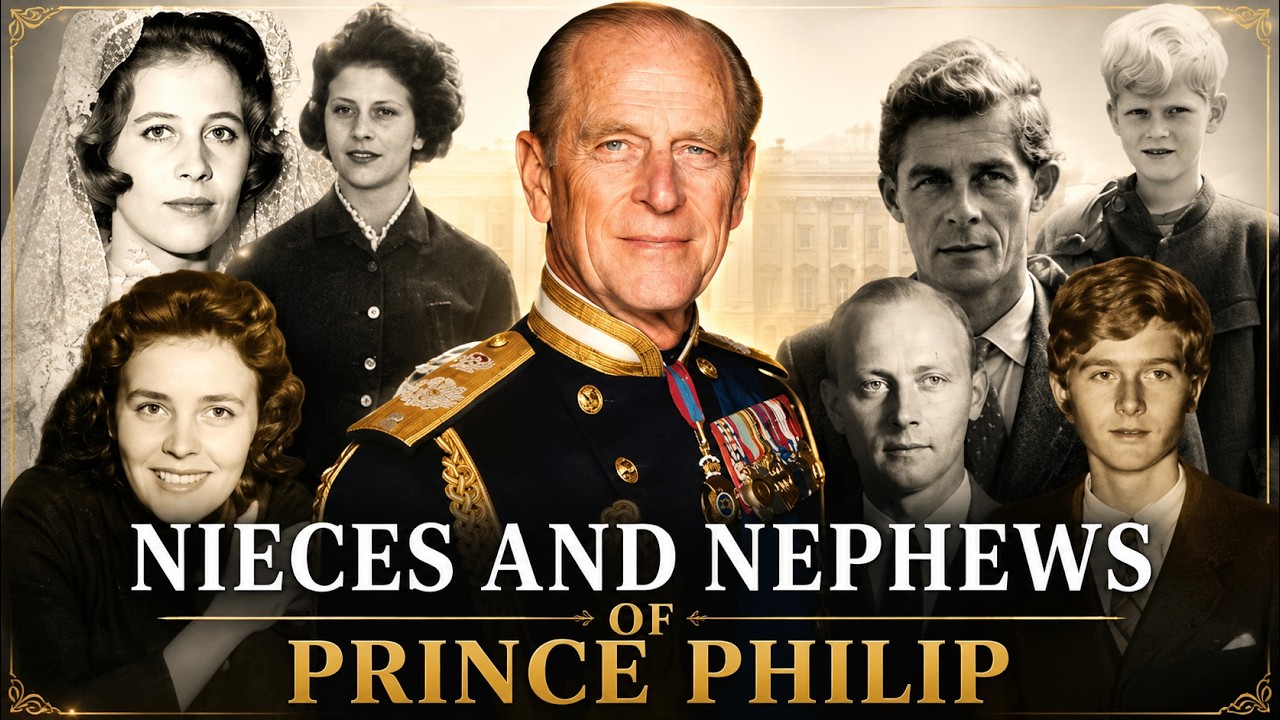
These were the children of Prince Philip’s sisters—Princess Margarita, Princess Theodora, Princess Cecilia, and Princess Sophie—women who married into German princely houses and whose descendants became living bridges between the British royal family and a continent scarred by conflict. Their lives, marked by privilege and pain in equal measure, trace an arc from palaces to ashrams, from wartime flight to quiet Canadian suburbs.
The eldest of this generation, Prince Kraft of Hohenlohe-Langenburg, was born in 1935 as the son of Princess Margarita and her German princely husband. He came of age in a Germany where his father, Prince Gottfried, served as a Wehrmacht officer while maintaining fragile connections to British relatives. After the war, the family faced initial shunning for their German affiliation before gradually being welcomed back into royal circles.
Kraft assumed leadership of the House of Hohenlohe-Langenburg upon his father’s death in 1960. Five years later, he married Princess Charlotte of Croÿ, and together they raised three children, ensuring the continuation of their noble line. He devoted himself to managing family estates and participating in local civic life in postwar West Germany.
In his later years, Kraft rekindled ties with his British royal cousins, symbolizing postwar reconciliation within the fractured family. He remained a respected figure of European nobility until his death in 2004, having witnessed his family’s journey from wartime ostracism to quiet acceptance.
His sister, Princess Beatrix of Hohenlohe-Langenburg, was born amid the upheaval of 1930s Europe and spent her early childhood in wartime Germany. In the postwar years, she grew close to her British relatives, even living in London for a time and appearing at the 1953 coronation of her aunt, Queen Elizabeth II.
Beatrix was briefly engaged to her first cousin, Prince Maximilian of Baden, in the 1950s, but that planned union of royal cousins never came to fruition. She remained unmarried thereafter, devoting herself to family obligations and discreet charitable work, living largely out of the public eye.
A beloved figure within the extended royal family, Beatrix embodied continuity between the old European aristocracy and the modern world. She died in 1997, her legacy one of loyalty and steadfastness during a century of great change.
The youngest son of Princess Margarita, Prince Georg Andreas of Hohenlohe-Langenburg, was born on the eve of World War II. His earliest years unfolded in a Germany at war, though his princely family remained far from the front lines. Coming of age during the country’s reconstruction, he inherited a deep sense of duty to his family’s legacy.
He married Princess Luisa of Schönburg-Waldenburg, uniting two venerable German noble houses, and the couple had two daughters. Since his elder brother Kraft assumed the headship of the family, Georg Andreas lived a more private life free from dynastic pressures, devoting himself to supporting the management of family estates and engaging in local civic and cultural activities.
His long life, which extended into the 21st century, bridged the era of Europe’s fallen monarchies and the era of a reunified Germany. Georg Andreas died in 2021 at the age of 82, his steady presence symbolizing the endurance of family heritage through tumultuous times.
Prince Ruprecht of Hohenlohe-Langenburg was one of twin sons born to Princess Margarita in April 1944, during the final year of World War II. His birth alongside his twin brother Albrecht brought a ray of hope to his exiled family amid the turmoil of wartime Europe.
Ruprecht’s earliest years were spent in the relative quiet of the family seat at Langenburg as the war came to an end. In the postwar decades, he led a life away from the spotlight, never marrying or taking on public duties. The privileges and certainties of the old nobility were fading in his adulthood, and Ruprecht at times struggled to find a defined role in this new world.
Tragically, his life was cut short in 1978 when he died at just 34 years old. His untimely passing was a somber reminder that royal status offered no immunity from personal trials. Within the family, Ruprecht’s story is remembered with sadness, a brief life that unfolded during a period of great transition and ended far too soon.
His twin brother, Prince Albrecht of Hohenlohe-Langenburg, also born in war’s twilight, grew up in a Germany that was rebuilding and redefining itself, far removed from the imperial courts his ancestors had known. In middle age, Albrecht charted a more settled personal course, marrying Maria-Hildegard Fischer in 1976, a commoner from outside royal circles, reflecting how Europe’s aristocracy was adapting to modern times.
The marriage produced one son, Prince Ludwig Ferdinand, continuing the family line into another generation. Albrecht lived largely out of the public eye, balancing respect for his family’s proud traditions with the realities of a changing society. He took on the quiet responsibilities of a country gentleman involved in his community and the upkeep of family properties.
Sadly, Albrecht’s life was also shortened early. He died in 1992 at the age of 48. With his passing, the hope that the twins represented for their family during World War II came to an end, but his legacy endures in the continued line of the Hohenlohe-Langenburg family and their adjustment to the modern era.
The children of Princess Theodora of Greece and Denmark present another branch of this remarkable family tree. Princess Margarita of Baden, born in 1932 in Germany just before the rise of the Nazi regime, witnessed her parents’ quiet opposition to Hitler’s ideology while growing up at Schloss Salem.
After World War II, Margarita moved to Britain, reflecting the strong family ties to England. There, she trained as a nurse at St. Thomas’s Hospital in London, an unusually hands-on vocation for a princess, showcasing her practical and compassionate nature.
In 1957, she married Prince Tomislav of Yugoslavia, an exiled prince and fellow descendant of Queen Victoria, whom she had first met during the coronation of her aunt, Queen Elizabeth II. The couple settled on a farm in the English countryside of Sussex, living an industrious yet modest life and raising a son and a daughter.
For 24 years, they shared a down-to-earth existence, running a fruit farm far from palace intrigues. Although that marriage ended in divorce in the early 1980s, Margarita remained a respected and well-loved figure in royal circles. She frequently appeared at major family occasions, including the 2011 wedding of the Duke of Cambridge, as a dignified elder stateswoman of Prince Philip’s family.
Princess Margarita spent her later years in England, her life epitomizing the blend of royal heritage and service-minded humility until her death in 2013 at age 80.
Her brother, Margrave Maximilian of Baden, was born in 1933 and raised at his family’s Schloss in Salem. He was a child during the Nazi years when his father, a former chancellor’s son, reluctantly served in the German military even as the family kept its distance from Nazi politics.
After the war, Maximilian benefited from a progressive education at Schule Schloss Salem, a school his father helped found with educator Kurt Hahn, which emphasized leadership and service. He went on to perform military service in the new West German Bundeswehr, eventually becoming a reserve colonel.
In 1963, upon his father’s passing, Maximilian assumed the title Margrave of Baden, a once-sovereign title now purely honorific. As head of his house, he took stewardship of the family’s remaining estates and business interests, adopting the role of a modern noble.

In 1966, he married Archduchess Valerie of Austria, herself a great-grandchild of Emperor Franz Joseph, thus uniting two storied royal dynasties. The couple had three sons and one daughter. Maximilian dedicated himself to preserving his family’s legacy, overseeing the family winery at Salem and supporting numerous charitable causes in his region.
Despite Germany’s abolition of royalty, he maintained a cultural and familial influence, and he kept warm personal ties with the British royal family, notably with his uncle, Prince Philip, illustrating the reconciliation of former wartime foes. Maximilian died in 2022 at the age of 89, closing a significant chapter for the older generation of European royalty.
Prince Ludwig of Baden, the youngest son of Princess Theodora, was born in 1937 as the last child of his generation, arriving just before global conflict engulfed Europe again. Ludwig’s childhood spanned the final years of World War II and the hardships of Allied occupation in Germany. These early experiences imprinted on him an understanding of upheaval and the value of stability.
In contrast to some of his more prominent royal cousins, Ludwig chose a quieter path in adult life. He married Princess Anna Maria von Auersperg-Breunner, a member of an old Austrian noble family, linking the House of Baden with another lineage of the former Austro-Hungarian aristocracy.
Together they had two daughters and a son, and Prince Ludwig focused on family life and the management of certain ancestral assets, all while staying largely out of the public eye. Without the burden of a marquee title—his elder brother Maximilian carried the Margravial title—Ludwig enjoyed more personal freedom to define his role.
He became known as a courteous, learned man who valued privacy and the quiet dignity of country life. Now in his late 80s, Prince Ludwig of Baden stands as one of the last surviving nieces and nephews of Prince Philip. He remains a living link to the era of pre-war princes and postwar reconstruction, a dignified custodian of family heritage who has carried his royal lineage into the 21st century with little fanfare and much grace.
The children of Princess Cecilia of Greece and Denmark, however, met with unspeakable tragedy. Prince Ludwig of Hesse and by Rhine was the firstborn child of Princess Cecilia and her husband Georg Donatus, Hereditary Grand Duke. His birth in 1931 made him a great-grandson of a reigning monarch, Ernst Ludwig of Hesse, and also the first great-great-great-grandchild of Queen Victoria, reflecting the tightly knit tapestry of European royalty.
Little Ludwig’s life, however, was destined to be heartbreakingly short. In November 1937, the family boarded a plane bound for London to attend his uncle’s wedding. The aircraft crashed in Belgium, killing Ludwig, his parents, and his younger brother Alexander.
The tragedy left no direct heirs to the grand ducal house of Hesse.
Prince Alexander of Hesse and by Rhine was the second son of Princess Cecilia and Georg Donatus. Born in 1933, Alexander spent his life in the loving embrace of his family at the New Palace in Darmstadt, unaware of the political storms gathering in Europe. Descriptions of the little prince recall a fair-haired, lively child doted on by his parents and grandparents.
In November 1937, four-year-old Alexander accompanied his family on what should have been a joyous journey, the wedding of his uncle in London. Instead, the trip ended in unimaginable calamity when their plane crashed. Prince Alexander perished with his parents and brother.
He was laid to rest with his family at Rosenhöhe, the royal mausoleum in Darmstadt.
Though he never reached school age, Alexander’s memory survives in the annals of royal history as part of the profound loss that struck Prince Philip’s extended family in the 1930s. His story is often mentioned alongside his brothers as a reminder of the vulnerability of life even within palaces.
Princess Johanna of Hesse and by Rhine was the youngest child and only daughter of Princess Cecilia. Born in 1936, she was just an infant when catastrophe befell her family. In November 1937, one-year-old Johanna was left behind in Darmstadt while her parents and brothers flew to London, a decision that saved her life.
After the plane crash that killed the rest of her immediate family, Johanna became an orphan at barely 14 months old. The little princess was taken in by her paternal uncle, Prince Ludwig of Hesse, for whom the ill-fated wedding had been planned, and his new wife, Margaret. They intended to raise Johanna as their own, hoping to bring some solace by providing the child a loving home.
For a brief time, Johanna was a tiny ray of hope amid overwhelming grief, the last surviving member of her nuclear family. Tragically, fate struck another blow. In June 1939, Johanna contracted meningitis and despite medical efforts, the two-year-old princess passed away.
Her death extinguished the remaining light of Cecilia’s family line. Princess Johanna was buried with her parents and brothers at the family mausoleum in Darmstadt.
Though her life was heartbreakingly short, her story is remembered as a poignant footnote in royal history, illustrating both the compassion of family in how her aunt and uncle cared for her and the cruel fragility of life that even royalty could not escape.
The children of Princess Sophie of Greece and Denmark, by contrast, lived long lives that spanned immense change. Princess Christina Margaret of Hesse, nicknamed Christa by those close to her, was the eldest child of Princess Sophie and Prince Christoph of Hesse. She was born in 1933 and came of age as World War II ravaged Europe.
In 1943, her father, a German prince who served as an SS officer, was killed in a plane crash while on active military duty, a profound loss for ten-year-old Christina and her siblings. After the war, the widowed Princess Sophie moved her family to relatives in Germany, and in 1946, she remarried, becoming Princess Georg Wilhelm of Hanover.
Christina’s adolescence, therefore, was divided between the legacy of the Hessian princely house and the Hanoverian court of her stepfather. In 1953, at age 20, the elegant Princess Christina traveled to London to attend the coronation of her aunt, Queen Elizabeth II, reflecting the renewed bonds between her family and the British royals.
While in Britain, she developed an interest in art restoration and studied the craft. It was during this period that she met Prince Andrew of Yugoslavia, an exiled younger son of the former Yugoslav king. The two married in 1956, a union that produced a son and a daughter and was seen as a happy alliance of European royal cousins.
However, the marriage would prove tumultuous. By 1960, Christina made the 𝓈𝒽𝓸𝒸𝓀𝒾𝓃𝑔 decision to leave Prince Andrew and her life as a Yugoslav princess behind. She had fallen in love with a non-royal, the Dutch artist Robert van Eyck.
This defiance of conventions scandalized royal circles at the time.
Prince Andrew sued for divorce and gained custody of their children. While Christina departed to start a new life, she married Robert van Eyck and had two more children with him, embracing a bohemian creative existence far removed from the protocols of court. That second marriage lasted over two decades before ending in divorce as well.
In her later years, Princess Christina settled in Switzerland, living quietly on the shores of Lake Geneva. She remained on good terms with her British and European relatives, occasionally appearing at family events. Christina’s life journey, spanning war, personal reinvention, and the breaking of royal norms, exemplified the 20th-century transformation of royalty.
 She passed away in 2011 at the age of 78, remembered as a strong-willed, independent princess who lived life on her own terms.
The second daughter of Princess Sophie and Prince Christoph, Princess Dorothea was born in 1934 and like her sister Christina was deeply affected by World War II. She was just nine years old when her father was killed in action in 1943. In the chaotic final days of the war, Dorothea, her mother, and siblings were forced to evacuate their home as Allied armies advanced.
The family took refuge with relatives, including a stay at Wolfsgarten, the estate of Prince Ludwig of Hesse, uncle of Dorothea’s late father. After the war, Dorothea’s mother’s remarriage into the Hanoverian royal family meant that Dorothea grew up amid a new set of royal relations and half-siblings.
Despite these disruptions, Dorothea’s demeanor was often described as calm and beautiful. In 1949, she and her elder sister even traveled to Britain to spend time with their grandmother, Princess Alice of Greece, indicating the far-flung support network the family had. Dorothea was present alongside her sister at Queen Elizabeth II’s coronation in 1953, representing the Hessian cousins.
Unlike more public royals, however, Dorothea preferred a life away from the limelight. She cultivated an interest in art and antiques, at one point modestly working in a London antique shop, a humble pursuit that showed her grounded personality.
In 1959, Princess Dorothea married Prince Friedrich Karl of Sayn-Wittgenstein-Berleburg, a member of a once-sovereign princely family from central Europe. In preparation for this marriage, she converted from Greek Orthodoxy to Roman Catholicism, reflecting her husband’s faith. The couple’s wedding in Munich was attended by numerous European royals, a testament to Dorothea’s connections.
After marriage, she moved to Milan, Italy, where her husband pursued a business career. There, Dorothea lived the life of a private gentlewoman, devoting herself to her husband and soon their two daughters. She remained a loving link between her new family and her royal siblings, often joining gatherings, but staying out of any public political role.
Prince Friedrich Karl died in 2002, and in widowhood, Dorothea eventually moved to Belgium to be closer to one of her children. She lived to the age of 91, passing away in 2025 as one of the last surviving nieces of Prince Philip. Princess Dorothea’s long life spanned eras of immense change, from the waning days of Europe’s royal empires through the Cold War and into the 21st century.
She navigated those changes with a quiet adaptability and is remembered for her kindness, humility, and steadfast dedication to her family.
Prince Karl was the only son born to Princess Sophie and Prince Christoph, arriving in March 1937. Tragically, he would have no memories of his father, who was killed in action when Karl was a small boy. Karl’s childhood was spent under the care of his widowed mother and, after 1946, his stepfather, Prince Georg Wilhelm of Hanover.
As he grew into a young man, Europe was healing from war and Karl became a symbol of renewed unity within his family. He emerged as a friendly link between the German branch of Prince Philip’s family and their British counterparts. In fact, Karl was a familiar presence at Anglo-German royal events in the postwar years.
He joined his uncle Prince Philip and cousin King Constantine of Greece on hunting expeditions and he dutifully attended major occasions such as royal weddings in London. These appearances were quiet but significant, helping to normalize relations that had been strained by the war.
On March 26, 1966, his 29th birthday, Prince Karl married Countess Yvonne Szapáry von Muraszombat, Széchysziget und Szapár, a Hungarian noblewoman. Their marriage, celebrated in The Hague, added a touch of central European aristocratic glamour to the family. Karl and Yvonne settled in Germany and had two children, Prince Christoph and Princess Irina.
Free from any throne, Karl pursued a life in the business sector and managed his family’s remaining estates in Bavaria. He also took on the role of a cultural ambassador of sorts, attending events like the funeral of his grandmother, Princess Alice, in 1969 and other European royal gatherings where his courteous demeanor was noted.
In his later years, Prince Karl was regarded as an elder statesman of the extended family, a tall, silver-haired figure often seen conversing genially with cousins from Britain, Sweden, and Spain at family reunions. He upheld the traditions and values imparted by his royal upbringing even as he witnessed the world modernize around him. Prince Karl died in 2022 at the age of 84.
Prince Rainer was born in November 1939, just two months after the outbreak of World War II. He was only three when his father, Prince Christoph, was killed in 1943. So Rainer grew up never really knowing his father, yet surrounded by stories and the legacy of duty he left behind.
Raised by Princess Sophie and later by her second husband in Hanover, Rainer witnessed firsthand the collapse of the old world and the birth of a new Germany. Instead of pursuing a military or political role as some of his ancestors might have, Rainer gravitated towards intellectual and artistic endeavors. He developed a deep interest in history, particularly the complex, sometimes uncomfortable history of his own family during the Nazi era.
In his professional life, Prince Rainer became a historian and a theater director. He apprenticed at theaters like the Staatstheater Darmstadt and the Münchner Kammerspiele, honing his craft in stage direction and production. His scholarly side led him to support academic projects.
Notably, he funded research by historian Jonathan Petropoulos that resulted in the book “Royals and the Reich,” an unflinching examination of how the Hessian princely family navigated the Third Reich.
By openly confronting that chapter, Rainer demonstrated a commitment to truth and reconciliation with the past. Unlike many of his royal cousins who married into other noble families, Prince Rainer never married and kept a relatively low public profile. He spent much of his time among books, archives, and the arts, preferring the company of fellow intellectuals to the pomp of court life.
Now in his mid-80s, Rainer lives quietly in Germany. He has become an elder figure with a wealth of knowledge, respected for his erudition and reflective nature. Within the family, he is often consulted for his historical insight, ensuring that the lessons and legacies of the past are not forgotten.
Princess Clarissa of Hesse, born in 1944, shortly after Prince Christoph’s death, is the posthumous daughter of Princess Sophie’s first marriage. Her birth came at a time of sorrow and chaos. Her mother was mourning her husband, and Europe was in the final throes of war.
Baby Clarissa’s early years were spent in a dramatically changing world. By the time she was two, her mother had remarried into the Hanoverian family, and Clarissa grew up alongside both her older Hesse siblings and a new set of younger half-siblings from her mother’s second marriage. Perhaps because of this blended upbringing, Clarissa learned adaptability from a young age.
In contrast to many royals of her generation, Clarissa stepped entirely away from public life and royal matchmaking. In the 1970s, she married Jean-Claude Derrien, a French businessman with no aristocratic title. This decision took her out of the sphere of royal Europe and into a more ordinary existence.

The couple had one daughter and Clarissa devoted herself to family life and personal interests, largely shielded from media attention. Living in France for much of her adult life, she became simply Madame Derrien in daily affairs, her royal status more a footnote than a defining feature of her identity.
Those who know her speak of a cultured woman with a love of the arts and a fluency in multiple languages who nonetheless values privacy above all. Now in her 80s, Princess Clarissa remains a discreet and little-publicized member of Prince Philip’s extended family. She occasionally appears at low-key family gatherings, but has no public role.
Her life exemplifies the path of a royal born at the end of one era who quietly transitioned into the life of a private citizen.
The children from Sophie’s second marriage to Prince Georg Wilhelm of Hanover carved their own remarkable paths. Prince Welf Ernst of Hanover was the first child of that union, born in 1947 as Europe was rebuilding from the ashes of World War II. Through his father, he was a grandson of the last reigning Duke of Brunswick and a great-grandson of Kaiser Wilhelm II, linking him to Germany’s imperial past on one side and to Greek royalty on the other.
In his youth, Welf seemed to be on track for a conventional aristocratic life. In 1969, he married a commoner, Wibke van Gunsteren, a woman outside royal circles, and the couple soon welcomed a daughter. However, the turbulent cultural currents of the 1970s had a profound effect on him.
Seeking deeper meaning beyond the privileges of royalty, Prince Welf Ernst and his wife became followers of the Indian spiritual teacher Bhagwan Shree Rajneesh, later known as Osho. In a move that astonished their families, they left behind their comfortable European existence and moved to the guru’s ashram in Pune, India.
Immersing themselves in this new life, they adopted Sanskrit names given by Osho and donned the orange robes of his disciples. They even went so far as to obtain a legal divorce as part of renouncing worldly attachments, though in practice they remained together as a couple within the commune. For Prince Welf, this radical departure was a search for personal enlightenment far outside the confines of royalty.
Tragically, it ended far too soon. On January 10, 1981, while participating in a morning karate exercise session at the ashram, 33-year-old Welf Ernst collapsed due to a cerebral hemorrhage. Attempts to save him were unsuccessful and he died that day.
His sudden death shook both the spiritual community in India and his royal relatives back in Europe.
Princess Sophie and Prince Georg Wilhelm flew to India to retrieve their son’s ashes. He was cremated in accordance with the ashram’s practices and brought Welf’s young daughter back home to be raised with family. Prince Welf Ernst’s life remains one of the most extraordinary in Prince Philip’s family, a young German prince who traded a life of privilege for one of spirituality.
Prince Georg of Hanover is the second son of Princess Sophie and Prince Georg Wilhelm, born in December 1949 in the peaceful years following the war. He was named for his father and inherited a rich blend of royal ancestry. Through his mother’s side, he is a nephew of Prince Philip, and through his father’s side, a great-grandson of Kaiser Wilhelm II and also related to the kings of Hanover and Prussia.
Georg spent his early childhood at Schloss Salem in southern Germany, where his father was a director of the famous boarding school located there. Growing up in the 1950s and 60s, he enjoyed a childhood that was both aristocratic and relatively normal, attending school and learning several languages.
In adulthood, Prince Georg continued the family tradition of cosmopolitan marriage. In 1973, he married Victoria Anne Bee, an American photographer and socialite. Victoria’s mother was Countess Eleonore Fugger von Babenhausen, connecting an American upbringing with one of Austria’s most prominent noble families, a sign of the changing social landscape where new world and old world met.
Georg’s marriage to Victoria brought a touch of transatlantic modernity to the House of Hanover. The couple had two daughters, expanding Prince Philip’s family tree to include half-American grandchildren. Prince Georg and his family spent time living in the United States as well as Europe, and he pursued a career in business, involving himself in international finance and the management of family investments.
Preferring a low profile, he did not take on public royal duties, but did attend major family events such as milestone birthdays and funerals. As the years went on, Georg settled back in Germany. He kept up the family’s ties to their royal cousins.
For example, he paid visits to Queen Sofia of Spain and King Constantine of Greece, both of whom are his first cousins through his aunt, Queen Frederica of Greece.
Now in his mid-70s, Prince Georg of Hanover leads a quiet life. He is often described as gracious and friendly, a man who comfortably straddles two continents and two eras. With his upbringing in postwar Europe and his later family life in America, Georg embodies the global dispersion of Europe’s royal descendants.
Princess Frederica of Hanover, the youngest of Princess Sophie’s children, was born in 1954 and named after her father’s sister, Queen Frederica of Greece. As the baby of the family, she grew up in a postwar environment that was already far removed from the grandeur her mother had known before the war.
Frederica’s childhood was spent at her parents’ home in Schleswig, Bavaria, and she was doted on by her older siblings. Queen Elizabeth II agreed to be one of Frederica’s godmothers, reflecting the close bonds between the British and Greek-German royal families.
In her youth, Frederica received a solid education and proved to be an adventurous spirit. In the early 1970s, she decided to further her studies in Canada, enrolling at Simon Fraser University in British Columbia. This move overseas was emblematic of her generation of royals, seeking roles and identities beyond the traditional European royal sphere.
She thrived in the academic and multicultural environment of Canada and ultimately chose to make her life there. Princess Frederica married a Canadian man, Jerry William Cyr, and embraced a down-to-earth life in North America. Settling in the Vancouver area, she became known simply as Frederica Cyr or Mrs.
Cyr, her royal title rarely used in daily life.
The couple had a daughter and a son, and Frederica devoted herself to her family and community. Far from the spotlight, her neighbors might not have guessed that the friendly, unassuming woman volunteering at local events was born a princess of one of Europe’s oldest royal houses.
Despite the distance from Europe, Frederica kept in touch with her mother and siblings, and her children grew up aware of their unique heritage. She would return to Germany or England occasionally for big family occasions such as milestone birthdays or reunions, often blending in rather than standing out.
Now in her early 70s, Frederica remains in Canada, enjoying a life that is largely private and fulfilled by the successes of her children and the company of friends. She exemplifies the way many of Prince Philip’s nieces and nephews adapted to the modern world by forging their own paths. In her case, that path led her across an ocean and into an entirely different way of life.
Together, these lives form a sweeping narrative of a royal generation that witnessed the collapse of empires, the horrors of war, the pain of exile, and the slow, often quiet work of reconciliation. From German estates to Indian ashrams, from London hospitals to Canadian universities, they carried their extraordinary heritage with a humility that speaks to the profound transformation of European royalty across the 20th century and into the 21st.