The Jerry Springer Show was quietly pulled from the airwaves in one American city in May 1998 over an episode about a man who left his family for a Shetland pony — not, as decades of rumor have suggested, over the episode connected to a Florida woman who was beaten and strangled to death hours after her taped appearance aired nationwide.
That contradiction sits at the center of a sprawling reassessment of the daytime television institution, fueled by a two-part Netflix documentary released in January 2025 and a season two premiere of Investigation Discovery’s “Hollywood Demons” in April 2026, both of which have forced a fresh reckoning with how the program was made and what it left behind.
The show’s host, Jerry Springer, died at his home in Evanston, Illinois, on April 27, 2023, at the age of 79. Most of his audience learned only afterward that doctors had found pancreatic cancer just months earlier. He kept the diagnosis so private that longtime viewers were blindsided.
His former bodyguard, Steve Wilkos, said that apart from his own father, Springer was the most influential man in his life. In the months before his death, Springer had already begun speaking like a man settling his accounts.
When the host of the “Behind the Velvet Rope” podcast asked him in November 2022 whether he saw himself as the granddaddy of reality television, he laughed and answered, “I just apologize. I’m so sorry. What have I done?”
The room treated it as a joke.
Once the people who worked beside him began talking after he was gone, that little apology started to sound far less funny. The most revealing voice in the Netflix documentary belonged to Richard Dominick, the executive producer who shaped the show during its wildest years.
Dominick told filmmakers he believes the program is responsible for making violence feel normal on reality television, and he said it without much sign of regret. His longtime producer, Toby Yoshimura, described the job even more plainly.
“You rev them up to tornado level and then you send them out on stage,” Yoshimura said. He compared the whole operation to the Stanford prison experiment, the famous study in which ordinary people turned cruel once given power over others.
The work cost Yoshimura personally. His father, the longtime “Saturday Night Live” designer Akira Yoshimura, disapproved so strongly that the two were estranged for years. Staff even had a word for what happened to guests before they walked out.
Guests were collected in limousines, fed free meals and given drink tickets, making the trip feel like a celebrity weekend for families from small towns. But those perks came with strings attached, according to multiple accounts.
Guests who stormed off and refused to return for the panel were threatened with losing their flight home. Some returned because they feared being stranded in Chicago. Most viewers laughed without wondering how a humiliated guest got home.
In April 2026, Investigation Discovery’s season two premiere of “Hollywood Demons” examined the show’s production. Associate producer Houston Curtis said producers instructed one brother to shout and spit in the other’s face while telling the second brother nothing.
Producer Reena Friedman Watts described another tactic involving lists of possible secrets, saying they existed so that the show would not be liable. She later quit, admitting she knew it was wrong.
Springer sounded strangely distant in that documentary when he said, “They never told me who the guests were going to be.” Listeners can hear that as the innocence of a host who simply read the cards he was handed, or as the comfortable distance of a man who chose not to ask.
Court records from the show’s final season include written guidelines instructing staff to avoid answering guests’ questions about their own episodes. In May 2018, a young father from Kentucky walked into a studio still running under those rules.
By then the show had long since left Chicago for a studio in Stamford, Connecticut, though the chant from the audience was the same one that had echoed through American living rooms for more than two decades.
Blake Alvey of Louisville arrived for a taping on May 8, believing he was there to talk about his relationship with his fiancée, Cassie Rutter. Once the cameras were rolling, she told him she had cheated on him with one of his close friends.
She said she no longer wanted to marry him and that she had already sold the engagement ring he gave her. The friend then walked onto the stage. The two men scuffled briefly, and security pulled them apart the way viewers had watched thousands of times before.
The episode aired on May 24. Ten days later, on June 3, Blake Alvey took his own life, leaving behind a newborn son who will grow up knowing his father mostly through photographs and family stories.
Nobody can say for certain what was in Blake’s heart during those ten days, and it would be wrong to claim otherwise. But his family believed the answer started on that stage.
On June 20, less than three weeks after Blake died, NBC Universal announced it was cancelling “The Jerry Springer Show” after 27 seasons. The network gave low ratings as its reason. The final episode aired on July 26, 2018.
There is no public evidence connecting the cancellation to Blake’s death. The fairest thing anyone can say is that the timing sits very uncomfortably beside the official explanation.
 In April 2019, Blake’s family filed a wrongful death lawsuit in Kentucky against Springer, NBC Universal, the producers and Cassie Rutter, arguing the show knew an ambush like that would provoke a severe reaction and went ahead with reckless disregard for his safety.
The court file included those guidelines telling staff to steer away from guests’ questions, which says a great deal about how little a guest was meant to know before the curtain opened. The case was sent to arbitration and later dismissed, so no jury ever heard the family’s story in open court.
Springer defended the show that August at the Edinburgh International Television Festival, where he compared blaming his program for a guest’s death to suing Walmart because a customer had argued with someone there weeks earlier.
He also said every applicant had to approve a list of 21 possible surprises before being accepted. But agreeing that something on a long list might happen is very different from knowing which surprise is waiting behind the curtain.
Springer rested his entire defense on the weeks and months that separated a taping from a tragedy. Yet 18 years before Blake’s episode aired, the distance between one broadcast and one killing had been measured in hours.
Nancy Campbell was a mother in Sarasota, Florida, who raised her two sons, Jeffrey and Gary, on her own after their father died. For years, she put those boys ahead of any romance of her own.
In the late 1990s, a friend encouraged her to try the chat rooms on AOL. Her son later said she hated having her photo taken and would hide her face whenever a camera appeared, which makes it even more heartbreaking that she ended up on one of the loudest stages in television history.
In one of those chat rooms, she met Ralph Penit, a German painter. They were married for 15 months before divorcing in February 1999 after a domestic violence incident. The divorce did not end things between them because they kept drifting back together.
In March 2000, Ralph quietly married a woman named Eleanor without Nancy knowing anything about it. For a stretch of time after the divorce, all three of them were actually living under the same roof.
In May 2000, the three flew to Chicago to tape an episode called “Secret Mistresses Confronted,” and Nancy believed she was going there for a reunion. Her lawyer, Lisa Kleinberg, told “Good Morning America” that until that taping, Nancy had wanted to reconcile with Ralph and marry him again.
Twenty-five years later, Jeffrey told Netflix almost exactly the same story, saying his mother believed Ralph had been deported to Germany and that the show would pay to fly him back so they could get back together.
When two people speaking a quarter of a century apart describe the same promise, it becomes very hard to wave it away as something a grieving family invented. The promise collapsed the moment the cameras started rolling.
Ralph revealed that he had married Eleanor, accused Nancy of stalking him, and said he hoped a television confrontation would finally make her leave him alone. Eleanor was stunned to learn on stage that Nancy and Ralph had slept together the night before the taping.
The argument lasted only about five minutes. After Eleanor called her old and fat in front of the crowd, Nancy stood up and walked off to applause. Anyone who has been humiliated in front of a room full of strangers knows that walking away quietly takes more strength than shouting back.
What happened after she left those cameras behind was never shown to a single viewer at home. According to Jeffrey, producers told his mother that unless she returned for the final segment, the show would not pay for her trip home.
When she refused, she was left in Chicago without enough money to get back to Florida. He says she wandered the city crying until a stranger noticed her and helped buy her a bus ticket. That account is her son’s, not a finding from any court.
Even after all of that, Ralph moved back into Nancy’s house only weeks later, and the relationship stumbled forward as though the humiliation in Chicago had never taken place. That tape sat on a shelf in Chicago for two months waiting for its air date.
On the morning of Monday, July 24, 2000, Nancy went before a judge in Sarasota to have Ralph removed from her home. For once, the system moved in her favor. The judge granted her sole ownership of the house along with a restraining order.
Nancy told the court Ralph had threatened to 𝓀𝒾𝓁𝓁 her, a warning the sheriff’s office took seriously enough that a captain later described him to reporters as dangerous. Deputies went to the house that same morning and made sure Ralph collected his belongings and left.
That was the same day the “Secret Mistresses Confronted” episode aired across the country. Reports say Ralph watched the broadcast in a local bar, and witnesses later said he grew angrier as it played.
Prosecutors believed he flew into a rage because a judge had just shut him out of the home he had been living in. Before that day was over, a worried friend called the police, and officers found Nancy dead inside her house after she had been beaten and strangled.
The restraining order she fought so hard for that morning protected her on paper for only a matter of hours. Her family has lived with that cruel arithmetic ever since.
 Ralph and Eleanor disappeared almost immediately. Within days, the case had become national news. Authorities feared the couple had gone to Maine and were trying to cross into Canada.
Investigators believed Eleanor might be heading for a First Nations reserve in New Brunswick, although their lawyer, Jane Winrob, insisted those reports were wrong. By that Thursday, the couple were in Boston, where their lawyers arranged a deal with Sarasota authorities. On Friday, they flew into Tampa and surrendered.
The show’s publicist, Linda Chaffron, released a statement saying, “We are gratified that they have turned themselves in.” It is striking how carefully that sentence avoids the woman whose private pain the show had just broadcast.
Ralph was jailed without bail on a charge of first-degree killing. A judge ordered Eleanor held as a material witness until she was released on $25,000 bail into the custody of a friend.
Newspapers around the country immediately began comparing the killing to an earlier talk show killing, and everyone working on the Springer show understood that questions about their own role were coming.
Inside the production, those questions were followed by a decision that one former producer still finds suspicious. As reports spread that staff members might be subpoenaed, Dominick planned a special episode in Jamaica that required the whole team to travel out of the country.
Dominick and the show deny the trip had anything to do with avoiding legal trouble. Yoshimura presents his view as personal opinion, but he says in the Netflix documentary that he has always seen a connection between that Jamaica production and the fact that nobody from the show faced legal action.
Investigators had already found 18 footprints inside Nancy’s house, and those prints would carry the case all the way to a sentencing hearing where the judge aimed her anger far beyond the man in front of her and straight at a television studio in Chicago.
Those footprints matched a pair of shoes belonging to Ralph. Investigators also found his DNA underneath Nancy’s fingernails, which told them she had fought him with everything she had left. His defense team argued that Nancy died of a heart attack during a struggle with somebody else.
After 18 hours of deliberation, the jury found him guilty of second-degree killing and of violating the restraining order Nancy had won on the last morning of her life. The sentencing in May 2002 became one of the most extraordinary moments ever connected to daytime television.
Ralph refused to enter the courtroom and listened from another room through a camera. So Circuit Judge Nancy Donnellan held up a photograph of Nancy’s battered face and made certain he could see it.
She said Ralph, Eleanor and Nancy had all been brought to Chicago and manipulated by the show’s producers. Then she asked, “Are ratings more important than the dignity of human life? Shame on you.”
Judges spend entire careers learning to keep their feelings out of their rulings. That is exactly why it matters that this judge chose to condemn a television program that was not even on trial in her courtroom.
She sentenced Ralph to life in prison without parole even though the law allowed her to give him as little as 20 years. He remains locked up at Marion Correctional Institution in Florida. Eleanor was reportedly granted immunity in exchange for her statements to investigators.
She walked away without charges and has stayed married to Ralph and openly supported him for more than two decades. When reporters asked Springer about the killing, he called it a very sad event but maintained that it had nothing to do with his show.
That answer stayed with Nancy’s family for years. Jeffrey later said it is pretty obvious that they were there to ambush her. He refused to let his anger simply fade, filing a multi-million dollar lawsuit on behalf of his mother’s estate.
His timing turned out to be terrible because the law was shifting beneath his feet in a Michigan courtroom. In 1995, a guest named Scott Amedure revealed a secret crush on Jonathan Schmitz during a taping of the Jenny Jones show in Chicago. Three days later, Schmitz killed him, even though that segment never aired.
A Michigan jury ordered the show to pay the Amedure family an award that grew to more than $29 million. But in October 2002, an appeals court threw it out, ruling that the program may have been the height of bad taste and sensationalism, yet had no legal duty to prevent a killing committed days later and hundreds of miles away.
After that ruling, Nancy’s family settled their lawsuit for nothing. Their attorney, Paul Vlachos, said the Michigan decision was part of the reason. The only thing the family received was a promise that the show would not countersue them for malicious prosecution.
Nancy’s sons walked away with less than the price of the bus ticket a stranger once bought for their mother. In July 2002, TV Guide had already named “The Jerry Springer Show” the worst television program of all time.
Dominick’s response to that honor was a mocking joke that ended with the words, “And I’d like to thank my mother.” The show had survived a killing, a furious judge and a wrongful death lawsuit.

It managed all of that because it had already survived something even stranger: a broadcast in May 1998 that its own executive producer still describes as his perfect episode, and the only episode ever pulled from the air.
Anyone who caught the show when it launched in September 1991 would barely recognize it. It began as a fairly serious talk program built around issues and politics. Everything changed after Dominick, a veteran of tabloids like Weekly World News and The Sun, took charge in 1994 and ran the show until 2008.
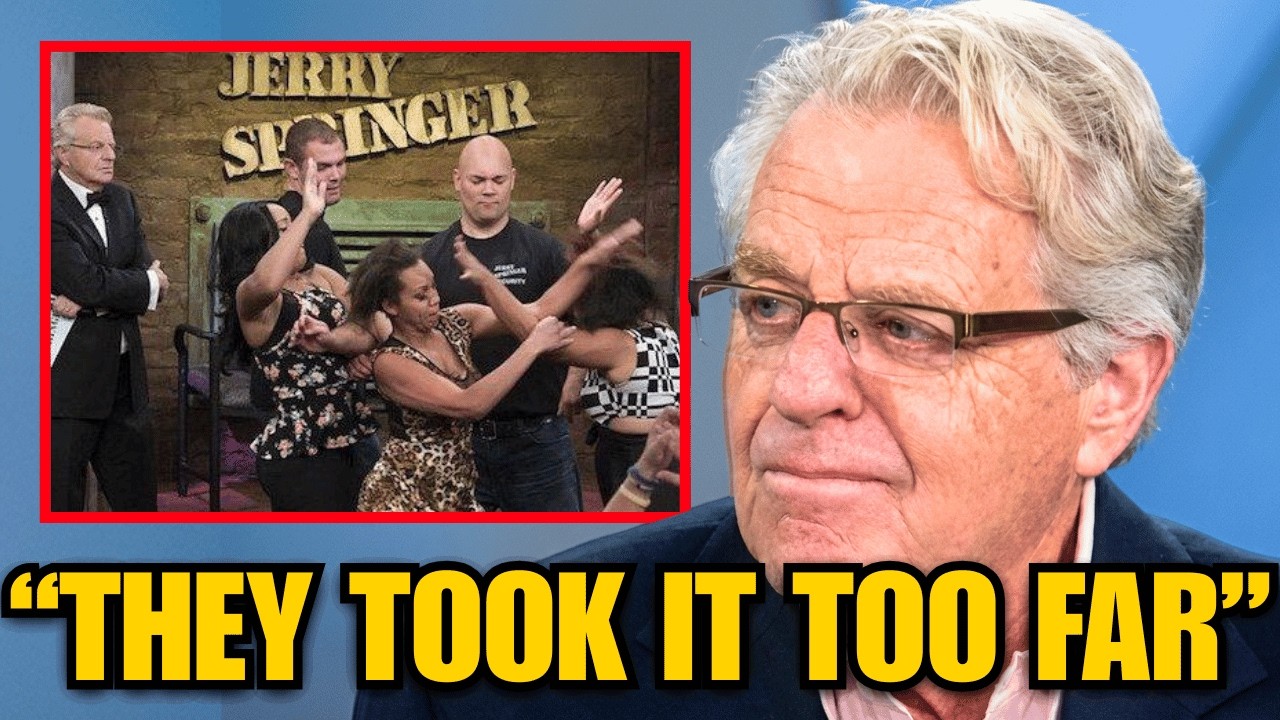
Under his direction, the guests grew louder and the stories grew wilder. A 1997 episode featuring the Ku Klux Klan and the Jewish Defense League exploded into a brawl that Houston Curtis says changed how producers built every fight that followed.
The first people to push back in Chicago were journalists rather than politicians. On May 1, 1997, Carol Marin, one of the most respected anchors in the city, resigned from WMAQ in protest after the station gave Springer a commentary segment on her newscast. Her longtime partner at the anchor desk, Ron Magers, left for the same reason.
Springer delivered only two commentaries before walking away from the role himself, which tells you how badly that experiment went for the station. The bigger war was with Oprah Winfrey, who publicly called the show appalling. Dominick admitted in the Netflix documentary that he wanted to teach her a lesson for saying so.
By March 1998, Springer’s program had become the first talk show in 10 years to beat Oprah in the ratings. Hollywood handed him a $2 million deal for a film called “Ringmaster,” which flopped so badly that he shared the Razzie Award for worst new star.
Yoshimura remembers the phone call that pushed everything even further because it came at 3 or 4 in the morning from a man who said he had left his wife and two daughters for a Shetland pony. The executives were nervous about even pitching the idea.
Yet the episode called “I Married a Horse” went out on May 22, 1998. It reached viewers in New York City and was pulled from the air almost as soon as it aired after talks between the syndicator Studios USA and the producers, who swapped in a backup episode and refused to explain why.
Several stations refused to show it at all, including WLWT in Cincinnati, the very station where Springer once built his name as a respected news anchor. If anyone has been waiting to learn which episode truly got taken off the air, it was not the one that ended in a killing, but this one, and it only ever reached a single city.
The fallout climbed all the way to the top because Studios USA chief Barry Diller ordered producers to eliminate the physical fights. By June 1999, the show had slipped slightly behind Oprah again.
That same month, Alderman Edward Burke called Springer before a Chicago City Council committee, arguing that if the fights were real, the off-duty police officers working security should arrest the guests, and if they were staged, the show needed an entertainment license.
At one point, Burke held up a heavy book and asked whether throwing it at someone would count as assault. Springer, playing to his cheering fans in the gallery, asked a delighted spectator whether they wanted the alderman to go ahead and try.
When the questions finally turned serious, he admitted there may have been a few staged incidents over the years while insisting that overwhelmingly the show is real. The man who charmed a gallery of cheering fans inside Chicago’s city hall had once stood before a wall of Cincinnati television cameras close to tears, confessing a secret that destroyed his first career.
He was born on February 13, 1944, inside Highgate Station on the London Underground while it was sheltering people from German bombs, to Jewish parents who had escaped Nazi Germany.
When he traced his family on “Who Do You Think You Are” in 2008, he discovered that 27 relatives were killed in the Holocaust, including both grandmothers, with Marie Kalman killed at the Chelmno extermination camp and Selma Springer dying at 72 in the Theresienstadt ghetto hospital.
Springer once said his family’s history made him profoundly liberal and that nobody needed to lecture him about tolerance. Yet he still gave members of the Ku Klux Klan a stage and a cheering studio audience.
Long before trash television made him infamous, Springer had become one of the most trusted faces in Cincinnati news, winning 10 Emmy Awards and closing every broadcast with the gentle sign-off, “Take care of yourself and each other.”
He never pretended to admire the talk show that replaced that reputation. In 2000, the same year Nancy walked off his stage, he told Reuters, “This is just a silly show,” adding that he did not take it seriously and would never watch it.
There is a painful distance between a man who asked viewers every night to look after one another and a program where, according to her son, producers refused to pay a frightened woman’s way home.
The statement his family released after his death asked people to skip the flowers and instead make a donation or perform an act of kindness for someone in need. It closed with those same familiar words from his newscasts.
It was a generous request from a family that clearly loved him. It also serves as a quiet reminder that simple kindness from strangers was exactly what Nancy Campbell Penit and Blake Alvey were hoping to find when they agreed to step onto his stage.
He ended thousands of broadcasts asking people to take care of each other. The private, camera-shy woman who walked off his stage in May 2000 went home to the one man who never did.