WASHINGTON — The four generals who stood closest to Douglas MacArthur when President Harry Truman relieved him of command on April 11, 1951, did not fall together, and they were not punished together, but within eighteen months every one of them had been sorted into a new and diminished future by an institution that had just demonstrated, publicly and unmistakably, where its ultimate loyalty was required to lie.
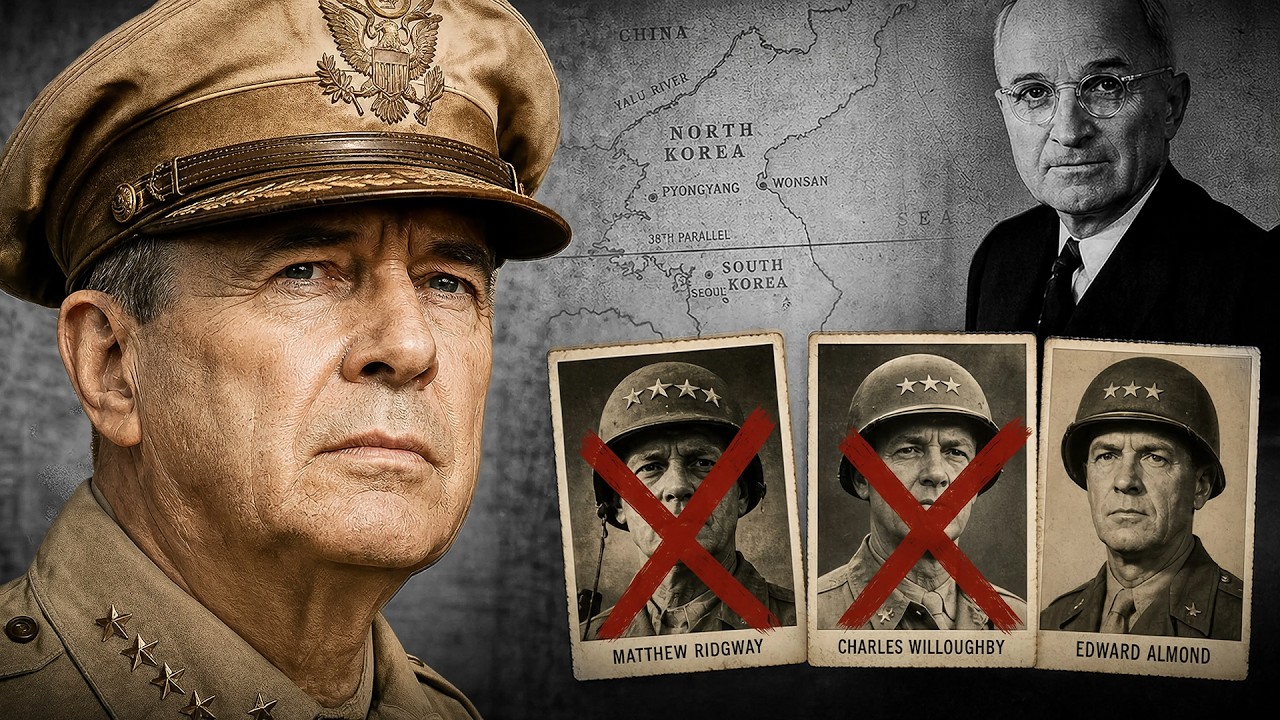
One resigned within weeks. One retired within months. Two stayed in uniform only to hit quiet ceilings that ended careers once thought destined for the Army’s highest ranks.
And the officer who replaced MacArthur — a man who never once publicly challenged the policy he had been ordered to execute — went on to become Army Chief of Staff, a trajectory none of the four loyalists came close to matching after 1951.
The dismissal itself was the product of months of open conflict between Truman and MacArthur over the direction of the Korean War. MacArthur favored a broader war against China, including strikes beyond the Korean Peninsula. Truman sought to limit the conflict and avoid escalation that could draw in the Soviet Union and trigger a third world war fought with newly developed nuclear weapons.
MacArthur publicly criticized administration policy repeatedly in the months before his removal. A letter he sent to House Republican leader Joseph Martin, expressing his disagreement with the administration’s limited-war strategy, was read aloud on the House floor. Truman treated the act as the final and unforgivable straw after a long pattern of public statements that undercut official policy.
Truman’s official statement held that MacArthur was unable to give wholehearted support to United States and United Nations policy, and that military commanders must remain governed by civilian policy and constitutional authority rather than by their own independent judgment — a principle Truman considered fundamental to the entire structure of American civil-military relations.
Lieutenant General Matthew Ridgway replaced MacArthur immediately, taking command of a war effort now openly divided over questions of strategy and constitutional authority. The immediate public reaction favored MacArthur overwhelmingly, with parades held in his honor, a televised address to a joint session of Congress, and open speculation in the press about a potential presidential run.
MacArthur’s supporters expected public outrage to reverse the decision entirely, and for a period of weeks that expectation seemed plausible given the scale of the reaction. The careers of the generals around him, however, began separating almost immediately, in directions none of the three predictions had fully anticipated.
Courtney Whitney did not try to save his army career. He left it. Whitney had served as MacArthur’s chief aide and confidant for years, a major adviser throughout the occupation of Japan and later within the Far East command structure during the opening phase of the Korean War, trusted with responsibilities well beyond the ordinary scope of a staff officer’s role.
National Archives records confirm both his position as MacArthur’s closest staff confidant and his resignation from the Army in May 1951, only weeks after the dismissal itself. The decision suggested Whitney saw his own institutional future as inseparable from MacArthur’s rather than as something he could rebuild independently within the Army’s new leadership.
 Rather than attempting to continue his own military career independent of MacArthur — an option that would have required him to serve under officers and policies he had spent years opposing — Whitney chose departure, becoming one of MacArthur’s closest civilian advisers and defenders in the years that followed.
He helped manage the general’s post-dismissal public legacy directly, working alongside MacArthur in a private capacity that mirrored, in many ways, the staff role he had once held inside the Army itself. He later wrote “MacArthur: His Rendezvous with History,” a lengthy and admiring biography that shaped how generations of readers would understand MacArthur’s career.
Whitney’s aftermath was not institutional survival. It was legacy gatekeeping — a full-time second career built entirely around preserving and defending the reputation of the man he had served for the better part of two decades.
Charles Willoughby, MacArthur’s intelligence chief from the Pacific War through 1951, followed a similar path on a slightly longer timeline. National Archives records confirm he served as MacArthur’s intelligence chief in the Pacific from 1941 to 1951, one of the longest and most consistent staff relationships in MacArthur’s entire command structure, spanning the Second World War, the occupation of Japan, and the opening year of the Korean War.
He retired from the Army in August 1951, several months after Whitney’s resignation. The delay suggests Willoughby may have initially considered remaining within the institution before ultimately concluding, like Whitney, that his professional future lay outside it.
Long considered one of MacArthur’s most loyal staff officers, sometimes to the point of controversy even during the war itself, Willoughby remained strongly anti-communist in later life and continued defending MacArthur’s Korean War worldview publicly through speeches, writings, and political associations.
He eventually became a controversial figure within broader anti-communist political circles, associating with figures and organizations well outside the mainstream of American political life. His career, by the time it ended, had become largely inseparable from MacArthur’s own mistakes and myth — the intelligence chief whose professional identity could not easily be separated from the general he had served for a decade, for better and for worse.
Edward Almond and George Stratemeyer stayed in uniform. But after MacArthur was gone, surviving the institution was not the same thing as inheriting its future.
Almond, a MacArthur loyalist who had commanded X Corps in Korea and supported the aggressive northern advance MacArthur favored during the campaign’s most controversial phase, remained in the Army after the dismissal rather than following Whitney and Willoughby into retirement or resignation.
National Archives records confirm he commanded X Corps from August 1950 through July 1951, a command that placed him at the center of some of the war’s most consequential and later most scrutinized decisions, and that he became commandant of the Army War College later that same year.

A respectable and honorable posting, it nonetheless represented a ceiling rather than continued advancement toward the kind of senior command positions his earlier career trajectory might once have suggested. He retired in January 1953, roughly a year and a half after taking up the War College post.
Stratemeyer, who had commanded Far East Air Forces through the first year of the Korean War and had supported broader use of air power along with greater operational freedom for his pilots and commanders, similarly remained in the Army briefly after MacArthur’s dismissal before retiring in 1952. His own departure came roughly a year after the dismissal that had reshaped the command structure he served within.
Both men’s military careers continued for a period after the dismissal, but neither rose further under any protection MacArthur might once have offered, and neither reached the highest ranks of Army leadership that had once seemed genuinely possible for officers so closely associated with the theater’s most famous commander.
Their loyalty did not end their careers outright, but it appears to have limited how far those careers could still climb once the general who had elevated them was gone from the command structure entirely.
The Senate hearings changed the story. MacArthur had returned to parades and applause, but behind closed doors, the men with the responsibility for the next war were explaining why his strategy could not become American policy.
Joint Senate Armed Services and Foreign Relations hearings began on May 3, 1951, with MacArthur himself testifying at length about his strategic vision for Korea and the broader conflict with Communist China, defending the same positions that had led directly to his dismissal weeks earlier.
Senior military leadership, including Army Chief of Staff George Marshall and Chairman of the Joint Chiefs Omar Bradley, testified in opposition to widening the war along the lines MacArthur had proposed, presenting a unified institutional case that the general’s approach risked a far larger and more dangerous conflict than the one already underway on the Korean Peninsula.
According to Senate historical records, MacArthur weakened his own case considerably through vague and overstated testimony that failed to hold up under sustained questioning from senators on both sides of the political aisle. The hearings gradually cooled the public frenzy that had greeted his return home, restoring public focus to the underlying question of civilian control over military strategy that Truman’s original decision had been built around from the start.
Ridgway replaced MacArthur, accepted Truman’s policy of limited war without public objection, and continued commanding United Nations forces in Korea without the public spectacle that had surrounded his predecessor’s tenure and dismissal.
Ridgway’s career after taking command demonstrates the clearest institutional contrast in this entire story. The Army rewarded those who adapted to civilian authority and worked within the policy framework set by elected leadership, while loyalty to MacArthur — though not automatically career-ending for the men who displayed it — could meaningfully limit advancement and permanently define an officer’s public identity around a controversy rather than around independent achievement earned entirely on his own record.

Ridgway would go on to further senior commands in the years that followed, eventually serving as Army Chief of Staff himself, a trajectory none of MacArthur’s four loyalists came close to matching after 1951.
Where MacArthur’s men defended the general, sometimes at real professional cost, Ridgway simply served the institution and the policy it had been ordered to follow. The difference in how each career subsequently unfolded speaks for itself far more clearly than any single statement either side made during the crisis itself.
Their aftermath was not uniform, and the archive does not support any claim that all four men were punished identically or that loyalty to MacArthur functioned as a coordinated career purge orchestrated from above. Their careers diverged after the dismissal in distinct and separate ways, following four genuinely different paths despite starting from the same command structure and the same single defining event.
Some resigned immediately. Some retired within the following year. And some remained in uniform only briefly before their own retirements arrived on a shortened timeline that nonetheless kept them serving for years after the general who had elevated them was gone.
What united all four was not a shared punishment, but a shared outcome. Their professional identities became increasingly and permanently tied to MacArthur’s side of the Korean War conflict, regardless of how their individual careers concluded or how much time separated their own departures from the original April dismissal.
Whitney became a historian and defender of MacArthur’s myth, spending years crafting the version of events that would reach the widest possible audience. Willoughby remained embedded in anti-communist networks that continued to validate the general’s worldview long after Korea itself had faded from daily headlines and public attention had moved on to other conflicts and other controversies.
Almond and Stratemeyer retired with their professional identities permanently tied to the Far East conflict and the commander who had once elevated them — examples less of punishment than of a military system that, when forced to choose, consistently favored civilian command over personal loyalty to any single officer, however celebrated that officer had once been.
Truman fired one general. But the order remade the lives of every officer who had built his career around him, sorting a decade of professional relationships into resignations, retirements, quiet ceilings, and one notable exception in Ridgway, whose willingness to serve the policy rather than the man became in the end the clearest career path available inside an institution that had just demonstrated publicly and unmistakably exactly where its ultimate loyalty was required to lie.
The four men who had once stood closest to MacArthur’s command each found their own way to carry that association forward — some by choice and some simply by the record they had already built — but none of them ever fully separated their own professional legacy from the general whose dismissal in April 1951 quietly rewrote all of their futures at once.