
Benito Mussolini, the fascist dictator of Italy whose brutal reign ended in his summary execution and the desecration of his corpse in Milan’s Piazzale Loreto, ordered the systematic erasure and eventual killing of his own firstborn son, a truth that has remained one of the most chilling and suppressed chapters of the Second World War, according to a detailed account of the dictator’s hidden family history.
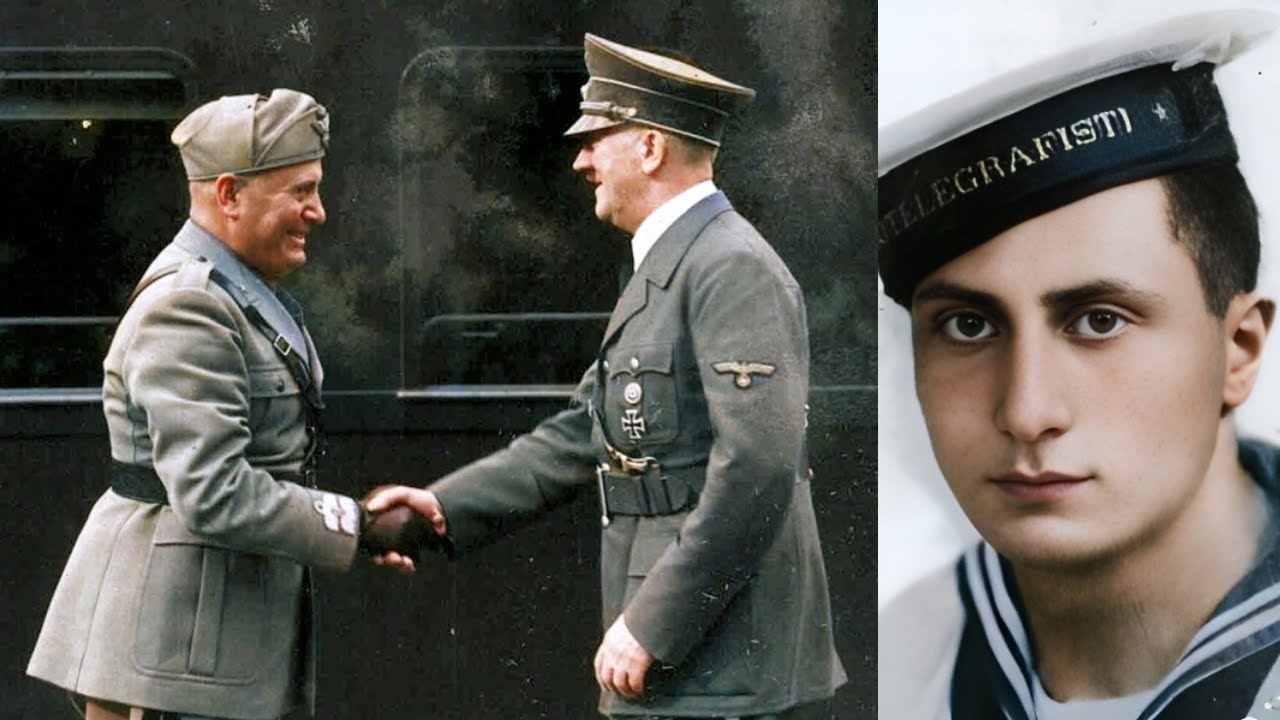
The story, which reads like a dark parable of absolute power and personal corruption, centers on Benito Albino Mussolini, a boy born in 1915 to Ida Dalser, a woman Mussolini married before he took Rosa Guidi as his second wife, making him technically a bigamist and the father of a child he would spend decades denying, imprisoning, and ultimately, according to multiple accounts, having killed inside a mental asylum in Milan.
The revelations cast a new and horrifying light on the man who stood shoulder to shoulder with Adolf Hitler, formed the Axis alliance, and dragged Italy into a catastrophic war that would leave millions dead and his own nation in ruins.
Mussolini’s path to absolute power began long before the blackshirts and the balcony speeches. Born into a family of modest means, he was the son of a blacksmith with socialist leanings, a background that shaped his early political consciousness. He was sent to a boarding school run by monks, where teachers noted his violent and defiant streak, though he was also described as shy.
Despite these contradictions, he achieved good grades and qualified as a schoolmaster in 1901.
By 1902, he had fled to Switzerland to avoid compulsory military service, working odd jobs in cities like Geneva and Bern while immersing himself in political philosophy. It was there, in the crucible of exile, that he began to embrace the importance of direct action, violence, and strikes as tools to overthrow democratic systems. He became a known figure among Italian socialist groups, organizing meetings and writing speeches, and was even introduced to Vladimir Lenin at one point.
But Mussolini was a troublemaker even then. He was arrested for advocating violent strikes and deported back to Italy, only to return to Switzerland. He studied at university but in December 1904 returned to Italy after being sentenced in absentia for avoiding military service.
An amnesty allowed him to escape punishment, and he resumed teaching.
In 1909, he left Italy again, taking a job as a secretary in Trento, then part of the Austro-Hungarian Empire. It was in that region, in a village near Trento, that Ida Dalser was born, the daughter of the town’s mayor, a woman well thought of in the local area. She had gone to France, particularly Paris, to study, and upon her return opened a French-style beauty salon in Milan.
The exact circumstances of how Mussolini and Dalser met remain uncertain. Some accounts suggest they crossed paths in Trento in 1909, where Mussolini worked as a journalist. Others point to Milan, where he moved later.
What is clear is that by 1912, Mussolini had become editor of Avanti, the newspaper of the Italian Socialist Party, a position he held for a couple of years before the outbreak of the First World War.
The war split him from the party over whether Italy should intervene. Mussolini favored Italian involvement, resigned from Avanti, and founded his own newspaper, Il Popolo d’Italia. It was during this turbulent period that he became romantically involved with Ida Dalser, whose beauty salon attracted wealthy Milanese women.
Dalser fell hard for Mussolini. She gave him money and financial help to fund his newspaper and political activities. It is said she even pawned her jewelry to provide him with the capital he needed to launch his new enterprise.
So deep was her devotion that she sold her beauty salon so he could continue the newspaper.
The pair were allegedly married in 1914. In 1915, Ida Dalser gave birth to a son named Benito Albino Mussolini. This child, who bore his father’s name, would go on to have a miserable life and, according to the account, would be killed upon the orders of his father, who was nowhere to be seen.
But even before the child was born, Mussolini had married Rosa Guidi, his mistress, who would later give birth to a number of his children. An edict from the city of Milan at the time denoted that Mussolini must make maintenance payments for the child to his wife, Ida Dalser. But the child bearing Mussolini’s name was forgotten and neglected, never fully accepted by his father.
When Italy entered the First World War, Mussolini joined the army. Following the war, he returned to politics and founded the National Fascist Party in 1921. The following year, he was elected to the Italian parliament.
 In 1922, he led 25,000 paramilitary Blackshirts in the March on Rome, forcing King Victor Emmanuel III to appoint him prime minister.
From that moment, Mussolini was in power, and it became crucial for him to establish himself as a clean, powerful leader with no 𝒔𝒄𝒂𝓃𝒹𝒶𝓁. The news that he had already been married and had not divorced his first wife before marrying his second could have destroyed his early reign. He was technically a bigamist and a father who had neglected his child, a combination that would not have sat favorably with the Italian people.
But Ida Dalser did not remain quiet. Once Mussolini was in power, she was placed under close surveillance by the police. Even her child, Benito, was followed by police.
They tracked down all the paper evidence of their marriage and relationship and destroyed the paperwork to ensure nothing could haunt Mussolini.
Yet his first wife continued to claim she was the dictator’s rightful wife. She denounced Mussolini as a traitor, claiming that during his time in Milan he had taken bribes from the French government to help campaign for the involvement of a neutral Italy in the war, in the hope that Italy would support the French. This would have made Mussolini a traitor, taking money from the enemy of the First World War.
Outraged by this, the dictator of Italy was furious. Benito Mussolini Jr. was followed along with his mother.
Their birth certificates were destroyed. But a number of documents were not ruined, including one in which Mussolini in 1915 acknowledged Dalser as his wife and Benito Jr. as his son.
He also signed a document in 1916 repeating his acknowledgement and saying he would help with financial support.
But when he came into power, he continued to deny the existence of his son. Dalser continued to push fascist officials to learn of her story. In 1926, she was arrested and locked up.
It was said she was abducted upon the orders of Mussolini, beaten, forced into a straitjacket, and declared insane by doctors. She spent the rest of her life in a number of mental hospitals and units before she died in 1937, suspected of a brain hemorrhage.
By doing this, Mussolini attempted to silence his ex-wife and eventually got what he wanted when she died. But what happened to Benito Mussolini Jr. was equally tragic.
He too was abducted by Mussolini’s officials and at a young age was told his mother was dead.
In 1931, he was adopted as an orphan at the age of 15 by the fascist ex-police chief of Sopramonte. It is assumed that within this household Mussolini could have controlled the care of his son. He had been sent to a number of boarding schools, but the child knew who his father was and was banned from referring to Mussolini as his father.
He was ordered to change his name to Bernardi.
The death of Benito Mussolini Jr. is incredibly sad and was obviously orchestrated by his father and his government. It could be seen as an organized execution.
When Benito Albino Mussolini was old enough, he enrolled in the Italian Royal Navy. While serving, he remained under close surveillance by government officials. It is assumed that he did serve in the Second World War on ships in some capacity, but he continued to tell people and claim he was the son of Mussolini.
Because of this, he was seen as dangerous. Shortly after seeing service, he was arrested and then sent, like his mother, to a mental hospital. It is clear that there was nothing psychiatrically wrong with Benito Mussolini Jr.
In fact, he was just telling the truth: that his father, the leader of Italy, was a bigamist and that he was his son.
But Mussolini, to eliminate the threat of people knowing about his son, silenced him by institutionalizing him. He was held inside an asylum in Milan, and it was here that he was brutally killed by doctors inside. It is clear that the doctors must have been under orders to 𝓀𝒾𝓁𝓁 Benito Mussolini Jr.
, the son of the dictator. The fascist government must have passed instruction for him to be killed.

There are different accounts as to what happened. Some claim the son of the dictator was killed at the age of 26 in July 1942 by coma-inducing injections. He was practically given medication in the form of a lethal injection that killed him, sending him to sleep.
Other sources document that he was killed from a number of electric shock treatments he was given, his body being subjected to shock treatment while inside the institution.
It is considered that his death must have been organized in an attempt to erase him from history, and the organization of it runs parallel to an organized execution. If this is the case, Mussolini, the dictator of Italy, happily ordered the execution of his own son. Following his death, he was buried in an unmarked grave.
Interestingly, the downfall of Mussolini would come not too long after the death of his firstborn son. In July 1943, a year after Benito Mussolini Jr.’ s death, his father would be arrested and deposed.
The Fascist Grand Council, in a dramatic overnight session, passed a vote of no confidence in the dictator. King Victor Emmanuel III summoned Mussolini to the Villa Savoia, dismissed him from office, and had him arrested as he left the building.
Mussolini was then imprisoned in a mountain resort in the Apennines, from which he was dramatically rescued by German paratroopers in September 1943. Hitler, determined to keep his ally in power, installed him as the head of a puppet state, the Italian Social Republic, in northern Italy. But Mussolini was now a shadow of his former self, a figurehead for German occupation and a target for the Italian resistance.
As the Allied forces advanced up the Italian peninsula, Mussolini attempted to flee to Switzerland. He was captured by communist partisans near Lake Como on April 27, 1945, along with his mistress, Clara Petacci. The following day, he and Petacci were executed by firing squad in the village of Giulino di Mezzegra.
Their bodies were taken to Milan and hung upside down from the roof of a gas station in Piazzale Loreto, where a crowd spat on, stoned, and abused the corpses.
The images of the former dictator’s body hanging upside down at a service station in Milan became some of the most iconic and disturbing photographs of the Second World War. They showed the depth of the hatred and contempt that many Italians felt for the man who had led their country into ruin.
The tragic story of Mussolini’s first wife and son shows us how ruthless and brutal the dictator of Italy could be. It also shows how he would stop at nothing to ensure the public did not know about his first marriage, which could have caused many to dissent against him. He was technically a bigamist and a father who abandoned his child.
But ultimately, he would, in a sense, organize the executions in the medical facility of his own son and his first wife.
The story of Ida Dalser and Benito Albino Mussolini needs to be told. They are forgotten victims of the man who was in the pocket of Adolf Hitler during the Second World War. Their fate is a reminder that behind the grand stage of history, behind the speeches and the parades and the alliances, there are human lives destroyed by the ambition and cruelty of those who seek absolute power.
Ida Dalser died in a mental asylum in 1937, her claims dismissed as the ravings of a madwoman. Her son, Benito Albino Mussolini, died in a mental asylum in Milan in 1942, killed by doctors acting on orders from the highest levels of the fascist government. Their graves, if they can be called that, are unmarked.
Their names have been largely erased from the historical record.
But their story is one of the most damning indictments of Mussolini’s character. It reveals a man who was not only a brutal dictator and a willing ally of Hitler, but also a bigamist, a liar, and a father who ordered the death of his own child to protect his political image.
The fascist regime went to extraordinary lengths to cover up Mussolini’s first marriage and his firstborn son. Police surveillance, destroyed documents, forced institutionalization, and ultimately, murder were all employed to ensure that the truth never came to light. The fact that it has taken decades for this story to emerge is a testament to the effectiveness of that cover-up.
Historians and researchers have pieced together the evidence from surviving documents, witness accounts, and the tireless efforts of those who refused to let the story die. The acknowledgment of Benito Albino Mussolini as his son, signed by Mussolini himself in 1915 and 1916, is a crucial piece of evidence that contradicts the dictator’s later denials.

The accounts of Ida Dalser’s abduction, beating, and forced institutionalization paint a picture of a regime that would stop at nothing to silence those who threatened its image. The fact that she was declared insane by doctors and spent the rest of her life in mental institutions is a chilling parallel to the fate of her son, who was also declared insane and institutionalized before being killed.
The killing of Benito Albino Mussolini, whether by lethal injection or electric shock treatments, was an act of cold-blooded murder carried out under the guise of medical treatment. The doctors who administered these treatments were not healers but executioners, acting on orders from a government that had decided that the dictator’s firstborn son was a threat that had to be eliminated.
The timing of his death is also significant. He was killed in July 1942, at the height of the Second World War, when Mussolini’s regime was beginning to crumble. The Allied invasion of Italy was still a year away, but the tide of war was turning.
Mussolini may have felt that the threat of his son’s existence was more dangerous than ever, and he may have decided to eliminate it once and for all.
A year later, in July 1943, Mussolini himself would be deposed and arrested. The man who had ordered the death of his own son would soon find himself a prisoner, rescued by the Germans and installed as a puppet ruler before meeting his own brutal end at the hands of partisans.
The story of Benito Mussolini Jr. is a tragic reminder of the human cost of dictatorship. It is a story of a child who was denied his father’s name, his mother’s love, and ultimately, his own life.
It is a story of a woman who loved a man who would become one of history’s most notorious dictators, and who paid for that love with her sanity and her life.
It is also a story that raises uncomfortable questions about how history is written and whose stories are told. Mussolini’s official biography, carefully curated by his regime, made no mention of Ida Dalser or Benito Albino Mussolini. The dictator presented himself as a family man, devoted to his wife Rosa and their children, while his first wife and firstborn son were erased from the record.
The fact that this story has survived, despite the regime’s best efforts to destroy it, is a testament to the resilience of truth. The documents that Mussolini failed to destroy, the witnesses who remembered, and the researchers who pieced it all together have ensured that Ida Dalser and Benito Albino Mussolini are not forgotten.
Their story is a dark chapter in the history of fascist Italy, a chapter that the regime tried to write out of existence. But it is a chapter that must be told, not only to honor the memory of its victims but also to remind us of the depths of cruelty to which those who seek absolute power will sink.
Mussolini’s legacy is one of war, oppression, and alliance with Hitler’s Nazi Germany. The story of his first wife and son adds another layer to that legacy: that of a man who was willing to destroy his own family to protect his image and his power. It is a legacy that should never be forgotten.
The execution of Benito Mussolini Jr. , ordered by his own father, is one of the most 𝓈𝒽𝓸𝒸𝓀𝒾𝓃𝑔 and least-known crimes of the fascist era. It is a crime that was covered up for decades, a crime that the regime hoped would never come to light.
But the truth has a way of emerging, and the story of Ida Dalser and her son is now part of the historical record.
As the world continues to grapple with the legacy of the Second World War and the horrors of fascism, the story of Mussolini’s firstborn son serves as a stark reminder of what happens when absolute power is placed in the hands of a man who will stop at nothing to protect his own interests. It is a story that should be told and retold, so that the victims of fascism are never forgotten and so that the lessons of history are never lost.
The brutal execution of Benito Mussolini Jr. is a story of neglect, denial, and alleged killing. It is a story that begins with a young woman’s love for a rising politician and ends with the deaths of both mother and son in mental institutions, their voices silenced and their names erased.
It is a story that deserves to be heard.