For decades, the future King Edward VII, known as Bertie to his family, built a hidden kingdom within London’s Marlborough House, a dazzling court of adultery, gambling, and political maneuvering that operated in direct opposition to his mother’s strict moral rule. While Queen Victoria mourned in seclusion, the Prince of Wales and his inner circle, known as the Marlborough House Set, openly defied Victorian morality, rewriting the rules of high society to the point of risking the monarchy’s stability. Bertie was viewed by his parents as a profound disappointment. He despised books and was driven by an insatiable appetite for pleasure.
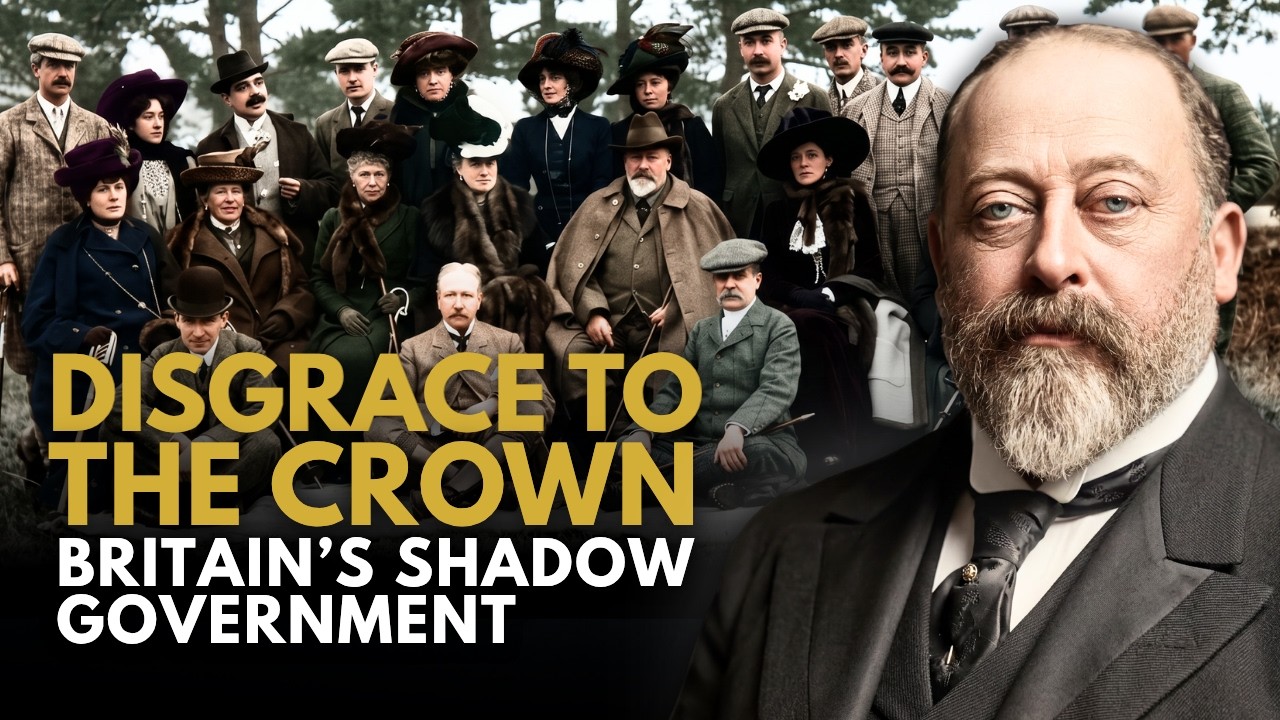
The point of no return came in 1861. After discovering his son’s affair with an actress, the already ailing Prince Albert traveled to reprimand him and died shortly afterward. Grief-stricken, Queen Victoria irrationally blamed Bertie for her husband’s death, freezing him out of political power and leaving the royal heir with immense status but no purpose. Moving into Marlborough House in 1863, Bertie transformed the mansion into a palace of hedonism.
He scandalized the old aristocracy by opening his doors to wealthy American dollar princesses and prominent Jewish financiers who had previously been excluded from the elite. His guest list reflected a shockingly modern criterion: not ancient bloodlines, but charisma and cash. This glittering circle lived by one unspoken motto: do whatever you want with whomever you want, just don’t get caught. Behind the scenes, the prince’s affection for his lawful wife, Princess Alexandra, did little to curb his infidelities.
Alexandra was fully aware of his affairs but played her part flawlessly, maintaining a perfect public facade and even forming polite friendships with his mistresses. The prince’s favorites became legends, including actress Nelly Clifton, whose affair with Bertie had driven his father to the grave, and the stunning American Jennie Jerome, mother of future Prime Minister Winston Churchill. It was actress Lillie Langtry who became the first true superstar of the set. Born Emily Le Breton, she lacked noble lineage but possessed a striking beauty that captivated Bertie at a dinner party in 1877.
Their romance changed high society’s rules; Langtry achieved worldwide fame solely through her connection to the heir. She openly rode with him through Hyde Park, and Bertie even built a secret retreat for their rendezvous. In an act of audacity, he introduced her to his strict mother. Langtry became one of the first celebrities to endorse a commercial brand, Pears’ Soap.
Money also defined the circle, as seen with figures like Princess Daisy of Pless, who married into one of Europe’s wealthiest families. She presided over a 600-room castle and traveled by private train, with a wardrobe that included seven-meter-long pearl necklaces. However, history dealt Daisy a cruel hand; the outbreak of the First World War collapsed her fairy-tale world, leaving her to live out her days in poverty. As Bertie aged, his mistresses became less about passion and more about power.
In 1898, he met the 29-year-old Alice Keppel, who would become the last love of his life. For the aging prince, Alice was a companion, a confidant, and a power behind the throne. Known for her incredible tact, she was the only one who could diffuse the royal temper. Her influence grew so great that government ministers secretly approached her to push ideas past the king.
Alice’s husband, George, silently accepted the arrangement, tactfully disappearing whenever the monarch visited. In 1910, as Edward lay dying, Queen Alexandra even allowed her husband’s mistress to approach his deathbed. The system seemed perfect, but far from all members possessed Alice Keppel’s composure. The world of Marlborough House was a volatile mix of fragile male egos, colossal gambling debts, and reckless passion, balanced on a knife’s edge.
When the golden rule of discretion was broken, three major public scandals dragged the prince and his entourage into the courtroom. The first disaster began in 1866 when wealthy politician Sir Charles Mordaunt married the dazzling 18-year-old Harriet. While he was away at Parliament, his young wife entertained influential admirers, led by the Prince of Wales himself. In 1869, after a difficult childbirth, doctors suspected Harriet’s newborn daughter had an eye infection, a symptom of venereal disease.
Seized by panic, Harriet confessed to her husband: “Charlie, I have deceived you. The child is not yours. ” She admitted to constant infidelities and began naming names, including the Prince of Wales. Sir Charles took an unthinkable step for that era: he filed for a public divorce.
Breaking into his wife’s desk, he found letters from the heir to the throne. The press dubbed it the Mordaunt scandal, and for the first time, a future king was subpoenaed to testify in an adultery case. To save the monarchy from disgrace, Harriet’s family deployed a cruel but effective strategy. Her father brought in doctors who testified she was suffering from postpartum insanity, claiming her confessions were delusions.
When the Prince of Wales took the stand, he remained there for only seven minutes. Asked if he had engaged in criminal intimacy with Lady Mordaunt, he replied, “Never. ” The court accepted the defense. Harriet was locked away in psychiatric asylums for 36 years until her death in 1906.
The prince escaped legal consequences, but furious crowds hissed at him in the streets, and Queen Victoria was livid. Six years later, another bombshell dropped. In 1876, a friend of the prince accompanied him on a tour of India, while his wife, Lady Aylesford, began a whirlwind romance at home. The husband discovered the affair and demanded a divorce.
The prince publicly supported his betrayed friend, but Lord Randolph Churchill, whose brother was the lover, took a reckless step to save his sibling. Churchill obtained old, intimate love letters the prince had written to the woman and marched into the palace with an ultimatum: if the prince didn’t stop the divorce, the letters would be leaked. Churchill declared, “The prince will never sit on the throne of England. ” The heir challenged him to a duel, and the British prime minister had to secretly intervene.
The blackmail was hushed up, the letters destroyed, and the Churchill family was banished from society and exiled to Ireland for eight years. The third great scandal erupted in September 1890, and this time the catalyst was not a woman but a deck of cards. At Tranby Croft, a country estate in Yorkshire, Bertie suggested a game of baccarat, which was strictly illegal in England. Among the players was Lieutenant Colonel Sir William Gordon-Cumming, a decorated officer and a close friend.
Over two nights, five guests became convinced they had seen Gordon-Cumming cheating by sliding extra chips onto his bets. Rather than cause a scene, they confronted him behind closed doors. In exchange for silence, Gordon-Cumming signed a document promising never to play cards again, believing it would save his honor. The story leaked, and his reputation was destroyed.
He sued his five accusers for slander, guaranteeing a very public trial. The trial became a media sensation, and the Prince of Wales was forced to take the stand for the second time, this time about his participation in an illegal gambling game and his role in coercing a confession. Despite a robust defense, the jury, swayed by a biased judge, ruled against Gordon-Cumming. He was dismissed from the army and ostracized, with public opinion sharply divided; many believed he was a scapegoat sacrificed for the monarchy’s reputation.
After three monumental scandals, Bertie’s reputation lay in ruins. He was viewed as a playboy willing to sacrifice friends to save his own skin, and his own grieving mother dreaded the day he would wear the crown. In January 1901, Queen Victoria died, and at age 59, the eternal heir finally became King Edward VII. Politicians braced for disaster, certain the empire was doomed.
But the catastrophe never came. It turned out that decades at card tables, racetracks, and in boudoirs had been a masterclass in diplomacy. Edward’s charm, social tact, and ability to manipulate people made him brilliant. He pulled Britain out of isolation, earned the nickname “Uncle of Europe,” and forged alliances that dictated world events in the twentieth century.
Upon ascending the throne, he didn’t turn his back on his old circle; he opened the doors of Buckingham Palace to them. Gamblers, American heiresses, and Jewish financiers were suddenly awarded high posts and knighthoods. It became clear that the Marlborough House Set had never been just a social club; they had been a shadow government, building networks and honing influence while Victoria grieved. When their time came, they killed Victorian morality and forged the glittering Edwardian era.
They proved a simple brutal truth: behind the facade of absolute power, there are always living, breathing humans with their own vices, and sometimes monumental changes in history begin behind the closed doors of a really good party.