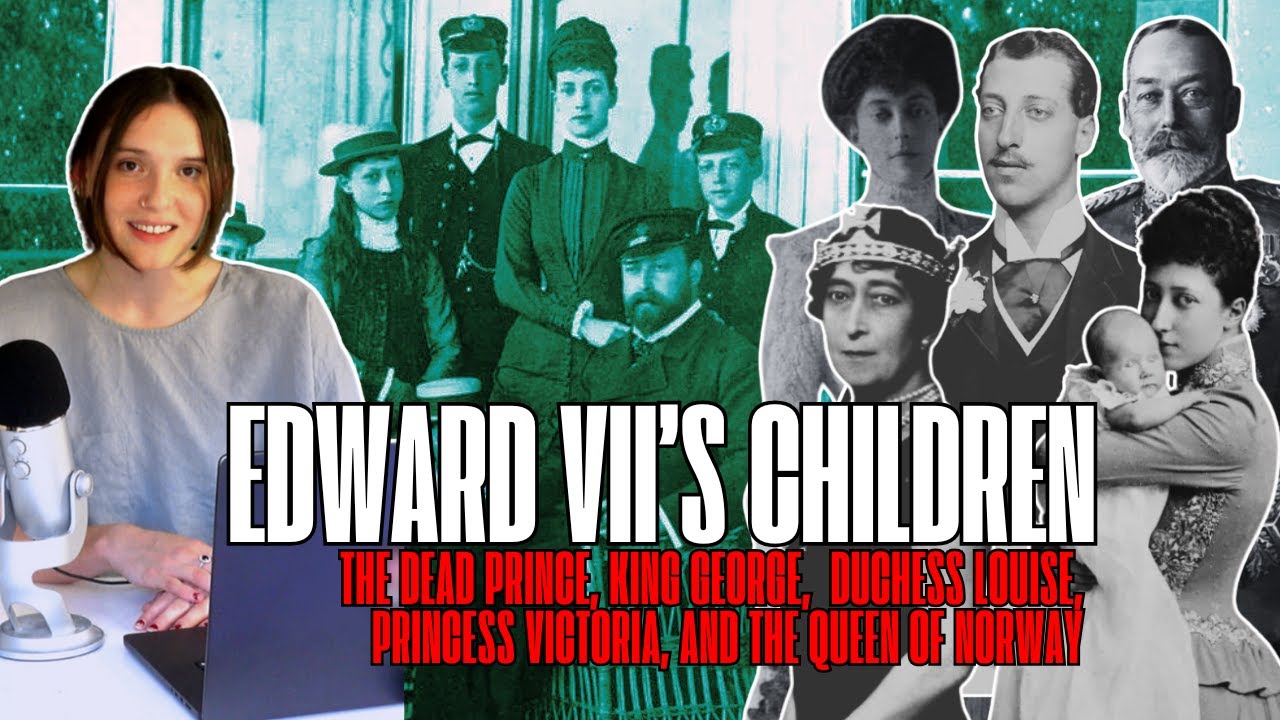
The 60-year tenure of the Prince of Wales produced six children for King Edward VII and Queen Alexandra, though Queen Victoria harbored serious doubts about her daughter-in-law’s ability to bear them. Worried about Alexandra’s slight frame and 22-inch waist, Victoria wrote to her eldest daughter expressing dread about the future children, given what she called the prince’s “small empty brain” and Alexandra’s small head. Despite the Queen’s fears, the couple had six children between 1864 and 1871, though only five survived infancy. The firstborn, Prince Albert Victor, arrived two months prematurely on January 8, 1864, at Osborne House.
Alexandra had been insisting on watching her husband play ice hockey that afternoon despite stomach pains, but the cold forced her to retire early, and she gave birth at 9 p. m. that night. Albert Victor and his younger brother George, born less than 17 months later, were educated together and later spent three years at sea, traveling to the Caribbean, South Africa, Australia, South America, and East Asia, where both brothers got tattoos during a visit to Japan.
Albert Victor never excelled academically. At Cambridge’s Trinity College, he was excused from examinations and lived alongside the university’s teachers rather than fellow undergraduates. In 1889, he proposed to Princess Alex of Hesse, who would later become Empress of Russia, but she refused, writing that they could not marry even though it grieved her to pain him. That same year, Albert Victor became implicated in the Cleveland Street scandal after a 15-year-old messenger boy confessed to working as a prostitute for aristocratic clients.
Although Albert Victor’s involvement was never substantiated, his trip to India amid the fallout raised suspicions, with The New York Times even arguing that the scandal should disqualify him from the throne and calling him a “stupid, perverse boy. ” The rumors would follow his memory for decades. Albert Victor found marital success when Princess Mary of Teck accepted his proposal on December 3, 1891. But before the wedding could take place, he fell ill with pneumonia and died in January 1892, less than a week after his 28th birthday.
His father wrote afterward that he would have gladly given his own life to save his beloved son. The second child, George, was born on June 3, 1865. Destined for military service as a second son, George joined the Navy after his brother went to Cambridge. A year after Albert Victor’s death, the new heir proposed to his dead brother’s fiancée.
George and Mary married in 1893 and were created Duke and Duchess of York. They had five sons and a daughter, including the future kings Edward VIII and George VI. George was crowned at Westminster Abbey on June 22, 1911. During the First World War, he made more than 450 visits to troops and, responding to anti-German sentiment, officially changed the family name from Saxe-Coburg and Gotha to Windsor.
After the war, his only official trips abroad were tours of the Belgian and French battlefields and a 1923 visit to Italy. In 1932 he delivered the first annual royal Christmas radio address. As his health declined in his final years, the royal physician Lord Dawson administered a fatal dose of morphine and cocaine to end the dying king’s life on January 20, 1936. Edward and Alexandra’s eldest daughter, Louise, was born on February 20, 1867.
She pursued acting, photography, and guitar lessons with the German virtuoso Katherina Pratton. In 1889, she asked Queen Victoria for permission to marry Alexander Duff, the sixth Earl Fife, insisting that if she could not marry him, she was sure she would die an old maid. Duff was the grandson of one of King William IV’s illegitimate daughters, making him Louise’s third cousin. Her aunt, also named Princess Louise, had set a precedent by marrying a British subject, so the Queen was easily convinced.
Princess Louise married Duff on July 27, 1889, and they set up residences in London and at Mar Lodge in Aberdeenshire, where Queen Victoria herself laid the foundation stone. They had two daughters: Princess Alexandra, born May 17, 1891, and Princess Maud, born April 3, 1893. In 1905, Louise was made Princess Royal by her father, succeeding her aunt Vicki, the former German Empress, who had died of cancer in 1901. At the end of 1911, Louise and her family were shipwrecked off the coast of Morocco during a trip to Egypt.
Louise and her daughters were thrown into the sea but escaped unharmed. It was likely as a result of the shipwreck that Duff contracted pleurisy, which killed him in less than a month. After her husband’s death, Louise lived a more private life, spending most of her time at Mar Lodge. Her health declined by 1925, and she died at her London home on January 4, 1931, at age 63.
The fourth child, Princess Victoria, was born July 6, 1868. She was educated at home, enjoyed horse riding, reading, dancing, and photography, and reportedly kept a tamed pigeon that she took on walks. Victoria never married, much to her mother’s satisfaction, and became Queen Alexandra’s most constant companion. Russian Grand Duchess Olga wrote that Queen Alexandra treated Victoria like a glorified maid.
Victoria spent nearly 60 years as her mother’s companion until Alexandra died in 1925. Afterward, Victoria lived at her Buckinghamshire home and called her brother King George every day. It was said that his attendance at Victoria’s funeral on December 7, 1935, hastened his own death, as the king died just a month later. The fifth surviving child, Maud, was born November 26, 1869.
Known as “Harry” to her family, likely in tribute to Admiral Henry Keppel and a testament to her supposed boyishness, she loved outdoor sports. During summers visiting her mother’s family in Denmark, Maud got to know her first cousin, Prince Carl of Denmark. Though there had been talk of Maud or her sister Victoria marrying another Danish prince, Christian, it was Carl who pursued her. They married on July 22, 1896, and Edward gave them Appleton House on the Sandringham estate.
Their only child, Prince Alexander, was born on July 2, 1903, seven years after their wedding. Maud’s life took an unexpected turn in 1905 when Norway’s 91-year-old union with Sweden was dissolved. Norwegian voters overwhelmingly backed the dissolution, and Sweden formally recognized Norwegian independence in October. A delegation traveled to Denmark to offer Prince Carl the Norwegian crown.
Carl agreed on the condition that he had the support of his potential subjects, and a second plebiscite saw more than three-quarters of voters choose a monarchy over a republic. Carl took the regnal name Haakon, his son was renamed Olaf, and the couple were crowned King and Queen of Norway on June 22, 1906. Maud’s 30-year queenship was marked by private support of charities, elegant fashion, and a fund in her name for those harmed by the First World War. Her final public appearance was at the coronation of her nephew, King George VI, in May 1937.
She fell ill during a visit to England the following year and died four days after surviving a stomach operation. Alexandra’s sixth and final pregnancy was different from the others. She was constantly tired, depressed, and had two significant falls. The 26-year-old went into premature labor, and the newborn was obviously weak.
The baby was hastily baptized Alexander John Charles Albert and died 24 hours after birth. Alexandra insisted on lying next to the dead child. The funeral took place on April 11, and it was agreed that because of Alexandra’s health, she could not risk having any more children.