The most brutal figures in American drug history are often remembered for their empires, their money, and their power. But a small group of kingpins crossed lines that even the streets considered sacred: they ordered hits on women, children, and even their own families. Court records verify the details of five such men, whose crimes range from the murder of a girlfriend to the drowning of infants. In the late 1980s, Aaron Jones ruled Philadelphia’s crack trade as the head of the Junior Black Mafia.
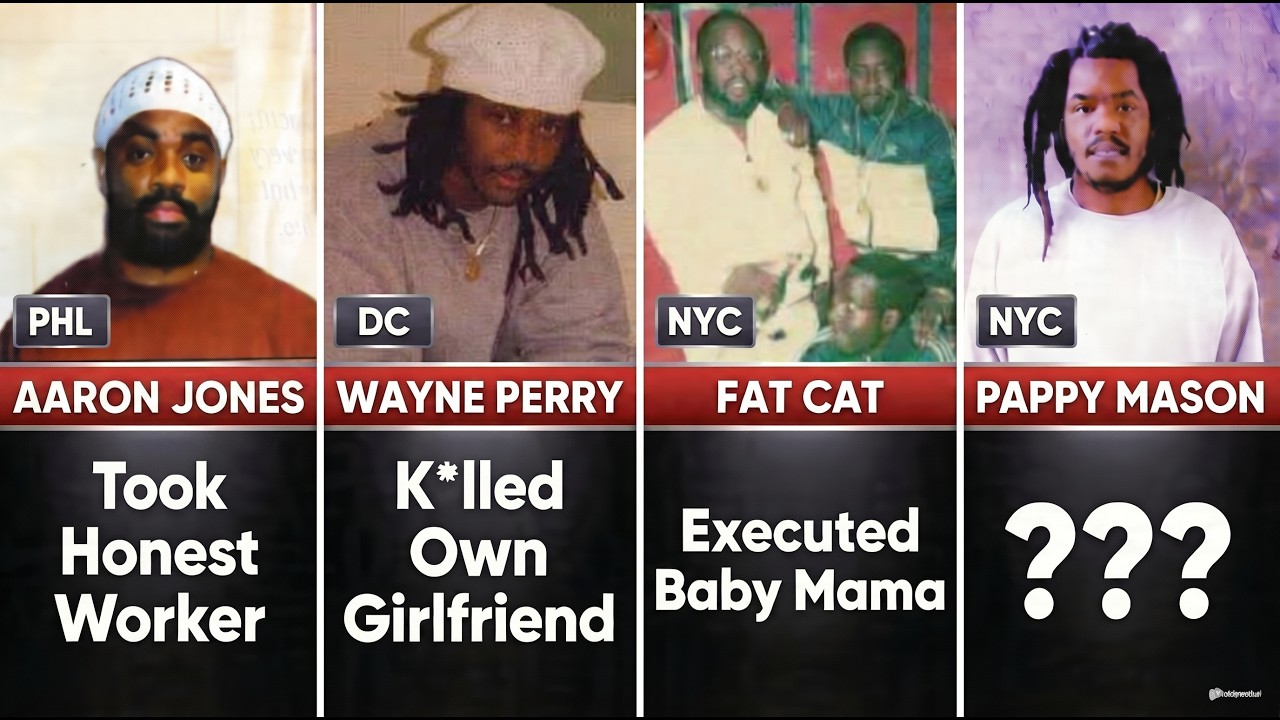
The organization’s slogan was “get down or lay down,” meaning sell for the JBM or die. At his peak, Jones earned hundreds of thousands of dollars a week and styled himself after Marlon Brando’s character in *The Godfather*. By 1990, Jones was in federal prison, yet he continued to run his organization from behind bars. When one of his top lieutenants was murdered, Jones was told that a rival named Brian “Moochie” Thornton was responsible.
Unable to reach Thornton, who was also incarcerated, Jones turned his attention to Thornton’s cousin, 26-year-old Bruce Kennedy, who ran a convenience store in West Philadelphia. Kennedy had made two mistakes in Jones’s eyes: he was related to a suspected rival, and he was dating Jones’s baby’s mother. On August 18, 1990, two hitmen entered Kennedy’s store, Mommy’s Market, and shot him more than a dozen times. One shooter stood over his body and fired three additional bullets into his head.
The younger shooter eventually testified against his co-defendants. Jones was sentenced to death and remains on death row in Pennsylvania today, his appeals still pending. In Washington, D. C.
, the crack era earned the city the grim nickname “Drama City” due to its record murder rate. One of its most feared figures was Wayne “Silk” Perry, the main enforcer for Alpo Martinez’s drug organization. *The Washington Post* later called Perry “the Michael Jordan of the murder game. ” He was indicted for eight murders tied to the Martinez ring.
Perry was known for killing without hesitation, even in broad daylight or in front of police. In 1984, as a teenager, he killed a man who had first shot at him, even though the shooting occurred directly in front of a parked police car. Convicted and sent to a violent youth prison, Perry continued killing after his release. His downfall began in October 1991, when he killed a D.
C. drug dealer. His girlfriend, Evelyn Carter, knew about the murder, and when police began investigating, Perry killed her to prevent her from testifying. After his arrest in 1992, he avoided the death penalty by testifying against his friend and boss, Alpo Martinez.
Perry was sentenced to life without parole at ADX Florence, the supermax prison in Colorado, where he remains. Martinez entered witness protection, a mutual betrayal of two men trying to survive. From his cell in a federal prison in 1987, Lorenzo “Fat Cat” Nichols ruled a $20 million-a-year drug operation in Queens, New York. He had a problem: his former girlfriend, 20-year-old Myrtle “Myesha” Horsham, the mother of his infant son, had been stealing from his organization.
Nichols ordered her killed. Two men hid in the backseat of a friend’s car, waiting for Myrtle. When she walked out of her mother’s house holding her baby, she was forced into the vehicle and driven to a dead-end street. Both Myrtle and her friend were shot at point-blank range.
Myrtle died; her friend survived. Hours later, the killers called Myrtle’s mother and told her to check her yard, where baby TC had been dumped. For each of the four hitmen, Nichols paid $5,000 and 125 grams of cocaine. Nichols pleaded guilty to ordering the murder in 1989 and was sentenced to 40 years.
He was released on parole in 2022 after serving 34 years. TC, now an adult, was raised by the grandmother who received that call. On February 26, 1988, 22-year-old rookie NYPD officer Edward Byrne was sitting alone in his patrol car, assigned to protect a Guyanese immigrant whose home had been firebombed twice after he reported drug activity. A car pulled up, and a man fired five bullets through the window, killing Byrne instantly.
The order had come from Pappy Mason, leader of a Queens drug crew called the Bibos. Mason was furious over an encounter ten days earlier, when a plainclothes officer told him to put his beer in a paper bag. Mason took the comment as a deep disrespect. Two days later, he was sent back to prison on an unrelated gun charge.
From his cell, he ordered the death of a cop—any cop—as a message. The four men hired for the hit were paid $8,000. They passed over a female officer and a Black officer, believing those killings would be seen as weak. They chose Byrne, a white rookie alone at 3:30 a.
m. Byrne had nothing to do with the beer incident and had never met Mason; he died because another cop had disrespected a drug dealer. The shooters received 25 years to life, while Mason received a federal life sentence in 1994. He remains in prison.
The worst case involved Ronald Harvey, who led a group of Philadelphia Black Mafia members to Washington, D. C. , on January 18, 1973. Their target was Hamaas Abdul Khaalis, leader of the Hanafi Muslim community, which occupied a house donated by basketball star Kareem Abdul-Jabbar.
Khaalis had enraged the Nation of Islam by sending letters calling Elijah Muhammad a fraud. Knocking on the door, the men claimed they wanted to purchase religious literature. Once inside, they announced a robbery. They shot Khaalis’s adult son and another relative.
They forced Khaalis’s wife to watch them drown two children in an upstairs bathtub. They then made her watch as they drowned her 9-day-old granddaughter in a kitchen sink. A 10-year-old boy was shot dead, and Khaalis’s adult daughter was shot in the head, surviving with permanent brain damage. Seven people were killed; five were children.
Harvey was convicted and sentenced to life in prison, dying behind bars in 1988. The tragedy did not end there. Four years later, Khaalis and armed followers stormed three D. C.
buildings, taking 149 hostages. His demand was to be given the men who murdered his family. During the 39-hour siege, a radio reporter was killed. Khaalis surrendered after three foreign ambassadors negotiated with him and died in prison in 2003.
The fates of these five men were sealed in concrete cells. Aaron Jones remains on death row in Pennsylvania. Wayne Perry is held in America’s most secure prison. Fat Cat Nichols was released on parole in 2022.
Pappy Mason, now 66, will die in federal prison. Ronald Harvey died in prison in 1988. Their victims’ families continue to live with the consequences. A child grew up motherless.
A father wore a black band on his police badge until retirement. Families still visit graves decades later. These are the men who did the unthinkable, and their legacies are written in the lives they destroyed.