The FBI once described Russell Bufalino as one of the most ruthless and powerful leaders of the Mafia in the United States. For 40 years, he ran one of the most quietly influential crime families in America from northeastern Pennsylvania, and almost nobody outside law enforcement knew his name. Bufalino was born in 1903 in Montedoro, Sicily, and came to the United States as a young boy. His family settled in the coal country of northeastern Pennsylvania, where Italian immigrant communities built tight-knit neighborhoods and the line between legitimate business and organized crime was often blurred.
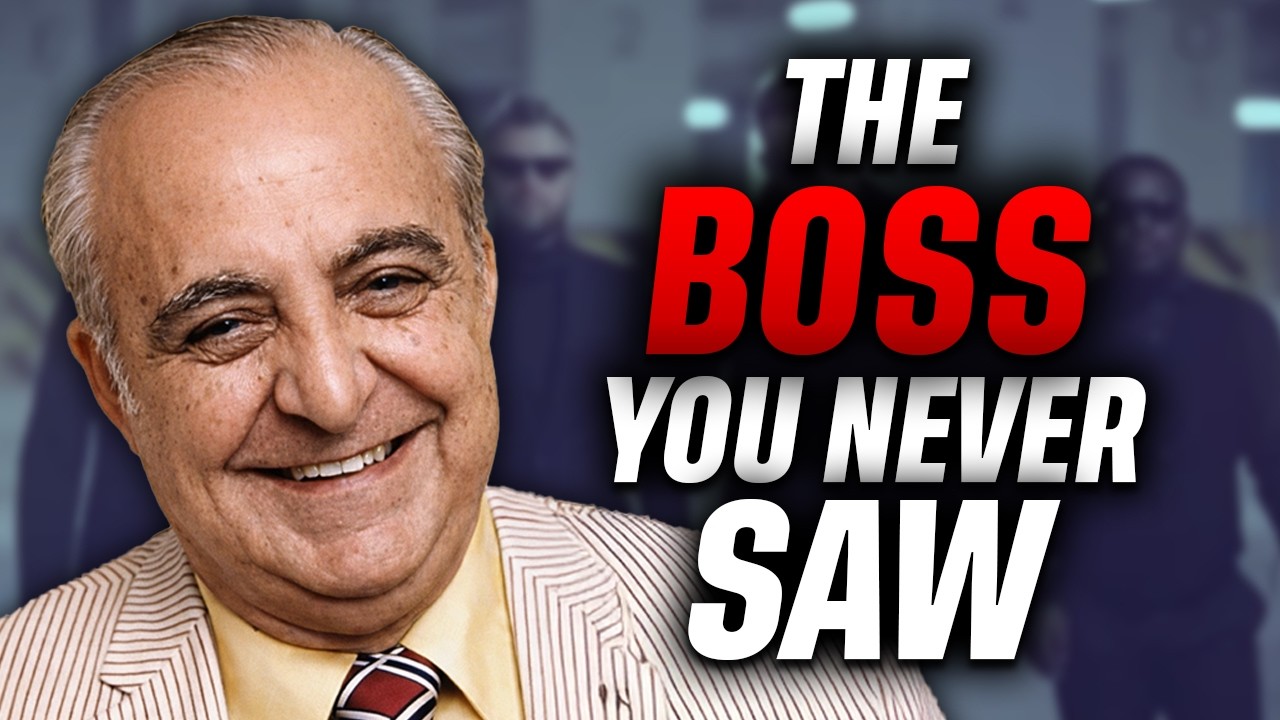
By his early adult years, Bufalino was already running with serious people. He had arrests dating back to the 1920s, including receiving stolen property and suspicion of murder, but the charges rarely stuck. He learned early that survival in his world depended not on being the loudest or most violent, but on being useful and solving problems. Bufalino took control of what became known as the Bufalino crime family in the early 1950s, following the death of his predecessor, Santo Volpe.
His operation was built on a deceptively ordinary foundation. He had interests in the garment and textile industry, a hand in the jewelry trade, vending machine operations, and a dress shop in Pittston. Behind those storefronts, the family controlled gambling, loan sharking, and labor racketeering across a wide swath of territory. On paper, the Bufalino family was never among the largest in America.
It did not have the numbers of the Gambinos or the territorial reach of the Chicago Outfit. But Bufalino had something more valuable than soldiers: respect. He had established relationships with mob families in New York, New Jersey, Philadelphia, Detroit, and beyond. When he picked up the phone, bosses took the call.
When he came to a meeting, men who commanded armies deferred to him. He was a fixer and a mediator, a man who could sit across from two bosses who wanted each other dead and walk both out of the room satisfied. In November 1957, Bufalino’s world collided with public attention in a way he had spent a lifetime avoiding. On November 14, New York State Police Sergeant Edgar Croswell noticed that the Park View Motel in the small town of Apalachin was fully booked in November.
He ran some license plates and found a connection to Joseph Barbara, a known organized crime figure with a large estate on the edge of town. The next day, Croswell drove past Barbara’s estate and saw it packed with expensive cars bearing plates from states across the country. He called for backup and set up roadblocks. What followed was one of the most embarrassing moments in the history of American organized crime.
Fifty-eight of the most powerful mob figures in the United States ran through the woods in their suits to escape. Vito Genovese was there, along with Carlo Gambino, Joe Profaci, Joseph Bonanno, Santo Trafficante, and bosses from Buffalo, Cleveland, and Detroit. Bufalino was found by police on a back road, out of breath, with burrs on his suit jacket. The FBI later concluded that he had played a central role in organizing the gathering.
The fallout was enormous. The Apalachin meeting disproved J. Edgar Hoover’s long-standing claim that there was no national organized crime syndicate. Congress launched investigations, and Robert Kennedy used the conference as ammunition to go after organized crime.
Bufalino was charged with conspiracy to obstruct justice for allegedly lying about the meeting’s purpose, though he beat the charge on appeal. Bufalino’s influence extended far beyond his family’s size. He had working relationships with the Genovese, Gambino, and Colombo families, deep connections into Detroit, ties into Florida, and a relationship with the Chicago Outfit. Law enforcement sources from the era described him consistently as the man other bosses came to when they could not solve a problem themselves.
The FBI also connected his organization to multiple murders. People who became problems for Bufalino had a way of becoming former problems very quickly. The most famous chapter of his story involves Jimmy Hoffa. Hoffa built the International Brotherhood of Teamsters into the most powerful union in America, representing over two million workers at its peak.
The union’s Central States Pension Fund held billions of dollars that the mob used as its personal lending institution. The relationship between Bufalino and Hoffa ran through Frank Sheeran, an Irish-American Teamsters official from Philadelphia who became one of Bufalino’s most trusted associates. By his own eventual admission, Sheeran was a killer who claimed to have committed dozens of murders on behalf of the mob. Hoffa went to prison in 1967 on jury tampering and fraud charges.
Richard Nixon commuted his sentence in 1971 on the condition that he stay out of union leadership until 1980. Hoffa immediately began campaigning to get that condition overturned so he could take back the Teamsters, something the mob and the current union leadership did not want. On July 30, 1975, Hoffa drove to the Machus Red Fox Restaurant in Bloomfield Township, Michigan, believing he was meeting with Anthony Giacalone of the Detroit mob and Anthony Provenzano, a New Jersey Teamsters official with mob ties. He was never seen again.
He was 52 years old. Sheeran claimed in his memoir, I Heard You Paint Houses, and in conversations before his death in 2003, that he personally picked Hoffa up that day, drove him to a house in Detroit, and shot him twice in the back of the head on Bufalino’s orders. That account is genuinely contested. The FBI investigated Sheeran’s claims and came away with conflicting conclusions.
DNA testing on a house Sheeran identified as the murder scene was inconclusive. What is not disputed is that Bufalino had both the motive and the authority to be involved in a decision of that magnitude. Hoffa was never found, and nobody was ever charged with his murder. The federal government had been trying to convict Bufalino since Apalachin.
For 20 years, it kept running into a wall because he was careful in ways most mob bosses were not. He did not make speeches or threats in public, did not conduct business on telephones he thought might be compromised, and did not put things in writing. In 1977, the government finally found an opening. Bufalino was convicted of extortion in a case centered on a plot involving stolen jewelry.
He was sentenced to four years in federal prison at age 74. In 1980, he was convicted of ordering the murder of a small-time criminal named Willie Medina, who had become a liability to his organization. The conviction added more years to his sentence. The government was also pursuing a separate track.
Because Bufalino had been born in Sicily, the Immigration and Naturalization Service had been pursuing deportation proceedings against him for decades. He fought the effort every step of the way. Bufalino was released from federal prison in the late 1980s, in his mid-80s. He went home to Pittston and returned to his quiet life.
He died on February 25, 1994, at age 90. Most of the world had no idea who he was. The Bufalino family largely declined after his death. Without his specific combination of relationships, reputation, and personal authority, the family lost its position as a power broker between larger organizations.
His story offers a study in how power actually operates. The loudest man in the room is rarely the most dangerous one. Russell Bufalino never needed to be the loudest man in the room.
He just needed to be there.