WASHINGTON — The American general who commanded the largest U. S. field army in Europe during World War II, led his troops across the Rhine at Remagen, closed the Ruhr Pocket and met the Red Army on the Elbe River, remains almost entirely unknown to the public he served — and historians say the silence surrounding Gen.
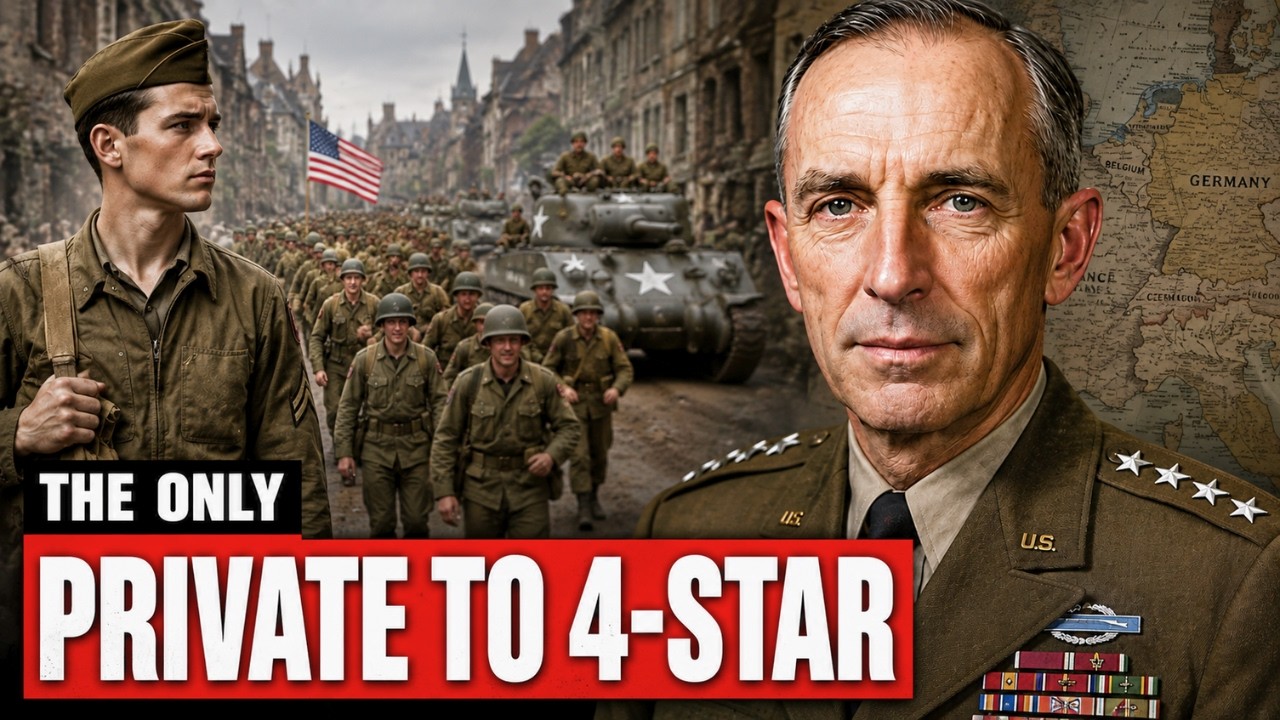 Courtney Hicks Hodges is one of the most striking oversights in modern military memory.
Hodges, who died in San Antonio, Texas, on Jan. 16, 1966, at age 79, was the only man in the history of the United States Army to rise from private to four-star general and command the largest fighting force in Europe. He is buried at Arlington National Cemetery, Section 2, Grave 198.
Almost nobody visits.
His story is one of the most extraordinary and least-told narratives of the Second World War, spanning 337 days of continuous combat from the beaches of Normandy to the shattered bridge at Torgau on the Elbe River, where American and Soviet soldiers shook hands on April 25, 1945, cutting Germany in two.
Born Jan. 5, 1887, in Perry, Georgia, Hodges was the son of a small-town newspaper publisher. He won a congressional appointment to West Point in 1904 and lasted almost exactly one year.
On June 17, 1905, the academy found him deficient in geometry and sent him home.
His classmate, George S. Patton Jr. , had also failed mathematics.
Patton came from money and connections and was permitted to repeat the year. The academy kept the rich boy and sent the newspaper editor’s son home. It was a verdict that would echo through four decades of American military history.
Hodges did not give up. He swept the floor of a grocery store in Cartersville, Georgia, for nearly a year. On Nov.
5, 1906, he enlisted in the United States Army as a private in Company L, 17th Infantry Regiment, at Fort McPherson, Georgia.
He rose to sergeant faster than anyone expected. In 1908, at the national marksmanship contest at Fort Niagara, New York, the former West Point reject took second place — one of the two best rifle shots in the entire United States Army, officers included.
In 1909, at the Presidio in San Francisco, Hodges passed the competitive examination for prospective officers, a narrow pathway that allowed enlisted men to earn commissions by pure merit. On Nov. 13, 1909, he was appointed a second lieutenant in the infantry.
He had arrived at the same destination as his West Point classmates through a different door, on his own two feet. He was 22 years old. He had been a private, a corporal and a sergeant.
He had swept floors and shined boots. Now he wore the shoulder bar of a lieutenant.
In the Philippines, he served alongside two other young lieutenants whose names meant nothing at the time: George Catlett Marshall, future Army chief of staff, and Henry Harley “Hap” Arnold, future commander of the Army Air Forces. Nobody in that officers’ mess could have imagined what they would all become.
In 1916, Hodges rode as a scout platoon leader under Brig. Gen. John Joseph Pershing in the Mexican desert, chasing Pancho Villa.
Riding the same dusty trails were Patton and William Hood Simpson, who would one day command the Ninth U. S. Army in Europe.
In France during World War I, Maj. Hodges crawled forward under German fire to the Meuse River alone, on his belly in the mud at night, looking for a place where his battalion could cross alive. He found it, organized a storming party and led an assault across a canal in the dark.
For 20 hours without stopping, without sleep, without food, Hodges kept attacking. By the end, he had gotten his men across the canal, across the Meuse and up onto the heights on the eastern bank. He received the Distinguished Service Cross, the Silver Star and the Bronze Star.
 Decades later, Dwight D. Eisenhower would note in a private letter to Marshall that Hodges held the Distinguished Service Cross for personal valor — something Eisenhower himself never held and never would. The supreme commander had never personally led an assault under fire.
Hodges had.
Between the wars, the Army shrank and Hodges reverted to major, where he stayed for 14 years. He would not make full colonel until 1938, nor pin on his first general’s star until 1940. He said nothing as lesser men were promoted around him.
In 1920, he returned to West Point as a tactics instructor — the first non-graduate of the academy ever to serve on its teaching faculty. He taught cadets who had passed the geometry exam he could not pass. He never once mentioned that the academy had thrown him out.
At Fort Benning, Georgia, under Marshall and alongside Col. Joseph “Vinegar Joe” Stilwell, Hodges helped push through adoption of the M1 Garand rifle, the standard steel helmet and the Jeep. Every GI who carried that rifle from Normandy to the Elbe owed something to his quiet work.
On Aug. 1, 1944, at exactly 0900 hours in a Normandy farmhouse, Omar Bradley formally handed command of the First United States Army to Courtney Hicks Hodges. He was 57 years old and inheriting nine divisions, three corps and roughly 250,000 American soldiers.
At peak strength, First Army would command 18 divisions. It was and would remain the largest American field army in the European theater — larger than Patton’s Third, larger than Simpson’s Ninth, larger than any American army in history up to that point. Its commander had started as a private.
His day began at 6:30 every morning with a staff meeting in a room full of maps. He never raised his voice. He made decisions quickly in a low voice and expected them carried out without argument.
He hated cameras, reporters and ceremony. He gave exactly one press conference in the entire war.
Several times a week he flew over the front lines himself in a tiny single-engine Piper Cub L-4, dropping to a few hundred feet to study the ground, the trees, the villages, the terrain his men were fighting through. He did not trust maps alone.
He was merciless with subordinates who failed to meet his standards, relieving 10 of 13 corps and division commanders who served under him — the highest relief rate of any American army commander in the war. Some reliefs were justified. A few were arguably premature.
On D-Day, June 6, 1944, First Army was the American assault force. Approximately 60,000 soldiers and 6,500 fighting vehicles hit Omaha and Utah beaches. By midnight, First Army casualties totaled roughly 6,283 men.
Omaha Beach alone cost approximately 2,400 casualties.
Then came the bocage — centuries-old hedgerows, earthen mounds 3 to 12 feet high, each field a fortress. In 17 days of intense combat, First Army suffered approximately 42,000 casualties for an advance of three miles. Nearly 6,000 casualties per mile.
Operation Cobra, launched July 25, 1944, dropped roughly 4,000 tons of bombs on a narrow rectangle of French farmland. The wind shifted and some American bombers dropped short on their own men. Lt.
Gen. Lesley J. McNair, 61, was killed.
His body was identified by the three-star insignia on his shoulder.
But the German Panzer Lehr Division was annihilated. By July 28, the Fourth Armored Division advanced 12 miles in a single day. Coutances fell, then Avranches on July 30.
 The army that had bled for seven miles in 17 days had, in 72 hours, torn the entire German front wide open.
Between Sept. 1 and Sept. 11, 1944, First Army advanced roughly 200 miles and trapped approximately 25,000 Germans in the Mons Pocket.
On Sept. 11, an American patrol from First Army crossed into Germany — the first Allied soldiers to set foot on German soil in the war.
The Battle of Aachen, Oct. 2 through 21, 1944, saw the first German city fall to the Allies after 10 days of savage house-to-house combat. American casualties totaled approximately 5,000 to 7,000.
Eighty-five percent of Aachen was destroyed.
Then came the Hürtgen Forest — 88 days, from Sept. 19 to Dec. 16, 1944, the longest single battle fought on German soil in the entire Second World War.
Total American casualties reached at least 33,000 men, with upper estimates near 55,000, for ground many historians argue should have been bypassed entirely.
Hodges personally overruled Maj. Gen. Norman Cota, the hero of Omaha Beach, when Cota warned that the attack plan into the Hürtgen was inadvisable.
Cota’s 28th Infantry Division suffered 6,184 casualties with almost no ground gained. When a man who stormed Omaha tells you an attack is a mistake, you own the consequences.
On Dec. 16, 1944, 25 German divisions slammed into the Ardennes. Before noon, Hodges ordered two of the most consequential moves of the Battle of the Bulge: the 101st Airborne Division to Bastogne and the 7th Armored Division to St.
Vith. Both units reached their positions in time because Hodges acted before the panic set in.
On Dec. 25, Eisenhower transferred temporary command of First and Ninth Armies to British Field Marshal Bernard Law Montgomery. Montgomery asked Eisenhower for permission to relieve Hodges of command.
Eisenhower refused, writing that Hodges was “the quiet, reticent type who does not appear as aggressive as he really is.”
Hodges came down with serious influenza and exhaustion. For days, much of the actual command work fell to his chief of staff, Maj. Gen.
William Benjamin Kean. But the decisions that saved First Army — Bastogne, St. Vith, the fuel dump prepared for demolition, the headquarters moved to Liège — were Hodges’ calls, and they were the right calls.
On the northern shoulder, the 2nd and 99th Infantry Divisions held Elsenborn Ridge against the 6th SS Panzer Army and did not give up an inch of ground that mattered. John Eisenhower, son of the supreme commander, later called the defense of Elsenborn Ridge the single most decisive action of the entire Ardennes campaign.
On March 7, 1945, a task force from the 9th Armored Division came around the slopes above Remagen and saw a bridge across the Rhine still standing. German engineers set off demolition charges. The bridge shook, chunks of steel fell — but it did not fall.
A second charge failed to detonate.
Lt. Karl Heinrich Timmermann, 27, ordered his men to run. They crossed a thousand feet of open steel decking under German fire.
Sgt. Alexander Andrew Drabik, 35, of Holland, Ohio, was the first American to reach the far side. Within hours, an entire American bridgehead was forming on the east bank.
Hodges did not hesitate. He ordered every available unit across immediately. Bradley’s response was two words: “Hot dog.”
When word reached Eisenhower, he said the bridge was worth its weight in gold. Over the next 10 days, 25,000 American troops, tanks and artillery pieces crossed the Rhine at Remagen.
By April 1, 1945, First Army and Ninth Army met at Lippstadt, closing the Ruhr Pocket — the largest encirclement on the western front. Approximately 317,000 German troops surrendered. Field Marshal Walter Model walked into a forest near Duisburg on April 21 and shot himself.

On April 15, 1945, an aide handed Hodges a set of shoulder insignia: four silver stars. He was 58 years old. He had been a private in the United States Army for two years and eight days.
He was one of only two men in the entire history of the Army to make that climb. The other was Walter Krueger.
Ten days later, on April 25, 1945, Lt. William D. Robertson of the 69th Infantry Division walked onto the wreckage of a bombed-out bridge over the Elbe at Torgau.
Coming from the other side was Soviet Lt. Alexander Silvashko, 22, of Belarus. They shook hands over the ruin.
Germany was cut in two.
First Army fought for 337 days of continuous combat from D-Day to VE Day. Total medical admissions exceeded 365,000. American soldiers wounded: 164,174.
Combat psychiatric casualties: 34,048. Non-battle injuries: 51,410. First Army advanced more than 600 miles and captured the first German city.
Patton’s Third Army fought for 281 days — 56 fewer than First Army. Hodges was present at the German surrender at Reims and the Japanese surrender aboard the USS Missouri in Tokyo Bay, the only American army commander of the European theater in attendance at both ceremonies.
Both Marshall and Eisenhower recommended Hodges to lead the American ground forces for Operation Coronet, the planned invasion of Japan. MacArthur accepted him. The atomic bombs ended the war before the invasion could happen.
Hodges retired in 1949 after 43 years of service. Bradley, in his best-selling memoir “A Soldier’s Story,” described Hodges as “a spare, soft-voiced Georgian without temper, rumor, or visible emotion” and “a military technician” — a craftsman, not a hero. Then Bradley wrote that “no other leader and no other armed force unit in World War II is entitled to credit than that which belongs to the quiet, modest General Courtney Hodges and his First Army.”
Bradley collected the credit himself. His book sold hundreds of thousands of copies. Hodges never wrote one.
Eisenhower saw the injustice, complained privately that Hodges was “not getting credit in the United States for his great work,” and did nothing to fix it.
Hodges died in San Antonio on Jan. 16, 1966. His obituary in The New York Times was three columns wide but ran on an inside page.
He is buried at Arlington National Cemetery, Section 2, Grave 198, near the top of a slope, under old trees, where there are no crowds and no honor guards changing every half hour.
There is a diary kept during the war by Maj. William C. Sylvan, Hodges’ aide, published in 2008 as “Normandy to Victory.”
It sits in the stacks of university libraries. Almost nobody reads it. A biography by scholar Stefan Wisniewski, published in 2006, has not sold in 20 years what a Patton biography sells in a single year.
The lesson goes beyond Courtney Hodges. The loudest voice gets the credit. The person who puts their head down and does the work, who believes the results will speak for themselves, gets overlooked.
Hodges believed the results would speak. They did not speak, because results never speak for themselves. Somebody has to speak for them.
He rose from private to four-star general. He led the largest American army in Europe. He was at the German surrender at Reims and the Japanese surrender aboard the Missouri.
He was chosen by MacArthur to lead the invasion of Japan. And now, at least, you know his name.