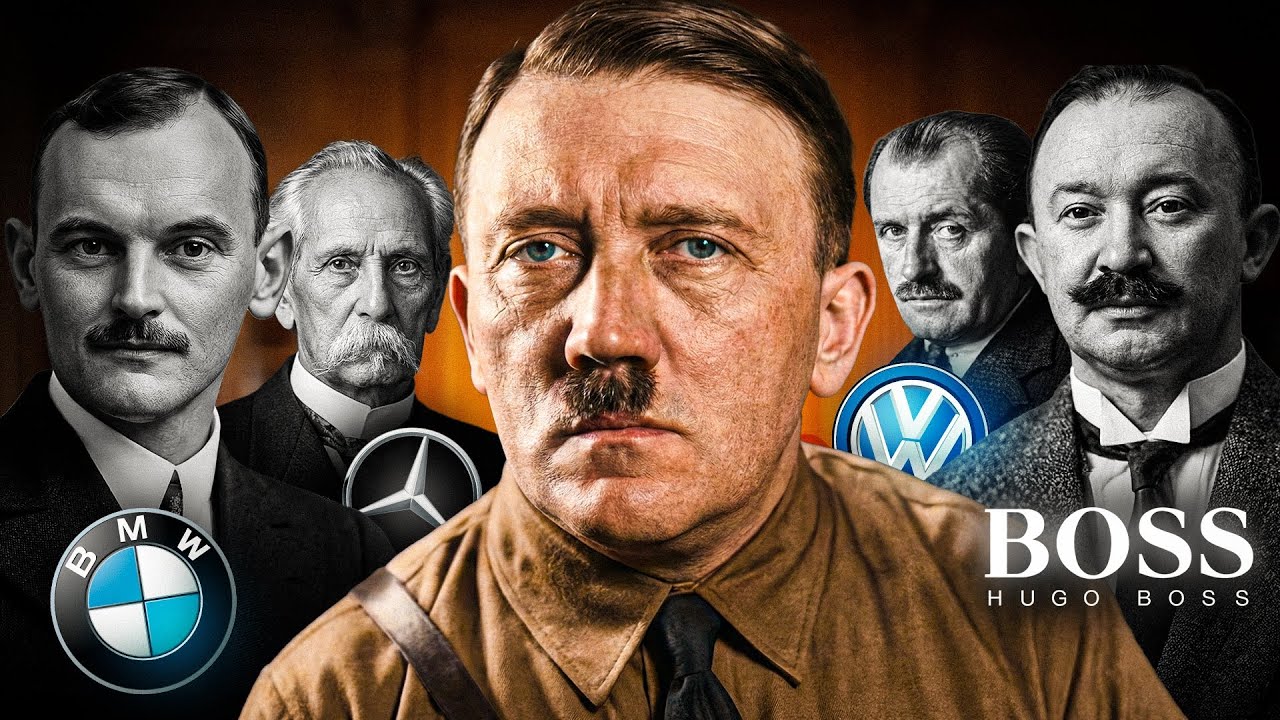
BMW, Volkswagen, Hugo Boss, and BASF, Bayer, and Hoechst are among the best-known names in global industry and fashion today. But their rise to prominence was preceded by a dark chapter in the 1930s and 1940s, when their predecessors built vehicles, engines, uniforms, and chemicals for the Third Reich. While one corporate giant, IG Farben, was so deeply tied to the Nazi regime that it did not survive the war, other companies managed to rebuild, reinvent, and eventually become global icons. IG Farben was formed in 1925 when several major chemical producers merged into one Frankfurt-based conglomerate.
Under leaders like Carl Bosch and Carl Krauch, it quickly became one of the world’s largest industrial groups. By the mid-1930s, IG Farben was already tied to state rearmament, investing heavily in synthetic fuel and rubber, products Germany saw as vital for future conflict. When the regime announced its Four Year Plan in 1936, IG Farben expanded further, signing contracts to build facilities in strategic locations. These plants aimed to reduce dependence on imported oil and rubber, giving Germany more freedom in military planning.
Historians still debate what motivated the company, whether it acted mainly for profit or pursued a deeper ideological partnership. What is clear is that its growth was tightly connected to state priorities. The company’s most controversial project began in 1941, the synthetic rubber plant at Monowitz, near the Auschwitz complex. Construction moved at extraordinary speed.
The site needed thousands of workers, and labor shortages led to coerced labor being brought in by state authorities. Surviving documents from the Nuremberg trials, including transport lists, work assignments, and internal correspondence, show how closely the company’s operations were linked to wartime planning. IG Farben also held significant shares and board influence in Degesch, a subsidiary that manufactured Zyklon B. Originally developed as a pesticide, it became the poison used in the gas chambers at Auschwitz and other camps.
Nuremberg trial records examined correspondence, supply contracts, and management oversight connected to these subsidiaries. Historians still debate how much direct control IG Farben exercised, but the documented links became a major focus of postwar legal scrutiny. As the war turned against Germany in 1943 and 1944, IG Farben kept operating across dozens of sites. Many suffered bomb damage, while others were evacuated or abandoned as Allied forces advanced.
By May 1945, company leadership tried to preserve records and reorganize assets, but Allied authorities quickly took control. The US military government saw the conglomerate as too large and too tied to the war economy to survive intact. This assessment led to the 1947–48 IG Farben trial, one of twelve Nuremberg follow-on trials. Twenty-three executives faced charges of plunder, exploitation, and involvement in forced labor.
The court examined thousands of documents, memoranda, and testimonies. Sentences varied widely, ranging from acquittals to prison terms of up to eight years. In 1950, Allied authorities ordered IG Farben’s formal breakup. By 1952, three successor firms, BASF, Bayer, and Hoechst, had emerged.
Each inherited different assets, but none carried on IG Farben’s wartime structure. Over the following decades, these companies became global chemical and pharmaceutical leaders. They also funded compensation initiatives and opened archives, acknowledging the need to examine IG Farben’s role between 1933 and 1945. IG Farben itself continued on paper for decades, managing remaining claims.
Its legacy remains one of the clearest examples of how deeply industry and state became intertwined during the war and how the postwar world tried to respond. While IG Farben disappeared entirely, other companies survived and transformed. One of them was Volkswagen. Volkswagen began as a political idea.
In May 1937, the German Labor Front founded the company to build an affordable people’s car. A new factory rose at Fallersleben, chosen for its rail links and skilled workforce. Ferdinand Porsche led the design of a compact, low-cost vehicle. Promotional campaigns framed it as proof that modern industry could serve national goals.
Buyers paid into a savings scheme, promised a car once production reached full scale. Those civilian plans never materialized. When war began on September 1st, 1939, the factory shifted to military production. Volkswagen built the Kübelwagen, a light utility vehicle used across multiple fronts, and the amphibious Schwimmwagen.
It also produced aircraft parts and components for V-1 weapons. Production expanded quickly, and demand surged after Germany invaded the Soviet Union in June 1941. Labor shortages soon became critical. Company records confirm Volkswagen relied heavily on coerced labor.
Workers came from occupied countries, assigned across the factory complex under wartime regulations rather than normal employment rules. Everything changed in 1945. When British forces arrived in April, much of the factory lay damaged from air raids. Yet, the British military government saw potential.
Major Ivan Hirst, an officer with engineering experience, took charge. He repaired machinery, cleared unexploded ordnance, and persuaded local authorities to restart production. By late 1945, the first postwar Beetles rolled off the line to supply occupation forces. Revival was not guaranteed.
The company faced questions about ownership, assets, and its wartime role. But the British chose to rebuild rather than dismantle. In 1949, control passed to the government of Lower Saxony. Production climbed rapidly as West Germany’s economy boomed.
By the mid-1950s, the Beetle had become a global export, and Volkswagen one of the world’s most recognizable car brands. In the decades that followed, historians examined Volkswagen’s wartime record more closely. Company-commissioned studies in the 1990s documented the use of coerced labor. In 2000, Volkswagen joined other German firms in the Remembrance, Responsibility, and Future Foundation to compensate former forced laborers, part of a broader national reckoning with industrial responsibility.
By then, Volkswagen had grown far beyond its 1937 origins, becoming an international group with multiple brands and a reputation shaped more by engineering than early history. Yet its past remains part of public memory. BMW and Daimler Benz entered the 1930s as established engineering firms. BMW, based in Munich, focused on engines and precision manufacturing.
Daimler Benz, in Stuttgart, produced commercial vehicles, luxury cars, and military engines. As Germany rearmed, both expanded rapidly. When war began in September 1939, military demand surged. BMW became a key aircraft engine supplier.
The BMW 801 powered much of the German Air Force. Daimler Benz played a parallel role, producing engines, trucks, and components supporting military mobility across multiple fronts. The Mercedes-Benz 770 served as the official car for senior political leaders. Daimler Benz also supplied parts for weapons manufacturing, including components for infantry rifles.
As Germany expanded its wartime commitments, labor shortages intensified. By 1941, both companies relied heavily on coerced labor from occupied territories, assigned through state authorities. Production peaked in 1943 and 1944. BMW’s engine facilities ran at maximum capacity.
Daimler Benz operated multiple sites producing for the Army, Air Force, and Navy. Air raids caused heavy damage, forcing emergency relocations and the creation of satellite facilities. Germany’s defeat brought immediate consequences. BMW’s factories lay heavily damaged.
Allied authorities banned the company from making vehicles or aircraft. To survive, BMW made pots, pans, and bicycles. By 1948, it restarted motorcycle production. In 1952, it returned to cars with the BMW 501.
The Isetta microcar followed in 1955, but long-term financial troubles persisted. By 1959, BMW faced absorption by Daimler Benz. The turning point came from the Quandt family. Herbert and Harald Quandt provided the funding to keep BMW independent.
Their father, Günther Quandt, had been a prominent industrialist whose wartime enterprises were later studied for their use of coerced labor. Those companies were not connected to BMW during the war, but the family’s postwar wealth shaped BMW’s ability to rebuild. Herbert Quandt’s 1959 investment became a defining moment, enabling the growth that followed. Daimler Benz, though also damaged, emerged with more intact facilities and recovered faster.
Like BMW, it later acknowledged its wartime involvement and supported compensation initiatives. As West Germany’s economy recovered, Daimler Benz expanded internationally and cemented its position as a leading manufacturer. Today, BMW and Mercedes-Benz Group operate as global leaders in automotive design and technology. Their histories show how industrial giants adapted to wartime demands, faced postwar collapse, and rebuilt into international companies.
One textile company faced a different kind of scrutiny. Its wartime contracts would follow it long after the war ended. Hugo Ferdinand Boss opened his textile workshop in Metzingen in 1924. By the early 1930s, the business was struggling, and in 1931, Boss declared bankruptcy.
That same year, he joined the Nazi Party, a decision that coincided with efforts to secure new contracts. As Germany rearmed, uniform production offered stability for manufacturers who could meet official standards. In 1932, the black SS uniform designed by Karl Diebitsch and Walter Heck was adopted. Hugo Boss became one of several licensed firms producing it.
Throughout the mid-1930s, the company manufactured uniforms for the SS, SA, and Hitler Youth. These orders transformed the struggling workshop into a mid-size manufacturer. Government contracts offered predictability that civilian markets could not. Like many wartime factories, the Boss company relied on coerced laborers assigned by authorities.
Historical studies describe around 140 laborers working at the factory by 1944, mostly women from Poland, along with 40 French prisoners of war placed under regulated conditions to meet rising demand. After Germany’s defeat, Hugo Boss faced denazification proceedings. The initial classification labeled him as an activist, supporter, and beneficiary, the second highest category of culpability. He received a fine of 100,000 reichsmarks and lost his voting rights and his right to run a business.
On appeal, his status dropped to Mitläufer, or fellow traveler. The fine was reduced, but the practical effect remained. Boss could no longer direct the company. He died in 1948, just months after the appeal.
Control passed to his son-in-law, Eugen Holy. The shift from uniforms to menswear took years. In the late 1940s and early 1950s, the company focused on workwear, adapting to material shortages. Gradually, Hugo Boss moved toward tailored suits.
By the 1970s and 1980s, the company had repositioned itself as a premium menswear brand, expanding internationally through licensing deals and sponsorships. Then in 1997, Hugo Boss’s name appeared on a list of dormant accounts released by Swiss bankers, prompting the company to confront the full extent of its founder’s Nazi ties. In 1999, US lawyers acting on behalf of Holocaust survivors started legal proceedings over the use of forced labor. Hugo Boss commissioned historian Roman Köster to investigate.
In 2011, the company published his findings and issued a formal apology, expressing profound regret to those who suffered harm or hardship under its wartime operations. By the time Hugo Boss emerged as a global fashion label, it had traveled far from the small workshop dependent on government contracts. Yet its history remains important for understanding how companies navigated economic pressure, political alignment, and postwar accountability.