
Nearly every P-51 Mustang flown by the legendary Tuskegee Airmen was melted down for scrap after World War II, but one surviving Red Tail still roars through American skies, and the story of how it got there is forcing a new generation to confront what the country tried to erase.
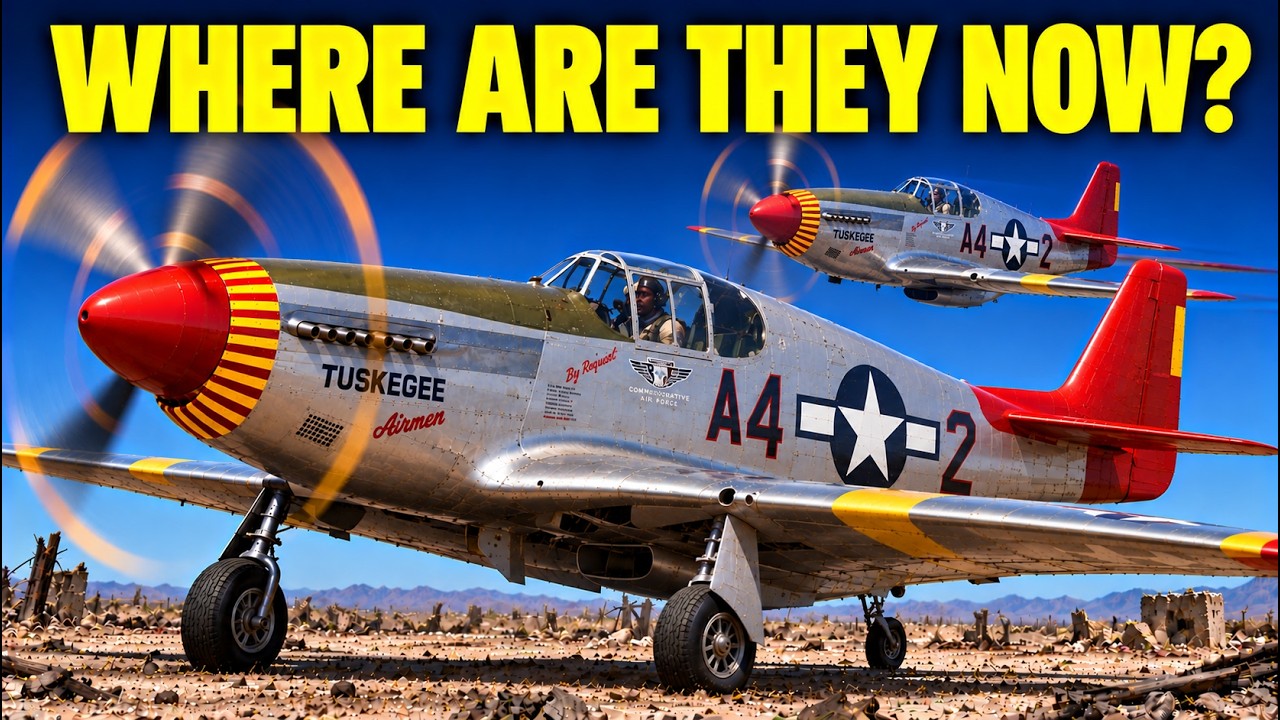
The aircraft that escorted American bombers over Nazi Germany, the planes whose red-painted tails became a symbol of protection for thousands of airmen, were declared surplus within months of the war’s end. They were reduced to aluminum ingots. The country that built them had no further use for them.
Almost none survived. That is the part of the Tuskegee story most Americans have never heard.
The military told black Americans they could not fly combat aircraft. It was not an assumption whispered in back rooms. It was written policy.
In 1941, the United States Army Air Corps formally held that black service members were unsuited to the complex judgment required in combat aviation.
The military was segregated in every meaningful way. Separate barracks. Separate dining facilities.
Black servicemen were kept from the roles that carried the most risk and the most honor.
Civil rights organizations fought back for years. The pressure eventually forced the War Department into what it called an experiment. A unit of black pilots would be trained at Tuskegee, Alabama.
The expectation in the rooms where that decision was made was that it would fail.
It did not fail. It produced one of the most decorated fighter groups in American military history.
In April 1941, before the program had fully begun, First Lady Eleanor Roosevelt visited Tuskegee Army Airfield. She asked the chief flight instructor, Charles Anderson, to take her up. Her Secret Service detail objected.
She went anyway.
Photographs of Roosevelt airborne over Alabama with Anderson at the controls were published across the country. She told reporters she had always heard black people could not fly. Now she knew differently.
A letter from the White House soon followed, suggesting the program deserved proper support.
The first class graduated in March 1942. Five men received their wings. By the time the program ended, nearly a thousand pilots had been trained.
The washout rate was high. Standards were deliberately set higher than at white training programs. The men who cleared them knew exactly how many people had expected them to fail.
They formed the 99th Fighter Squadron, then the larger 332nd Fighter Group, commanded by Benjamin O. Davis Jr. Davis had graduated from West Point in 1936, 35th in a class of 278.
In four years at the academy, not one white cadet spoke to him. He learned to make silence work for him.
The 332nd deployed to the Mediterranean, flying P-40 Warhawks and then P-47 Thunderbolts. In 1944, they received the P-51 Mustang, one of the finest long-range fighters America had built. It had the range to fly from Italy deep into Germany and return.
It had the speed to match the latest German fighters. It had the ceiling to reach bombers under attack above 30,000 feet.

Handing that aircraft to the 332nd was a statement, even if the Army never described it that way. The men who received it understood.
They painted their tails red. The markings became unmistakable. Bomber crews could see them from miles away and know exactly who was coming.
Their reputation grew because they stayed with the bombers instead of breaking formation to chase enemy fighters. Other escort units hunted kills and left the formations unprotected. The 332nd held position.
They gave up personal victory counts to stay on the wing.
Bomber crews noticed. They talked. The word spread across the bases.
Crews began requesting the Red Tails specifically, not by unit number, by the color.
The Tuskegee Airmen flew thousands of combat sorties across the Mediterranean and Europe, including missions against the heavily defended oil fields of Ploesti and aircraft factories inside Germany. Those missions required eight hours in a single-seat fighter with no autopilot and no heated cockpit above 30,000 feet, with enough fuel left to fight and get home.
In March 1945, a pilot named Roscoe Brown spotted a German ME 262, the Luftwaffe’s revolutionary jet fighter, climbing after a bombing run. He shot it down. He was 24 years old.
A pilot named Lee Archer shot down four confirmed enemy aircraft. His fellow pilots credited him with a fifth, which would have made him the only black ace of World War II. The official record listed four.
Archer said for five decades that the fifth was real. He was not bitter about it. He had other things to point to.
Among the men who flew with the 332nd was Daniel “Chappie” James Jr. of Pensacola, Florida. He flew combat missions over Europe, then in Korea and Vietnam.
In 1975, he became the first black four-star general in the history of the United States military. He died in 1978, weeks after retiring.
The 332nd flew its last combat mission in April 1945. Germany was weeks from surrender. The men who had been told they would fail had been proving otherwise for two years.
They earned 150 Distinguished Flying Crosses. Sixty-six pilots were killed in action. Thirty-two were captured and held as prisoners of war.
Then they came home.
They returned to the same country they had left. Segregated buses. Segregated lunch counters.
Whites-only facilities in the railway stations they passed through. Some were still in uniform when they were told to move to a different seat, use a different door, wait in a different room.

At Freeman Field in Indiana in the spring of 1945, more than 100 black officers were arrested for attempting to use a whites-only officers club on their own base. They had been fighting for the country that was arresting them for sitting at a bar. The charges were eventually dropped.
The policy did not change immediately.
The military did not desegregate until 1948, when President Truman signed Executive Order 9981. What the Tuskegee Airmen accomplished in the air made that order harder to resist. The evidence was documented.
The combat record existed. It could not be argued away.
Benjamin O. Davis Jr. continued his career in the newly independent United States Air Force.
He became its first black general officer. In 1998, more than 50 years after commanding the 332nd, he was promoted to four-star general. He died in 2002 at 89.
Most people assume that is where the story ends. It is not, because there is still the question of what happened to the aircraft.
When the war ended, the P-51 Mustangs of the 332nd Fighter Group were not preserved. They were not restored. They were not flown home for display.
The military surplus of a world at war was enormous beyond any peacetime accounting.
Aircraft by the thousands were declared surplus and sent to scrapyards. The red-tail P-51s that had flown escort over Germany and Romania and the Adriatic Sea were reduced to aluminum and melted down. Aircraft essential six months earlier were suddenly worth nothing as machines.
The men who flew them came home to find themselves in roughly the same position. The aircraft did not survive. The men did.
The record did. But the specific planes, the ones with the red tails that bomber crews watched for in the sky above them, those were gone.
For decades, so was much of the story. The Tuskegee Airmen were left out of histories of the air war over Europe. Books were published.
Documentaries were made. Museums opened exhibits about American air power in World War II. The 332nd was frequently missing or reduced to a footnote.
The men who had flown to Berlin and back were still alive and watching it happen.
In the 1990s, filmmaker George Lucas decided he wanted to make a film about the Tuskegee Airmen. He brought the project to every major Hollywood studio. He was told repeatedly that a film with an all-black cast would not find an audience, that it was too much of a risk.
He was told this for more than two decades.
He eventually made it himself, financing it with roughly $58 million of his own money. “Red Tails” was released in January 2012. Critics noted its flaws, but it put the story in front of an audience that had grown up without knowing it and introduced the Red Tail to a generation that had never heard the name.
What exists today in terms of the actual aircraft was built by people who believed the planes should not be the last word. One genuine World War II P-51C survived. It had served as a trainer during the war rather than as one of the 332nd’s combat aircraft.
 Decades later, it was restored in Tuskegee Airmen markings by the Commemorative Air Force. The work took years. The result is an aircraft that flies.
At air shows across the United States, a red-tailed P-51 climbs and banks and comes low over the runway. The sound is the Merlin engine that powered the original aircraft. The silhouette against the sky is what bomber crews saw when the escorts arrived on their wing over Germany in 1944.
The National Museum of the United States Air Force at Wright-Patterson Air Force Base in Dayton, Ohio, displays a P-51D in Tuskegee Airmen markings. Visitors can stand next to it and look at the red tail from two feet away.
The Tuskegee Airmen National Historic Site at Moton Field in Tuskegee, Alabama, is where the program began. The hangars where the men trained are still standing. The field is still there.
In 2007, the surviving Tuskegee Airmen were awarded the Congressional Gold Medal, the highest civilian honor Congress can give. Many came to Washington to receive it. Some were in wheelchairs.
Some walked with canes. They had waited more than 60 years. President Bush shook their hands.
The men who had been arrested at their own base for sitting at a bar sat in the United States Capitol and received a gold medal from the country that had once built a policy around the belief that they could not fly.
Charles McGee flew combat missions in World War II, Korea, and Vietnam. By the time his flying career ended, he had logged more than 6,300 flight hours and 409 combat missions across three wars. He lived past 100.
He gave interviews in his final years that were quiet and direct in the way of a man who had spent his whole life being quiet and direct in the face of things designed to stop him. He died in January 2022 at 102.
The story of the Tuskegee Airmen is taught in schools now. Their photographs are in museums. Their names are on buildings and scholarships and programs designed to bring more people into aviation.
All of that came after. None of it was given. It was accumulated slowly over decades by people who refused to let the record disappear.
The aircraft they flew over Europe are gone. Scrapped. Returned to raw material.
What remains is the record of what those aircraft did, the men who flew them, and a handful of restored planes that carry the paint and the markings back into the air.
There is a building in Dayton, Ohio, where anyone can stand next to a P-51 with a red tail and look at it for as long as they want. There is an airfield in Tuskegee, Alabama, where the hangars are still standing from the time when men who had been told they would fail arrived and began to prove otherwise.
And somewhere above the United States every summer, a P-51 Mustang with a red tail is climbing at an air show. The color was chosen to be unmistakable so that bomber crews could see it coming from miles away and know the escorts had arrived and were staying.
After 80 years, you still know what it means the moment you see it. That was always the point.