
In the frozen darkness of the Ardennes forest, as American soldiers shivered in foxholes and Allied commanders toasted what they believed was the imminent collapse of Nazi Germany, a quiet intelligence officer with ink-stained fingers and thick glasses saw what no one else dared to see: the largest German counteroffensive of the war massing directly in front of them.
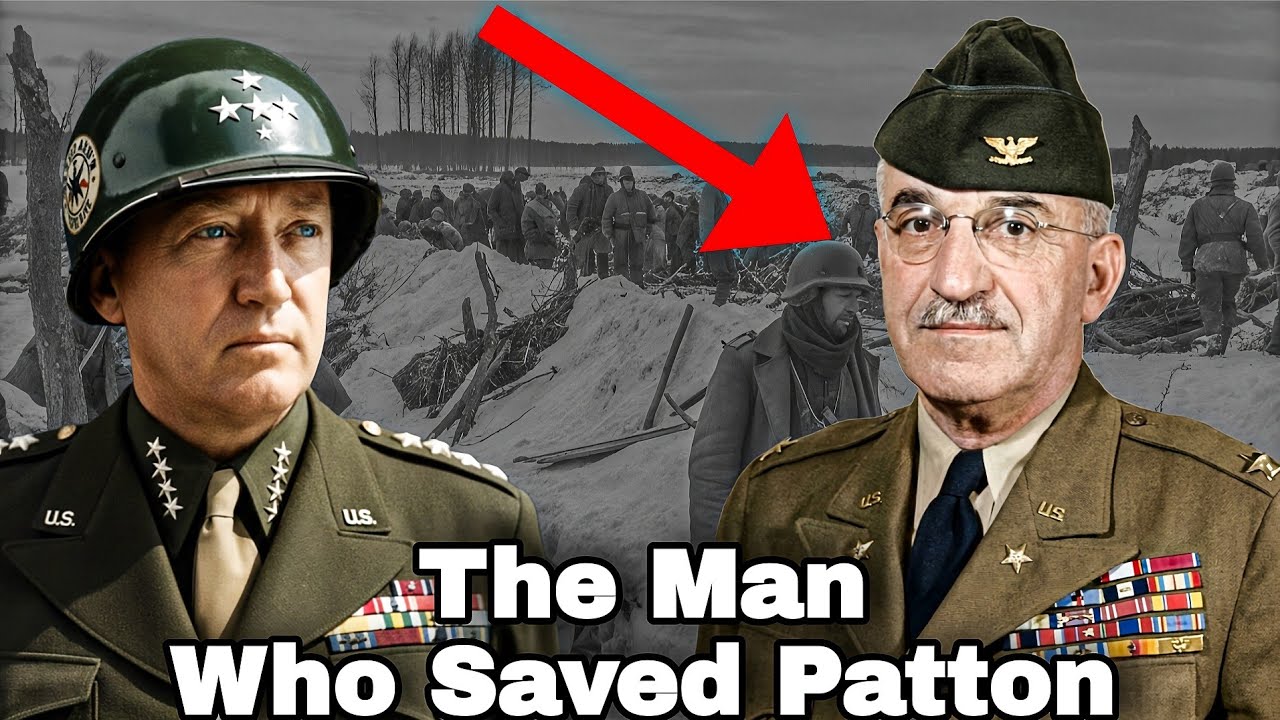
Colonel Oscar Koch, chief of intelligence for General George S. Patton’s Third Army, stood alone before a wall-sized situation map in a dimly lit room in eastern France, tracking the disappearance of elite German armored divisions that had simply vanished from Allied reconnaissance reports in late October 1944.
While Supreme Headquarters Allied Expeditionary Force celebrated what they viewed as mathematical certainty that Hitler’s armies were collapsing, Koch recognized that the Sixth Panzer Army and Fifth Panzer Army, hardened SS divisions equipped with Tiger and Panther tanks, had not dissolved into thin air but were hiding in preparation for a massive strike.
The intelligence officer dove into granular details that others dismissed as meaningless: obscure railway reports showing heavy freight trains heading west toward the front lines, field agent reports of German civilians being systematically evacuated from villages near the quiet Ardennes sector, and meteorological warnings of a massive storm system rolling in from the Atlantic.
Separately, these facts might have been dismissed as routine wartime noise. Together, they spelled catastrophe. Koch understood that bad weather would ground Allied fighter bombers, giving the Germans the perfect cover to concentrate their armor without fear of annihilation from above.
On December 9, 1944, with indicators screaming that a German blow was imminent, Koch made the brave decision to walk into Patton’s office, a place where staff officers feared to bring negative intelligence to a general famous for his explosive temper and intolerance for anything he perceived as defeatism.
Spreading his maps across Patton’s desk, the quiet colonel calmly explained the missing armored divisions, the nighttime rail movements, the evacuated towns, and the glaring gap in the Allied line where green and exhausted units sat in thin positions along the Ardennes.
For a long moment, the room fell silent as staff officers held their breath, expecting Patton to ridicule the warnings as he usually did with pessimistic intelligence. Instead, the general walked to the window and stared at the gray winter sky, contemplating the risk of ignoring a man he had trusted for years.
Patton turned back to the map, studied the red question mark Koch had drawn over the Ardennes sector, and muttered that it was indeed the perfect place for an enemy to try and cut the front in half. In a rare display of humility, he set his massive ego aside and asked a single simple question: What do we do?
 Koch did not hesitate. He had already thought through the contingency, suggesting that the Third Army needed a secret plan to pivot its entire force ninety degrees, a maneuver that would require reorienting a quarter of a million men and thousands of tanks in the dead of winter.
Patton ordered his staff to begin secret planning immediately, keeping the details away from Eisenhower and Supreme Command. For the next week, the Third Army lived a double life, appearing to prepare for an invasion of Germany on paper while secretly scouting new routes and testing bridges for tank weight.
Sixty miles to the north, the unwitting victims of the coming storm sat in their foxholes, shivering in the damp cold of the Ardennes. The soldiers of the 106th Infantry Division, many barely out of basic training, complained about thin winter gear and wrote letters home about Christmas presents.
They could not see the white-clad German infantry slipping into position among the dark pines. Nor could they hear the low growl of Tiger tanks waiting just beyond the ridges.
At 5:30 in the morning on December 16, 1944, the silence of the forest was ripped open by the roar of 1,600 German artillery pieces firing at the same instant. The night sky turned into a wall of orange fire as shells screamed over the treetops and the earth shuddered with such force that men were thrown from their foxholes.
The Battle of the Bulge had begun, a massive German counteroffensive that would test the resolve of Allied armies and the foresight of the two men who had dared to see the truth. Communication wires were severed instantly, and thick unnatural fog swallowed the battlefield, rendering American air power completely useless.
German commandos led by the infamous Otto Skorzeny infiltrated behind the lines wearing American uniforms and driving captured jeeps, flipping road signs and cutting telephone lines to sow maximum chaos among retreating units.
By December 18, the sheer scale of the catastrophe finally pierced the bubble of optimism at Supreme Headquarters. General Dwight D. Eisenhower called for an emergency meeting in a cold, damp barracks at Verdun, where the atmosphere was thick with tension and the smell of wet wool.
When Eisenhower asked Patton how long it would take him to disengage his army from their current offensive in the south and pivot ninety degrees to attack the German flank, the room went silent. Most staff officers expected Patton to ask for a week or more.

Patton simply leaned forward and said he could start with three divisions in 48 hours. The claim was so audacious that it drew gasps of disbelief from other generals, some whispering that Patton’s ego had finally overridden his military judgment.
What they did not know was that because of Colonel Koch’s warnings, Patton had already begun moving heavy equipment and identifying routes days before the first German shell was even fired.
Over the next three days, more than 250,000 men and 130,000 vehicles began a frantic synchronized dash northward through a landscape of ice and fire. Truck drivers pushed their engines to the breaking point, driving through the night with dimmed headlights on roads that were nothing more than ribbons of black ice.
Inside the perimeter of Bastogne, the men of the 101st Airborne Division were digging into the frozen earth with their bayonets because the ground was too hard for shovels. They were short on food, low on ammunition, and lacked winter clothing.
On December 22, two German officers approached the American lines under a white flag of truce, carrying a formal demand for immediate surrender to avoid total annihilation. When the message reached Brigadier General Anthony McAuliffe, his initial response was a single four-letter word that has since become legend.
His official typed response to the German commander was equally defiant: Nuts. This reply boosted the morale of the freezing paratroopers and signaled the start of an even more brutal phase of the siege as the Germans unleashed every gun they had to flatten the town.
Frustrated by the weather that was protecting German columns, Patton famously ordered his chaplain to write a prayer asking for clear skies so his planes could see the targets. Whether by divine intervention or a shift in the high pressure system, the clouds suddenly parted on December 23.
Thousands of Allied fighter bombers swarmed over German supply lines, catching panzers in the open and turning them into blazing pyres of steel. Patton ordered the Fourth Armored Division to punch a hole through German lines at any cost.
 On the afternoon of December 26, a column of tanks from the 37th Tank Battalion, led by Lieutenant Colonel Creighton Abrams, spotted the silhouettes of the 101st Airborne’s positions. The lead Sherman tank, nicknamed Cobra King, rolled into the American perimeter to the cheers of weary paratroopers.
The relief of Bastogne was the psychological turning point of the entire battle, signaling to German high command that their gamble had failed to achieve its primary objective. While fighting would continue for another month, the strategic initiative had shifted irrevocably back to the Allies.
Hitler’s last great reserve of tanks and elite infantry had been spent in the snows of the Ardennes, leaving the defense of the German heartland to old men and boys as the Red Army prepared its final assault from the east.
The cost of victory was staggering. The Battle of the Bulge became the bloodiest conflict American forces had ever faced, resulting in nearly 80,000 casualties. The landscape was littered with charred remains of thousands of vehicles and the frozen bodies of young men who would never see the end of the war.
For the Germans, losses were even more catastrophic. They had lost over 100,000 men and nearly all of the armored strength they needed to protect Berlin.
Colonel Oscar Koch, the man who had seen the storm coming when everyone else was looking at the sunshine, remained in the shadows as medals were handed out to more famous generals. He did not seek the spotlight, satisfied in the knowledge that his meticulous maps and refusal to accept easy answers had saved thousands of lives.
Patton never forgot the man who had given him the gift of time, frequently citing Koch’s intelligence work as the foundation upon which the Third Army’s legendary reputation was built.
The Battle of the Bulge serves as a timeless reminder of the danger of organizational arrogance and the vital importance of quiet voices in leadership. It proves that a single intelligence officer with the courage to challenge consensus can change the course of a world war, provided they have a leader willing to listen.
As the sun set over the liberated forest of the Ardennes in January 1945, the road to Berlin was finally clear and the shadow of the swastika began to fade from the map of Europe forever.