Fritz Sauckel, the Nazi official who organized the forced deportation of some five million workers to German factories during World War II, was hanged at Nuremberg prison in the early hours of October 16, 1946, but the ordeal of his wife and surviving children was only beginning.
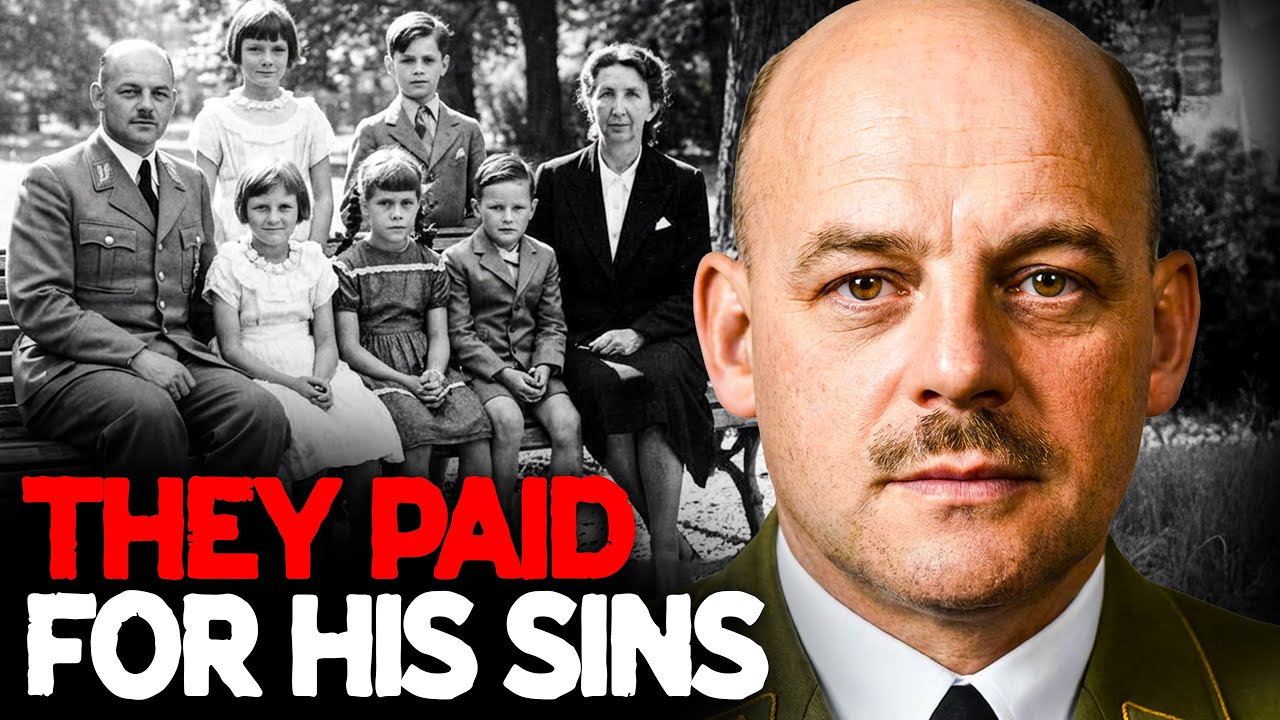
The man chief prosecutor Robert Jackson called the organizer of the largest slave labor program since the pharaohs climbed thirteen wooden steps to the gallows and shouted, “I am dying innocent. The sentence is wrong. God protect Germany and make Germany great again.
God protect my family.”
Minutes later he was dead. His body was cremated and the ashes scattered in the Isar River to prevent any future shrine. For Elisabeth Sauckel and her eight surviving children, the fall from privilege to obscurity had already begun.
Fritz Sauckel had built his empire in Thuringia over two decades. Born on October 27, 1894, in Hassfurt, Bavaria, the only child of a postman and a seamstress, he went to sea at fifteen and spent five years interned in France during World War I, an experience that radicalized him.
He joined the Nazi Party in 1923 as member number 1,395 and rose steadily through the ranks. As Gauleiter of Thuringia from 1927 and Reichsstatthalter from 1933, he transformed the region into what he proudly called a model Nazi district.
In Weimar, the city of Goethe and Schiller, he constructed a castle-like villa on Windmühlenstraße between 1938 and 1939. The Villa Sauckel served as both his residence and a symbol of his power. Elisabeth, whom he married in 1924, had given him ten children, and Nazi propaganda celebrated them as the ideal German family.
The Sauckels lived in privilege, their home staffed with servants, their status unquestioned in the hierarchy of the Third Reich. Sauckel founded the Wilhelm Gustloff Foundation using assets confiscated from the Jewish company Simson in Suhl and built it into a powerful industrial conglomerate.
The Fritz Sauckel Werk in Weimar became a centerpiece of his economic empire, eventually employing thousands of workers, including concentration camp prisoners from nearby Buchenwald. He collaborated closely with the SS in establishing Buchenwald concentration camp just eight kilometers from the city center in 1937.
By April 1945, that world was collapsing. On April 10, 1945, only one day after declaring Weimar a fortress city and ordering his Volkssturm forces to resist the approaching American army, Fritz Sauckel fled by car. The man who had exhorted others to fight to the death abandoned his post as Allied troops closed in.
Weimar fell to the US 80th Infantry Division on April 12, 1945, and residents were soon forced to walk through nearby Buchenwald to witness firsthand the horrors that had occurred just kilometers from their homes. The camp that Sauckel had helped establish now stood as testimony to crimes that could no longer be denied.
The Sauckel family’s comfortable existence came to an abrupt end. American forces occupied the villa, and Elisabeth found herself suddenly without the status, protection, or resources she had enjoyed for over a decade. The servants were gone.
The privileges had vanished overnight.
For the children, the transition was even more disorienting. They had grown up surrounded by the trappings of Nazi power, their father a figure of authority and admiration. Now he was a fugitive and they were the family of a wanted war criminal.
Sauckel’s flight took him toward Austria, hoping perhaps to disappear into the chaos of a collapsing Reich. On May 12, 1945, members of the US Army Counter Intelligence Corps arrested him in Salzburg. He was transferred to Nuremberg to face justice alongside other major war criminals.
The charges against him were devastating in scope. As General Plenipotentiary for Labor Employment from March 1942 until the end of the war, he was responsible for the deportation of some five million foreign workers to Germany. The methods his administration employed included manhunts, village burnings, family separations, and outright kidnapping.
His own written orders laid bare the exploitation at the heart of the program. In a letter to Alfred Rosenberg dated April 20, 1942, Sauckel wrote that foreign workers must be fed, sheltered, and treated in such a way as to exploit them to the highest possible extent at the lowest conceivable degree of expenditure.
At a meeting of the Central Planning Board in March 1944, he admitted that of the five million foreign workers who arrived in Germany, not even 200,000 came voluntarily. The vast majority had been torn from their homes by force.
Elizabeth Sauckel and the children faced their own reckoning. Weimar fell into the Soviet occupation zone after the initial American liberation, and Soviet authorities proved even less sympathetic to families of prominent Nazis. The villa was confiscated.
All properties associated with the former Gauleiter were seized under land reform policies targeting anyone connected to the Nazi regime.
The family’s bank accounts were frozen, their possessions inventoried and largely taken. Elisabeth found herself responsible for her surviving children with no resources and a name that now carried immense stigma rather than privilege.
The family had already suffered tragedy during the war itself. Two of the Sauckel children died during the conflict, though the circumstances remain obscure in the historical record. Fritz Sauckel referenced this loss in his final statement at Nuremberg, speaking of following his sons to death.
Whether killed in military service, by Allied bombing, or through some other wartime catastrophe, these deaths meant that Elisabeth faced the post-war period with eight surviving children rather than ten. For a family celebrated by Nazi propaganda for its size, the war had already extracted a terrible personal toll.
The Nuremberg trial brought global attention to Sauckel’s role in the slave labor program. Prosecutor Robert Jackson assembled overwhelming evidence. Documents showed Sauckel had personally approved the use of force for labor recruitment.
His own memoranda revealed his philosophy of exploitation.

Workers were to be used to the maximum extent at the minimum cost. Their humanity was irrelevant to their value as labor units. The methods employed under his authority were documented in horrifying detail: villages burned to force compliance, families torn apart, workers transported in cattle cars, beatings and starvation used to maintain discipline.
Eyewitnesses at the trial described Sauckel as nervous and agitated, a sharp contrast to defendants like Göring who maintained an air of defiance. He seemed unable to comprehend how his administrative decisions had translated into such massive suffering.
His lawyer, Robert Servatius, attempted to portray Sauckel as a representative of the German working class, an earnest party man committed to the welfare of workers. This portrait was deliberately contrasted with Albert Speer, whom Servatius characterized as an elite technocrat. The strategy was clear: if blame was to be assigned, it should fall on Speer who had demanded the workers rather than Sauckel who had merely supplied them.
But the tribunal was unconvinced. They found that while Speer’s tasks were numerous, with the forced labor program comprising only one facet of his ministerial responsibilities, Sauckel was singularly responsible for his office as General Plenipotentiary.
On October 1, 1946, the verdict came: guilty on counts three and four, war crimes and crimes against humanity. The sentence was death. The execution itself was brutal even by the standards of judicial hanging.
Wearing a sweater with no coat and looking wild-eyed, Sauckel proved to be the most defiant of the condemned except Julius Streicher, according to journalist Kingsbury Smith who witnessed the executions. After Sauckel’s body dropped through the trap, witnesses reported hearing groans from within the concealed interior of the scaffold, suggesting death was not instantaneous.
By 3:00 in the morning, all ten condemned men had been hanged. Their bodies were photographed to document that justice had been done, then transported to Munich for cremation. The ashes were scattered to prevent any possibility of a memorial.
For Elisabeth Sauckel, the period after her husband’s execution brought the humiliation of denazification. In June 1947, she appeared before a German denazification court, one of thousands of tribunals established to categorize German citizens according to their involvement in the Nazi regime.
The proceedings attracted international attention because she was the first of the major Nazi leaders’ widows to be tried. Newspapers from Sydney to London reported on the case, curious about how Germany would handle the wives of executed war criminals.
The court found her guilty of being a lesser Nazi, a classification in German known as a Minderbelastete, indicating involvement without being a major offender. She was fined 25 pounds, a relatively modest penalty that nevertheless marked her officially as complicit in the regime her husband had served.
The court reportedly told her that she could best atone for her sins by going home and educating her children democratically, a directive that carried both irony and weight. How was she to teach democratic values to children raised in the heart of a Nazi household? How was she to explain their father’s crimes while still preserving some sense of family identity?
The denazification of Elisabeth Sauckel represented a broader pattern affecting families of executed war criminals. Unlike some wives of Nazi leaders who faced harsher classifications, her case resulted in a judgment that she had been a follower rather than an active participant.
This outcome reflected the genuine ambiguity surrounding many such cases. Elisabeth had not held any official position. She had not signed orders or made policy decisions, but she had lived in privilege, presided over a household maintained by the Nazi state, and borne ten children celebrated by regime propaganda as model German offspring.
Where did complicity begin and victimhood end? The tribunal struggled with these questions, often producing inconsistent results that satisfied no one. Some observers felt the judgment was too lenient.
Here was a woman who had enjoyed years of luxury while her husband oversaw the enslavement of millions.
Others argued that wives should not be punished for their husbands’ crimes, that Elisabeth had simply lived the life that was presented to her, like countless German women during the Nazi years. The debate reflected deeper uncertainties about guilt and responsibility in a society where millions had participated in or benefited from the Nazi system.
The immediate post-war years were marked by severe hardship for the Sauckel family. The Soviet occupation zone, which became the German Democratic Republic in 1949, was no place for the widow and children of a prominent Nazi.
The communist authorities who took over Thuringia had no sympathy for families connected to the former regime. Properties were seized under the comprehensive land reform program that targeted former Nazis along with large landowners and industrialists. The Villa Sauckel was confiscated along with everything else associated with the former Gauleiter.
The family’s options were severely limited. They could not reclaim their former property, which had been distributed or converted to state use. They could not easily find employment as the Sauckel name was notorious throughout the region.
Anyone who hired them risked drawing the attention of communist authorities eager to root out fascist sympathizers.
They faced the hostility of a population that had been forced to confront the crimes committed in their name at places like Buchenwald, where over 56,000 people had died during the Nazi years, many of them laboring for the very factories that Sauckel had controlled.
The Soviet zone was experiencing its own form of political repression in these years. The authorities used the occupied Buchenwald camp as an NKVD special camp to imprison former Nazis and other Germans deemed enemies of the new order. Between 1945 and 1950, thousands of people passed through these facilities, many never returning.

Whether the Sauckel family members faced direct persecution is unclear from available records, but the atmosphere of fear and suspicion made life extremely difficult for anyone connected to the old regime.
At some point, likely in the late 1940s, Elisabeth and at least some of her children made their way to the western zones of occupation where conditions, while still difficult, offered somewhat more opportunity for former Nazi families to rebuild their lives. The border between East and West was not yet the fortified barrier it would become, and many Germans crossed in both directions during these years.
For the Sauckels, moving west meant leaving behind whatever remained of their old life in Thuringia, but it also meant escaping the particular harshness of communist rule toward families like theirs.
In the West, the Sauckel family joined thousands of others attempting to disappear into the anonymity of post-war German society. The massive displacement of populations, the flood of refugees from the East, and the sheer scale of devastation across Germany meant that families could sometimes reinvent themselves.
Children might use their mother’s maiden name or simply avoid mentioning their father. The economic miracle of the 1950s offered opportunities for those willing to work regardless of their family backgrounds. But the Sauckel name remained toxic, a constant reminder of crimes that the world was not prepared to forget.
West Germany in the 1950s was a study in contradictions when it came to dealing with the Nazi past. On one hand, the Nuremberg trials had established clear legal precedents and punished major war criminals. On the other hand, the practical needs of reconstruction led to the quiet reintegration of thousands of former Nazis into government, business, and professional life.
This was not a deliberate policy of rehabilitation, but rather a recognition that Germany could not function without the expertise of people who had served the previous regime. Teachers, civil servants, judges, doctors, and engineers who had been party members returned to their professions, their past conveniently overlooked in the interest of rebuilding.
For families of executed war criminals, however, the situation was more complex. Their relatives had been publicly tried, convicted, and put to death. There was no possibility of quiet reintegration when everyone knew your father had been hanged at Nuremberg.
The Sauckels could not benefit from the general amnesty that covered lesser offenders or the practical accommodations made for technically skilled former Nazis. They carried a burden of notoriety that no amount of time could fully erase.
Unlike some families of Nazi leaders, the Sauckels largely avoided public attention in the decades after the war. There were no memoirs published defending Fritz Sauckel’s actions, no prominent children speaking out either to condemn or excuse their father.
This silence itself is notable. Some descendants of Nazi perpetrators, like Gudrun Himmler, devoted their lives to defending their fathers’ memories, joining organizations like Stille Hilfe that supported former SS members and war criminals. Others, like Katrin Himmler, confronted their family histories publicly, writing books and speaking about the burden of inherited guilt.
The Sauckel children appear to have chosen neither path, instead retreating into a privacy that has largely been respected.
The contrast between Fritz Sauckel and Albert Speer in the post-war imagination remained a source of controversy for decades. Speer, who had demanded the slave workers that Sauckel provided, received a 20-year prison sentence rather than death. He served his time at Spandau Prison, emerged in 1966 to write best-selling memoirs, and died peacefully in 1981.
His books portrayed him as the good Nazi, a technocrat who claimed ignorance of the regime’s worst crimes while accepting some measure of general responsibility. Critics pointed out that Speer had personally witnessed concentration camps and had used forced laborers in his own projects, but he managed to craft a narrative of partial redemption that the public found compelling.
Sauckel, the man who fulfilled Speer’s demands, received no such posthumous rehabilitation. He remained what he had been at Nuremberg: the brutal overseer of the largest slave labor program in modern history, a man who had torn five million people from their homes and worked them under conditions that killed countless numbers.
The discrepancy troubled many observers, including historian Gitta Sereny, who interviewed Speer at length about his responsibility for slave labor. Why did the supplier face execution while the demander faced imprisonment? The answer lay partly in Speer’s skillful self-presentation, his willingness to express limited remorse, and the complexity of the Nuremberg judgments.
But for the Sauckel family, the injustice must have seemed overwhelming. Their husband and father was dead while Speer’s family waited for him to return, eventually welcoming him home to a comfortable existence that seemed to mock the very concept of justice.
Elisabeth Sauckel lived into the post-war period, though the exact date of her death remains unclear in available historical records. She had married Fritz in 1924, when both were young and Germany was struggling through the chaos of the Weimar Republic.
She had stood by him through his rise to power, his years of dominance in Thuringia, and his elevation to one of the most important positions in the Nazi war economy. She had borne him ten children and watched two of them die during the war. She had seen her husband led away to Nuremberg and learned of his execution through official channels.
Whatever Elisabeth believed about her husband’s guilt or innocence, she lived the remainder of her life in the shadow of his crimes.
The surviving Sauckel children grew up marked by their father’s legacy in ways that can only be imagined. Born between the mid-1920s and early 1940s, they ranged from young adults to small children when the war ended. The oldest would have clear memories of life in the Gauleiter’s villa, of their father’s position and power.
 The youngest might barely remember him at all, knowing him only through photographs and family stories.
All of them carried a surname that identified them immediately as the offspring of a man hanged for crimes against humanity. How did they explain their family history to friends, employers, potential spouses? Did they change their names, and if so, when and why?
These questions remain largely unanswered, a gap in the historical record that the family itself has apparently chosen not to fill.
The fate of the Sauckel family reflects broader patterns in how Germany dealt with the legacy of Nazism in the post-war decades. The initial period of denazification gave way to what historians call the era of silence, during which many Germans preferred not to discuss the recent past.
Economic recovery took priority over historical reckoning. Former Nazis were quietly reintegrated into society, their crimes overlooked or minimized in the interest of national reconstruction. For families like the Sauckels, this silence offered a form of protection, allowing them to fade from public memory even as the name remained associated with some of the worst crimes of the Nazi regime.
The question of what children owe for their parents’ crimes has no easy answer. The Sauckel children did not choose their father, did not participate in his decisions, were not responsible for the deportation of millions to forced labor. Yet they benefited from his position, growing up in privilege made possible by the suffering of others.
They inherited a name that would forever be associated with slavery on an industrial scale.
Some families have found ways to address this burden publicly, either defending their relatives or condemning them. The Sauckels, for the most part, chose silence, a response that is perhaps understandable even if it leaves historians and the public without answers to questions that continue to matter.
Fritz Sauckel’s legacy remains one of the darkest chapters of the Nazi regime. The forced labor program he administered brought unimaginable suffering to millions of people across Europe. Men and women were torn from their homes, transported to Germany under horrific conditions, worked to exhaustion, beaten, starved, and often killed.
The survivors carried physical and psychological scars for the rest of their lives. Many never returned home, dying in factories, mines, and construction sites far from anyone who loved them. Efforts to secure compensation for these victims continued for decades after the war, eventually resulting in agreements that acknowledged Germany’s responsibility while providing only partial redress for losses that could never truly be repaired.
The terminology itself became a point of contention. At Nuremberg, the prosecution consistently used the word slave to describe the workers Sauckel had procured. It was a deliberate choice meant to emphasize the involuntary nature of the labor and the brutal conditions under which it was performed.
Sauckel himself objected to this characterization, insisting that his program had nothing to do with exploitation, that it was simply an economic process for supplying labor. This self-justification revealed the moral blindness at the heart of his crimes. To Sauckel, the five million people he had deported were resources to be managed, not human beings with rights and dignity.
This bureaucratic mentality made the horrors possible, allowing administrators to order mass deportations without confronting the suffering they caused.
The forced laborers themselves left behind testimonies that contradicted every claim Sauckel made in his defense. They described being seized from their homes at gunpoint, packed into cattle cars for journeys lasting days without food or water, beaten by guards, housed in freezing barracks, fed starvation rations, and worked until they collapsed.
Those who tried to escape were hunted down and shot. Those who became too weak to work were often sent to concentration camps where few survived.
The scale of the program was almost beyond comprehension. At its height in August 1944, over 7. 6 million foreign workers were officially registered in the greater German Reich, representing one-fifth of the total labor force.
Most of them had been brought there against their will, many through the machinery that Sauckel commanded.
For the descendants of perpetrators and victims alike, the passage of time has not resolved the fundamental questions raised by the Nazi period. How do we understand evil conducted on such a massive scale? How do we hold individuals accountable while recognizing the systems that enabled their crimes?
What do later generations owe to those who suffered, and how can that debt ever be paid?
The Sauckel family story, fragmentary as it is, represents one answer to these questions: silence, withdrawal from public life, an attempt to live privately with a burden that can never be fully set down.
The Sauckel family story mirrors Germany’s own complex path after the war, from initial accountability through decades of silence to the more recent efforts at historical reckoning. Fritz Sauckel was tried, convicted, and executed within 18 months of the war’s end, one of the swiftest and most definitive instances of justice for Nazi crimes. But his family remained, carrying forward a legacy that could not be so easily resolved.
They represent the countless families across Germany and Europe who lived in the shadow of the Nazi period, shaped by events they did not control but could never escape.
Today, the Villa Sauckel still stands in Weimar, a physical reminder of the Gauleiter who once ruled Thuringia. The city itself has reclaimed its identity as a center of German culture, emphasizing its associations with Goethe, Schiller, and the Bauhaus, rather than the Nazi era.
But the history cannot be entirely erased. Buchenwald Memorial serves as a permanent reminder of the crimes committed just kilometers from the classical monuments. And somewhere, perhaps, descendants of Fritz Sauckel still carry his name, living with an inheritance that time has not erased.