On April 20, 1966, two Cleveland police detectives driving past the Manhattan Tap Room witnessed a man on the ground being kicked in the head repeatedly by another man holding a . 357 Magnum. The victim’s skull was bouncing off the asphalt. The detectives ordered the attacker to stop and drop his weapon.
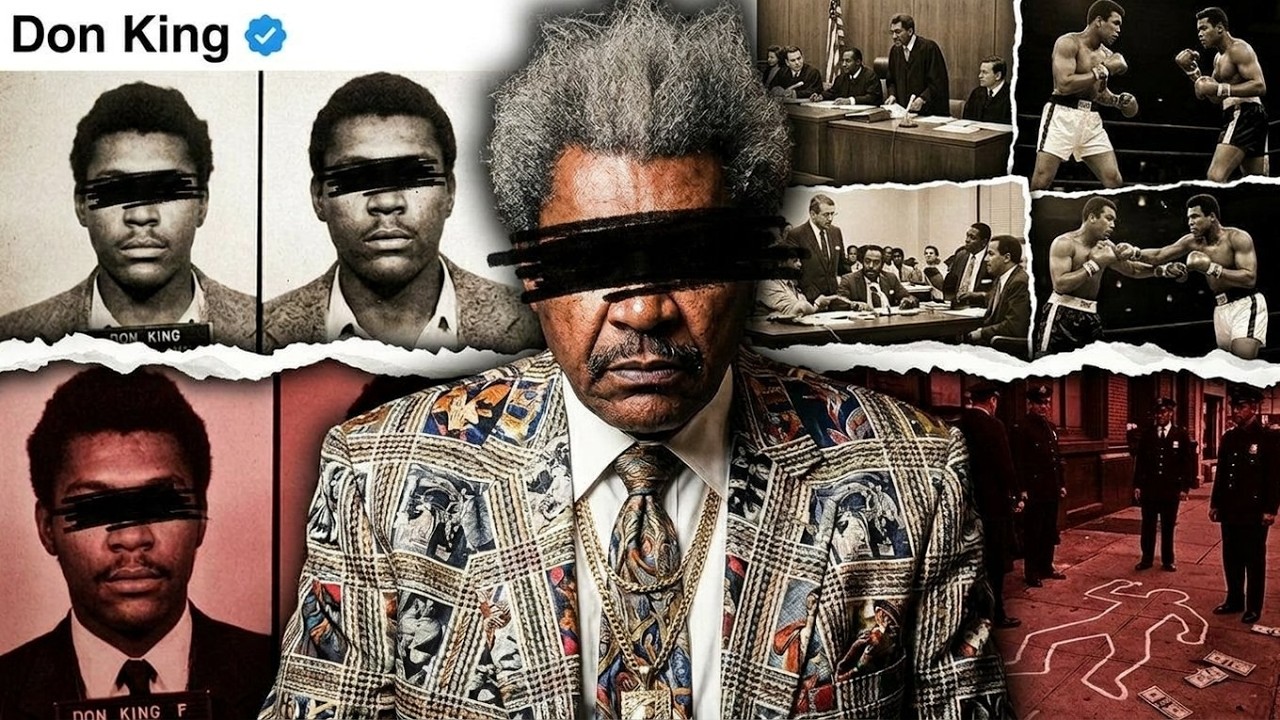
He tossed the gun onto a nearby car, then delivered one final kick to the victim’s face while the officers stood watching. The victim was Sam Garrett, a small, sick man who owed a gambling debt. Witnesses said his last words were, “I’ll give you the money, Don. ” He never regained consciousness and died five days later.
The man who stomped him was convicted of second-degree murder, served less than four years in prison, and was later pardoned by the governor of Ohio. His name was Don King, and he went on to become the most powerful boxing promoter in history. Don King was born in Cleveland on August 20, 1931, the fifth of six children. His father, Clarence King, worked at the Otis steel plant and died in an explosion on December 7, 1941, the same day as the Pearl Harbor attack.
Molten steel engulfed him. Don was 10 years old. His mother used the $10,000 compensation to move the family to a middle-class neighborhood, but when the money ran out, she baked pies and roasted peanuts, which her sons sold door-to-door. As a sales gimmick, Don and his brothers slipped a lucky number into each bag of peanuts.
Local gamblers loved it, and the bags became the hottest item in the neighborhood because of the numbers inside. That was how Don King met the gambling world. By his early 20s, he controlled one of the biggest numbers rackets in Cleveland, a betting operation where a dollar could win $600 but the odds always favored the house. King was charismatic, loud, and possessed a near-supernatural memory.
He memorized thousands of bets without writing anything down, leaving no paper trail for police. He was arrested at least 35 times for gambling, carrying a concealed weapon, and assault and battery, but he talked, paid, or intimidated his way out every time. By 30, he was one of the top numbers operators in greater Cleveland, known on the streets as “Cadillac Slim. ”
In December 1954, a man named Hillary Brown walked into one of King’s gambling houses intending to rob it.
King shot him in the back, killing him. A court ruled it justifiable homicide, and King walked free. He was 23. The message was clear in Cleveland’s underworld: Don King would kill you if you crossed him.
In 1957, mobster Shondor Burns, the most feared racketeer in Cleveland, demanded that King and other operators pay him $200 a week for protection. King paid for a while, then stopped. On May 20, 1957, a bomb destroyed the front porch of King’s home. King told police that Burns was responsible, and charges were filed.
Before King could testify, a man aimed a 12-gauge shotgun at his head and fired. The blast hit him in the back of the head and neck. King survived, and a CAT scan decades later revealed shotgun pellets still lodged in his skull. King testified against Burns, but the jury hung and Burns walked free.
King went back to running numbers with a lesson he would never forget: trust nobody, fear nobody, and always be the most dangerous person in the room. In April 1966, Sam Garrett, a former employee of King’s numbers operation, owed King money from a gambling debt. King claimed it was $900; Garrett said $600. The amount was not the point, the disrespect was.
After an argument in the Manhattan Tap Room, King pistol-whipped Garrett, knocked him to the ground, and stomped on his head repeatedly. Detective Robert Ton described seeing the man’s head bouncing off the asphalt like a rubber ball. King was charged with second-degree murder. At trial, he claimed self-defense, saying Garrett threatened his life and came at him first.
He denied stomping the man or using the gun. The two detectives who witnessed the beating testified otherwise, describing a helpless man being kicked while King held a revolver. A jury found King guilty of second-degree murder, which carried a potential life sentence. Five months later, Judge Hugh Corrigan reduced the conviction to voluntary manslaughter.
Journalist Jack Newfield, who wrote the biography “Only in America: The Life and Crimes of Don King,” alleged that the judge was under the influence of organized crime. King was sentenced to 1 to 20 years and served three years and 11 months. He later called prison the best thing that ever happened to him, saying, “I was sent to serve time. I made the time serve me.
”
At the Marion Correctional Institution, King read philosophy, history, law, and literature, educating himself in the prison library. He came out in 1971 with a new vocabulary, new references, and the ability to make educated men believe he belonged in their world. He also adopted the gravity-defying hairstyle that became his trademark. In 1972, Cleveland’s only black hospital, Forest City Hospital, was about to shut down.
King saw an opportunity. He convinced Muhammad Ali to come to Cleveland for a 10-round exhibition to raise money for the hospital. The event raised $80,000 and saved the hospital. More importantly, King realized that boxing was the numbers game on a global scale.
In 1974, King promoted the Rumble in the Jungle in Kinshasa, Zaire, between Muhammad Ali and George Foreman. He secured a $10 million purse, the largest in boxing history at the time, through an arrangement with the government of Zaire. Ali knocked out Foreman in the eighth round, and King stood in the ring when it happened. Eight years earlier, he had been stomping a man’s head on a Cleveland sidewalk over $600.
A year later, King promoted the Thrilla in Manila between Ali and Joe Frazier. He went on to promote Larry Holmes, Roberto Duran, Mike Tyson, Evander Holyfield, and Lennox Lewis, overseeing more than 500 world championship fights. He also promoted the Jacksons’ 1984 Victory Tour and became one of the most recognizable figures in America. But King’s pattern with fighters was consistent.
He signed young fighters, controlled television deals, venue contracts, and purse negotiations, and fighters often saw only a fraction of the money. Contracts were structured so that teams of lawyers could not untangle them. Fighter after fighter sued him. Mike Tyson sued King for $100 million, alleging King cheated him out of tens of millions in earnings.
Tyson said King did more bad to black fighters than any white promoter in the history of boxing. In his autobiography, Tyson described beating King on two occasions, including kicking him in the head while driving on a highway. Larry Holmes accused King of threatening to break his legs. Lennox Lewis, Tim Witherspoon, Terry Norris, Chris Byrd, and Meldrick Taylor all sued him.
King was sued more than any other person in the history of boxing, but he never went back to prison. In 1992, during a U. S. Senate investigation into organized crime in boxing, King invoked the Fifth Amendment when asked about his relationship with Gambino crime family boss John Gotti.
In the early 1980s, the FBI launched Operation Shadow Boxing, a four-year investigation targeting King. Agents documented meetings between King and high-ranking mob figures, and an undercover agent got close to his operation. King was never indicted for mob-related crimes. In 1999, when the president of the International Boxing Federation, Robert W.
Lee Sr. , was indicted for racketeering, prosecutors called King an unindicted co-conspirator who was the principal beneficiary of Lee’s actions. Don King is now 94 years old. He killed two men.
He served less than four years in prison. He was bombed, shot in the head, and still carries pellets in his skull. He was investigated by the FBI, questioned by the Senate, and sued by nearly every major fighter he promoted. He remains free and still promoting fights.
Sam Garrett’s family never saw justice. A man who owed $600 had his head bounced off a sidewalk while begging for his life, and the man who killed him went on to promote Muhammad Ali, Mike Tyson, and George Foreman. Hillary Brown, shot in the back in 1954, remains a footnote. Most people who know Don King’s name have never heard of Brown.
The governor of Ohio pardoned King, the boxing world made him rich, and the entertainment world made him famous. The legal system that gives others decades for selling product on a corner gave Don King three years and 11 months for stomping a man to death while two police officers watched.