On the evening of March 12, 1936, Ellsworth “Bumpy” Johnson walked through a cold rain to a meeting of the Harlem Property and Loan Association on West 116th Street. Around 40 landlords, shopkeepers, and lawyers had gathered, and the association’s chairman, Harmon Deitch, controlled the proceedings. During the discussion of the block’s future, Deitch implied that rents would rise and certain families would be pushed out, a quiet method of displacement that required no open confrontation. When a grocer named Coley asked whether his own rent would increase, Deitch answered with a pleasant threat about the market determining what was fair.
Then Deitch turned his attention to Johnson, seated in the back, and publicly insulted him, saying the block did not need men who had come up through prisons and pool halls telling honest property owners how to run their affairs. The room turned to watch Johnson’s reaction. Johnson did not stand, did not speak, and did not react. He understood the insult was deliberate, a display meant to humiliate him before the community and demonstrate Deitch’s power.
He waited until the meeting moved on, then put on his hat and walked out into the rain without a word. Coley and others assumed the quiet man had been beaten. What had actually happened, according to this account, was that Johnson had gathered everything he needed from the room. Walking the 14 blocks home, he shifted his thinking.
He stopped viewing Deitch as a man who had wronged him and began viewing the system Deitch served as a structure that could be understood, pressured, and moved. He set his anger aside and chose patience. Johnson’s background shaped that response. Born in Charleston, he had been sent north as a boy by a mother who feared the South.
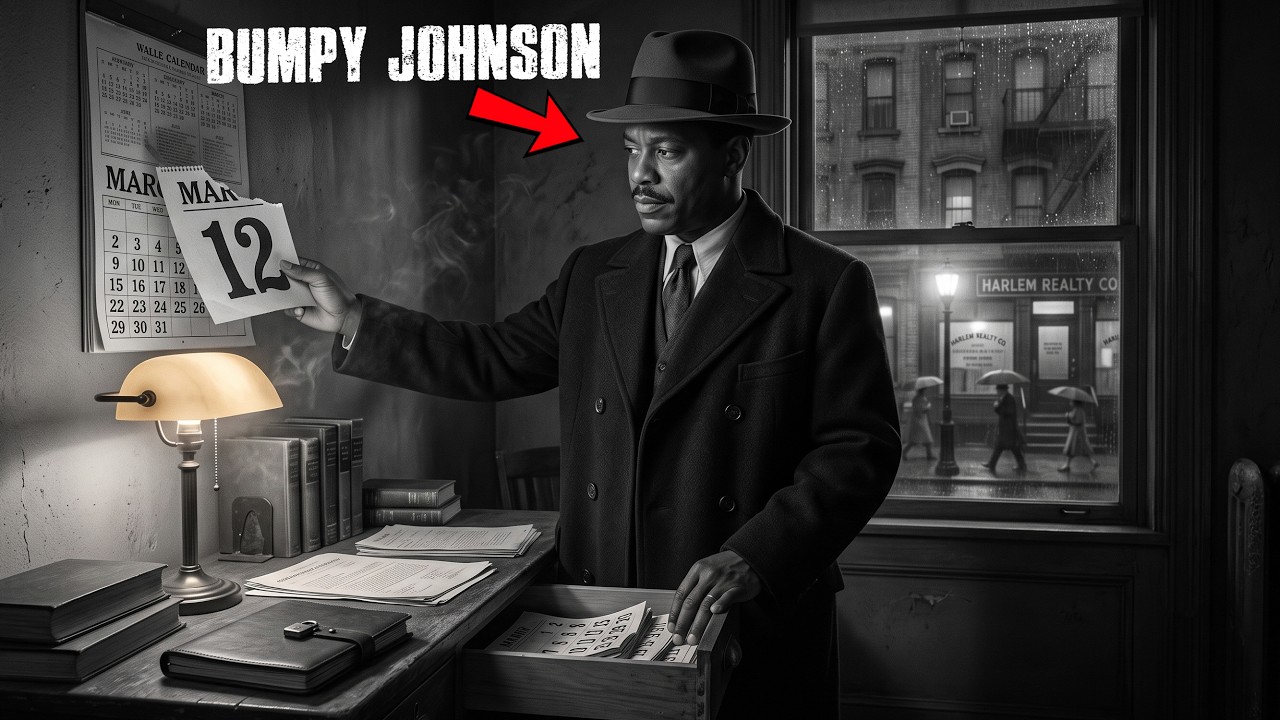
He spent years in state prisons, where he read history, philosophy, and plays in the prison library. He observed that the men who truly governed the prison were not the guards but those who worked the invisible arrangement of debts, favors, and fears beneath the official order. He carried that principle into Harlem. Back in his rooms that night, Johnson tore the page for March 12 from his calendar, folded it once, and placed it in his desk drawer.
For the rest of his life, he repeated that ritual each year, never explaining it. Those close to him noticed but never learned the meaning, which he kept private as a reminder of the difference between anger and strategy. In the days that followed, Johnson spent three full days learning everything he could about Deitch and the association. He mapped who Deitch owed money to, which members were overextended, the lawyers who handled the papers, and the bank that carried the account.
He recorded it all in a notebook kept locked beside the folded calendar page. He then approached allies, each chosen for a specific strength. He went to see Aldous Renfrew, a careful lawyer on 135th Street known for examining documents no one else had checked. Renfrew confirmed that Deitch’s method was legal only in the way a locked door is legal, meaning it worked only because no one had tested whether the lock was properly fitted.
Altered lease terms and a bank sensitive to public scrutiny offered points of leverage. Johnson built a coalition without revealing the full plan to anyone. He visited Estelle Frazier, who ran the largest block association and could spread information from porch to porch. He visited Reverend Isaiah Price, whose sermons carried further than any newspaper and who had wanted a reason to speak against the quiet evictions.
He visited Saul Merrick, a union printer who could produce documents cheaply and quickly. And he spoke to the grocers, barbers, and laundry owners whose rents Deitch intended to raise. The strategy had several layers, each released slowly so no one could see the shape until it was complete. Renfrew filed narrow legal challenges one at a time, forcing Deitch’s lawyers to answer and spending their time, money, and certainty.
Frazier and Price prepared the community to understand that the same method was being used against all of them, dissolving the isolation that made resistance seem hopeless. Merrick was tasked with printing a plain account of who owned the buildings, what the rents had been, what they were to become, and which bank held the mortgages. There was no anger in it, only facts arranged in columns, and the bank’s name at the bottom. The dullness made it unanswerable, because every number in it was true.
The shopkeepers were asked to quietly move their accounts out of Deitch’s bank and into a smaller institution downtown. They did so one at a time over several weeks, without announcement. The bank watched its Harlem deposits shrink and could not identify a cause it could correct. A problem that cannot be named, this account notes, is more frightening to an institution than any open attack.
Renfrew filed the first legal challenge in the last week of March. Deitch’s lawyers answered carelessly, which opened a second question in April, which forced disclosure of a document that raised a third. By the end of April, the evictions that were to have cleared the block by spring had not begun, and the season Deitch had planned around was slipping past him. In the second week of May, Merrick’s plain sheet of paper appeared in shop windows and under doors.
Within two days, a copy reached the bank’s downtown offices, and within a week it reached a reporter at a Negro weekly who had waited years for such a document. The story ran, and the bank saw its reputation placed in danger of being seen. The bank moved first. Its officers met with Deitch and informed him with cold courtesy that unless the matter of the block was resolved quietly, the bank would reconsider the mortgages on Deitch’s own properties.
Deitch, who had built his leverage on those mortgages, discovered that leverage runs in both directions. In the third week of May, Deitch sent a threat into the neighborhood, saying he knew who was behind the trouble and that men who made trouble for him would find themselves without a place to live or trade. The threat reached Johnson in the back room of Coley’s grocery. Johnson listened without expression and replied that Deitch was welcome to carry it out.
He added that the moment Deitch moved against a single shopkeeper or family, there would be a second sheet of paper and a second story, naming the clerks, marshals, and bankers who had helped him. The threat was never carried out. What followed was a negotiation, which Renfrew handled. The planned rent increases were withdrawn on the buildings in question and capped in writing for five years.
The three evictions Renfrew had challenged were abandoned, and the families remained. The altered leases were corrected. A committee of the block’s own residents, with Estelle Frazier at its head, was to be consulted before any future change to rents or tenancy. The change held.
Coley kept his grocery for another 19 years. The families stayed. The bank began lending more openly to Harlem’s own businesses. Other property owners, watching what had happened to Deitch, quietly abandoned methods they had used for years.
Johnson took no public credit. His name appeared nowhere in the negotiations, the story in the weekly, or the signed agreement. He understood that credit was a form of visibility, and visibility made a man vulnerable. He had made Deitch visible while keeping himself unseen.
He carried that lesson forward into everything that came after. Years later, when Johnson had become a figure of real consequence in Harlem, men who worked alongside him would occasionally notice the ritual of the calendar, the single page torn each year from March 12, folded once, kept in the drawer. He told them it reminded him of something and changed the subject.
The page reminded him of the room, the turning faces, and the walk home in the rain, where he learned the difference between anger and strategy, between noise and power.