The name is Ellen Ainsworth. She was twenty-four years old, a farm girl from Glenwood City, Wisconsin, population eleven hundred, and on the night of February 10, 1944, as German shells fell on the Anzio beachhead in their thousands, she refused to leave her patients.
Six days later she was dead, struck in the chest by shrapnel inside a tent whose roof bore a Red Cross fourteen feet across, white pigment visible from two thousand feet, a symbol with treaty weight behind it under the Geneva Convention of 1929, signed by Germany, ratified by Germany.
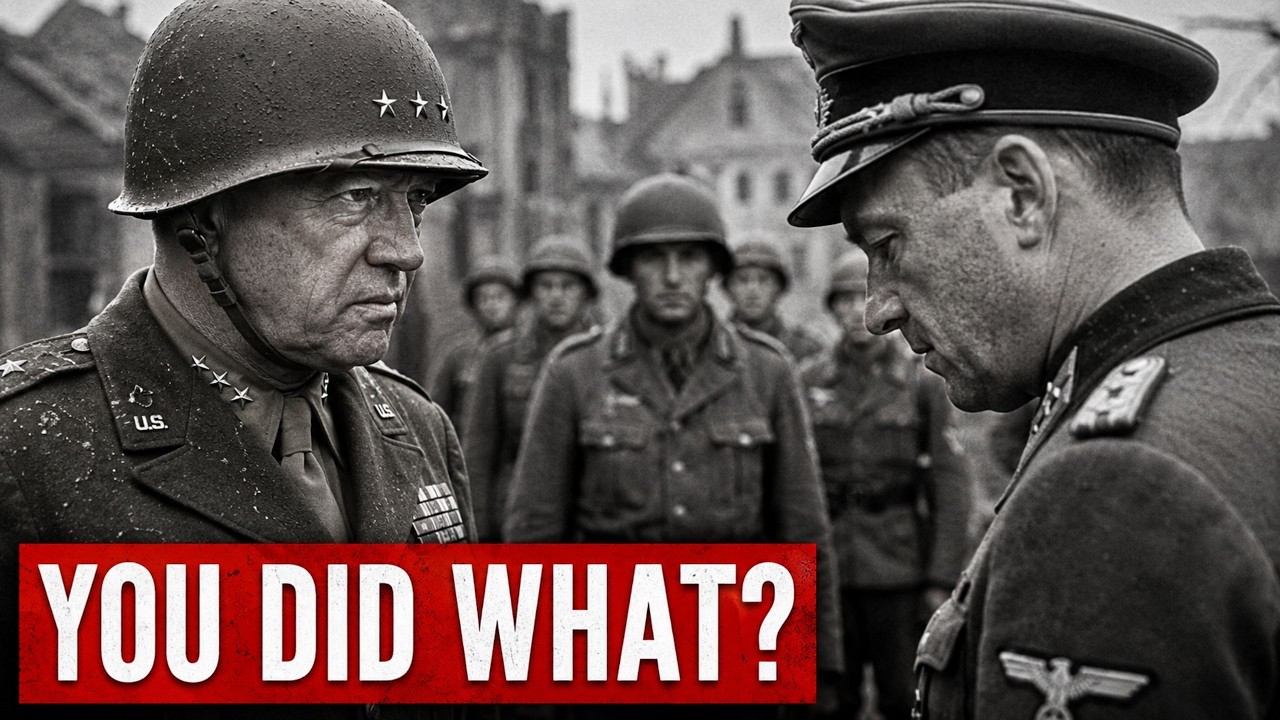 The record of what was done to the American medical personnel at Anzio, in the Lorraine, and in the Ardennes is not a single dramatic scene. It is a pattern, logged report by report in a Judge Advocate General’s file that grew through the autumn of 1944 on the second floor of a former French barracks in Nancy, France.
And the man who ordered that file kept, the man who insisted in writing that the Geneva Convention be enforced while his own career sat in disgrace, was George Smith Patton Jr., fifty-eight years old, a general who had slapped two of his own soldiers in Sicily and been sidelined from the invasion of France.
Both things are true. The record does not let you choose.
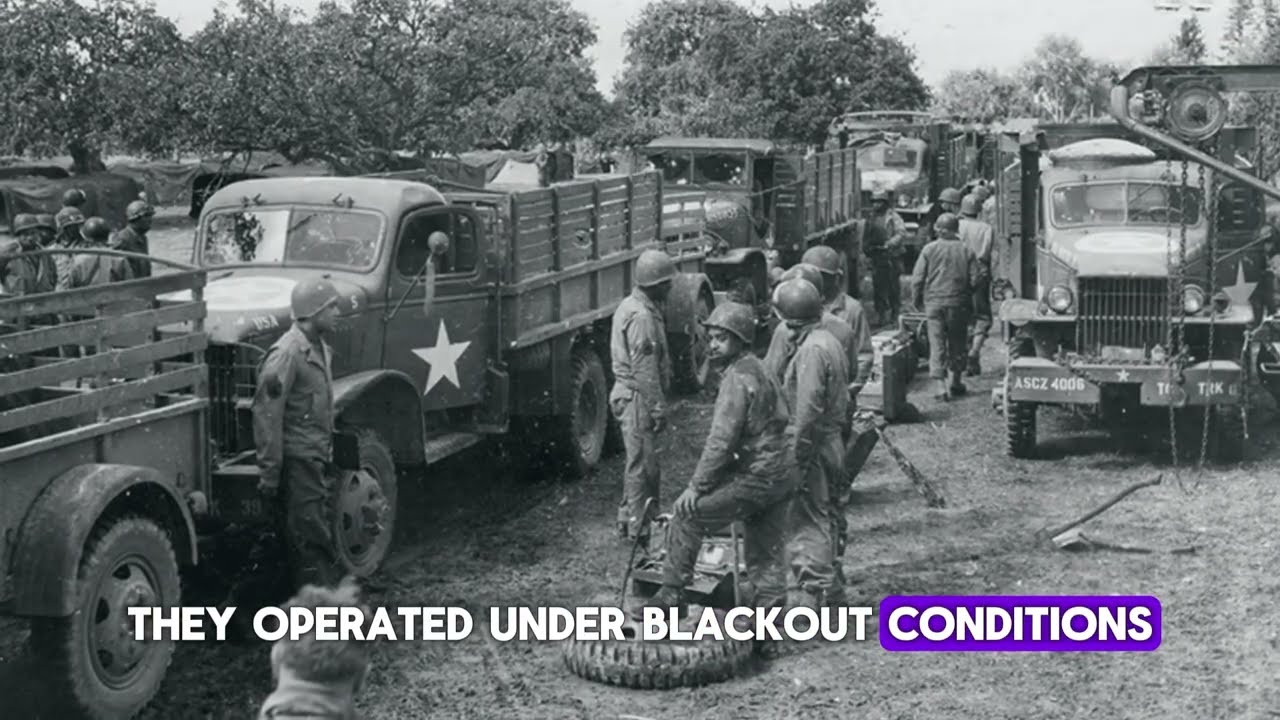
The Army Nurse Corps in 1944 was the largest contingent of American women ever deployed to a foreign war, roughly fifty-nine thousand women, some seventeen thousand of them in the European theater alone. They worked at aid stations within range of small arms fire, in clearing companies behind the front, in field hospitals in the rear.
They lived in tents in winter. They operated under blackout conditions, under air raids, under shelling. In June of 1944, Public Law 350 granted Army nurses full commissioned officer rank for the first time in American history.
They wore the bars. They earned the pay. And when they died, they died as officers of the United States Army.
In the second week of February 1944, German bombs fell on the 33rd Field Hospital complex at Anzio. Three American nurses were killed where they stood: Lieutenant Blanche Sigman, the chief nurse of the unit; Lieutenant Carrie Sheets; Lieutenant Marjorie Morrow. The Red Cross above them was still smoldering when the bodies were recovered.
Ellen Ainsworth, of the 56th Evacuation Hospital, died on February 16, 1944, eight days before her twenty-fifth birthday. She was awarded the Silver Star posthumously, among the first American women in history to receive it. Her grave is at the Sicily-Rome American Cemetery in Nettuno, Italy, Plot D, Row Four, Grave 18.
The Geneva Convention for the amelioration of the condition of the wounded and sick in armies in the field was not vague. It was not aspirational. Medical personnel were not combatants.
Medical installations were not targets. Markings of the Red Cross, displayed openly, conferred legal protection. Germany had signed the convention.
German officers were trained in its provisions.
The pilots above Anzio had been briefed. They had charts. They had reconnaissance.
The crosses below them were the size of a small house. Whether each individual bomb was aimed at the cross or merely indifferent to it, the pattern, repeated for weeks across a beachhead ten miles wide and seven miles deep, could not be reconciled with the convention Germany had signed.
By November of 1944, the Third Army’s JAG office outside Nancy was building a separate cabinet for the reports. A medic shot on a stretcher run near Pont-à-Mousson. An ambulance strafed on the road from Lunéville, burning for an hour with three patients, a driver, and a medic inside.
A field hospital tent east of Metz, its roof marked, registered by a German battery that fired a five-minute concentration onto it.
Each report was logged with date, location, unit, witnesses, and where possible the identity of the German formation responsible. The work was slow. The work was meticulous.
The work was done under a standing directive from the top of the command: document everything, document it cleanly, document it as if a court will eventually read it.
In November of 1944, no such court existed. The London Charter that would create the Nuremberg tribunal had not been drafted. The Dachau trials had not been conceived.
The legal framework that would eventually place German officers in the dock for the killing of medical personnel existed only in that file and in the head of the general who had ordered it kept.
Then, on December 16, 1944, German artillery opened fire along an eighty-five-mile front through the Ardennes. Behind the barrage came twenty-four German divisions. The objective was Antwerp.
The Allies called it the Battle of the Bulge.
On the second day of the offensive, at a crossroads near Malmedy called Baugnez, a column from Kampfgruppe Peiper, the battle group of the 1st SS Panzer Division Leibstandarte SS Adolf Hitler, rolled past a captured group of Americans from the 285th Field Artillery Observation Battalion.
The prisoners, somewhere between 113 and 120 men, were disarmed and herded into a snow-covered field. They stood in rows with their hands above their heads. The killing began without warning.
Pistol shots from officers walking among the standing men, then machine guns from the armored vehicles on the road.
Eighty-four American prisoners died at Baugnez Crossroads on the afternoon of December 17, 1944. A small number survived by playing dead and crawling away after the column moved on. By the morning of December 18, the report had reached every American headquarters on the front, including Patton’s.
Patton’s public response was immediate and on the record. He ordered down the chain of command that the standards of treatment for German prisoners would not change. The Geneva Convention applied.
 Surrender would be accepted. Prisoners would be processed. Officers who violated this would be subject to discipline.
He issued those orders precisely because he understood what was about to happen. A massacre of American prisoners by an SS unit does something to the men who hear about it. It produces in the front-line soldier who has lost friends an impulse to do the same thing in return.
Every senior American commander understood it. The question was whether the orders against retaliation would be enforced.
They were not.
On New Year’s Day of 1945, two weeks after Malmedy, soldiers of the 11th Armored Division of the Third Army made contact with German forces near a Belgian village called Chenogne, just outside Bastogne. The 11th Armored was green. Most of its men had never been in combat before the Bulge, and every one of them had been briefed on what happened at Malmedy.
German soldiers attempted to surrender. They came out of buildings with their hands up. They threw down weapons.
Some stood in the open with white cloth held above their heads. What happened next was not a single event but a series of events spread across several hours and several locations within and around the village.
American soldiers, in groups, in twos and threes, shot German prisoners. They shot them as they surrendered. They shot them after they had surrendered.
They shot them in barns and in courtyards and along the snow-packed road outside the village. The most carefully documented estimates place the number of German dead at approximately sixty.
Three days later, in his diary entry for January 4, 1945, George Patton wrote about it. The entry addresses operational matters first. Then it touches on the 11th Armored Division, which Patton characterized as green and as having taken unnecessary casualties.
And then, almost in passing, it contains the sentence preserved in the published edition of the Patton papers.
There were also some unfortunate incidents in the shooting of prisoners. I hope we can conceal this.
The man who in October had ordered the JAG file kept complete, who had insisted on a question of moral and legal principle that the record be assembled with care so that German officers responsible for the killing of American medical personnel could be held accountable in a courtroom, the same man in the same handwriting three months later hoped that a massacre committed by his own soldiers could be hidden from history.
He did not write the entry in shame. He did not write it in anger. He wrote it in the practical voice of a senior commander managing a public relations problem.
The soldiers were green. The mistakes were unfortunate. The cover-up was operationally desirable.
It was not Patton’s position alone. It was taken in coordination with the chain of command above him. General Omar Bradley, commanding the 12th Army Group, which included Third Army, knew about Chenogne.
The reports went up. The decisions about whether to open a formal investigation were made at that level and at higher.
The records documenting the events of January 1, 1945 at Chenogne were classified. They remained largely outside public view for decades. No American soldier was court-martialed for the killings.
No prosecution was opened. No public acknowledgement was made.
The legal machinery Patton had ordered built in Nancy, the careful documentation, the witness statements, the chain of command attributions, all of it would be brought to bear in due course against German officers. The same machinery was not turned against American soldiers when American soldiers did the same thing.
In February of 1945, the Third Army crossed the Sauer River into Germany. In March, it crossed the Rhine. By April, it was driving east through Thuringia, taking small towns by the dozen, finding things in the German countryside that no soldier in any American unit had been prepared to find.
On the morning of April 12, 1945, Patton walked through a gate north of the town of Ohrdruf, Thuringia. What he found was a subcamp of Buchenwald, liberated eight days earlier by the 4th Armored Division, the first American unit to liberate a Nazi camp on German soil.
Bodies stacked in a courtyard. The shed where the killings had been finished. The narrow-gauge railway used to bring victims in from the larger camp system.
The pit where a few hundred had been thrown. The American command had decided that certain people needed to see it with their own eyes.
General Dwight Eisenhower flew in from his headquarters in France. General Omar Bradley came with him. And George Patton, commanding the army that had taken the ground, drove down to meet them.
 The three generals walked through the camp together. Eisenhower’s face did not change. He said the world had to be made to see this.
He ordered Allied journalists brought in. He ordered film cameras brought in. He ordered American congressmen flown over to bear witness.
Bradley said almost nothing. The photographic record shows his face set in the expression of a man who has decided to be still.
Patton walked partway through the camp. Then he turned and walked behind a barn and vomited. He was fifty-nine years old.
He had been a soldier for forty years. He had fought in two World Wars and the Mexican Expedition. He had seen battlefields after the firing.
He had walked through field hospitals at the worst hours. He had read the JAG file from Nancy. Nothing in any of it had prepared him for Ohrdruf.
He composed himself. He went on through the rest of the inspection. And when it was finished, he gave an order that became one of the most photographed gestures of his entire career.
The civilian population of the town of Ohrdruf, he said, would be brought to the camp on foot. Every adult, men and women. They would walk the route the prisoners had walked.
They would see what had been done in their name on a road they had been pretending led to a military installation.
American MPs marched roughly a thousand townspeople out from Ohrdruf and through the gate. The mayor of the town and his wife were among them. They were forced to look.
They were forced to walk through every part of the camp. That night, the mayor and his wife went home to their house in Ohrdruf. They hanged themselves together.
What Patton had walked through at Ohrdruf put the JAG folders in a different light. Not because the nurse killings were equal to what had been done in the camps. Of course they were not.
The scale at Ohrdruf was orders of magnitude beyond anything the file had documented in the Third Army zone.
But what Ohrdruf established, in a way no individual report had quite established, was the unity of the conduct. The men who had shelled a marked field hospital outside Metz, the men who had strafed an ambulance on the road from Lunéville, and the men who had run the camp at Ohrdruf were not different categories of men. They had served in the same army.
They had operated under the same command culture. They had taken the same oath. They had read the same Geneva Convention and decided the same thing about it.
The JAG file was not a collection of unrelated incidents. It was a chapter of the same book.
The Nuremberg Tribunal opened on November 20, 1945. Twenty-two major German political and military leaders stood trial in person, with Martin Bormann tried in absentia. Twelve would be sentenced to death.
But the larger machine of accountability was working below Nuremberg, in a different American military court at the former concentration camp at Dachau.
The Dachau trials ran from November 1945 to August 1948. The United States Army would try hundreds of cases involving more than sixteen hundred defendants: the killing of American airmen who had bailed out over German territory, the killing of prisoners of war at named locations on named dates, the murders inside concentration camps the American Army had liberated.
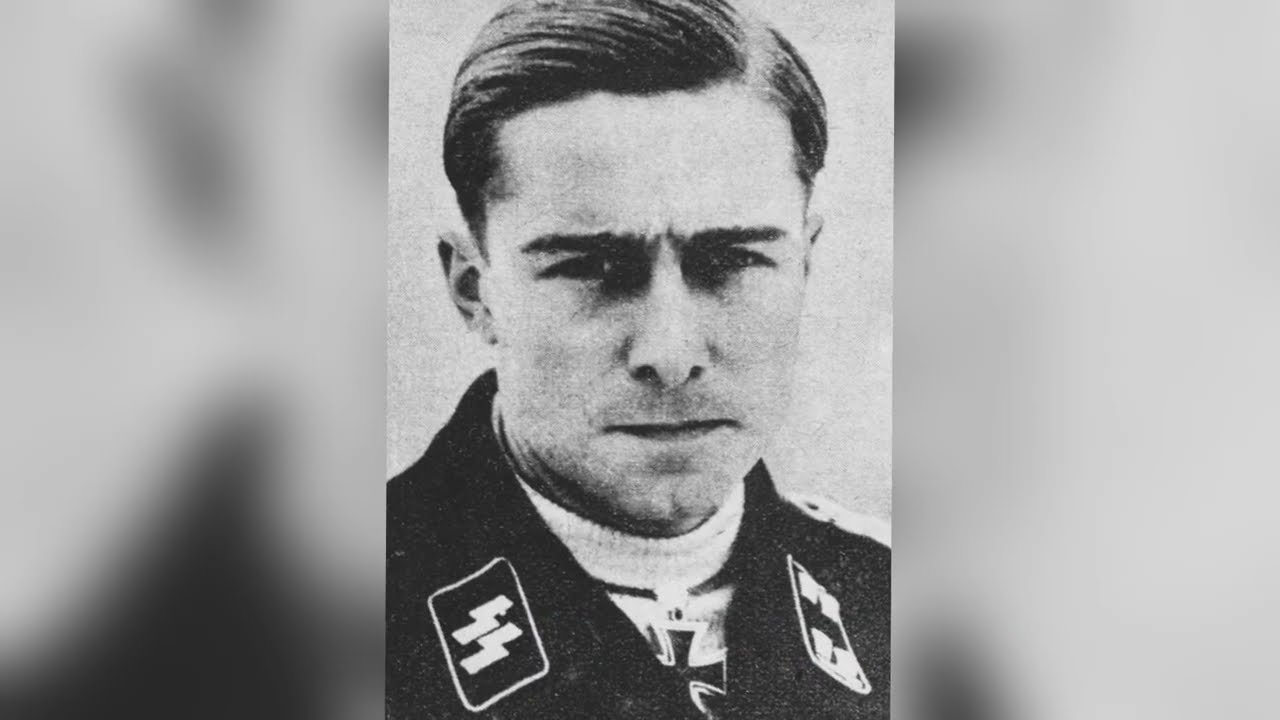
The Malmedy Massacre Trial opened at Dachau on May 16, 1946. The lead defendant was Joachim Peiper, twenty-nine years old at the time of the killings, once personal adjutant to Heinrich Himmler, holder of the Knight’s Cross with Oak Leaves and Swords. Seventy-three German defendants in total.
The prosecutors put on a case built from survivor testimony, forensic evidence collected at the Baugnez crossroads, captured German documents, and investigative work that resembled in its methodology the work done at the JAG office in Nancy.
The verdicts were returned on July 16, 1946. Forty-three of the defendants, including Peiper, were sentenced to death by hanging. Twenty-two received life imprisonment.
The rest received lesser sentences.
What followed is the part the official summary does not tell you. In the years after the verdict, defense attorneys raised serious objections about the methods of the pre-trial interrogations at Dachau. Affidavits were produced alleging beatings, mock executions, sleep deprivation.
United States Senator Joseph McCarthy, two years before he became famous for other reasons, took up the case and pressed for review.
 The Army convened review boards. The review boards reduced sentences. By 1951, every death sentence imposed at the Malmedy trial had been commuted.
Peiper’s sentence was reduced to life imprisonment. By December of 1956, Joachim Peiper was a free man. He had served roughly eleven years.
He moved to France in the 1970s and lived in a small village called Traves in the Haute-Saône department. On the night of July 13, 1976, his house was set on fire. His body was found in the wreckage.
The killing was never officially solved.
The justice that George Patton had spent the winter of 1944 ordering documented, the justice the JAG file had been built to support, the justice that had begun in a courtroom at Dachau eighteen months after Baugnez Crossroads, was by 1956 partial. It was incomplete. It was the kind of justice that human institutions actually produce, which is to say something less than what the killings would have warranted, something more than nothing.
Patton himself did not see any of it. On December 9, 1945, three months before the Nuremberg verdicts and six months before the Malmedy trial opened at Dachau, Patton was being driven from his headquarters in Bad Nauheim to a pheasant hunt outside Mannheim. His Cadillac, traveling at low speed, was struck by a US Army truck at an intersection.
The impact threw Patton forward against the partition between the front and rear seats. His neck was broken. He was paralyzed from the neck down.
He lived for twelve days in a military hospital in Heidelberg, conscious, in command of his mental faculties, attended by his wife Beatrice, who had flown over from the United States. He died on the evening of December 21, 1945, at the age of sixty.
He had outlived V-E Day by seven months and thirteen days. He had never seen Joachim Peiper in a courtroom. He had never seen the verdicts.
He had never seen the commutations. He was buried, at his own request, among the men of the Third Army at the Luxembourg American Cemetery in Hamm. His grave is one white cross among more than five thousand white crosses.
The marker gives his name, his rank, his dates, and his unit. It does not give his contradictions.
Here is the contradiction we owe him. In the autumn of 1945, in the weeks before his death, while serving as the military governor of Bavaria, George Patton kept a diary. The entries from September of that year were filled with material that does not fit the heroic outline.
He wrote about the displaced persons camps holding the surviving Jews of Europe. He used language about them that, when the diaries were edited and published after his death, embarrassed his family and complicated his historical reputation in ways that have not been resolved. He described Jewish survivors in terms that compared them to animals.
He resisted the denazification program removing former Nazi officials from positions of authority in Bavaria. He drew false equivalences in private between the Nazi party and American political parties he disliked.
These are not interpretations. They are the words in the diary. The diary was published.
The words are there.
This was the man who had vomited at Ohrdruf five months earlier. This was the man who had ordered the JAG file kept in Nancy. Both things are him.
The record holds both.
He was not a saint. He was not a monster. He was a senior American commander in the worst war in human history, who, in the autumn of 1944, in a building in Nancy, insisted that one specific thing be done.
He insisted that the record be kept. The record is what we have. The record outlives the contradictions.
Ellen Ainsworth’s grave is at the Sicily-Rome American Cemetery, Nettuno, Italy, Plot D, Row Four, Grave 18. She is twenty-four years old in the records, and she will always be twenty-four years old.
The Geneva Conventions were rewritten and expanded in 1949 in direct response to what the investigators of 1945 and 1946 had documented. The protection of medical personnel was strengthened. The language was tightened.
The signatures were taken again. The treaties are in force in every theater of war today, and they will be in force tomorrow, and they will be in force whatever new wars come.
They are in force because someone wrote it down. They are in force because a JAG office in Nancy, France, in November of 1944 kept the file.
Remember the nurse. Remember what the law said she was owed. Remember that in the imperfect, partial, contradictory machinery of human justice, someone made the record that is the history, not simplified, not flattered, not made easy.
The record holds.