He was known on Chicago’s South Side as a man who carried a loaded revolver every single day of his adult life. He had shot men in the street and walked away while they bled out on the pavement. His personal bodyguards were off-duty police officers, not because he was scared, but because the bodies were starting to attract attention. Yet even with all that violence, Al Capone did not move against him.
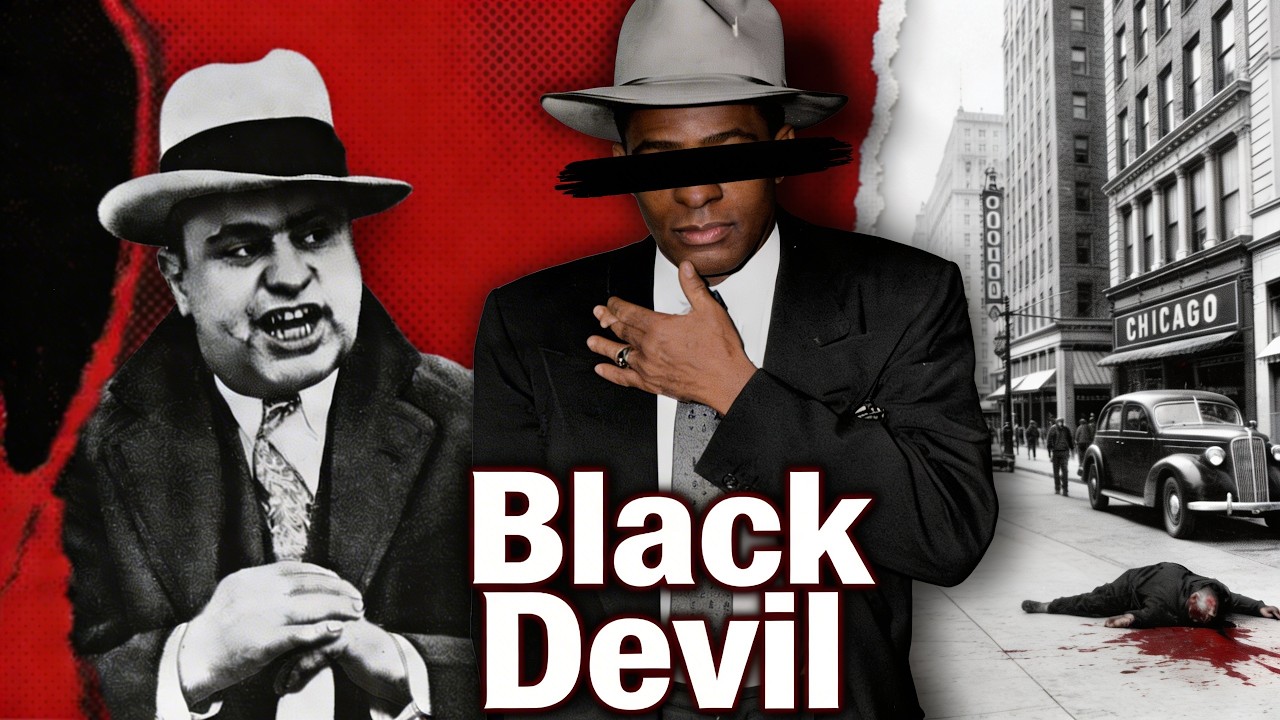
Not while Capone was alive. Because the most violent gangster in American history did the math. The man’s name was Teddy Row, a name that has largely faded from the history books but once dominated a world Capone himself could not enter. Row ran the policy racket on Chicago’s South Side, a gambling empire built on pennies and dimes from the black community.
It generated millions of dollars every single year. But this was not a man who had been raised for power. Deep in the bayou, about as far from power as a human being could get, Row was born a sharecropper’s son. He never received a single day of formal education.
Not one. He taught himself to read, to fight, to sew a suit, and to shoot a man between the eyes. That last skill would follow him his entire life. Row rose to the top of the South Side’s numbers game, a position that came with a specific kind of respect.
He ran his operation with a fairness that legitimate businesses could not match. He loaned money to his own employees and then forgave the debts. If there was a dispute, Row settled it. If there was injustice, Row corrected it.
He dressed in custom-made suits, personally tailored, because the sharecropper’s son who learned to sew as a child never lost the skill. His living room featured a fireplace made entirely of mirrors, floor to ceiling, and a six-foot television set mounted on a turntable, a device so rare in the 1940s that most people did not even have a regular television. In the policy game, his reputation was his currency. And his reputation was flawless.
But he was not soft. Stories, the kind that travel through neighborhoods like electricity through a wire, spoke of what happened to men who tried to cheat his operation. Stories of men who walked into meetings with Row confident and walked out missing teeth, or did not walk out at all. He always had a revolver on his body and a fuse shorter than a match.
He had proven more than once that he was willing to use both. When Capone’s scouts went into the black belt to assess the situation, they came back with the same report: these men were armed, organized, deeply embedded in a community that would die for them, and led by a man who settled disputes with a pistol, not a handshake. Capone did something he almost never did. He made a deal.
The agreement was simple: Capone’s men would stay out of the south side, and the policy kings would stay out of the beer and liquor business. Each side stayed in its own lane. But that wasn’t a partnership between equals. It was a division of territory that left the South Side as the one place in the city where the Italian mafia could not simply walk in and take over.
For two decades, the South Side of Chicago was the one piece of territory that the Italian mafia did not control. Then Capone was gone. With the boss out of the picture, the Italian mafia sent its most ambitious soldiers south. They were armed.
They were arrogant. And they had no idea what they were walking into. The first move was a kidnapping. Then one by one, the major policy operators on the south side made the same choice.
Some simply vanished, packed a bag in the middle of the night and drove until they hit a state line. They were never heard from in Chicago again. Teddy Row did not pack a bag. When the outfit came to him with the same demand, pay the tax, hand over control, or face the consequences, Row did not negotiate.
He did not ask for terms. Flat, final, absolute. And then he did not run. The Italian mafia sent enforcers into the black wards, but the people rallied behind him like he was a general in a war, because that is exactly what he was.
They started placing their bets with him specifically because he was fighting. He had a crew that included off-duty police officers, and he was a man who had been settling disputes with a revolver since before the young Italian soldiers were old enough to hold a gun. A fight broke out between Teddy Row and the outfit’s man. Punches, grappling, and then a gunshot.
The rest of the crew scrambled into their car and fled. It had almost never happened, and when it did, the person responsible usually ended up in a ditch within 48 hours. But Row did not hide. He waited.
The outfit sent more men, and they were greeted with the same answer. Row was denied bail six times before and during the trial. He was a man who would die on his own terms, not behind walls, not surrounded by guards, not hiding. Three days after the last conversation, on the evening of August 4th, 1952, Teddy Row put on a three-piece suit, a pressed shirt, and a hat, the same way he had dressed every day of his adult life.
He never had a chance to pull his revolver. The men who came for him found him standing, and they shot him down. He left behind a fortune of over a million dollars, a sum that in 1952 was more than most families earned in a year. His funeral was the largest for any black person in Chicago since Jack Johnson, the first African-American world heavyweight boxing champion, had died in 1946.
Over 6,000 people came to the church on Wabash Avenue. Strangers held each other. The entire community stopped to mourn a man who had done what no one else had dared to do. After Row’s death, the Italian mafia seized complete control of the Southside policy racket.
But it was not handed to them by the police or the government. It was taken by the same men who had come for Row and found one man standing in their way for six years, a man who had earned the one thing the Italian mafia almost never gave anyone: respect. The south side of Chicago never forgot his name.
They killed him, but they never broke him.