On a cold morning on 116th Street, a man in a charcoal coat approached a newsstand and asked for a copy of the morning paper. When the vendor offered a remark—suggesting that certain people had no need to follow the news, since they would always be errand runners in a neighborhood belonging to other men—the man did not argue. He reached into his pocket, produced another coin, and requested a second copy of the same paper. He folded that second copy once, placed it under his arm unread, and walked away, leaving the first copy in his hand.
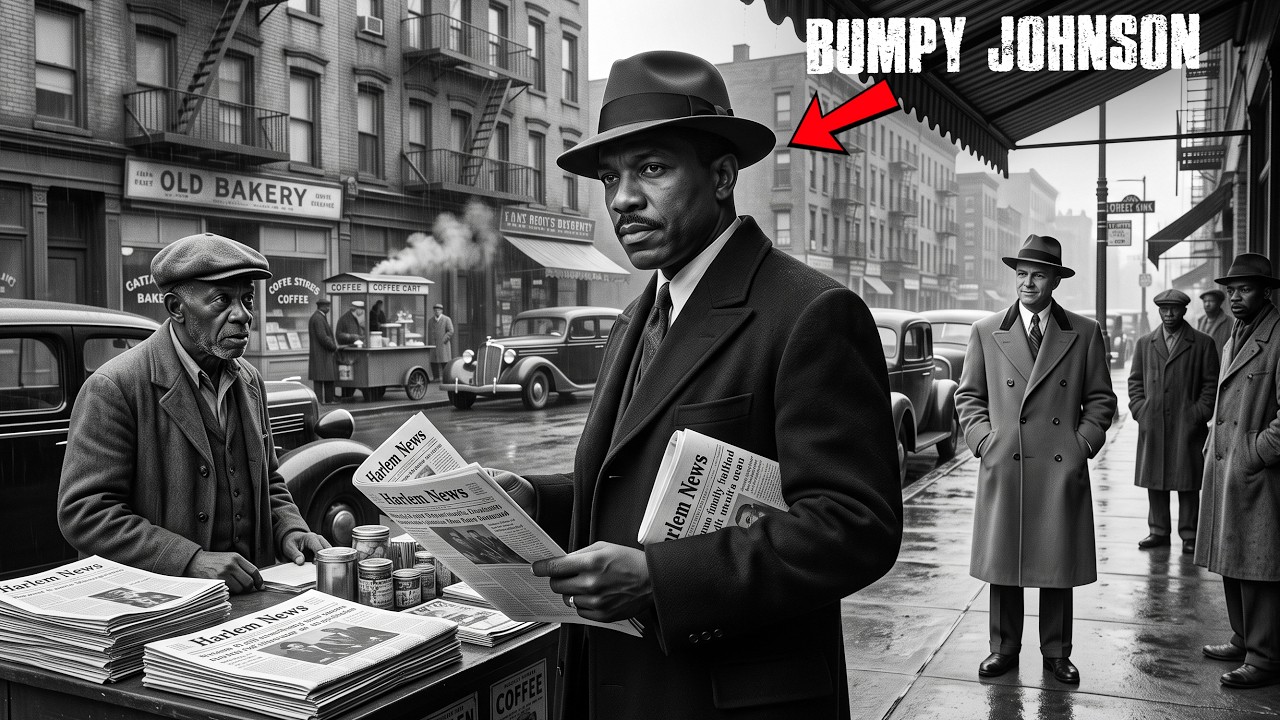
The man was Johnson, and the small, quiet exchange became a private ritual. From that morning on, he bought two copies of the paper every day, and every day he carried one copy unread beneath his arm. To those who noticed, the habit seemed strange, but for Johnson it was a daily discipline. The folded paper was a reminder of a larger truth he had come to understand: that a man who wished to control a neighborhood must first understand who controlled the flow of everything within it—including the news, the small transactions, and the coins that passed across the newsstand’s wooden ledge.
Johnson had spent years studying that flow. He saw that Harlem generated enormous sums of money each day, and that nearly all of it left the neighborhood by nightfall. The system, as he understood it, was not built on force alone. It depended on the belief, carefully cultivated and widely accepted, that the people of Harlem were small, that their labor was meant to enrich others, and that their own economy was beyond their ability to control.
The downtown interests, the lenders and landlords and suppliers who profited from that arrangement, did not need to threaten anyone individually. They only needed to keep the belief in place. Johnson began asking questions. He consulted a woman of the church, a figure of quiet authority whose community standing could not be attacked by the downtown interests because it rested on faith rather than commerce.
When he asked her how much of the neighborhood’s wealth flowed away each week, she considered the question for a long time. She told him the amount was greater than most people imagined, and that it grieved her to watch it go. She told him that if that money stayed, it could rebuild half the neighborhood within a decade. He spoke next to Grayson, a lawyer who had built a modest practice handling the wills, property disputes, and small contracts that made up the legal life of a working neighborhood.
Johnson explained that he was not looking to break the law, but to understand where it lay—so that pressure could be applied in places where the opposing power had no legal recourse. Grayson, cautious but convinced, proposed a strategy that avoided lawsuits and public confrontations, which would have alerted the other side and invited retaliation. Instead, he suggested the quiet education of individual businessmen, one at a time, each of whom would be shown a fairer alternative. Johnson also sought out O’Conquo, a natural organizer who commanded the loyalty of hundreds of working men.
These were the deliverymen and laborers who formed the physical circulatory system of the neighborhood’s commerce. Johnson’s plan spoke directly to their desires. He did not ask them to sacrifice themselves in a doomed uprising. He offered them a role in building something that would reward them and the community together.
Not everyone trusted him. A woman of the church, the same one he had consulted, had heard such promises before and had watched them dissolve into the same corruption they claimed to oppose. She told him as much plainly. Johnson did not defend himself with words.
He asked her only to observe him and to judge his actions over time. He told her that if she ever saw him betray the community, she should say so from her pulpit, and he would not contest it. She could not order anyone to do anything, and she would not have even if she could. But her acceptance carried weight in a neighborhood where the church stood at the center of community life.
Johnson understood that no single ally could replace another. Each occupied a position that no other could occupy. The woman of the church supplied moral authority, Grayson supplied legal knowledge, and O’Conquo supplied organized labor. Johnson himself supplied the overall structure, the plan that bound their separate strengths together.
He divided his approach into several distinct forms of pressure, and he applied each one deliberately, in sequence and in combination, so that the opposing power never faced a single clear threat it could identify and destroy. His first target was the system of high-interest lending. A shopkeeper who had borrowed money years before to stock his shelves was paying interest at a rate that consumed nearly all his profit. He worked long days merely to enrich a lender he had never met.
Johnson arranged for that shopkeeper to refinance through a pool of capital assembled within the neighborhood, at rates that were fair and that kept both the loan and the interest inside Harlem. The shopkeeper kept the fruit of his labor for the first time in years, and the downtown lender lost a steady source of income. It was a single transaction, insignificant on its own. But there were hundreds of such shopkeepers, and as the months passed, one after another made the same quiet choice.
Each choice was a small wound to the old arrangement, and together they began to form the shape of something new. The change was woven into the ordinary fabric of the neighborhood’s life. To undo it, the opposing power would have had to undo the neighborhood itself. Johnson did not rely on dramatic acts.
He filed no dramatic lawsuits and he issued no threats. Instead, he made it known, one client at a time, that the law did not require them to submit to arrangements they had accepted only out of ignorance. He created alternatives that were legal and defensible, supported by lawyers and clergy and organized workers and merchants. Any attempt to attack the new arrangement would provoke a response from every other point.
When the moment came for a direct meeting with the downtown interests, Johnson brought no weapons and no show of force. He brought only the knowledge of what he had built and the certainty that it could not be dismantled by any means available to the men across the table. He did not threaten them in return. He explained that the neighborhood’s money had already begun to circulate along new channels, that these channels were legal, and that any attempt to interfere would cost them more than they could hope to gain.
The men across the table understood the calculation. They were not persuaded by a single conversation, but they were realists. They understood that the choice before them was not between dominance and negotiation, but between negotiation and a prolonged conflict that would cost them more than they could gain. And so, slowly and without any public announcement, the relationship between Harlem and the downtown interests was renegotiated.
The victory was not announced in any newspaper and it was not celebrated with any public ceremony, but it was felt in a thousand small ways. The downtown interests did not disappear, and Johnson did not drive them out entirely. He allowed them to retain a diminished but real position. By doing so, he transformed them from enemies who must resist him into participants who had reason to accept the new arrangement.
This was not weakness, but a deeper form of strength—the strength of a man secure enough in his victory that he did not need to make it absolute. The campaign that began at the newsstand on 116th Street stood apart in the memory of the neighborhood because it had been won without a single dramatic act. There was no public battle, no noise, no spectacle. It had been won through patience, organization, and the accumulation of countless small choices.
The folded newspaper remained under Johnson’s arm each morning, a discipline that reminded him each day of the difference between reacting and responding—between the man who answers an insult with anger and the man who answers it with years of patient work. The lesson outlasted the campaign that had created it. Younger men and women who came of age in Harlem in the following decades absorbed, sometimes without knowing its origin, the idea that a community’s wealth should serve the community, that its labor and its capital and its moral authority could be organized into a coherent force. They learned that the loudest response to an insult was rarely the most effective one, and that a network survives the loss of any single node while a chain breaks at its weakest link.
Johnson lived many years after that period, and his life contained other chapters that history has recorded in its own way. But the belief that a community could organize itself to reshape its own economy was perhaps his most lasting legacy. It was more lasting than any particular arrangement of money, because arrangements change and money moves, but the understanding that a people could control their own affairs—once planted—was not easily removed. The story returns at its end to the image with which it began: a man in a charcoal coat standing at a newsstand on a cold morning, holding two copies of a single newspaper.
He made no promises and issued no threats. But the folded paper under his arm was a statement all the same, quiet and complete.