Egil’s Saga chronicles the transformation of a fearsome Viking warrior from a youth consumed by violence into a figure of considerable wisdom, all while navigating the brutal political landscape of 10th-century Scandinavia. The tale begins with his grandfather, Kveldulf, a revered berserker whose volatile temper earned him the name “Evening Wolf. ” This fierce lineage unfolded under the iron rule of King Harald Fairhair, a monarch who sought to unite Norway through conquest and bloodshed. Even as a child, Egil demonstrated the explosive nature that would define his early years.
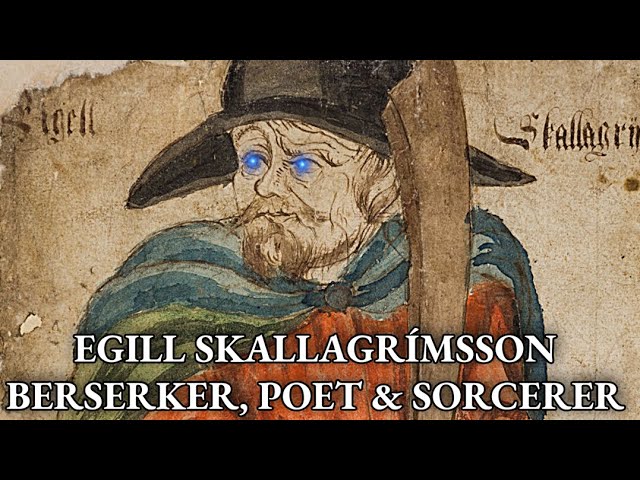
After losing a ball game to an older boy, the young Egil, consumed by rage, fetched an axe and killed his opponent with a single blow to the skull. By age twelve, he had grown into a towering figure, surpassing most men in size and strength. His confrontation with his own father, Skallagrim, proved equally violent. When Egil and a companion challenged him in a game of strength, Skallagrim’s fury erupted, and he killed Egil’s friend by slamming him into the ground.
Only the intervention of a devoted thrall, who sacrificed herself to calm the enraged father, spared Egil’s life. In the aftermath, Egil retaliated by killing one of his father’s prized thralls, creating a bitter silence between father and son that lasted for a considerable time. Egil’s family had been exiled from Norway, and after his father’s death, he and his brother Thorolf sought to reclaim their place in the world. They eventually offered their services to King Aethelstan of England, who welcomed the battle-hardened warriors as potential allies.
During a fierce battle, Egil fought with unyielding ferocity, his sword slicing through enemy ranks while Thorolf fought with equal valor. As night fell over the blood-soaked landscape, both sides made camp, their weary warriors nursing their wounds and planning their next moves. During the engagement, Thorolf was killed, and Egil found and buried his fallen brother before going to see King Aethelstan at the victory feast. The king, recognizing Egil’s immense service and grief, rewarded him with two golden arm rings and an expensive cloak that Aethelstan had personally worn.
He invited Egil to remain in his court as his man, but Egil felt bound by honor to return to Norway. He had learned that his late brother’s widow, Asgard, needed his protection, and he was determined to look after her and claim his inheritance. Before leaving, Egil met with Asgard and vowed to care for her. King Aethelstan, however, persuaded his old friend to remain in England once his business in Norway was concluded, promising him command of his armies upon his return.
Egil agreed but insisted on first settling his brother’s affairs. Egil’s time in Norway placed him directly in the path of King Eric Bloodaxe, his family’s bitterest enemy. Eric, who had killed two of his brothers to secure his crown, had a deep-seated hatred for Egil’s family. After Egil killed one of Eric’s men in a dispute, the king summoned him.
At the royal court, Queen Gunnhild, who had long harbored a personal grudge against Egil, demanded his death. However, Arinbjorn, a loyal friend who had once saved Egil’s life from Eric, spoke in his defense. Arinbjorn argued that if Egil had spoken ill of the king, he could atone with words of praise that would endure forever. After a long silence, Eric relented and decreed that Egil should live, though he commanded that Egil never appear before him or his family again.
To secure his freedom, Egil composed a magnificent drápa, a formal skaldic poem in honor of King Eric. In the poem, titled “Head-Ransom,” Egil wove verses of praise for the king, celebrating his prowess in battle. The poem was filled with vivid imagery of battle—swords swelling with sound, shields smiting around the king, and blood streaming from foes. Eric, moved by the praise and the audacity of the poet, granted Egil his life and allowed him to leave, though the enmity between them never truly faded.
Egil, grateful to his friend Arinbjorn, presented him with the two golden arm rings given to him by King Aethelstan before setting sail once more for Norway. In Norway, Egil learned that Thorolf’s father-in-law had died, leaving a considerable inheritance. He and his cousin Thorstein made plans to claim their due, but King Eric demanded payment for Egil’s crimes, viewing the Norwegian land claims as forfeit. Eric told Thorir, one of his men, “I will accept some payment for what Egil did, but he cannot stay in my kingdom for long.
” A substantial fine was then paid to Thorir, and Egil was given a short time to leave the country. Before departing, Egil sought out Asgard and his young nephew. After settling his family affairs, he made his way to the estate of a man named Armod, an act that would lead to one of the most famous episodes in his saga. Armod, a relative of Eric’s, was known for his inhospitality.
When Egil arrived demanding shelter and a place at the table, Armod refused, mocking the outlaw. In the confrontation that followed, Egil killed Armod, an act that once again put him at odds with the king. Rather than flee, Egil decided to face his enemies directly. He went to the estate of King Eric, where he presented himself before the king and Gunnhild, who was both his greatest enemy and his uncle’s widow.
At court, Egil recited a poem in honor of the king, but the mood was hostile. Gunnhild, who had a personal vendetta against Egil, reminded Eric of their son’s death, and the king ordered Egil’s execution. But Arinbjorn, ever loyal to his friend, intervened once more, telling Eric that Egil’s poetry would be remembered long after the king was gone. Weary of the constant conflict, Eric agreed to spare Egil’s life on the condition that he leave Norway and never return.
Egil, his life spared, recited a verse of gratitude and left the hall. He then made his way to the home of Thorfinn, a powerful chieftain and a distant relative. Thorfinn’s daughter, Gunnhild, had been married to Egil’s brother, and the two men developed a deep bond. When Egil learned that King Eric had laid claim to his family’s lands, he decided to take a dramatic stand.
He traveled to the king’s estate and, under the cover of night, erected a large pole with a horse’s head attached to the top. In a solemn ritual, he declared:
“Here set I up a curse pole, and this curse I turn on King Eric and Queen Gunnhild. This curse I turn also on the guardian spirits who dwell in this land, that they may all wander astray, nor reach or find their home, till they have driven out of the land King Eric and Gunnhild. ”
He then planted the pole in the ground and left it to stand, the horse’s head turned inland to the mainland.
On the pole, he carved runes expressing the entire curse. With this act, Egil sealed his fate, but he also cemented his reputation as a man who challenged even kings with impunity. He then made his way to Iceland, where he would spend the rest of his days. Back in Iceland, Egil reunited with his father, Skallagrim, but the reunion was short-lived.
Skallagrim soon died, leaving Egil to take charge of the family farm. He managed his inheritance with the same fierce determination he had shown in battle, but the loss of his brother Thorolf and the death of his father weighed heavily on him. He also carried the knowledge that his family had long been at odds with the kings of Norway, a conflict that had cost them their ancestral lands. Egil’s story, as told in the saga that bears his name, is one of a complex man defined by virtues of honor, loyalty, respect, and friendship—qualities he cherished above all else.
To break these codes was to invite his wrath, and whether through force or guile, he always sought to defend his family’s honor. He was described as large-featured, broad of forehead, with large eyebrows, a nose not long but very thick, lips wide and long, and a chin exceedingly broad. He was thick-necked and big-shouldered, a physical presence that matched his formidable reputation. He triumphed in many single combats, becoming known as one of the finest warriors of his age.
He is also considered by many to be one of the greatest poets and skalds in Scandinavian history, credited with introducing the dróttkvætt meter into Old Norse verse. The saga also tells of Egil’s final years, when he felt the weight of his past. In his old age, he became embittered and, in a final act of violence, was said to have killed two thralls who had helped him bury his silver. He commanded them to hide his treasure, and to keep the secret, he killed them.
The legend of Egil’s hidden treasure was born—a cache of silver that may still lie buried in Iceland’s soil today. Egil’s Saga, written around the mid-13th century, spans the years 850 to 1000, immortalizing a man who was both a legend in his time and a symbol of the fierce, complex world of Viking Scandinavia. His story remains one of the most detailed and incredible in the sagas, a testament to a life lived on the edge of a sword and a verse.