The garage door rattled upward. Cold morning air rolled in. I frowned. The spot where my Volvo had stood for twelve years was empty.
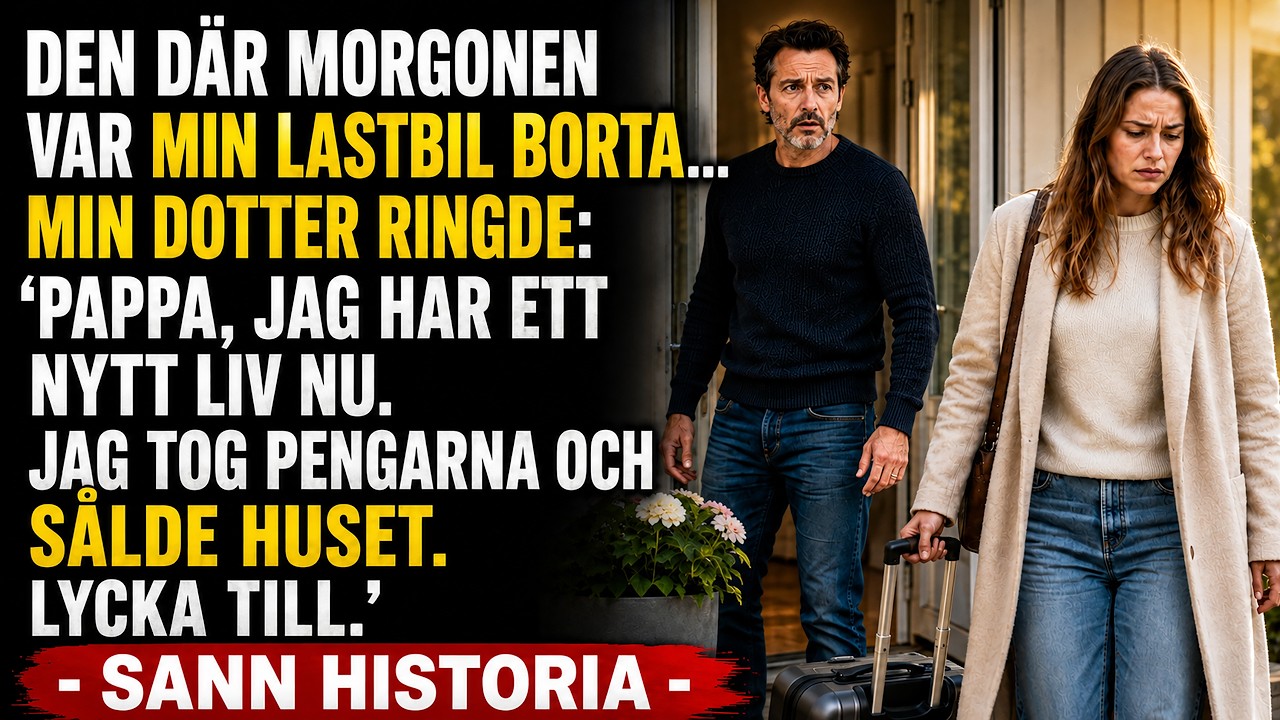
I looked left, then right, as if a full-size station wagon could hide behind the garden tools. Nothing. Just the dark oil stain on the concrete. The spare keys were gone from the workbench.
The garage remote too. My stomach tightened. I hurried back inside faster than my knees appreciated. The bottom drawer of the filing cabinet hung open.
Every document that mattered was gone—registration papers, insurance, tax records, even my passport. The phone vibrated. Linnea. “I see you’ve already found it,” she said.
She actually laughed. “Found what? ”
“The empty garage. ”
I leaned against the kitchen counter.
“What are you talking about? ”
“I’m done, Pappa. No more responsibility for an old man. ”
“I handled your bills, your appointments, your bank matters.
I basically ran your life. ”
“You offered because someone had to. ”
Outside, a lawnmower started somewhere down the street. The neighborhood continued like any ordinary Thursday.
My world had silently stopped. “What have you done, Linnea? ”
“I sold the house. I moved the money.
I took the Volvo. ”
The words landed one at a time, each heavier than the last. “That house isn’t yours. ”
“In practice, it is.
”
“Where are you? ”
“Far enough away. ”
“Are you with Oscar? ”
She didn’t answer.
That was answer enough. “Soon we’re leaving Västmanland. ”
“Do you really think this ends well? ”
“I think I deserve something after wasting ten years taking care of you.
”
I could have corrected her. Reminded her who paid every electricity bill after each divorce. Who covered the credit cards. Who paid the lawyer when her second marriage collapsed.
Who let her move home three times. Instead I asked quietly, “Did you ever feel grateful? Even once? ”
She snorted.
“You always play the victim. ”
A man’s voice murmured in the background. Oscar. “I don’t have time for this,” she said.
Then: “You’ll figure something out. ”
Click. The line went dead. I stood at the counter until my coffee went cold.
Maybe ten minutes. Maybe thirty. Eventually I carried the mug to the patio and sat in Ingrid’s old chair instead of my own. The birds had already finished eating.
The yard felt strangely quiet. I thought about Linnea at five, chasing fireflies until she tripped over her own feet. The night her first husband admitted the affair—she showed up at my door after midnight, wedding ring still on her finger. “Pappa,” she whispered through tears.
I opened the door without a single question. The second divorce came four years later. The third lasted less than two. She stood on this same patio with two suitcases and said she didn’t know where else to go.
I never hesitated. Maybe that was my mistake. I spent so much time helping her survive that I never taught her to stand alone. At eight o’clock I called Lennart Holm.
He answered on the second ring. “My Volvo is gone. My accounts are empty. Linnea says she’s sold my house.
”
Lennart didn’t interrupt. When I finished, he asked one calm question: “Do you still have everything? ”
I looked toward the basement door. “I think so.
”
“Go check. ”
The old gun cabinet stood behind a shelf of paint cans. I hadn’t opened it in years. The heavy steel door creaked open.
Inside lay a thick yellow envelope. On the front, six words in Ingrid’s handwriting: *If Linnea ever tries again. *
“I found it,” I whispered into the phone. Lennart let out a long breath.
“I hoped we’d never need that envelope. ”
“So did I. ”
—
Lennart arrived in less than twenty minutes. He’d worked thirty-two years as a local police investigator.
He knew feelings could wait. Evidence couldn’t. We spread the envelope’s contents across the dining table. Ingrid always called that table the family court.
Every major decision in our home had been made there. Now it held documents I’d hoped never to use: certified copies of the property deeds, bank authorizations, a thick binder from an inheritance lawyer, and a small USB drive taped inside the cover. Seven years earlier, life had looked very different. Ingrid had been gone four years.
Linnea had just ended her third marriage, standing on my patio with two suitcases and a cardboard box of framed photographs. “I have nowhere to go,” she’d said. “You always have somewhere to go. ”
Three days later she started helping around the house.
Organized my medications. Set up digital accounts for bills because I still preferred mailing payments the old-fashioned way. She called it dragging me into the modern age. I appreciated it.
That was the problem. One call changed everything. A loan officer from a local credit union asked why I hadn’t made the first payment on a private loan for three hundred thousand kronor. I’d never applied for any loan.
When she put the papers in front of me, my stomach turned. The signature looked almost perfect. Almost. I knew my own handwriting.
That wasn’t mine. Surveillance footage showed Linnea submitting the documents. “My daughter forged my signature,” I said, hoping I was wrong. She confessed before I finished the question.
“I was going to pay it back. I just needed time. I didn’t think you’d help me again. ”
That hurt more than the forgery.
Because she was wrong. I had helped her. I always had. Lennart wanted me to report it.
“If you let this pass, she’ll think she got away with it. ”
“I can’t send my own daughter to prison. ”
“It’s not you sending her, Erik. ”
“I can’t.
”
I paid the loan. Linnea promised it would never happen again. Lennart stopped arguing and drove me to a lawyer two weeks later. Karin Lundqvist had gray hair and sharp eyes.
She listened more than she spoke. Then she put her hands on the table. “Mr. Bergström, your biggest financial risk isn’t a stranger.
It’s someone who already has your trust. ”
I didn’t want to hear it. She explained a Swedish family foundation and holding structure—legal protections I could put around the house and assets. Not to cut Linnea out, but to make sure no one, not even her, could lose everything before I was gone.
She recommended an independent administrator. Certified copies kept in multiple places. Her office, the land registry, my fireproof cabinet, a digital backup, and a sealed envelope with Lennart. “If anyone ever questions ownership,” she said, “there should not be a single weak point.
”
It felt excessive. I almost laughed. Who would go to so much trouble? She looked at me kindly.
“People who never thought they’d need it. ”
I didn’t follow all her advice. She’d suggested separate passwords and two-factor authentication for everything. I thought Linnea handled all that.
I was wrong. —
The investigation moved fast once it started. Detective Inspector Sara Lindqvist from the Economic Crime Authority showed up at my door with business clothes and a leather briefcase. No uniform.
She shook my hand firmly. “I’ve already spoken to the bank,” she said. My heart sank. “The transfers were approved through your account.
”
“I approved nothing. ”
“I know. ” She opened her folder. “Whoever did this made several mistakes.
”
The land transfer filed yesterday didn’t match the registry’s ownership records. The electronic BankID verification didn’t exist. The certificate had failed validation. The power-of-attorney document wasn’t even a correct version of a Swedish form.
Lennart raised an eyebrow. “Whoever did this downloaded a fake template. ”
Sara nodded. “It won’t hold up.
”
For the first time that morning, I felt something other than grief. Not hope, exactly. Certainty. Linnea hadn’t gotten away with it.
“This isn’t just a family dispute anymore,” Sara said. “We’re investigating identity abuse, bank fraud, digital fraud, and conspiracy. ”
The room went very quiet. Three days passed.
No calls. No explanations. No messages. I checked my phone anyway, the way old men do—telling ourselves we’re checking the weather when we’re really hoping for a missed call from someone who used to need us.
The following week, Sara called with an update. Part of the money had already been frozen. The land registry had rejected the transfer. My house had never legally been sold.
Then she asked a question that made my stomach clench: “Does the name Oscar Lind appear on any of your financial accounts? ”
“No. ”
“We didn’t think so. But his office computer appears in several login logs.
”
“How is that possible? ”
“We believe your daughter gave him access. Or he convinced her to. ”
Later, Sara showed me the text messages recovered from a cloud backup.
Hundreds of them, mostly between Linnea and Oscar. *”Linnea, do we really have to do this so fast? “* Oscar wrote. *”The old man will figure it out if we wait,”* he answered himself a minute later.
Another exchange: *”Linnea, are you sure this is legal? “*
*”Oscar, stop asking questions. “*
Then the message that drained all the color from Linnea’s face when it appeared on the courtroom screen: *”Take everything. “*
Sara had linked Oscar Lind to three previous investigations involving elderly victims.
One in Norway. One in Denmark. One in Skåne. Same pattern: older person, new romantic relationship, sudden financial activity, assets disappearing.
Linnea wasn’t the mastermind. She was manipulated. But she’d chosen it—chosen him, chosen the access, chosen to go through with it. A part of me wanted to hate her.
It would have been easier. Instead I kept seeing the little girl who ran into the garage after school holding drawings. *Pappa, look what I made. *
I didn’t know when that little girl disappeared.
Or maybe I’d just stopped noticing. —
Lennart came over with fishing rods. “We’re going tomorrow. ”
“I don’t feel like fishing.
”
“Good. Neither do I. ”
“Then why? ”
“Because sitting in this house changes nothing.
”
He was right. I wanted her to call. I wanted her to cry and say she’d ruined everything. Instead, Sara called before seven the next morning.
“We’re ready. ”
“Ready for what? ”
She answered quietly. “Tomorrow everything changes.
”
—
I woke before dawn to three steady knocks at the door. Not banging. The kind of knocking that tells you the person outside isn’t selling anything. Two police cars.
One unmarked vehicle. Sara stood on my porch in a navy windbreaker with the Economic Crime Authority emblem on the chest. Two uniformed officers and a man with evidence boxes waited behind her. The search was methodical.
No one rushed. Sara wore white gloves, examined every document, compared copies against electronic records on her laptop. Foundation documents, the original holding agreement, Ingrid’s death certificate, my driver’s license. Everything photographed before being placed in evidence binders.
By mid-morning, the neighborhood had noticed. Fru Andersson stood on her porch across the street. Then another neighbor. Within fifteen minutes, half the block had found a reason to check their mail.
Sara’s phone buzzed. Someone had posted a photo of my house in the local Facebook group. “Eight police cars at Erik Bergström’s house this morning. ” It was three cars.
By the fifth comment, someone claimed I’d been arrested for tax fraud. Another guessed domestic violence. The rumors spread faster than the facts. Then Sara got the call.
They’d found my Volvo outside Malmö. Oscar had been arrested trying to change the registered owner through the transportation agency. “There’s more,” Sara said carefully. “They found documents in the car.
”
“What kind? ”
“Fake identification. BankID credentials belonging to at least four other elderly people. ”
I stared at her.
Four. Possibly more. “We’re coordinating with investigators in Skåne, Denmark, and Norway. ”
Lennart muttered under his breath.
“I knew he wasn’t an amateur. ”
Linnea agreed to meet with investigators voluntarily. She thought she could explain everything. Instead they showed her document after document—electronic signatures, login histories, property records, transfers, GPS data, phone logs.
At the end of the interview, she stopped talking. Sara told me she asked one question: “Can I call my father? ”
They asked me. I looked at Ingrid’s empty rocking chair.
She’d been gone eleven years, but I still caught myself expecting to see her knitting there. What would she have wanted? Forgiveness, probably. Also protection.
Those two things had never seemed so far apart. “I can’t,” I said. Sara waited. “Tell her I need time.
”
—
The district court looked exactly as I remembered. Stone walls, high pillars, flags moving slowly in the July heat. I’d been there before to update the deed on our first house. I never imagined walking through those doors because of my own daughter.
Lennart parked and killed the engine. “Are you ready? ”
“No. ”
“Neither am I.
”
We sat for a moment. Then he sighed. “If we stay here, the judge’s schedule won’t change. ”
Linnea came in first.
No designer sunglasses, no jewelry. A simple navy blouse and gray trousers. Her shoulders were slumped. She looked smaller.
Older. She looked at me. For one second I saw the girl who used to wave from the school bus window. Then the court officer led her to the defense table.
Oscar arrived with a pressed suit and perfect hair, smiling at someone in the gallery like he was attending a business meeting. That smile disappeared when the prosecutor began. Witness after witness laid out the evidence. A land registry official described the forged transfer.
A bank investigator walked through the electronic transactions. A cybersecurity analyst showed login logs on a large screen. Every transfer, every IP address, every timestamp. The prosecutor never raised his voice.
He didn’t need to. Facts can speak louder than anger. Oscar’s lawyer argued that Linnea handled the financial decisions. Linnea’s lawyer argued that Oscar had manipulated her.
Then Inspector Sara Lindqvist took the stand. “Based on your investigation, who initiated the fraudulent property transfer? ”
“The evidence shows Oscar Lind prepared the forged documents. ”
“And who provided access to Mr.
Bergström’s financial accounts? ”
Sara paused. “Linnea Bergström knowingly provided account information and personal data. ”
The room went silent.
After lunch, the prosecutor displayed the recovered text messages. One appeared on the screen:
*”The old man won’t understand. Take everything. “*
Nobody moved.
Oscar’s lawyer slowly removed his glasses. The silence did more than any further questioning. Then it was my turn. “Mr.
Bergström, how long did you work as a heavy machinery mechanic? ”
“Forty-three years. ”
“What did you like most about it? ”
“Fixing things.
”
“Why? ”
“Because most problems have a cause. Once you find the cause, you can usually repair it. ”
The prosecutor waited.
“Did you think people worked the same way? ”
I looked at Linnea. She stared at the defense table. “I did.
”
“What changed? ”
I swallowed. “I spent years believing that if I just loved my daughter enough, if I kept helping her, she would eventually stop needing to be rescued. ”
The courtroom was completely still.
“I didn’t protect her. I protected her from being responsible for her own choices. ”
I paused. “I spent forty years fixing broken machines.
”
A faint smile crossed my face. “Turns out engines are simpler. ”
Even the judge smiled briefly at that. Oscar’s cross-examination lasted less than ten minutes.
His lawyer suggested I’d voluntarily given Linnea access to my accounts. “She knew your passwords? ”
“Yes. ”
“So she had permission to help pay bills.
”
“Yes. ”
“Then why are we here? ”
I looked straight at him. “Because I never gave anyone permission to pretend to be me.
”
He nodded once. No more questions. Before the verdict, Linnea was allowed to speak. She rose slowly, hands shaking.
“I’ve blamed everyone my whole life,” she said. “My ex-husbands. My mother for dying. My father for always making everything okay.
”
She was crying openly now. “I convinced myself I deserved what I took. ”
She turned toward me. “Pappa.
I don’t expect forgiveness. ”
I didn’t answer. She nodded, as if she’d expected exactly that. Then, almost like a frightened child: “Did you ever stop loving me?
”
The room disappeared. For a second there was only the two of us. I remembered teaching her to ride a bike. Holding her hand at Ingrid’s funeral.
Waiting outside emergency rooms after every failed marriage. “No,” I said, my voice steady. “I never did. ”
She closed her eyes.
“That’s why today hurts. ”
Tears ran down her face. Mine too. The judge sentenced Oscar first.
Prior convictions, his role organizing the fraud—a long prison sentence, restitution, additional penalties for economic crimes across multiple investigations. Then Linnea. The court noted her cooperation after Oscar’s arrest and her lack of prior serious convictions. Still, the crimes were serious.
Prison time with supervision, restitution, damages. Justice wasn’t loud that day. It wasn’t satisfying the way movies pretend it is. No one applauded.
No one celebrated. A father walked out of the courtroom without his daughter. A daughter walked out in handcuffs knowing she had put herself there. As the officers led her toward the side door, she turned one last time.
She didn’t say anything. Neither did I. Some conversations are already over before either person realizes it. Outside, Lennart handed me the keys.
“Your Volvo. Recovered yesterday. ”
I stared at the old blue Volvo parked across the street, sunlight reflecting off the hood. For the first time in months, I understood I wasn’t walking away empty-handed.
I was walking away with the truth. Sometimes that’s the only thing worth carrying. —
Nearly a year has passed since that day in court. People ask if life ever returns to normal after something like that.
The honest answer is no. It becomes different. Different isn’t always worse. Sometimes it’s just quieter.
I still wake before sunrise. The blue ceramic mug Ingrid bought me all those years ago still sits in the same cabinet. The crack in the handle hasn’t grown. Neither has the crack in my heart.
I’ve just learned to carry both. The old silver Volvo never came back the way it left. The insurance covered some repairs, but eventually I sold it. Too many memories.
Too many fingerprints from a chapter I wanted to close. I bought a blue Volvo instead. Ingrid’s favorite color. Not pretty, not new.
Just reliable. At my age, reliable matters more than impressive. Two days a week I volunteer at a workshop on the north side of Västerås. We repair cars for pensioners who can’t afford workshop costs.
Most of us are retired mechanics. One worked at Volvo. Another spent thirty years fixing city buses. We joke that the four of us together have forgotten more about engines than most workshops ever knew.
One Wednesday, an older woman came in with a twenty-year-old Saab and a gearbox problem. She apologized three times before handing me the keys. “I’m embarrassed to bring something so old. ”
I smiled.
“Half the people who work here are older than your car. ”
She laughed so hard she had to wipe her eyes. Those moments surprised me. I wasn’t sure I’d ever laugh again after everything that happened.
Healing doesn’t arrive all at once. It creeps in quietly. One ordinary afternoon at a time. Lennart still comes by almost every Saturday.
Sometimes we fish. Sometimes we don’t. Truth is, we spend more time drinking coffee than catching anything. One cold October morning we sat at Mälaren, lines in the water, not a single bite for over an hour.
“You know what? ” he said. “We’re terrible fishermen. ”
“We’ve always been terrible fishermen.
”
“So why do we keep coming? ”
I looked out over the water. “Because fish don’t ask uncomfortable questions. ”
He laughed.
“I’ll drink to that. ”
We sat quietly for a while. Then he asked the question he’d been avoiding for months. “Have you heard from Linnea?
”
“Some letters. ”
“Do you answer? ”
“Not directly. ”
“What does she write?
”
“The first ones asked for forgiveness. The others asked for money. ”
Lennart sighed. “That’s disappointing.
”
“A little. But not unexpected. ”
The letters kept coming. Every few weeks.
Sometimes a page. Sometimes five or six. She wrote about prison work, therapy, books she’d started reading. She apologized over and over.
Some weeks I believed her. Some weeks I wasn’t sure. One line stayed with me: *I don’t know who I became anymore. *
I read that sentence at least ten times.
I wasn’t sure either. One rainy Sunday afternoon, I decided to answer. I didn’t write much. Then I went to the hall closet and opened an old photo box.
Hundreds of pictures—birthdays, Christmas mornings, camping trips, school plays. I found the one I was looking for. Linnea, five years old, sitting on my shoulders at Sala market, spun sugar all over her face. Ingrid stood beside us, laughing so hard she wasn’t even looking at the camera.
I’d always loved that photo. I made a copy, not the original. Some memories belong at home. On the back I wrote one sentence: *I still remember this little girl.
I hope you find her again. *
About a month later, another envelope arrived. Inside, just a short note. *Pappa, I cried for an hour after seeing that photo.
Thank you for remembering a part of me I’d forgotten. *
No request for money. No justification. For the first time, no one to blame but herself.
I folded the letter carefully and placed it in Ingrid’s old chest. Not because everything was fixed. It wasn’t. Trust doesn’t grow back overnight.
Sometimes it never fully returns. But people can still change. Whether Linnea truly would—only time could answer. —
Near the end of November, Inspector Sara Lindqvist stopped by the workshop.
She’d been in the area and wanted to say hello. “You look different,” she said. “I’ve lost weight? ”
She smiled.
“No. You sleep better. ”
I thought about it. “I do.
”
She looked around the garage. “So this is retirement. I thought it meant sitting still. ”
“I got bored.
”
She laughed. “I have good news. Most of the frozen money has been recovered. The restitution process is moving faster than expected.
”
“That’s good. ”
She tilted her head. “You don’t sound very enthusiastic. ”
I wiped grease from my hands with an old rag.
“I stopped measuring my life by the money I lost. ”
“What do you measure it by now? ”
I looked across the workshop. An elderly man smiled after hearing his Volvo start again.
A young volunteer helped another mechanic sort tools. Outside, autumn leaves drifted across the parking lot. “Peace,” I said. Sara nodded.
“I think you’ve earned some. ”
—
Christmas came with its usual blend of joy and heartache. Ingrid’s stocking still hung above the fireplace. Mine too.
Linnea’s stayed packed away in the attic. Not out of anger. Out of honesty. Some traditions need time before they can return.
That evening I stood on the back patio with a cup of coffee. Snowflakes fell through the glow of the porch light. For a moment I almost heard Ingrid’s voice. Not really.
Just memory doing what memory does. She would have been proud of me for finally learning what she’d understood years earlier. You can love someone with your whole heart and still refuse to let them destroy your life. Those two things can exist at the same time.
It took me sixty-seven years to understand that. I wish it hadn’t taken so long. But I’m grateful I learned it at all. If there’s one thing this experience taught me, it’s that setting a boundary isn’t the opposite of love.
Sometimes it’s the strongest form of love we have left.