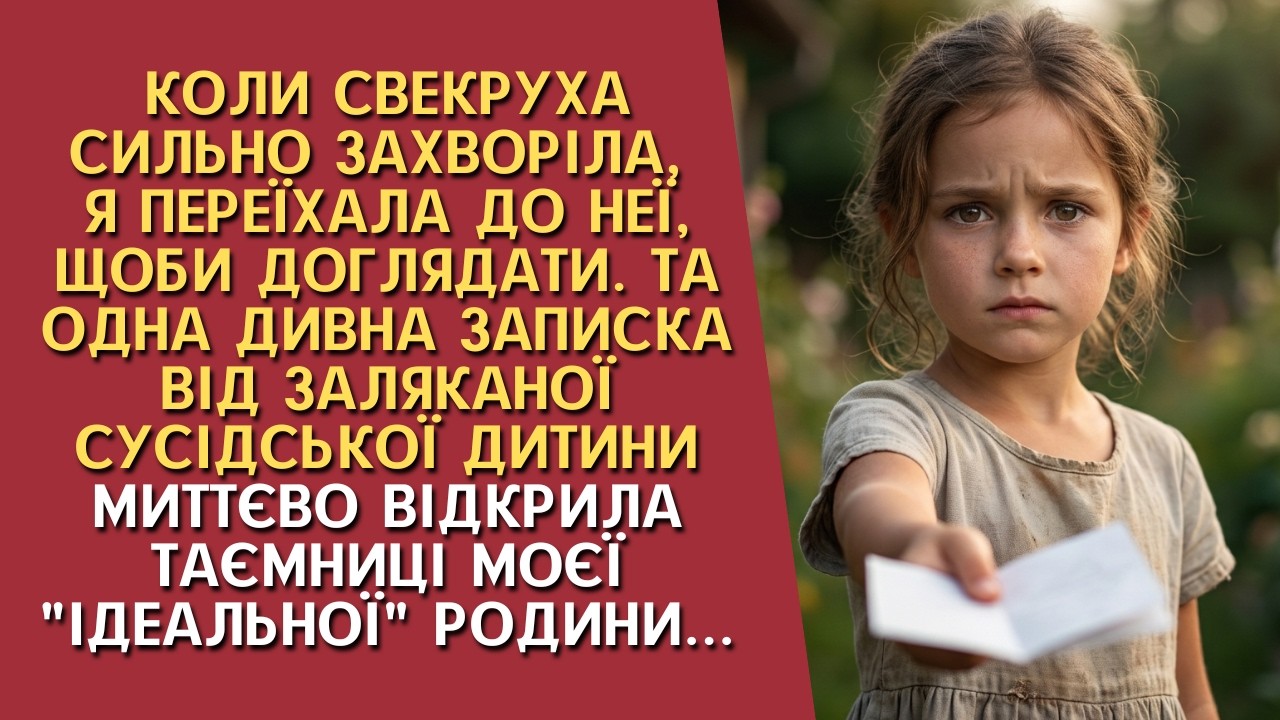
The rain soaked the crumpled paper in Olena’s hand, but the three words burned through it: She’s not sick. A small girl had pressed the note into her palm and run. Tanya. The thin child from the crooked house across the road, the one who dragged two heavy buckets of water through the mud like a grown woman carrying the world on her shoulders.
Olena’s first reaction was anger. What could a seven-year-old possibly know? She almost crumpled the note and threw it away. But then the details started surfacing.
The coffee cup with dried grounds in a sink she had scrubbed before leaving for the pharmacy. The expensive perfume in the hallway when the sick woman was supposedly bedridden. The way Tamara Ivanivna always found strength for cruelty, but never for getting better. Olena had been trapped in that estate for a month.
Her husband, Artem, had asked her to spend the summer at his mother’s house. “She doesn’t tolerate strangers. You’re family. We need to stick together.
” His voice had been convincing, but his eyes had hidden something she couldn’t name then. The performance his mother gave was flawless. Tamara clutched the walls, clutched her heart, demanded broth at all hours. Olena slept three hours a night, jumping at every moan from the other room.
She had spent years trying to earn that woman’s approval, swallowing every insulted joke, smoothing every corner. And for what? To become a free round-the-clock nurse for a woman who hated her. Through it all, Tanya kept appearing at the fence.
First to borrow salt, then to ask the time, then just to sit and watch Olena with a desperate hunger in her eyes. Olena had been a primary school teacher for eight years. She knew how to read children. And this one was a small, hunted creature who had forgotten what childhood felt like.
Now the girl had risked everything to warn her. Olena folded the paper into her pocket and walked back to the house. If she was wrong, she would apologize. If she was right, she needed proof.
She entered the bedroom wearing her mask of devotion. “I need to go to the city. Your medication is running low, and I want your cardiologist to see the latest tests. I’ll be gone three or four hours.
”
Tamara opened her eyes slowly, as if fighting pain, and nodded weakly. “Go, dear. Just don’t be long. My heart is fluttering so badly.
If anything happens, I’ll call Artem. ”
Olena grabbed her keys, slammed the front door, drove two blocks, then stopped. She killed the engine, walked back through the wet forest, and slipped through the gardener’s gate she had noticed weeks ago. It was unlocked.
She crouched behind the hydrangea bushes and peered through the panoramic window of the living room. Her dying mother-in-law was striding across the room in a silk robe, a face mask on, a glass of something sparkling in her hand. She was laughing into her phone. Olena eased the window open a crack.
“I’m telling you, Liusia, it’s brilliant. Artemik will close the deal now. ” Tamara took a long sip. “Just keep her stuck in the countryside for a couple more months while my son gets close to the daughter of that construction holdings owner.
Millions in contracts. And her? He played noble long enough. She’s nothing.
A worthless nobody. ”
Olena stood in the rain, listening to her life being carved apart. Her husband. Her marriage.
Five years of love and care, reduced to a business strategy. She didn’t cry. Something cold and sharp settled in her chest. She walked out from the bushes, climbed the terrace steps, and opened the glass door.
Tamara froze, glass halfway to her lips. Her phone slipped from her hand and hit the parquet floor. “I hope the prosecco was cold enough for your sick heart,” Olena said quietly. “Olenka, you’ve misunderstood everything—”
“Enough.
” Olena raised her hand. “The performance is over. The curtain falls. ”
She packed in twenty minutes.
Tamara pleaded, threatened, invoked Artem, even tried guilt. Olena didn’t listen. She walked out of the estate and crossed the street to the crooked house. Tanya sat on the steps, knees drawn to her chest.
She saw Olena’s bags and understood everything. The girl ran and wrapped her thin arms around Olena’s waist. “Thank you, little one,” Olena whispered into her rain-damp hair. “You opened my eyes.
I won’t forget you. ”
She drove back to Kyiv in a blur. Artem’s phone rang out again and again. She let herself into their apartment on Pechersk and found his work phone forgotten on the console table.
She sat on the leather sofa and waited. The lock clicked within an hour. Artem came in, his hands resting on the waist of a laughing blonde. “Artemchyk, stop, we just came from the restaurant—”
Olena stepped out of the shadow of the living room.
“What an interesting evening,” she said. He recoiled as if she’d slapped him. “Olena! What are you doing here?
You were supposed to be at mother’s. ”
“Plans changed. Your mother is in excellent health. Especially when she’s drinking prosecco and discussing her plans.
”
The blonde straightened, looking Olena up and down with disdain. “This is your wife? You told me you were practically divorced. You said she was just a formality—”
“Vika, please—”
But Vika’s eyes turned cold.
“My father will never sign a contract with you if he finds out what a pathetic liar you are. ” She yanked her handbag from him and slammed the door behind her. Artem stood in the silence. Then his face changed.
The frightened husband was gone, replaced by a cold-eyed businessman whose deal had just collapsed. “Are you satisfied now? You just destroyed months of work. ”
Olena almost laughed.
“You’re cheating on me in our home, and I’m somehow the guilty one? ”
“She’s not just some girl, Olena. Her father owns the largest construction holding in the country. Contracts, millions, the international market.
Do you have any idea what kind of prospects those are? ”
“Then why didn’t you simply divorce me? ”
He looked at her like she was a failed investment. “Because for my image, I needed exactly this kind of wife.
Quiet. Modest. A schoolteacher. Investors love family values.
When we married, you fit the role perfectly. But business grows. Rules change. Mother suggested sending you out of the city so you wouldn’t be in the way while I secured things with Vika.
Nothing personal. It’s just business. ”
Each word landed like a stone in her chest. Five years.
Her love. Her devotion. All pieces of someone else’s business plan. She looked at the stranger in the expensive suit and walked to the bedroom.
“I’m grateful to your mother for that stupid mistake with the prosecco. A few more years with you would have turned me into an empty shell like yourself. ”
She packed two suitcases. He sat on the couch, muttering about lost contracts, and never even turned his head as she left.
Two months passed. Olena rented a small studio, finished the divorce, and threw herself into work. The noisy children in her classroom were the best therapy she could have asked for. Only among them did she feel needed again.
One cool afternoon, as she walked out of school, she froze at the gate. A little girl was running toward her. “Olena! ” Tanya flew into her arms with such force that Olena nearly stumbled.
The thin arms that once hauled heavy buckets now clung to her neck. Tanya was crying, but not the silent tears of despair from the village. These were tears of pure, unguarded joy. “Olenochka, I missed you so much!
”
“Tanya, my dear, where did you come from? How did you find me? ”
Behind her, a tall man in a wool coat stood a few steps away, his face tired but his eyes warm. He approached and extended his hand.
“Hryhorii,” he said. “Tanya’s father. ”
Fifteen minutes later, they sat in a small café near the school. Tanya devoured a chocolate eclair, keeping one hand on Olena’s sleeve as if afraid she’d vanish.
“We searched for you for almost a month,” Hryhorii said, turning his untouched coffee cup in his hands. “We went to more than twenty schools in Kyiv. Tanya couldn’t stop talking about the woman who was kind to her. I had to find you.
To thank you. ”
Then he told his story. A tragedy wrapped in quiet words. Years ago, his own mother, proud and controlling, had sabotaged his relationship.
She framed the woman he loved, fabricated evidence, drove them apart. Hryhorii, young and wounded, left for an internship abroad, breaking all contact. He didn’t know the woman he loved was carrying his child. “My mother confessed on her deathbed,” he said, his voice cracking.
“I came back to Ukraine. But my love had died a year earlier from complications after the flu. All I found was Tanya. I lost so many years.
So much precious time. ”
Olena listened, tears running silently down her cheeks. This man had faced his mistakes, taken responsibility, and found the strength to rebuild. What a contrast to the world of lies and calculation she had escaped.
They met once a week. Then twice. They walked through autumn parks, fed squirrels, went to children’s plays. Hryhorii learned to be a father, discovering the world through his daughter’s laughter and tantrums.
Tanya blossomed, the haunted alertness fading from her eyes, replaced by ordinary, messy childhood. One winter evening, with the blizzard howling outside and Tanya asleep in her bed, they sat in the small kitchen that smelled of cinnamon and tea. Hryhorii was quiet for a long time. Then he looked up.
“I don’t know how to say beautiful speeches. ” He covered her hand with his own. “But you gave us back our lives. You taught us to breathe again.
I love you, Olena. I want us to be a real family. ”
His palm was warm. There was no calculation in his eyes, no search for profit, no image to maintain.
Just honesty and tenderness. “I love you too,” she said. Their wedding was modest. No hundreds of guests, no designer dresses, no staged photos.
Just close people, a quiet registry office, and little Tanya spinning in her new dress, calling Olena “mama. ” The single word warmed her heart more than any vow. A year later, Olena stood at the window of their cozy apartment, watching Hryhorii run through the yard behind Tanya, steadying her new bicycle. The girl shrieked with delight, and her husband’s jeans were dark with dirt at the knees.
Olena thought of her previous life. The luxurious, cold estate. The endless efforts to please. The perfect photos with Artem that hid a ringing emptiness.
She had been a decoration then. A convenient prop. Now she lived with a man who might forget to buy bread, but never forgot which flowers she loved. With a daughter who dragged mud into the house and kissed her goodnight with genuine, uncomplicated love.
It wasn’t a glossy, flawless life. It was real. Smiling, Olena waved back at her family.