I was still in the kitchen, still wearing the pale pink dress I’d bought for her wedding. Simple, elegant, the kind a mother wears when she wants to be noticed but not to eclipse. I’d chosen it weeks before, practiced smiling in the mirror, rehearsed what I’d say when I saw her. That moment never came.
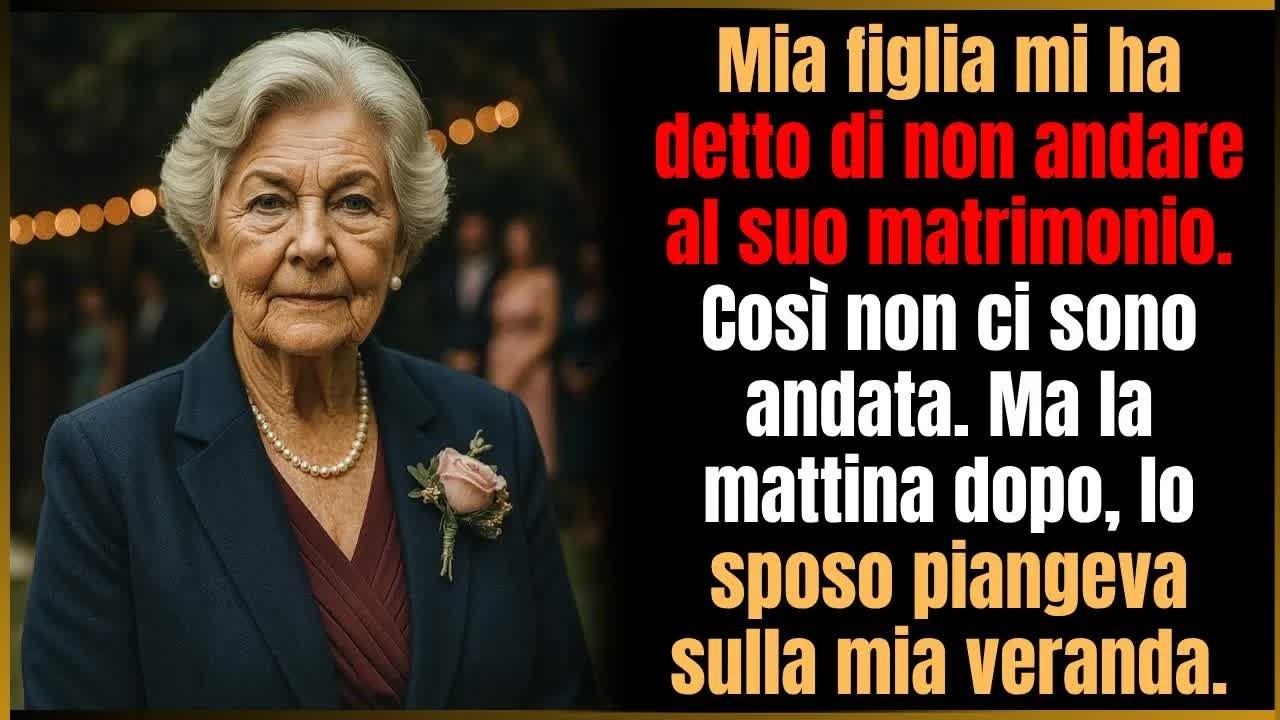
No reunion smile, no tears, no necklace clasped around her throat while I whispered, “You will always be my baby. ” Just a short, cold phone call. “Mom, I think it’s better if you don’t come. ”
No fight.
No argument. That was all. I sat at the kitchen table for hours, the silence pressing against me like a second skin. I made coffee I didn’t drink.
I wrapped the gift—a delicate gold chain with a heart-shaped pendant engraved “always yours, Mom”—and left it on the table. The ceremony started. I kept checking my watch as if that could change something. It didn’t.
Before the dress, before that phone call, before Lorenzo showed up on my porch looking like he hadn’t slept in days, there was love. Real love. The kind that settles into your bones. That was me and my daughter.
Her name wasn’t easy for people to pronounce, so we called her Violante. She was my only child, born after five years of fertility treatments and more pain than I let anyone see. I was alone when I gave birth. Her father had left long before.
But when they placed her in my arms under the hospital lights, with thunder shaking the windows, the world went quiet. She grabbed my finger as if she’d been waiting for me. I raised her alone, working two jobs—teaching third grade by day, tutoring high schoolers at night. I skipped dinners, slept too little, counted every cent.
She never knew. Her world was full of books, piano lessons, and Saturday pancakes. We had our rituals: Friday movie nights, matching pajamas, road trips in our old station wagon singing at the top of our lungs. On stormy nights she climbed into my bed even at fifteen and whispered, “Just until it passes.
” I never said no. She told me everything. At least, she used to. I remember the day she brought Lorenzo home.
She was twenty-four, glowing like she’d swallowed the sun. “Mom, this is Lorenzo. ” He was quiet, polite, the kind of young man who looks you in the eye and actually listens. I liked him immediately—not because he impressed me, but because Violante seemed so steady beside him.
I cried when they got engaged six months later. I started a small notebook of wedding ideas—nothing pushy, just a mom trying to help. I bought her the necklace, planning to clasp it around her neck on the morning of her wedding. We looked at floral arrangements together once, circling favorites at the kitchen table like old times.
It felt good. I held onto that moment tightly, not knowing it would be the last time she asked my opinion about anything. After that, something shifted. The calls came less often.
Our weekly coffees became “maybe next week. ” Her texts got shorter, drier. I gave her space. I told myself she’d come back like she always did.
But I knew. Deep in my stomach, I knew. It was a Sunday. Violante invited me to brunch with Lorenzo’s parents at a trendy café in Florence.
I showed up in a blue blouse she used to love, hair curled, trying not to look like I was trying too hard. They were already seated. Lorenzo stood to greet me. Violante didn’t.
“Mom,” she said flatly. “You made it. ” Distant, like I was someone who had to be included, not someone she wanted there. Lorenzo mentioned they’d finalized the guest list.
I perked up, pulling a florist’s brochure from my bag. “Have you picked a florist? One of my former students started a business—”
“We have it under control,” Violante cut me off. Her voice was sharp, final.
The brochure felt ridiculous in my hand. Lorenzo looked at his plate. Beatrice raised an eyebrow and sipped her mimosa. I folded the brochure back into my bag, cheeks burning, and laughed like I didn’t care.
But something cracked inside me. Not because of what she said, but because of how quickly she dismissed me. The silence that followed wasn’t the normal kind. It was the kind that feels like being slowly erased.
The calls stopped. Messages became one-word answers. No more “I love you” at the end of conversations. I kept trying, gently.
Sent a photo of my old wedding veil, asking if she wanted it as her “something old. ” She replied three days later: “Going with something different. No thanks. ”
One day I stopped by her apartment with a small basket—homemade biscuits, a box of little memories, pressed flowers from a trip when she was six, a crayon drawing she’d made of us holding hands.
Lorenzo opened the door. “She’s not really up for visitors right now,” he said. Not unkindly. The box came back a week later, untouched.
Then came the moment that broke me. Not with shouting, not with a dramatic betrayal, but with laughter. I was making lentil soup on a quiet Thursday when my phone buzzed. “You’ve been added to Violante’s bridesmaids’ group chat.
” My heart jumped. Maybe she was pulling me back in. But the messages were about me. Girls I barely knew, talking like I was a warning label.
“Classic overbearing mom energy. ” “Someone make sure she doesn’t do anything weird. ” And then, right between the emojis and sarcasm, Violante’s message: “She has good intentions, but sometimes she’s just too much. Everything turns into emotional blackmail with her.
Honestly, I don’t have the energy. ”
I couldn’t breathe. I read it again and again. It didn’t change.
She said that about me. And they laughed. I sat there, the soup hissing on the stove behind me. I didn’t cry.
I didn’t respond. I just left the group and felt small, like I’d become the joke in a story I thought I’d helped write. Morning came, the day of the wedding. I pulled out the dress, held it against my body in the mirror.
It was still beautiful. But the woman in the reflection was no longer invited to wear it. I wore it anyway. I sat in the kitchen, the gift box unopened on the table, and watched the clock.
The ceremony had already started. I pictured her walking down the aisle. I wondered if she thought of me even once. Then I stopped wondering, because it didn’t matter anymore.
At noon I changed into pajamas, put the dress in its garment bag, and shoved it under the bed. I curled up on the couch and tried to disappear. No cinematic moment. No last-minute message.
Just a slow, steady heartbreak. The day after the wedding was heavier. She was married, and I hadn’t been there. It was Sunday, our old pancake day.
No jazz, no strawberries, just silence so thick I could barely breathe through it. I opened social media. There she was, radiant in her wedding photos. “The best day of our lives.
” Then I saw a photo of Violante and Beatrice, cheeks pressed together. “My second mom. ” Second mom. As if I’d been the temporary one.
I went to the fridge. Inside was the cake I’d made the day before—three tiers, chocolate and raspberry, her favorite. I carried it straight to the trash and dropped it in. Then I slid down onto the floor, back against the cupboard, and sobbed—raw, breathless heaves.
I cried for the daughter I’d raised, the bond we’d lost, every bedtime story, every scraped knee I’d kissed. Because I’d tried, I’d shown up, and I’d still been left behind. That night I dreamed of her. She was small again, five or six, in a sundress, holding a daisy.
“Are you okay, Mom? ” I reached for her, but she ran into a fog I couldn’t follow. I woke up tangled in my blanket and knew I’d hit the bottom. There was nowhere lower to go.
Only forward. The next morning I started cleaning. At the bottom of a drawer, hidden under forgotten plans, I found the lavender box. The necklace box.
Still wrapped, still perfect. Inside, the necklace nestled in velvet. And beneath it, a letter I’d forgotten I wrote. “Dear Violante,” it began.
“Today you become a wife. And while that is sacred and beautiful, I hope you never forget the role you’ve always had. My daughter. From the moment I first held you, I knew I would spend my life protecting you and loving you in every way I knew how.
Every scraped knee, every whispered secret, is sewn into my soul. I haven’t been perfect. I’ve held on too tightly. I’ve missed the signals.
But never once has my love wavered. Not for a second. This necklace holds a piece of me—and of your grandmother. Her wedding ring was melted into the pendant.
I don’t know where life will take you now, but I hope you’ll always find your way back to me—not because you have to, but because you want to. Because real love has room for both roots and wings. With all my heart, Mom. ”
By the time I finished, I couldn’t see the words.
But these tears weren’t for what I’d lost. They were a reminder of who I’d been, how deeply I’d loved. I put the letter back, but I didn’t put the necklace in the velvet. I clasped it around my own neck.
The pendant fell just above my heart. It didn’t feel like surrender. It felt like claiming something back. Something changed that day.
I spent the rest of that week quietly rebuilding. Not my relationship with her—my relationship with myself. I found old diaries in the garage, stories I used to write. I made tea, sat at the same kitchen table, and opened a blank page.
The pen felt foreign. But four hours passed without me thinking about her once. The next day I ran into an old colleague who told me the school district was looking for reading tutors. I called and got an interview.
I started going to a writing group at the library. When I read a short piece about a woman who loses her map and finds herself, a retired English teacher leaned over and said, “You have a gift. Your words don’t just speak—they breathe. ” I believed her.
I volunteered for story hour at the library. A little girl named Ginevra reminded me of Violante—the real one, the child who climbed into my bed during storms. After story hour she wrapped her arms around my knees and said, “You read good. ” I blinked back tears.
I wasn’t sure anyone had told me that in years. The leaves began to change. Then the email arrived. “Would you be willing to talk?
” It was from Lorenzo. He said he’d read the letter—the one in the gift box Violante never opened. He came on a Sunday morning and we sat at the kitchen table, the same table where I’d waited on the wedding day. “She didn’t open the gift,” he said.
“I did. That letter wasn’t written by someone controlling or dramatic. It was written by someone in pain. ” He told me he’d believed her when she said I was too much.
“But she was building a wall. She’s been different since the wedding. It’s like she thought having the day without you would fix something. All it did was open a hole.
”
“She once told me,” I said softly, “she would never get married unless I walked her down the aisle. ” He blinked. “I didn’t know that. ”
He told me she’d said my love was so big it felt like a spotlight, and she was afraid of disappointing me.
“That’s the thing,” I whispered. “We don’t need our children to match us. Just not to erase us. ”
Two weeks later, a handwritten letter arrived.
My name in her familiar cursive. She wrote that she’d hurt me, that she’d shut me out because she was afraid of not being enough. “Instead of growing into myself, I pushed you away. I thought if I could control everything, the fear would go away.
It didn’t. I’m not asking for forgiveness. I just wanted you to know that I see it now. ”
I read it three times.
I didn’t cry. It didn’t feel like an ending. It felt like a beginning. That week I sent her a package: a childhood photo, the first story she ever wrote, a cookbook with pages stuck together from years of flour-dusted fingers.
No note. A few days later she posted a picture of the children’s book I used to read her at bedtime. Inside the cover was my handwriting: “To Violante, who made me a mother. ” Her caption: “Some things take time to understand.
I’m still learning. ”
Then, on a Tuesday evening, the phone rang. Unknown number. “Hi, Mom.
” That voice. I hadn’t heard it in months, but I’d know it anywhere. She thanked me for the package. She said she’d read the letter, the one in the necklace box.
“I couldn’t stop crying. Not just for what you wrote, but because I realized how long it’s been since I saw you. Not just as my mother—but as Lucrezia. ”
That name landed like a bell inside me.
“You don’t owe me anything,” I said. “This call isn’t a door you have to walk through unless you really want to. ” “I want to,” she said. “Maybe lunch.
Neutral ground. ” We agreed on the café near the bookstore. “They still have those cinnamon rolls. ” “You always ordered them with extra glaze.
” “I still do. ” And for the first time in months, I heard her smile. I arrived early. The café hadn’t changed—same brick walls, same mismatched cups, same Ella Fitzgerald humming through the speakers.
Then she was there. Not the polished version in her wedding photos. Real. Tired.
Softer. She hugged me—not hard, not dramatic, but real, like someone who remembered how we did this. She pulled a worn photo from her bag. Us on a beach, matching towels, sunburned cheeks, laughing.
“I found this,” she said. “I don’t remember the exact day, but I remember how safe I felt. ” “You built a sandcastle,” I said. “The tide washed it away.
You cried so hard. ” She laughed. “You told me, ‘Even though the castle gets washed away, you’ll always know how to build it again. ‘” “Sounds like something I’d say.
” Her eyes glistened. “I forgot so many things, Mom. I want to remember them, if you’ll let me. ” “I never stopped hoping you would.
”
We didn’t talk about the wedding. Not yet. We talked about cinnamon rolls and the bookstore next door. Light, sweet—but underneath, everything.
The weeks settled into a rhythm. She called every few days. One day she showed up with a cardboard box of old photos and diaries. “Maybe we could make an album together,” she said.
“Not to fix anything. Just to remember. ” We spent the afternoon side by side, glue sticks and colored paper. Laughter came easily.
Tears too. It felt like repair—one photo, one caption at a time. One rainy Tuesday she told me she’d started therapy. “I thought pushing you away would make me feel grown.
But it just made me feel unmoored. ” She talked over visits, over cups of tea. About how Beatrice made her feel, about how a part of her still believed she’d disappoint me if she wasn’t perfect. “I made you my measuring stick,” she said once.
“And I hated myself for never measuring up. But I built that narrative. Not you. ”
I listened.
It wasn’t about fixing anything. It was about being there while she fixed herself. One afternoon in the park, she pulled the necklace from her bag—the one I’d made for her wedding. “I’ve carried it everywhere,” she said.
“I couldn’t put it on until I’d earned it. ” Then she clasped it around her neck and tucked the pendant under her sweater. “I’m ready now,” she whispered. At Christmas, we spent the eve together—just the two of us, two plates, candles, jazz playing softly.
She brought a pumpkin pie she’d baked herself. “I burned the crust,” she said, embarrassed. I took a bite and smiled. “Tastes like love to me.
”
Later, curled up on the couch under a shared blanket, she asked, “Do you think we’ll ever be like we were? ” I shook my head gently. “No. But I think we’ll be something new.
Maybe something better. Now we’re learning how to stand beside each other—not above, not below. Beside. ”
In the spring, we planted basil together.
She still hated worms. One day she turned to me and said, “Thank you for not giving up on me. ” I squeezed her hand. “You were never mine to give up on.
Only mine to love. ”
The necklace still hangs around her neck most days. When I see it, I don’t feel the sting of rejection. I see a thread woven through generations—not binding us by blood, but by choosing each other again and again, even after the pain.
Especially after the pain. There’s no perfect ending. Just a hundred small beginnings. A Tuesday walk.
A shared recipe. A voice message about a song on the radio. We’re not the same. But we’re not strangers either.
And in the quiet hours, when the house is still, I sometimes whisper to the stars: “We made it. ”
Not back. Forward.