“Ingrid. It’s my daughter’s graduation. ”
She didn’t raise her voice. She looked at me the way you look at something you’ve already decided to let go.
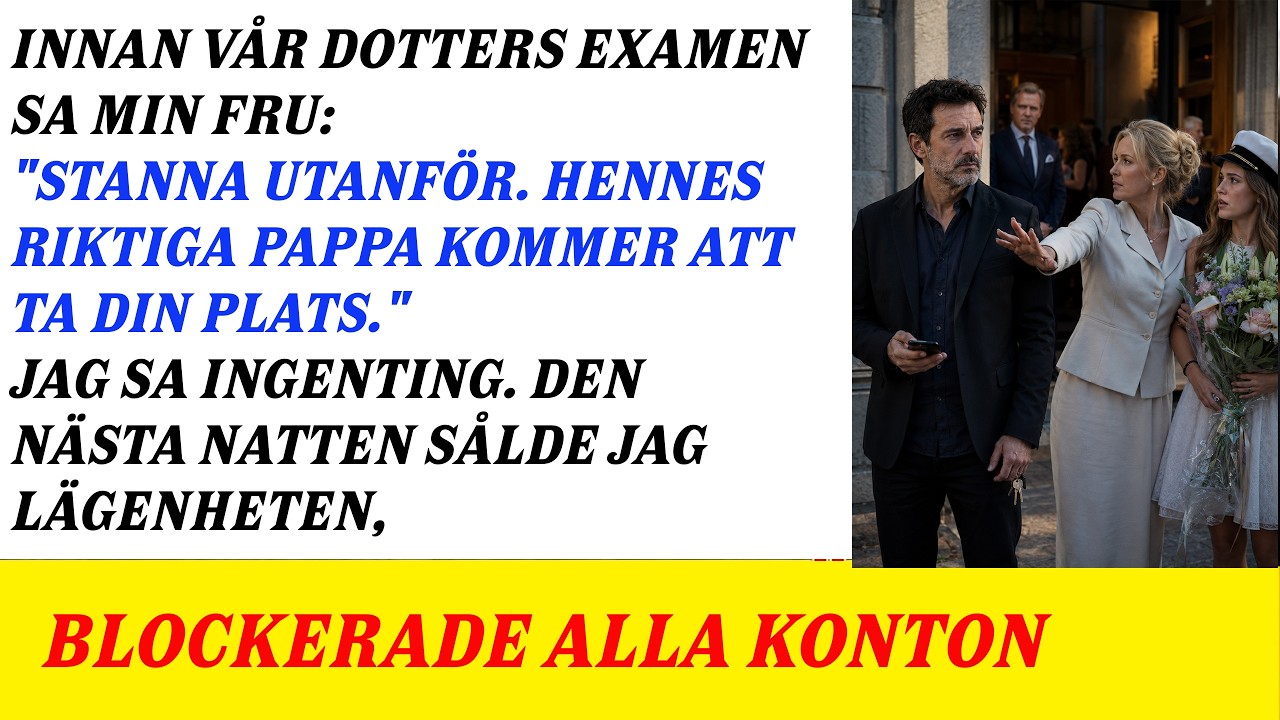
“It will be easier this way. Lina agrees. Don’t make it hard for her. ”
She took her bag and left.
The front door closed softly behind her. That careful silence hurt more than a slam. My name is Carl Neerg. I’m fifty-eight.
I built an industrial service company in Västerås from nothing—twenty years of six-day weeks, emergency repairs, long drives on the E18, coffee in paper cups. I was there when Lina was born. I held her before I knew what kind of father I’d be. I carried her boxes up three flights of stairs when she moved between student rooms.
I told myself a man stayed, paid what needed paying, fixed what could be fixed, and didn’t ask for more. Then Lina began to drift. She called less. When she came home from Uppsala, she shared everything with her mother, and the conversation changed shape when I entered the kitchen.
A month before graduation, I texted her about the ceremony. She answered nearly a day later: the time, the address, and three words. “You don’t need to bring me anything. ”
There was a letter from a law firm on the kitchen table: Arvidsson Berg, family law.
Ingrid said it was about the housing association. I didn’t press. I heard Lina’s voice once through the hallway door: “Have you told him yet? ” I waited for Ingrid to say something.
She never did. Three days before graduation, Lina came to get things from her old room. She said “hej” without stopping, took a bag, and left. She said goodbye to Ingrid in the kitchen, not to me.
She was in and out in ten minutes, the way you move through a place you don’t want to stay. —
The morning of the ceremony, I’d ironed my dark blue shirt and bought white tulips—Lina’s favorites since she was seven. I put them in water overnight. Ingrid stood at the kitchen window with her back to me, phone in hand.
When she turned, she had the calm of someone who’d already said her piece a hundred times in her own head. “Carl, don’t come today. ”
It wasn’t a request. It was a decision already made, and I was the last to know.
I drove to Uppsala anyway. I parked on a side street where I could see the exit without being seen. Families gathered with cameras and flowers. Students came out in dark suits and gowns.
Lina stood in the middle, black cap in her hand. Ingrid stood to her right. On her left was a man I’d never met—tall, grey hair, dark coat. They moved together like people who already had history.
Lina tilted her head toward his shoulder. Ingrid held his arm. Then Lina smiled, not the careful smile for photographs. The real one.
Open, without tension. The smile of someone exactly where she’d always wanted to be. I sat in the car. The white tulips were still on the passenger seat.
I’d carried them all that way as if there would be a moment to hand them to her. There wasn’t. —
When Lina called that afternoon, she said “It’s me. ” Not “Pappa.
” “It’s me. ” The presentation had gone well. Then, flat: “I know this isn’t easy to understand, but it meant something to me to have him there. ”
I said I was glad it went well.
She said “Okay, thanks” and hung up. No hesitation. No apology. Anger would have meant something was left.
That flat, finished voice meant she was already done. I sat in the dark as evening came. The law firm letter that had disappeared from the drawer. The words I’d overheard.
The cold reply to my text. The visit where she wouldn’t look at me. Alone, each was nothing. Together, they had a shape.
—
That night I opened her laptop. Her email was still logged in. I searched “Markus. ” Thirty-four results.
The oldest was eleven years old. The most recent, three days old. I read. Not all of it.
Enough. Their contact wasn’t a recent affair. It was a thread running alongside our marriage for eleven years—sometimes months apart, but never broken. Eleven years earlier, Lina had been thirteen, still coming to me with math homework and broken bike lights.
I was still building the company then, working six days a week. From six years ago: “Have you talked to her about me? ” “Not yet. It’s not the right time.
”
From three years ago: “When will you tell him, Ingrid? ” “When she’s ready. Let me handle it. ”
From two years ago: “She knows everything now.
It was hard, but she understands. ”
Lina had known for two years. She’d known, and she’d still answered my calls, taken my money, let me believe I was her father. Then four years ago: “How long does he have to stay there?
” “As long as the company holds. Lina will be done in two years. Then we’ll see. ” “And if he refuses to leave?
” “Carl doesn’t make problems. He never has. That’s just how he is. ”
I read that sentence three times.
No hatred in it. No drama. Just the flat assessment you’d use for a predictable tool. I hadn’t been betrayed out of passion.
I’d been kept out of usefulness. And when the usefulness ended, they’d begun planning the exit. I closed the laptop at three in the morning. They’d chosen a day they thought I’d be too broken to think.
They’d counted on paralysis. Instead, the day had woken me up. My wife was asleep in an apartment in my name, certain that Carl didn’t make problems. She was wrong.
—
The next day I drove to a café in Södermalm, far from places Ingrid knew. I went through the joint account line by line. A cash withdrawal of twenty thousand three weeks earlier. Fifteen thousand before that.
I extended the search to six months: ten more, eight more. Fifty-three thousand in cash, all on weekdays when I was at work, all without notation. Not a fortune. Not a mistake.
A method. I called a financial advisor in Solna. Göran Lind. He listened, asked three precise questions, and confirmed what I’d hoped: the prenuptial agreement Ingrid had signed without interest made the apartment and company my separate property.
He gave me a list of things to do before the week ended. Nothing visible. Just preparation that changes the weight of every step that follows. I drove to the office, locked the apartment documents in a drawer only I used, and called the bank.
I removed Ingrid as an emergency contact on the company account. Ten minutes. No notification. —
I reached Petra Åkesson, a real estate agent I’d met years ago through a client.
She handled complicated sales and knew how to stay quiet. She valued the apartment at just over three million and said a motivated buyer could close within a month. One Thursday, when Ingrid was out, Petra brought a couple through. I watched them check the water pressure, open the kitchen cabinets, measure the bedroom with their eyes.
The woman stood at the window and said something low to her husband. He nodded slowly. Already decided. When Ingrid came home, she stopped in the living room.
“Did you open the bedroom window? ”
“No. ”
“The air is different. ”
She looked at the cushions.
“This one was on the other side this morning. ”
“I haven’t touched anything. ”
She searched my face, then the room, for something else to be wrong. She found nothing.
But at dinner she was different. She kept studying me across the table. “Are you okay? ”
“Yes.
”
“You’re very calm. ”
“I’m always calm,” I said. She didn’t answer. That night I heard her low, tense voice in the bedroom on the phone.
I didn’t need to hear the words. —
The next morning the bid came at 9:42. Three million, three hundred and fifty thousand. Bank-approved.
Fast contract. I answered with two words: “Go ahead. ”
At 11:20, Ingrid called. Her voice was different from the first second.
“I got a letter from Petra Åkesson Real Estate. With your name on it. About the apartment. ”
“Yes.
”
A long silence. “Carl. What have you done? ”
“I’ve put the apartment up for sale.
It’s in my name. I have the right to do that. ”
“You can’t do that without talking to me. I live there too.
I have rights. ”
“Ingrid. I’ve spoken to my lawyer. I know what I can do.
”
She hung up. She came home at two, put her keys down with almost violent precision, and said: “How long have you been planning this? ”
“Since I read your emails. ”
The silence that followed had never existed between us in thirty years.
It was the silence of someone discovering that the map she’d been following no longer matched the ground. “Markus,” I said. “Eleven years. I’ve read enough.
”
Her face didn’t show fear. It showed calculation. “So this is your revenge,” she said. “This is me exercising my rights over what I bought and paid for.
If you want to call it something else, that’s your choice. ”
She stepped closer. “If you sell this apartment without an agreement, I’ll take you to court. I have rights.
Sixteen years in that home. ”
“I know. That’s why I have a lawyer. Mine, not yours.
”
She stopped. For the first time, she didn’t have an answer. “Does Markus know the apartment you promised him was never yours to promise? ”
The color in her face shifted.
“I didn’t promise him anything. ”
We had both read the same words, even if she didn’t yet know how much I’d seen. “What do you want? ” she tried to flatten her voice.
“Nothing from you. It’s already in motion. The bid is accepted. ”
—
The sale closed in twenty-eight days.
Her lawyer tried to stop it, citing the marital home. Mine answered point by point. The sale was legal. Nothing stopped it.
On the day of transfer, Ingrid wasn’t present. The signature was mine. The money landed in an account she couldn’t touch. When she learned the outcome, she sent one line: “I will never recognize you as the person who did this.
”
I didn’t answer. That sentence told me how she processed it: not as the result of what she’d done, but as an injustice done to her. Some people don’t change. They just learn to be more careful next time.
—
I learned about Markus from Ingrid herself, one evening when I came back for the last of my things. She sat in the living room with tired eyes. Markus didn’t want her to move in. He’d said that wasn’t the agreement.
He wanted to stay close to Lina, not build a family from scratch. Eleven years of messages, a plan built on me as its foundation, and the man she’d built it for stepped away the moment the situation became real. He hadn’t waited eleven years to get his family back. He’d waited eleven years without having to give anything up.
When the price appeared, he left. “I’m sorry,” she said. “For how it happened? ” I asked.
“No. You’re sorry for how it ended. That’s not the same thing. ”
I took what I’d come for and left.
—
Lina called two weeks later. We met at a café near her apartment in Uppsala. She sat and looked at the table before raising her eyes. Her voice was different from the flat administrative tone on graduation day.
Something underneath had cracked. “I didn’t know you’d go this far,” she said. “I didn’t start it,” I said. “I just finished it.
”
“I know. Maybe I should have told you when I found out. Two years ago. ”
“Yes,” I said.
“You should have. ”
She looked down. Markus had disappeared fast—a dinner, a few messages, then less and less. Her mother was looking for a rental.
The story she’d believed for two years looked different without its foundation. “I was there every morning,” I said. “Every payment. Every phone call.
You decided it was convenient to make all of that invisible. Now you know what it was worth. ”
She didn’t answer. Then, quietly: “Yes.
I know. ”
—
I don’t know what will happen with Lina. Not yet. But that conversation was different.
The call on graduation day closed a door. This one left a space. I live in a smaller apartment now, in an area I chose myself. The company works.
I wake up in the morning and do what I’ve always done—without carrying the weight of a story that wasn’t true.