Olena flinched as heavy grey thunder rolled over the Kyiv suburbs. She stood at the panoramic window of her mother-in-law’s mansion, a cup of herbal tea cooling in her hands, but her eyes were fixed on the other side of the street. There, knee-deep in mud, a small girl was dragging two plastic buckets of water. She wore an oversized, faded raincoat.
Her arms, thin as twigs, strained to their limit, but she didn’t stop. She only pushed a wet strand of hair from her eyes. There was no childish clumsiness in her movements, no complaint. Only the cold, practiced exhaustion of an adult.
Olena had taught primary school for eight years. She could read children like open books. The kids at her Kyiv school were loud, demanding, full of energy. This girl, living in her aunt’s crooked old house across from the gated cottage community, reminded her of a small, hunted animal.
That morning Olena had watched her chase geese to the pond, then drag a sack of rabbit grass nearly as big as herself. Unable to bear it, she grabbed warm garlic dumplings from the table, threw on a jacket, and ran out into the rain. “Hello,” she called softly, approaching the old fence. “I’m Olena.
What’s your name? ”
The girl stopped. Her dark eyes narrowed, scanning the stranger with a distrust that shouldn’t exist in someone so young. She looked at the dumplings as if they were a trap.
“Tanya,” she whispered at last. She stretched out a scratched, frozen hand, snatched the bun, and without a nod of thanks, vanished through the creaking gate. Olena stood in the rain long after she’d gone, a tight knot forming in her chest. Children had always been her one consolation.
After her mother’s second marriage, Olena had become an appendage to a past life, a shadow in someone else’s family. She could have grown bitter. Instead, she chose to give love to those who needed it. That sincerity was what had attracted Artem.
A successful Kyiv developer, used to calculating socialites, chose an ordinary teacher. Their life looked like a perfect social media feed: an apartment in Pechersk, weekends in Europe, hundreds of likes. But the fairytale had a dark side: Tamara Ivanivna. Artem’s mother was domineering, harsh, and never hid her contempt.
She called Olena “Olenka,” but her voice dripped poison. Olena, with her good-girl syndrome, spent years trying to earn her approval. So when Artem asked her to move to his mother’s suburban mansion for the summer, she agreed. “Maybe we should hire a professional caregiver?
” she’d suggested, packing her suitcase. “Olenka, you know Mom. She won’t tolerate strangers. You’re family.
We need to stick together. ”
His voice was convincing, but his eyes held a strange shadow. Tamara played her role brilliantly. She moved through the rooms clutching the walls, grabbed her heart theatrically, demanded special diet broths.
Olena slept three hours a night, jumping at every moan. Artem called rarely, citing critical tender negotiations, and Olena waited, exhausting herself for a woman who hated her. The only light in that hopeless routine was little Tanya. After the dumpling incident, the girl began appearing at the fence with increasing frequency.
She invented excuses: borrowed salt, asked the time. But really, she just sat on the terrace steps and silently watched Olena, her eyes full of a desperate need for maternal warmth. Then, one morning, Tamara threw another scene, claiming she was dying of a migraine and demanding total silence. Olena went to the backyard to hang towels and heard a rustle in the bushes.
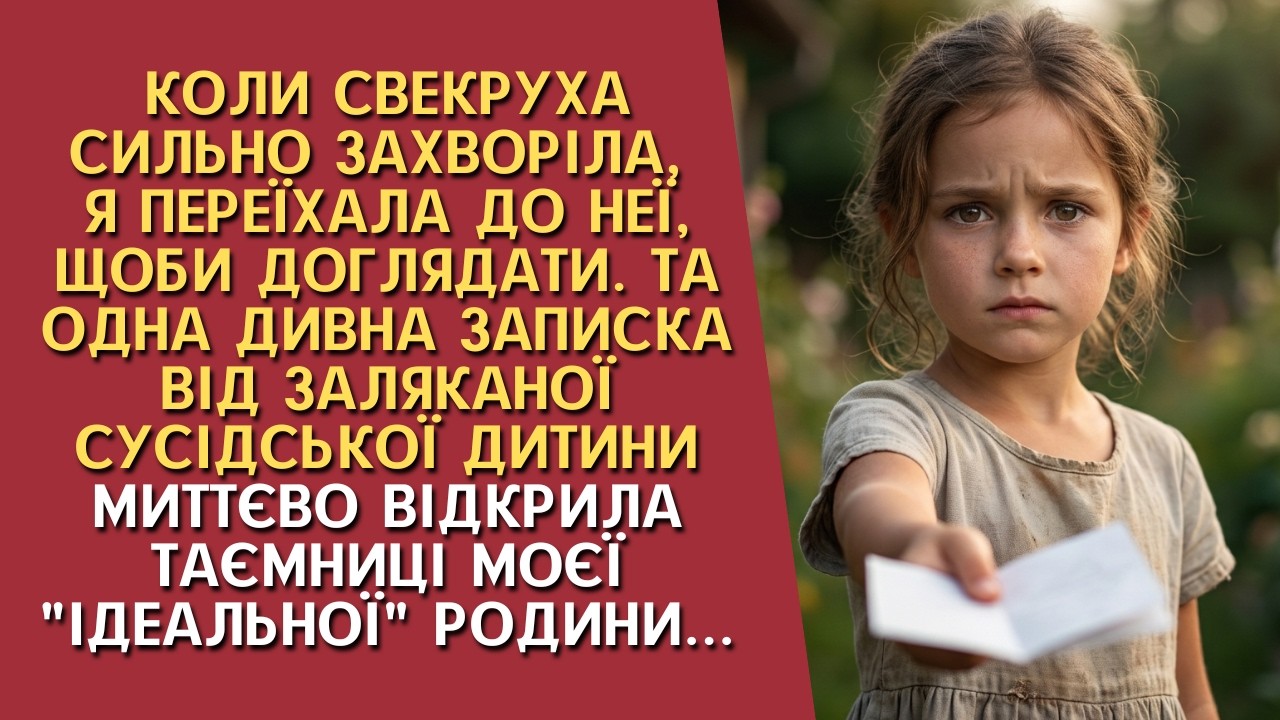
“Lena! ” Tanya hissed, eyes wide with fear. She glanced at the mansion windows, ran to Olena, pressed a crumpled piece of notebook paper into her palm, and bolted. Olena unfolded the damp paper.
In a first-grader’s crooked blue handwriting were three words:
“She is not sick. ”
Her first instinct was to crumple the note. What could a seven-year-old know? But a worm of doubt had already begun to gnaw at her.
She remembered yesterday. Tamara complained of unbearable heart pain. Olena drove almost an hour through the night to the nearest pharmacy. When she returned, a coffee cup stood in the kitchen sink—a cup she knew she’d washed before leaving.
And the faint scent of expensive perfume hung in the hallway, though Tamara supposedly hadn’t left her bed for two days. No. She needed proof. Not a child’s note, not assumptions.
Facts. Olena tucked the note into her pocket and walked back inside, her steps quiet but certain. She put on her usual mask of submissive care. “Tamara Ivanivna?
” she called softly, approaching the sofa where the older woman lay gasping. “I need to go to the city. Your blood pressure medication is running low, and I want to consult your cardiologist. It will take three or four hours.
Will you be alright? ”
Her mother-in-law slowly opened her eyes, feigning unbearable pain. “Go, Olenka, go. Just don’t be long.
My heart is fluttering so badly. If anything happens, I’ll call Artem. ”
Olena promised to hurry, loudly slammed the front door, started her old car, and drove off. A few blocks away, she turned into a dead-end lane, killed the engine, and got out.
Her heart hammered. She was acting on pure instinct, but there was no turning back. She circled back through the pine forest, pushing through thorny undergrowth, ruining her jeans and sneakers in the mud. The gardener’s gate was unlocked.
She slipped through, hid behind tall hydrangea bushes, and crept to the panoramic window of the living room. What she saw made her stop breathing. Tamara Ivanivna, dying twenty minutes ago, paced the room in an elegant silk robe, a nourishing mask on her face, a tall glass of what looked like expensive prosecco in her hand. She laughed loudly, chatting on a video call.
Olena cracked the window open a millimeter. “I’m telling you, Lucya, it’s a genius plan,” the mother-in-law’s voice rang clear, no trace of illness. “Artem will do everything right now. He has every chance.
”
Tamara took a grand sip, fixed her hair, and continued. “The main thing is to keep her here a couple more months, until Artem gets close to the daughter of the construction holding owner. Millions in contracts. And this one?
The boy played at nobility, and that’s enough. She’s not our match. A common beggar. ”
Each word drove into Olena like a rusty nail.
Betrayal. Total, cynical betrayal. Did Artem know? Judging by his mother’s words, he was either a blind tool in her manipulative hands—or a silent participant.
A cold clarity flooded her. No pain, no despair, no self-pity. Only ice-clear determination. She stepped out of the bushes, climbed the terrace stairs, and threw open the glass doors.
Tamara froze, the crystal glass halfway to her lips. The smartphone slipped from her hand and hit the polished parquet. “Tamara Ivanivna,” Olena said, her voice disturbingly calm. “I hope the prosecco was cold enough for your sick heart.
”
“Olenka! You—you misunderstood everything! ” The woman stammered, clawing the mask off her face. “It’s therapy.
The doctor recommended it for my blood vessels. On the phone I was just joking with my friend—”
“Enough. ” Olena raised her hand. “No more lies.
The play is over. ”
She turned and walked to her bedroom. Her hands trembled with adrenaline, but her mind was clear. She threw her belongings into a travel bag with mechanical precision.
Her mother-in-law shuffled at the foot of the stairs, whimpering, invoking Artem, but Olena no longer heard her. Slinging the bag over her shoulder, she walked onto the porch. The rain had stopped. She crossed the street to the crooked old fence.
Tanya sat on the steps of her house, knees drawn to her chest. Seeing Olena with luggage, the girl understood without words. She ran and threw her thin arms around Olena’s neck. “Thank you, little one,” Olena whispered, kissing the top of her head.
“You opened my eyes. I won’t forget you, I promise. ”
The drive back to Kyiv passed in a blur. Olena tried calling Artem several times.
The calls rang out, ignored. “Critical tender situation,” she smiled bitterly. When she opened the door of their two-level apartment in Pechersk, the first thing she saw was Artem’s work phone thrown carelessly on the console. Forgot it, rushing to his important meetings.
The apartment was suspiciously quiet. Olena dropped her muddy sneakers, walked to the living room, and sank onto the leather sofa. She was ready to wait. She didn’t wait long.
Less than an hour later, a key clicked in the lock. Artem walked in, hands resting possessively on the waist of a striking blonde who was laughing, playfully pushing him away. “Artemchik, stop it, we just came from the restaurant,” she purred, not noticing Olena in the shadow. Olena stepped into the light.
“What an interesting evening we’re having. ”
Artem recoiled as if burned. His face went pale. “Olena!
What—what are you doing here? You were supposed to be at Mom’s. ”
“Plans changed, Artem. Your mother has remarkably good health, especially when she drinks premium prosecco and shares her brilliant strategies on the phone.
”
The blonde recovered quickly. She straightened up, lips curled in contempt. “Artem, this is your wife? You said you were practically divorced.
You said she was just a formality. ”
“Vika, please shut up,” Artem hissed. “Olena, this isn’t what you think. I can explain.
”
“Explain what? That you turned me into a free nurse for your manipulative mother so you’d have time for your affairs? That you lied to both of us? ”
“Oh, go to hell, Artem,” the blonde exploded, yanking her purse from his hands.
“My father will never sign a contract with you if he finds out what a pathetic liar you are. ”
She spun on her heels and slammed out of the apartment. Silence fell. Artem stared at the closed door, then slowly turned to Olena.
The confusion was gone. The fear was gone. In their place was the cold, hard mask of a businessman whose deal had just collapsed. “Happy now?
” His voice was dull and irritated. “You ruined months of work. ”
“I ruined? ” Olena almost laughed.
“You’re cheating on me in our apartment, and I’m the guilty one? ”
“She’s not just some rich girl, Olena. Her father owns the largest construction holding in the country. Millions in investments, international markets.
Do you understand the prospects? ”
“Then why didn’t you just divorce me? ” Her voice trembled. “Why the circus with your mother’s illness?
Why keep me in the countryside? ”
Artem stopped in front of her. His gaze was cold, like a stranger’s. “Because for my image, I needed exactly this kind of wife.
Quiet, modest teacher. Homey, undemanding. Investors love family values and stability. When we got married, you fit that role perfectly.
But business grows, Olena. The rules change. Now I need different connections. Divorce would raise questions.
Mom proposed the perfect solution: keep you away so you wouldn’t interfere with my relationship with Vika until I secure the partnership with her father. Nothing personal. Just business. ”
Five years of her life.
Her sincere love. Her care. All of it was part of someone’s business plan. Olena looked at the man she thought she knew.
She saw a stranger. A pragmatic, soulless mannequin in an expensive suit. “You know, Artem,” she said quietly, turning toward the bedroom. “I’m deeply grateful to your mother for her absurd mistake with the prosecco.
A few more years with you would have turned me into an empty, cynical shell just like you. ”
She didn’t make a scene. In twenty minutes, she packed two large suitcases. Artem sat on the sofa staring at the dark TV screen, muttering about ruined contracts.
When Olena dragged her suitcases into the hallway, he didn’t even look up. She clicked the lock and stepped into the cool night. Ahead was emptiness, loneliness, but also freedom from lies. Two months passed.
Olena’s life found a new rhythm. She rented a small studio, completed the divorce, and plunged into work. The noisy schoolchildren, grading notebooks, preparing lessons—this became her best therapy. Among children, she felt needed again.
One cool day, as Olena walked the last student out, she froze on the school’s threshold. By the wrought-iron fence, holding the hand of a tall unfamiliar man, stood little Tanya. “Olena! ” the girl shouted joyfully, her face lighting up.
She dropped the man’s hand and sprinted toward the teacher. Tanya crashed into Olena’s arms so hard she nearly knocked her over. Thin arms—the same arms that once dragged heavy buckets—now clung to Olena’s neck. She was crying, but her tears were nothing like the silent despair Olena had seen during the storm in the suburbs.
Now the girl wept with pure, boundless happiness. “Olenochka, I missed you so much,” she chirped, burying her face in the collar of Olena’s coat. “Tanya, my dear. ” Olena stroked her back, a lump rising in her throat.
“How did you find me? ”
She looked up and met the man’s eyes. He stood a few steps away, tall, in a simple but quality wool coat. His face looked tired, with dark shadows under his eyes, but his gaze was warm and open.
“Hello. ” His voice was deep and calm. He extended his hand. “I’m Hryhorii.
Tanya’s father. ”
Fifteen minutes later they sat in a small cafe near the school. Tanya, pressed against Olena, devoured a chocolate eclair, keeping a firm grip on the sleeve of Olena’s coat, as if afraid the teacher might disappear again. Hryhorii ordered black coffee but didn’t touch it.
He turned the cup in his hands, finding words. “We searched for you for almost a month,” he finally began. “We visited maybe two dozen schools in Kyiv. Tanya couldn’t calm down.
She kept telling me about the woman who was the only one who treated her like a human being. I had to find you and thank you. ”
And he told his story—a tragedy as mundane as it was terrible. Years ago, his own mother, a domineering woman, had rejected the girl he loved.
She slandered the girl, fabricated evidence, engineered a betrayal. A terrible fight followed. Young, hot-headed Hryhorii, blinded by hurt, went abroad for an internship, cutting all ties. He didn’t know his beloved was carrying their child.
“Mother confessed everything only before her own death,” Hryhorii’s voice wavered. “When illness left no chance, her conscience proved stronger than her pride. She told me she’d lied. I dropped everything, returned to Ukraine, went to that village.
But my beloved had died a year earlier, from complications after the flu. Instead, I found Tanya. I lost so many years. ”
Olena listened, tears rolling silently down her cheeks.
She looked at this broken but unbroken man who had found the strength to admit his mistakes and take responsibility for his daughter. What a contrast to the world of lies she’d escaped, where manipulation was praised as a genius business plan. Their coming together arrived without sparks or grand gestures. It unfurled the way a quiet dawn breaks after a long, exhausting night.
First, they met once a week, walked, talked, went to children’s performances. Hryhorii proved reliable, patient, and incredibly attentive. He was learning to be a father, discovering the world through his daughter’s laughter and whims. Tanya blossomed.
The eerie, unnatural, adult wariness vanished from her gaze forever. She was now an ordinary happy girl who brought home stray kittens and colored the wallpaper with markers. One winter evening, as a blizzard howled outside and Tanya slept peacefully, Olena and Hryhorii sat in the small kitchen. It smelled of cinnamon and herbal tea.
Hryhorii was quiet for a long time, then looked up. “You know, I’m not good at beautiful speeches,” he said, quietly covering her hand with his own. His palm was large and warm. “But you gave us our life back, Tanya and me.
You taught us to breathe again. I love you, Olena. I want us to be a real family. ”
Olena looked into his eyes.
There was no calculation, no search for profit, no desire to create a convenient picture for investors. Only sincere, endless tenderness. “I love you too,” she answered. And for the first time in years, her heart beat evenly and calmly.
Their wedding was modest. No hundreds of guests, no false pomp, no designer dresses worth thousands. Only the closest people, a quiet city registry office, and little Tanya twirling in her new fluffy dress, calling Olena “Mama” without stopping. That single word warmed her soul better than any vows.
A year later, Olena stood at the window of their new cozy apartment, watching Hryhorii laugh and run after Tanya in the yard, steadying her new bright bicycle. The girl squealed with delight, and her father encouraged her, not noticing his own knees covered in dirt. Olena pressed her forehead to the cool glass. She remembered her past life.
The luxurious but cold house of her mother-in-law. The endless efforts to please. The perfect photos with Artem, hiding a hollow emptiness. Then she was only convenient decoration.
Now she lived with a man who might forget to buy bread but remembered which flowers she loved. With a daughter who might drag mud into the house but sincerely kissed her every night before bed. There was mud on the floor and laughter that came easily. It was real.
And Olena, smiling, waved back at her family.