Forty minutes before the guests arrived, Sofia stood in the hallway, phone pressed to her ear. “Just don’t tell anyone yet, okay? Not even my husband. ”
From the kitchen, Bohdan’s voice carried through the half-open door.
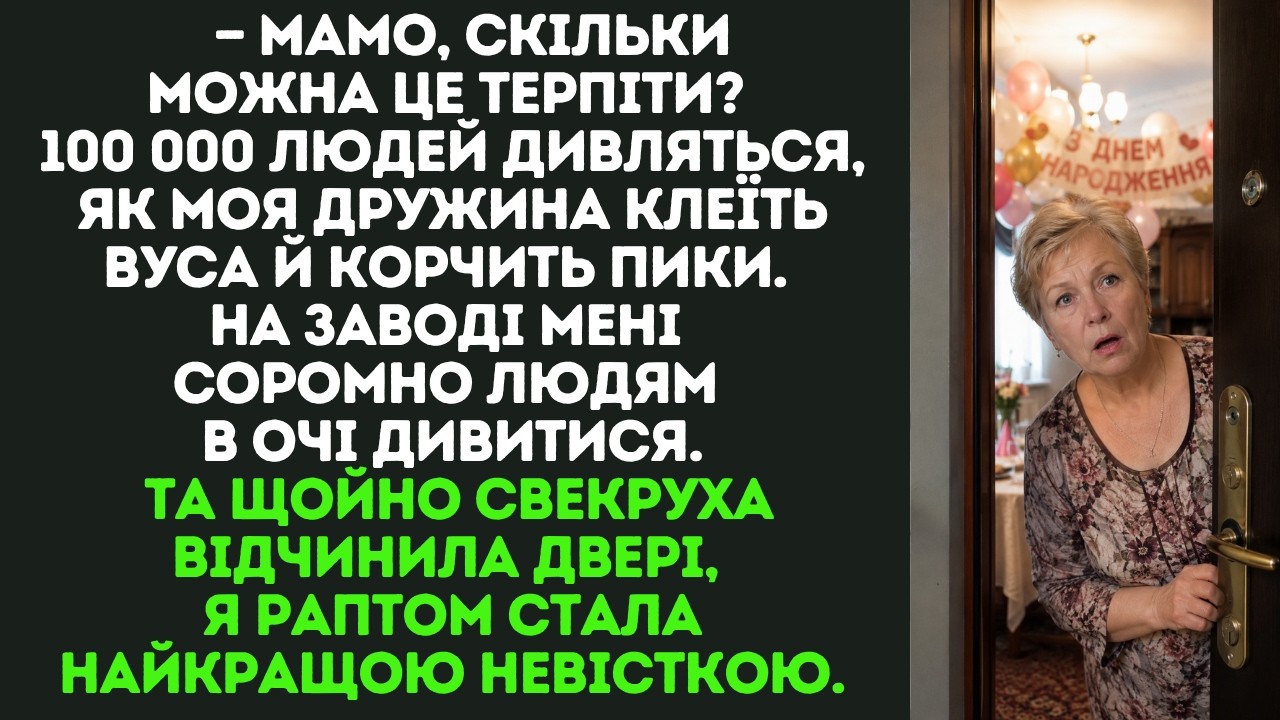
He had no idea he could be heard. “Mom, how much longer do I have to put up with this circus? A hundred thousand people watch my wife glue on mustaches and make faces. I can’t lift my head at the factory.
”
The manager on the other end of the line asked, “Sofia, are you still there? ”
Sofia looked at her reflection. Red wig, deliberately clumsy makeup, eyes painted like a mask. “Yes, I’m here,” she said quietly, and shut the bathroom door with her knee.
Bohdan hadn’t always been like this. Five years ago, at their wedding at the small registry office on Obolon, he told his friends, “My Sofia is a marketer. Smart, with a diploma, a good salary. ” She wore white blouses and heels, managed accounts for two supermarket chains, came home at six.
He came home from the plant. In the evenings they watched series together. Everything was clear. Two years ago, the agency cut half the department.
Sofia was left at home with severance pay and a two-month plan to find a new job. On the third week, she filmed a short video on her phone — a parody of a client demanding a logo that didn’t resemble anything but was instantly recognizable. It got twenty thousand views in a day. Bohdan laughed then.
He showed the video to his coworkers in the smoking room. “Look what a talented wife I have. ”
That was before the number became six figures. He came home from the plant, blue coveralls smelling of machine oil, a black line under his fingernails that never washed off.
He kicked off his shoes by the door without untying them and saw Sofia at the laptop — headphones on, ring light glowing, three editing windows open. “Playing again? ” he said — not asking, stating — and went to the shower. Sofia didn’t answer.
She counted to five, a habit she’d built over two years, and turned back to her timeline. Every Sunday, Valentyna Panasivna arrived with a pot of borscht and asked the same question, as if hearing the answer for the first time: “So, Sofiyka, found a job yet? ”
“Mom, she has a channel,” Bohdan would answer, with embarrassed pride — back when the number didn’t scare him. “A channel?
Like a television? ” Valentyna would repeat, setting the pot on the table. Her father-in-law ate silently, looked out the window, and never said anything bad — but never anything good either. Sofia made videos about everyday life.
The neighbor who borrows everything and never returns it. The cashier who comments on every purchase. The grandmother on the bench who knows everyone’s business. Each role got its own look: a wig, makeup, sometimes a costume.
Once she shaved half her eyebrows for a character, and Bohdan couldn’t look at her across the table for a week without laughing. “You look insane,” he said. “It’s a character, Bohdan. People love these characters.
”
“People? ” He waved a hand. “Which people? Have you ever seen a single one of them in person?
”
Only Marichka, her best friend from university, called after every video and told her what worked and what didn’t. “Sofia, you have eighty thousand. That’s not a hobby anymore. ”
The idea of a contract came from Artem, a young man who reached out two months earlier and offered to represent her to brands.
Sofia laughed at first — “I’m my own director, cameraman, editor, and manager” — but he showed her the numbers, and a cosmetics brand offered her a series of four videos for a sum equal to her old annual salary. She signed on a Tuesday evening while Bohdan was on the night shift. She sat in the kitchen, clicked the electronic signature, closed the file, and stared at the dark screen for a long time. She told no one.
Not Bohdan, not even Marichka. For the first time in two years, she understood: she could make a decision alone, without permission, without explanations. A week before Valentyna’s birthday, Sofia went to her in-laws’ to help clean for the holiday, as she did every year. Valentyna directed from the kitchen while Sofia was sent to search the bedroom closet for a spare tablecloth.
Under a stack of bedding, under an old plaid blanket, her fingers found a hard cardboard box. Inside lay a vinyl record. The cover had faded, the corner taped with yellowed tape. A young woman with a microphone.
Hair from the eighties. Big letters: Zlata Veres. Under the record — a concert ticket. 1988.
Dynamo Stadium. On the back, in handwriting faded to gray: “To Valya, with love. You’ll sing yet, I know. ”
Sofia sat on the floor longer than she’d planned.
The handwriting wasn’t Valentyna’s — round, slanted, almost childish. At the bottom of the box lay a folded document, a copy of some paper from a music school with a stamp, dated the same year. The surname: Myronenko. Valentyna’s maiden name.
The bedroom door opened. Valentyna stood in the doorway with a towel in her hands. “What are you doing here? ”
Sofia quickly closed the box.
She couldn’t think of anything but the truth. “Looking for a tablecloth. Found this by accident. ”
Valentyna crossed the room, snatched the box from her daughter-in-law’s hands, and pressed it to her chest.
“That’s none of your business. ”
“Did you study singing? ”
“I said it’s none of your business. ” Her voice cracked on the last word.
She left without looking back. Three days before the birthday, Bohdan brought his parents over for dinner. Sofia was editing the final video of the brand series when Valentyna walked into the room without knocking. “Again in a wig, Sofiyka.
Aren’t you ashamed? Five years married, and you dress like it’s a masquerade. ”
“Please, Mom, not now,” Bohdan said, but without conviction. “When, if not now?
When she turns into a complete clown? Look at her — she paints herself, walks around bald, sticks on mustaches. People on the street point fingers. ”
Sofia slowly removed her headphones.
“Enough,” she said, loudly, almost shouted, and her voice didn’t tremble. “For two years you’ve called this clowning. I have a hundred thousand subscribers. Do you understand what that means?
That’s a whole city. People who wait for me every week. But you think I’m worthless because I don’t sit in an office from nine to six. ”
“Sofia,” Pavlo Ivanovych began.
“No. ” She turned to her husband. Her hands were shaking, and she didn’t hide them. “And you — you’ve never once defended me.
Not once. For two years you never told your mother ‘enough. ‘ Are you ashamed of me, Bohdan? Say it to my face.
”
“What am I supposed to say? That I live with a woman who’s a grandmother one day and some guy with purple hair the next? I can’t lift my head at the factory, Sofia. The guys joke, ask whether I prefer you as a woman or a man.
”
“So it’s because of the guys in the smoking room? That’s why you don’t talk to me for weeks? ”
He didn’t answer. He turned to the window, hands in his pockets, shoulders rigid.
Valentyna silently gathered her bag and zipped her coat. “I’ll expect everyone at six, as always. ” The door closed quietly behind her. Sofia stood in the middle of the room, breathing hard, looking at the broken plate no one was going to pick up.
That evening, when Bohdan went to smoke on the balcony and didn’t come back, Sofia called Artem. “I need your help with something personal, not for content. You said you have contacts in the older generation of show business. I need to reach the manager of Zlata Veres.
”
Artem found the contact in two days. Zlata’s manager had gone to the same institute as Valentyna. Sofia wrote her a long message, told her about the ticket and the box, and asked for one thing: could Zlata come to Valentyna’s birthday and sing one song? The reply came slowly.
Then: “Zlata Dmytrivna remembers that year. She says there were many talented girls who never got their chance. ”
The day before the birthday, Bohdan came home gloomier than usual. He dropped his bag on the floor instead of putting it away.
“Tolya asked me today if it’s true my wife was in that video where she dresses as a pig at some blogger’s wedding. Someone in the smoking room showed a screenshot. They pinned it to the bulletin board next to the shift schedule. ‘The wife of turner Lytvyn.
Take a look. ‘”
Sofia put down her phone. “And what did you do? ”
Bohdan was silent longer than he should have been.
“I tore it down. A week later. Not right away. ”
“A week, Bohdan.
”
He sat down, held his head in his hands. “I didn’t defend you the first day, Sofia. Tolya showed me the screenshot on his phone, and I laughed along with them. I didn’t mean to.
It just slipped out. ”
Sofia looked at him for a long time. “So you’ve been cold to me not because of me, but because of yourself. ”
“I don’t know.
Maybe. ”
She sat down beside him. Not touching. Shoulder to shoulder.
The day before the holiday, Valentyna arrived with news she presented as a done deal. “I talked to Larysa. She works in accounting at the regional hospital. There’s a position for an assistant accountant.
You can start Monday. A proper job, Sofiyka, with a work record book. Enough of this foolishness. ”
“You forgot to ask me,” Sofia said calmly.
“What’s to ask? I’m looking out for your future. ”
“I already have a future. You just don’t see it because you don’t like it.
”
“I’ll tell Larysa you’ll think about it. ”
“Tell her I’m declining. Respectfully, but declining. ”
This time Valentyna slammed the door.
Bohdan stood in the kitchen doorway, having heard everything. He said nothing, only nodded briefly — Sofia couldn’t tell if it was agreement or confusion. The birthday fell on a Saturday. They prepared from the early morning.
Bohdan carried folding chairs from the storage room. His father set them up in the yard under the old apple tree that bloomed later than the neighbors’. Sofia arrived at four, in a simple dress, no wig, no makeup. For the first time in a long time, she showed up to family as herself.
About twenty guests gathered. Neighbors, some of Valentyna’s former colleagues from the music school, relatives from both sides. The long table was covered with the embroidered cloth Valentyna brought out only for big holidays. At exactly six, as everyone sat down and Pavlo Ivanovych raised the first toast, a black car stopped at the gate.
A woman in dark glasses got out. No one recognized her at first. “Good evening. I’m looking for Valentyna Panasivna.
”
The table went so quiet you could hear a dog barking in the neighboring yard. Valentyna rose slowly, gripping the edge of the table as if her legs might not hold her. “Zlata… Zlata Dmytrivna…
”
“Valya,” said Zlata Veres. And something in Valentyna’s face broke apart. She covered her mouth with her hand. Someone dropped a fork.
Bohdan stood by the gate — he’d run to meet the car before anyone else. He held the gate open, frozen, looking from the singer to his mother to Sofia, who stood a little ways off, watching. Zlata took Valentyna’s hands. “I was told you waited thirty-eight years for someone to tell you that you had a beautiful voice.
I remember your audition. You sang better than half of those they took. ”
Valentyna wept — openly, loudly, covering her face with her palms. Pavlo Ivanovych came up and held her from behind.
On his face was something Sofia had never seen in five years: tenderness and bewilderment at once. Zlata pulled a small portable speaker from her bag. “I didn’t come empty-handed. I’ll sing what you should have sung then.
”
It was the song from the record. Sofia recognized the melody immediately. Zlata sang in the middle of the yard, without a microphone, only the simple accompaniment from the speaker. Her voice, though no longer what it had been thirty years ago, held every note.
Valentyna cried through the whole song, not trying to stop. When it ended, the guests applauded standing. Someone filmed on their phone. The neighbor’s boy climbed the fence to see better.
Zlata hugged Valentyna again, longer, and said something in her ear that only the two of them heard. Then Zlata looked around and found Sofia. “Where’s the girl who wrote to me? ”
Sofia walked over slowly, under the eyes of the whole yard, including Bohdan’s — he was looking at her as if seeing her for the first time.
“She arranged all of this, Valya,” Zlata said, taking Sofia’s hand. “She found me through my manager, wrote me a letter three pages long about your ticket, your audition, about you keeping that record for thirty-eight years. I haven’t received a letter like that in years. ”
The guests murmured.
Someone from the music school said loudly, “Sofia, so you know celebrities? And here we thought you just filmed funny videos. ”
“I do film them,” Sofia said calmly. “And that’s why I have a hundred thousand people who listen to me.
That’s how I found the right person to write to. ”
Artem, who had also come and stood by the gate, phone at the ready, added quietly, mostly to himself: “Best content of the year. No campaign could buy this. ”
Valentyna heard.
She turned to her daughter-in-law, face still wet from tears. “Did you do this for a video? For your videos? ”
The yard went quiet again.
The question hung there — with hope and fear in equal measure. “I did it for you,” Sofia said. “The video will come out because it’s my job and I get paid for it. But I wrote that letter two weeks before I thought about a camera.
I found the box in your closet when I was looking for the tablecloth. I wasn’t going to tell you. I just couldn’t leave all of it — the ticket, the record, the dedication — sitting in a closet until the end of your days. ”
Valentyna covered her mouth again, looking at her daughter-in-law as if seeing her for the first time in five years.
Bohdan stood apart the whole evening, near the gate, hands in his pockets. The longer the celebration went on, the less he moved. People approached Sofia for photos, asked about her channel. One of the younger relatives recognized her from a video and began quoting her character’s line, laughing.
“Some daughter-in-law we have,” a guest said to Bohdan, clapping his shoulder. “Lucky you. She’s friends with stars. ”
Bohdan nodded and smiled, but he looked far from pleased.
Near the end of the evening, when Zlata was saying goodbye to Valentyna and exchanging phone numbers, Sofia went to him. “You could have told me about this,” he said quietly, not looking at her. “I wanted it to be a surprise for your mother. ”
“For my mother.
And what is it for me, Bohdan? I told you for two years I was ashamed. And you silently built something so big that the whole yard now looks at you like you can call a star and she’ll come. Who am I in this picture?
A turner who couldn’t take a piece of paper off the bulletin board for two weeks. ”
“I didn’t want you to feel that way. ”
“But I do, Sofia. And the worst part?
I’m not ashamed of you anymore. I’m ashamed of myself. You did something great, and I stood by the gate all evening waiting for the moment I could leave. ”
He finally looked at her directly.
His eyes glistened. For a second, Sofia thought something else might happen — that he would hug her, say something good. Instead, he stepped back. “I can’t keep living like this.
I need to be alone for a while. ”
He turned and walked to the gate, got into his old Skoda, and drove off — leaving everyone, including his parents, to watch him go. Sofia didn’t run after him. She stood in the middle of the yard as the guests drifted back to their conversations and someone played music from a phone, and she watched the empty street where the red taillights had vanished.
Valentyna came up to her a few minutes later and put a hand on her shoulder. For the first time in five years, the gesture was warm. “He’ll come back,” Valentyna said quietly. “I don’t know if I want him to come back today,” Sofia said, and surprised herself with how honest it sounded.
Valentyna nodded, as if she understood more than was said. “I kept that ticket in the closet for thirty-eight years and never showed anyone. Not because I was ashamed of the dream. Because I was afraid that if someone found out, I’d have to admit I never dared.
You dared, Sofiyka. Twice today — you shouted at me at that table, and you arranged all this. I underestimated you. ”
“You mocked me for two years, Valentyna Panasivna.
”
“I did. Because looking at you was painful. You did what I never allowed myself. It’s easier to laugh at someone else’s courage than to admit your own fear.
”
Sofia went home late, when the guests had already left. The apartment met her with darkness. Bohdan’s car wasn’t parked outside. She took off her shoes, sat in the kitchen without turning on the light, and stared at the empty courtyard below.
Her phone buzzed. Artem: “The video already has comments. People say they cried. Best result of the year.
”
Sofia read it and didn’t reply. She wasn’t thinking about numbers. She was thinking about how long Valentyna had kept that ticket without showing anyone, and how long Sofia herself had carried resentment toward Bohdan, waiting for him to defend her without being asked. She picked up the phone and called him.
Long rings. He didn’t answer. She left the phone on the table, screen down, until morning. In the morning, she woke to the sound of a key in the lock.
He stood in the doorway, looking at her as if he didn’t know where to begin. He didn’t say he was staying. He didn’t say he was leaving forever. He said only: “I need to understand who I am when my wife is far more successful than me.
I don’t know how long that will take. ”
He sat on the edge of the bed, still in his clothes, not touching her, just close enough that she could hear his breathing. Sofia looked at his back and thought: for two years she’d dreamed of him acknowledging that she was good at what she did. She’d built something real, something that made strangers laugh and cry and feel less alone.
And now that the moment had come, he’d noticed — he just couldn’t accept it.