The attorney read the final line and closed the folder. “The entire estate,” he said, “approximately four hundred and eighty thousand dollars in total assets, is left to Vanessa. ”
I sat motionless, waiting for my name, for some clarification. It never came.
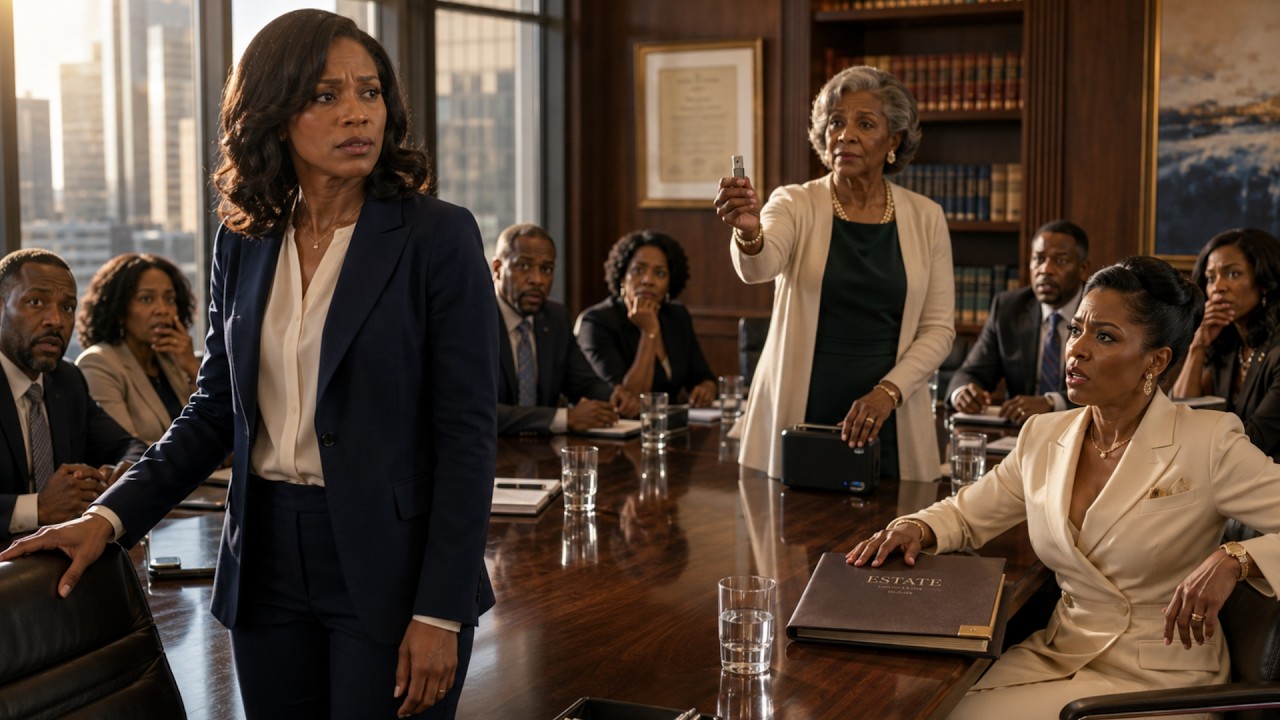
Beside me, Vanessa smiled before the meeting was even over, and then whispered, almost gently, “I told you Dad knew who deserved it. ”
I walked out of that conference room believing I had lost my father twice in the same month—once to his death, and once to the discovery that he had somehow stopped trusting me. I’m Olivia Bennett, and I’m an estate planning attorney. I’ve spent my career helping families protect their final wishes, making sure their intentions survive them clearly and completely.
I never imagined I would need that same protection for myself, against my own sister. To understand how I ended up in that room, you need to understand my father. Michael Bennett was an architect, a man who approached every part of his life like a set of blueprints—careful, deliberate, and deeply committed to fairness. He raised my older sister Vanessa and me to believe that love in a family wasn’t measured by who showed up the loudest, but by who showed up consistently, in the ordinary moments that never make it onto anyone’s social media feed.
Vanessa is five years older than me, a luxury real estate agent with a natural charisma that made her the star of every family gathering. I loved her, and in many ways I still do, even after everything. But I also grew up watching her operate with a particular kind of confidence—a belief that things generally worked out in her favor because she generally made sure they did. I took a different path.
I was the one who visited Dad every week without being asked, who drove him to medical appointments, who learned his medication schedule, who cooked meals that fit his dietary restrictions after his heart problems started. I was the one who handled the mundane administrative details of an aging parent’s life that no one enjoys but someone inevitably has to manage. Vanessa loved Dad deeply too, but she loved him in a different rhythm—showing up for birthdays and holidays, the moments that photographed well, while the quieter caretaking fell to me. Dad never complained about the difference.
He wasn’t the type to keep score out loud. But I remember, more than once, him squeezing my hand after a long appointment and saying quietly, “I don’t know what I’d do without you showing up like this, Liv. ” Those small moments meant more to me than any inheritance ever could. And I never did that work because I expected something in return.
The red flags started small—so small I almost dismissed each one individually before they formed a pattern I couldn’t ignore. About a year before Dad passed, Vanessa began insisting on managing his finances more directly, saying it would make things easier for everyone. She started screening his phone calls, explaining that Dad got confused sometimes and needed protection from scams targeting older adults. I understood the concern in theory; I had seen elder financial abuse professionally more than once.
But something about the way she positioned herself as the sole gatekeeper of Dad’s affairs felt less like care and more like control, carefully wrapped in the language of care. Dad became unusually distant during that period—quieter during visits, sometimes hesitant when I asked simple questions about paperwork. Whenever I brought my concerns to Vanessa, she brushed them aside quickly. “You’re overthinking everything, Liv.
” She would say with the easy confidence of someone who had already decided the conversation was over before it started. There were other details I only understood much later. His Sunday phone calls to me became shorter, always with Vanessa’s voice audible in the background reminding him he had somewhere to be. Once, during a visit, I noticed a stack of papers on his desk that he quickly moved into a drawer when I walked in.
I told myself it was private financial paperwork and let it go. I think about that moment often now, wondering what might have changed if I had simply asked what was in that drawer. My grandmother, Evelyn Bennett, Dad’s mother, noticed the same pattern I did, though she said very little at the time. Grandma has always been a quiet woman, the kind of person the family sometimes mistakes for passive simply because she doesn’t feel the need to fill every silence.
What nobody understood until much later was that her quiet wasn’t weakness—it was observation. Dad passed away peacefully on a quiet morning in late autumn, following complications from a surgery that was supposed to be routine. His death itself was gentle, surrounded by people who loved him. At the time, grief was simply grief, uncomplicated by the suspicion that would follow.
Then came the reading of the estate, three weeks after the funeral. A small conference room at the law firm Dad had used for years. I sat beside Vanessa with a handful of extended relatives, Grandma seated quietly near the back. The attorney opened a folder and read through the documents calmly, professionally, until he reached the end: everything, the house, the savings, the investment portfolio, nearly $480,000 in total assets, left entirely to Vanessa.
I sat perfectly still, waiting for some clarification. It never came. A few relatives nodded slowly, and I caught at least two of them exchanging glances that suggested a silent agreement—a shared assumption that I must have disappointed him somehow. I left that meeting feeling hollow.
Over the following weeks, I found myself questioning memories I had trusted completely. Friends, trying to be supportive, suggested gently that maybe he had grown closer to Vanessa in his final years, that people’s priorities shift as they age in ways that don’t always make sense. I couldn’t argue with them because I didn’t have any proof. Meanwhile, Vanessa moved forward quickly.
She began discussing renovation plans for the inherited house, mentioning vacations she’d been wanting to take, hinting at investment opportunities. Watching her step so easily into a life suddenly transformed by money that I’d believed my entire adult life was meant to be shared between us was one of the loneliest experiences I’ve ever had. I didn’t confront her. I told myself keeping the peace mattered more than starting a conflict I wasn’t sure I could win, especially while I was still raw with grief.
There was one afternoon, about a month after the reading, when Vanessa called to ask if I wanted to walk through the house one more time before the renovations began, as if inviting me to admire changes to a home I had once believed would partly belong to me too was simply a kind gesture between sisters. I went, mostly because refusing felt like it would confirm whatever story the family had built about my resentment. I stood in that kitchen—the same kitchen where I had cooked Dad’s dinners for years—listening to her describe knocking out a wall for an open floor plan, and I felt like a guest in a house full of my own childhood memories. As an estate attorney myself, I understood better than most how difficult it would be to challenge a properly executed will without concrete evidence.
At that point, I had nothing but a feeling I couldn’t justify to a judge. I spent long nights reviewing my memories of conversations with Dad, searching for anything that might explain the shift, coming up empty every time. About five weeks after the estate reading, my grandmother called me. Her voice was different from usual—more deliberate, carrying a weight I hadn’t heard from her before.
She didn’t call to comfort me, not exactly. She asked me to come by her house the following afternoon, and something in her tone told me this wasn’t a casual invitation. The next day, we climbed together into her attic, a narrow space I hadn’t been inside since I was a child. Tucked behind a stack of old holiday decorations, exactly where Grandma remembered Dad placing it years earlier during a visit, we found a locked wooden cedar box, small enough to fit under one arm, heavier than it looked.
Inside were several things that made my hands start shaking. A leather journal filled with my father’s handwriting. Several earlier drafts of his estate plan, dated years before his death, each one dividing his assets evenly between Vanessa and me, exactly the way he had always promised. An envelope sealed and addressed specifically to Grandma.
And finally, tucked carefully beneath everything else, a small USB drive with a single line written across the label in Dad’s careful architect’s handwriting: “Play this only after the estate meeting. ”
Grandma looked at me for a long moment. “Your father knew there was a chance this day would come,” she said quietly. “He came to me almost a year before he died, worried about things he couldn’t quite explain yet.
He asked me to keep this safe and to wait, exactly the way the label says, until after everything played out the way he was afraid it might. ”
I sat on the floor of that attic for a long time, holding that small silver drive, understanding for the first time that my father had seen something coming that none of the rest of us had been willing to see clearly ourselves. Grandma and I agreed together that this truth deserved to be revealed the same way the inheritance decision had been delivered—in front of the family, openly, rather than quietly resolved behind closed doors where it could easily be reframed or denied later. Grandma reached out to relatives with the simple explanation that she wanted to gather everyone together to share some memories of Dad.
Nobody found that unusual. The family gathered at Grandma’s house on a Sunday afternoon two weeks later. Vanessa arrived exactly as confident and relaxed as she had been at the estate reading, clearly assuming this was simply another sentimental family gathering. She had no reason to expect anything else.
Once everyone was settled in the living room, Grandma calmly connected a small speaker to the USB drive and, without any dramatic build-up, simply pressed play. My father’s voice filled the room—steady, familiar, the same voice I had heard my entire life explaining blueprints, offering quiet advice, telling me he was proud of me after long days at hospital appointments. Hearing it again unexpectedly after weeks of grieving in silence brought tears to my eyes before he had even finished his first sentence. He explained, calmly and methodically, that over the final year he had noticed important financial and legal documents going missing from his files—documents he had kept carefully organized for years.
He described feeling pressured more than once to sign paperwork while still heavily medicated following his surgery, moments when his thinking wasn’t as clear as it should have been for decisions of that magnitude. Rather than confronting anyone directly while he was still uncertain about what exactly was happening, he had quietly asked his attorney—someone entirely separate from the family firm Vanessa had increasingly involved herself with—to prepare and safely store an authenticated copy of his true estate wishes alongside this recorded explanation, in case his fears turned out to be justified. “If you’re hearing this,” his recorded voice continued, calm but unmistakably serious, “then the version of my will that was presented at the reading may not be the one that reflects my actual wishes. ”
The room had gone completely silent.
I glanced at Vanessa and watched something shift in her expression—the easy confidence she had carried into the room slowly beginning to falter. Then my father’s voice softened, and he said something I don’t think I will ever fully stop hearing in my mind. “Olivia, if anyone has made you doubt my love for you, don’t believe them for a second. Your kindness has been the greatest blessing of my life.
Every appointment, every quiet dinner, every moment you gave up for me without ever asking for anything back—I noticed all of it. I noticed every single time. ”
I couldn’t hold back tears at that point, and I didn’t try to. Around the room, I noticed several relatives lowering their eyes—the same people who had nodded along weeks earlier, quietly assuming I must have somehow disappointed him.
Vanessa’s composure, which had carried her so effortlessly through every difficult moment in her life, began visibly cracking for the first time I had ever witnessed. Once the recording finished, Grandma calmly explained what she had already set in motion. Upon receiving Dad’s sealed letter and understanding the seriousness of what he suspected, she had contacted his original attorney directly—the one who had prepared the authenticated documents stored securely outside the family’s reach. An independent forensic document examiner had already been engaged to review the estate paperwork presented at the reading.
The investigation that followed didn’t rely on accusations or arguments between Vanessa and me. It relied entirely on evidence. The examiner’s findings identified missing pages in the original file, subtle inconsistencies in signature patterns compared to verified samples from years earlier, and specific changes made to the estate documents in the final months before Dad’s death—timed suspiciously close to periods when he had been recovering from surgery and, by his own recorded account, not entirely clear-headed. The probate proceedings took several months to fully resolve.
I sat through hearings where the forensic examiner explained in technical detail how signature pressure patterns and ink aging could reveal when a document had actually been signed versus when it claimed to have been signed. I watched Vanessa’s attorney attempt several different explanations for the irregularities, each one slightly less convincing than the last, until eventually even her own legal team seemed to lose confidence in the case they were presenting. There was no dramatic courtroom outburst, no tearful confession delivered under cross-examination the way television often portrays these moments. There was simply a slow, methodical accumulation of facts that eventually left no reasonable alternative explanation standing.
The altered documents were formally invalidated. My father’s authenticated estate plan—the one preserved carefully in that cedar box alongside his recorded explanation—was restored and honored exactly as he had originally intended, dividing the inheritance evenly between his two daughters. Vanessa never faced criminal charges. The evidence, while clear enough to invalidate the fraudulent documents in probate court, didn’t rise to the level prosecutors were willing to pursue criminally.
And honestly, I never pushed for that outcome myself. What she lost instead felt, in many ways, heavier than any legal punishment could have been. She lost the quiet, unquestioning trust of our extended family. Her professional reputation suffered once the legal findings became part of the public probate record, something potential clients in her line of work occasionally researched before agreeing to work with her.
She eventually sold the large house she had stretched to purchase in the months following the original fraudulent inheritance, and began rebuilding her life from a considerably humbler position than the one she had briefly and unfairly occupied. I received my rightful share once the court’s decision was finalized, but I didn’t feel much desire to celebrate. Instead, I used a significant portion of it to establish a scholarship in my father’s name, designed to support architecture students from low-income families who might not otherwise have access to the opportunities Dad had spent his own career quietly creating for others. Grandma, when I told her, simply smiled and said, “That’s exactly the kind of choice your father hoped one of you would make.
”
Months later, on a quiet afternoon, Grandma and I visited Dad’s favorite park together—the same one he used to take me to as a child while he sketched building ideas in a small notebook he always carried. We sat on a familiar bench, and for reasons neither of us needed to explain out loud, we played his recording one final time. Not because we needed the proof anymore—the legal matter had long since been settled—but simply because we missed hearing his voice, and some part of both of us wasn’t ready to let that particular sound fade into memory just yet. Vanessa and I have spoken a handful of times since everything settled.
Careful, measured conversations that haven’t yet and may never fully return to the closeness we shared before. I don’t carry active anger toward her anymore, though I won’t pretend the trust between us has been fully restored either. Some things, once broken, take far longer to rebuild than the time it took to break them, if they can be rebuilt at all. I’ve made peace with the possibility that our relationship may simply exist differently now—more distant, more careful.
During one of those conversations, Vanessa admitted something that surprised me, though it didn’t excuse what had happened. She told me that somewhere along the way, she had genuinely convinced herself that she deserved more, that her version of caring for Dad counted just as much as my years of quietly showing up. She said watching me handle everything so calmly, so competently, had made her feel small in a way she never wanted to admit out loud, and that feeling had slowly curdled into something she wasn’t proud of. I don’t know if that explanation makes what she did any easier to accept, but I appreciated that she was finally willing to look at it honestly.
For weeks after that first devastating meeting at the attorney’s office, I believed that losing my inheritance was the deepest wound my father had left behind. I was wrong about that. The real pain—the wound that cut far deeper than any amount of money ever could—came from believing, even briefly, that my own father had somehow stopped believing in me. His final recording didn’t simply restore what was rightfully mine according to the law.
It restored something far more important—the relationship I had genuinely believed his death had permanently taken away from me. Money, I’ve learned, can be divided, contested, redistributed, and eventually forgotten. Love, when it’s real, when it’s spoken honestly and preserved carefully enough to outlast even deliberate deception, simply can’t be erased the same way. My father spent his entire life building things meant to last—structures designed to withstand pressures he would never personally witness.
It turns out his final, most important construction wasn’t made of steel or concrete at all. It was six minutes of recorded truth, quietly preserved in a cedar box in his mother’s attic, patiently waiting for exactly the right moment to speak on his behalf long after he no longer could himself. And when that truth finally spoke, it didn’t just correct an inheritance.
It gave me back the one thing I feared losing more than any amount of money ever could—the absolute certainty that my father, until his very last breath, believed in me completely.