I woke to a hard white light pressing against my eyelids, a brightness that didn’t belong to any room in my house. My body felt too heavy, my thoughts scattered. The cold metal rail against my arm told me I was in a hospital bed, but I had no memory of how I got there. My head ached at the back, and my left arm throbbed as if someone had struck it with a hammer.
Before I could piece anything together, I heard a voice just outside the curtain. Masculine. Familiar. My son, Evan.
He wasn’t worried or frightened. He was laughing, the bright, casual laugh he used when he wanted to impress someone. “Yeah, my mom is here again. She’s basically an old nuisance.
”
A young woman giggled. A nurse, by the sound of her shoes on the linoleum. Evan took her laughter as encouragement and grew louder, bolder, crueler. “She always falls, cries, panics.
She’s helpless. Honestly, I basically raised myself. ”
Her laughter deepened. He fed on it like a performer hungry for applause.
“If she wants to rot here, let her. I have things to do. She’s not my problem. ”
The words didn’t just sting.
They hollowed something inside me. I lay still, eyes barely open, listening to my own son describe me as if I were a broken tool someone should throw out. I wanted to clear my throat, to tell him I was awake, to make him see me as a human being again. But shame pushed the air back down my chest.
The curtain slid aside and revealed my neighbor, Grant. He looked relieved when he saw me awake, though his eyebrows rose with concern. “Lillian, thank God. You fell down your stairs.
I heard the crash through the wall and found you at the bottom. You weren’t moving. I called for help and rode with you here. ”
His words filled in the blank space I feared.
The person who saved me wasn’t my son, wasn’t family. It was a neighbor. Behind him, Evan still flirted, unaware that the woman who gave him life had nearly lost hers hours earlier. When Grant gave me space, I unlocked my phone and dialed my daughter-in-law, Ila.
I needed someone who belonged to me, someone who should have cared. She answered by snapping. “What now? ”
“I’m in the hospital.
I fell. I—”
She cut me off with a sharpness that carved straight through my ribs. “Rot in the hospital if you want. Stop bothering us.
”
The line went dead. I stared at the phone until the screen dimmed. A deep cold settled in my chest, not the physical cold of hospital sheets, but the kind that arrives when you realize the people you love didn’t hesitate to cast you out of their lives. Evan finally pushed through the curtain.
He looked at me, then at the monitor, then back at me with mild annoyance, like a man checking on a car left idling. “Why do you always need attention? You scared everyone for no reason. ”
I stared at him.
“I fell. I didn’t call anyone. I didn’t ask to be brought here. ”
He shrugged.
“Grant made it sound like you were dying. Honestly, you really need to stop making everything a crisis. ”
The same boy who once cried when I scraped my hand on a broken dish now stood beside my hospital bed, irritated that I wasn’t injured in a more convenient way. He pulled out his phone and began checking messages.
“I need to go soon. Ila is mad that I’m even here. She thinks you do this to manipulate us. ”
Manipulate.
The word pierced deeper than any bruise on my body. I had spent years shrinking myself so he wouldn’t feel burdened by me. I kept my problems quiet, my worries private, my loneliness hidden behind gentle smiles. And now he believed I fell down a staircase to gain attention.
A nurse entered to check my vitals. Evan straightened his posture and acted concerned, placing a hand on the rail of my bed. “She just gets overwhelmed,” he told her, shaping himself again as the patient, long-suffering son. “She panics easily.
”
The nurse nodded sympathetically, her expression softening toward him, hardening toward me. His performance had succeeded. Even the staff saw me as unstable, troublesome. After she left, he muttered, “I don’t need any more drama today,” and walked toward the door.
“I’ll check on you later, I guess,” he said, though we both knew he wouldn’t. Just before the curtain closed, I watched his face arrange itself into the charming smile he used for the nurse. The smile he no longer used for me. I stared at the ceiling, feeling smaller than ever.
Nothing hurts quite like being treated as a burden by the child you raised with every piece of yourself. I dozed off for a moment before a low murmur from the hallway snapped me awake. The hospital had grown quieter, but something in the doctor’s voice was unmistakably serious. “The patient has advanced lung lesions.
Stage three lung cancer. We need immediate follow-up. ”
The words slid beneath my skin. But I had no lung issues.
Then I heard a sharp, familiar inhale. Evan. For a heartbeat, he sounded like the frightened boy he once was. But the softness vanished.
“Of course she would do this now. What a burden. ”
The cruelty hit harder than my fall. My son heard the word cancer and felt annoyance.
Not fear. Burden. Always a burden. He was standing just outside my door, whispering to himself, angry and inconvenienced.
“She can’t do this to me. Not now. My life is finally stabilizing. I have a lot going on.
She can’t drop something like this on us. ”
On us, not on him. On his plans, on his schedule. He sounded more angry than afraid, more inconvenienced than heartbroken.
He was not a son terrified of losing his mother. He was a man irritated that reality could disrupt his comfort. I lay still, swallowing the ache rising in my throat. If he thought I was dying, his first thought was how difficult it would be for him.
Not once did he ask whether I was frightened. Not once did he think of the years I spent stitching piece after piece of my life into his. Then the same doctor walked past, flipping through a chart. The tag clipped to the folder caught my eye.
Evan Smith. Date of birth, 1988. My breath faltered. They had been talking about Evan.
The cancer was his. The diagnosis belonged to him, not me. He had misheard everything. He assumed the worst and placed that weight on me because in his mind I was always the sick one, the weak one, the nuisance.
And in assuming so, he revealed his deepest truth. He resented the idea of caring for me. I felt no triumph in discovering the truth, only a hollow sadness. I had wished that if a moment like this came, he would show even a sliver of the tenderness he once carried.
Instead, he showed only frustration and inconvenience. He feared losing comfort, not losing me. A nurse came in to check my vitals. “How are you feeling, Mrs.
Lillian? ” she asked. There was no laughter now, no judgment, only routine politeness. “I’m all right,” I said quietly.
“Just tired. ”
She nodded and adjusted the monitor. “Your son looked concerned just now. He rushed past the station.
”
Concerned? The word almost made me laugh. He wasn’t concerned for me. He was horrified at the idea that his life might be altered by having to care, even briefly, for the woman who had carried him through every dark season of his childhood.
The doctor opened the curtain again. His expression had changed, softened into something cautious. “Mrs. Lillian, could you come with me for a moment?
I’d like to speak to you in private. ”
He led me down the hallway into a small consultation room and closed the door. He motioned for me to sit. I did.
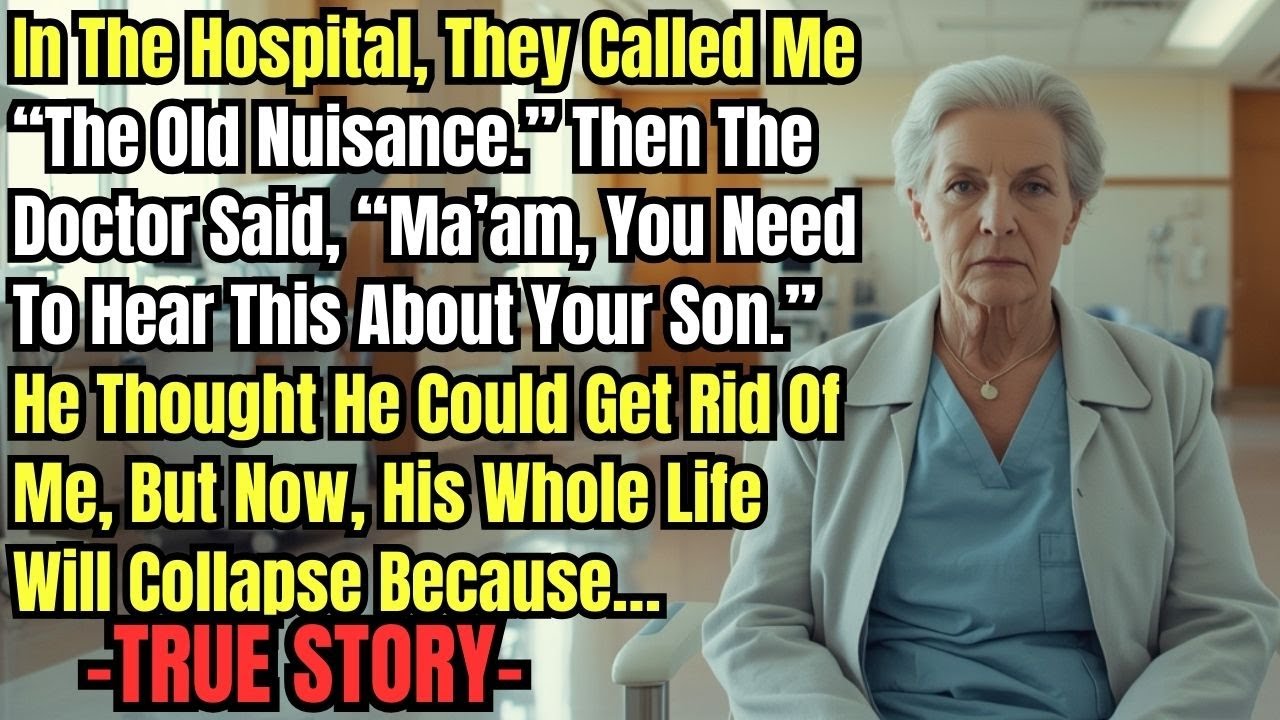
He placed a file gently on the table between us. “Ma’am, you need to hear this about your son. ”
My breath halted. He opened the file.
“Your son is the patient with lung lesions. The diagnosis we discussed in the hallway was his. Stage three lung cancer. Not yours.
”
The words struck with the force of a blow. I blinked slowly, trying to make sense of them. “Evan? ” I whispered.
“Are you certain? ”
“Absolutely certain. The scans and biopsy confirmation are his. There is no mistake.
”
I pressed my fingers against my lips. A moment earlier, I had been trying to understand how my son could resent me for being sick. Now I understood a different truth. He believed I was dying, and his first instinct was annoyance.
“We have not informed him yet,” the doctor continued. “He left the imaging department before we could review the results. You’re listed as his emergency contact, so you deserve to hear the truth before he does. ”
I closed my eyes.
I wished I could step back to when Evan was small and ran to me after scraping his knee, trusting me with his pain. But the boy I remembered had grown into someone who laughed while humiliating me, someone who told strangers I was a burden. The doctor studied my face. “You seem overwhelmed.
Do you have someone who can support you through this? ”
I shook my head. “No, not really. ”
He hesitated.
“Lung cancer at this stage is serious. He will need emotional and practical support. ”
A brittle laugh escaped me. “He hasn’t offered me a kind word all day.
He told a nurse I was a nuisance. He called me a burden when he thought I was the one with cancer. ”
The doctor’s eyes softened. He didn’t speak right away.
I looked down at my bruised hands. “I don’t know whether to tell him. ”
“That decision is yours,” the doctor said quietly. “But regardless of what he has said or done today, he deserves to know the truth about his health.
”
Through the thin door, faint laughter trickled from the hallway. Evan, still talking to someone, still shaping a version of himself that fit better than the truth. Boasting about his life while his future was fracturing in the next room. Then the laughter was interrupted by a cough.
A single sharp cough, then another, and another. It deepened, lung-deep, the kind that sounds like something inside is tearing. I moved toward the doorway just as the coughing grew louder, almost violent. Then came a wet choke followed by a splatter.
I stepped into the hallway and saw nurses turning, startled, eyes widening. Evan stood in the middle of the corridor, bent forward, hands braced on his knees. A red stream burst from his mouth, splattering onto the polished floor. Blood, bright, thick, impossible to misinterpret.
The nurse he had been laughing with screamed and backed away. Another nurse rushed forward, shouting for help. “Call the trauma team. Get suction.
Move her out of the way. Evan, stay with me. ”
I pressed myself against the wall, unable to breathe. Evan’s face drained of color.
He tried to speak but only gurgled, crimson dripping from his lips. Another violent cough triggered another gush of blood across the front of his shirt. He stared down at it, horrified, as though trying to understand why the blood was on him and not on me. A doctor sprinted to him and grabbed him by the shoulders.
“Evan, focus on my voice. You need to sit down now. ”
Evan shook his head wildly, gasping. “No, no, this is not… this is not mine.
This is not supposed to be me. ”
His knees buckled. The doctor guided him down before he hit the floor. I took a step forward without thinking, an instinct deeper than breath.
But a nurse held out her arm. “Please stay back, ma’am. We need space. ”
Evan grabbed the doctor’s sleeve with trembling fingers.
“My mom. She’s the one. She’s sick. Not… not me.
”
The doctor looked directly into his eyes. “Evan, you are the one who is sick. You are the lung cancer patient. ”
The hallway fell silent for a split second.
Evan froze, his eyes widening as if the world had suddenly become too bright. “No,” he choked. “That is not possible. That was her diagnosis.
That was my mom’s. ”
The doctor shook his head slowly. “The diagnosis is yours, Evan. It has always been yours.
”
Evan’s breathing turned erratic, desperate. He looked around the hallway, searching for something familiar to cling to. Our eyes met for just a second. In that second, I felt the full weight of what he was realizing.
He had mocked me, dismissed me, called me a burden, convicted me in his mind for a disease that was never mine. And now the truth was sitting on his chest like a stone. He reached out a bloodstained hand toward me, trembling violently. “Mom, help me.
”
My feet refused to move. Shock rooted me where I stood. After everything he had said, after the cruelty, the arrogance, the neglect, he finally called for me. Not Ila.
Not a nurse. Me. But another coughing fit ripped through him before I could step forward. The trauma team surrounded him, blocking my view.
They lifted him onto a rolling bed, pushing him quickly toward the emergency wing. Just before they turned the corner, I saw his hand reach out again, desperate, shaking, searching. For the first time since he became a stranger, he looked like my child again. Terrified, lost, fragile.
Then he disappeared behind the swinging doors, leaving only the streaks of blood on the floor and the echo of a truth he could no longer outrun. I sat alone for nearly an hour after they rushed him into the emergency wing. A nurse offered to wheel me back to my room, but I refused. My legs shook, but I stayed rooted in the waiting area like a tree bracing against a storm.
The doctor returned. His gloves were off, his posture less urgent but no less serious. “Mrs. Lillian, your son is stabilized for the moment.
He is awake. He is asking for you. ”
My heart tightened. For years, he had walked past me, away from me, around me.
Now he was asking for me. When I entered his room, I barely recognized the man in the bed. His eyes were swollen with exhaustion, rimmed with fear. Machines beeped softly beside him.
He turned when he heard my footsteps. For the first time since he was a little boy, his face crumpled the moment he saw me. “Mom,” he whispered, his voice cracking. “Mom, I am so sorry.
”
He reached out a trembling hand. I placed mine in his, and his fingers closed around it with a desperation that drained every ounce of anger I thought I had left. Tears spilled down his cheeks, silent at first, then shaking his whole body. “I was awful to you,” he choked.
“I was cruel. I thought you were the sick one. I thought…”
“You don’t need to explain now,” I murmured. But he shook his head.
“No. I have to. I have to say it while I still can. I treated you like you were nothing, like you were in my way.
I thought I was strong, but I was weak. I listened to Ila. I pushed you out. I laughed at you.
Mom, I am so sorry. Please forgive me. ”
Forgiveness is strange. Sometimes it comes like sunlight, sudden and warm.
Sometimes it comes like winter, slowly, painfully, each inch earned. But at that moment, hearing him call me mom without contempt, without distance, without performance, forgiveness came like breath. “I forgave you long before this moment,” I whispered. “You are my son.
”
He cried harder then. I held his hand until the tremors eased. We stayed that way for several minutes, not speaking, just breathing in the fragile peace that had finally returned to us. But peace rarely stays long in a life like mine.
The door burst open with a sharp swing. Ila stood there, perfect makeup, perfect hair, holding her baby on her hip. Her expression was not panic or worry. It was annoyance.
“Evan, I came as soon as I heard. Is it true? Cancer? Stage three?
”
Evan looked exhausted, vulnerable. “Ila, I—”
She cut him off. “Don’t start crying. Just tell me what the doctor said.
”
The doctor stepped in. “Mrs. Smiths, your husband needs support right now. ”
Ila scoffed.
“I need to know what his diagnosis means for me. ”
Even Evan closed his eyes, bracing for impact. “Ila, I’m sick. ”
She shrugged.
“People get sick. Life goes on. I need security. ”
The doctor spoke firmly.
“Your husband will require immediate oncology treatment, long-term monitoring, and possibly surgery. He needs a support system. ”
Ila rolled her eyes. “I did not sign up to be a caregiver.
”
The baby fussed. She bounced him impatiently. “This is ridiculous. I cannot do this.
”
Evan’s voice trembled. “Ila, please don’t leave me. ”
But she had already turned toward the door. “I am leaving.
I do not have time for this. ”
She paused at the threshold, glanced back at Evan, and delivered the final blow with a casualness so cruel it nearly knocked the breath from me. “Oh, and the baby? He’s not yours.
”
Silence crashed into the room. Evan’s entire body recoiled. His mouth opened, but no sound came out. Ila smirked.
“I thought you should know before I leave. Saves us both time. ”
Then she walked out, without a backward glance. Evan’s face drained of color.
His hand slipped from mine. “Not mine,” he whispered. “The baby… not mine. ”
He curled forward as if the truth itself had weight, pressing down on his ribs, his lungs, his already fragile breath.
His sobs tore at the air, raw, loud, desperate. I placed my hand on his back, unsure whether I was comforting him or holding him together. “My marriage, the baby, my body… everything is gone,” he whispered. He had spent years abandoning me.
But now he was the one abandoned. And no matter how much we had healed in the hours before, no matter how much forgiveness had begun to bloom, he was breaking at the exact moment he was finally trying to come home. Three weeks later, the cancer claimed him. He died quietly, holding my hand.
He managed one last apology before sleep overcame him. There was no time for repair. No time to rebuild the bridges he had burned. He left his life the same way he entered mine.
Crying, reaching for someone to hold him. And this time, the only person left was me. Three days after Evan passed, I was sitting alone at my kitchen table when a knock came at the door. It was gentle, almost hesitant.
A young delivery worker stood there holding a sealed envelope inside a protective pouch. “Ma’am, this was scheduled to be delivered after the sender’s passing,” he said quietly. My fingers trembled as I signed for it. The envelope was thin, but it felt heavy, as if grief had settled into the paper itself.
When I saw Evan’s handwriting on the front, my knees nearly gave out. I sat down slowly. For a long moment, I simply stared at it. A part of me wanted to leave it sealed forever, afraid of what regrets or apologies might wait inside.
Another part of me, the mother part, needed to know his final thoughts. I opened it. “Mom, if you’re reading this, it means I’m gone. And this time, you can’t tell me everything will be all right.
”
I pressed a hand to my mouth as tears blurred the words, but I forced myself to keep reading. “I have spent most of my adult life pretending I was stronger than I really was. I thought strength meant pulling away from you, proving I did not need you. I thought mocking you made me look confident, but now I know it only showed how weak I was inside.
I was angry at myself for failing to become the man I imagined, so I made you the target. You never deserved that. I told the nurses you were a nuisance because I wanted to impress them. I wanted to feel powerful.
But the truth is, I have always been standing on the ground you built for me, the ground you sacrificed everything to create. I lied about who you were so I could lie about who I was becoming. I followed Ila because she told me I needed to cut the cord, and I was foolish enough to think she was helping me grow. But she never loved me.
She loved what she thought she could take from me. I see that now. I have known for a long time that the baby wasn’t mine. I heard Ila on the phone once saying things she thought I would never hear.
I kept quiet because admitting it meant admitting my whole life was built on lies. I was too much of a coward to face it. I hurt you because I did not know how to face myself. I pushed you away because I felt unworthy of the life you gave me.
You were strong in the quiet ways I used to mock. You carried the world when I complained about lifting a stone. If I could start over, I would love you the way you deserved. I would defend you.
I would come home more often. I would sit with you, listen to you, and show you a gentleness I forgot you taught me. But life doesn’t give rewinds. I hope someday you can remember me without pain.
I hope you can live free from the burden of my mistakes. I hope you find peace in the years I will not get to see. I love you, Mom. I always did.
I just never learned how to show it until it was too late. ”
The signature at the bottom was shaky, uneven. Evan. I folded the letter slowly, my tears falling.
Not from anger, not from the fresh wound of losing a child, but from something deeper. Relief. After all the years of silence, distance, and cruelty, I finally heard the words I had waited for since he first turned away from me. The truth, the apology, the love he had buried beneath years of pride.
I pressed the folded letter to my heart and breathed in slowly, letting his final words settle into the places where the bruises of the past still lived. For the first time in a long while, the ache inside me loosened. I stood up and walked toward the window. Outside, the afternoon light spilled across the yard in soft gold.
The world felt unexpectedly wider, freer. The air no longer carried the heaviness of trying to hold together a relationship that had been breaking for years. I lost my son. But I found myself again.
And for the first time since Evan was a boy, I felt whole.