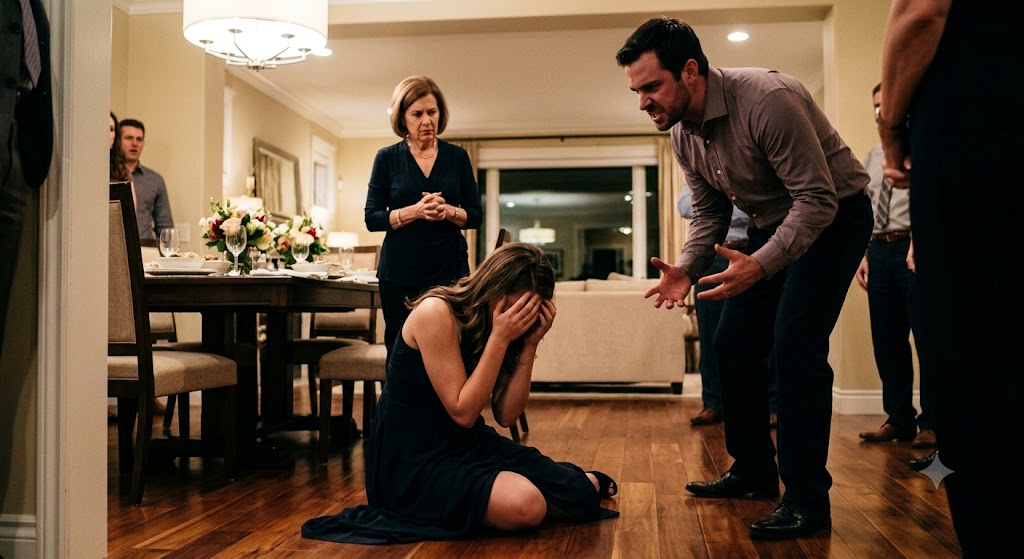
I rehearsed that moment for three years. I knew what I would say, how I would stand, the exact words I would use when I walked back into Millhaven. What I couldn’t have predicted was that my brother would finally destroy himself. All he needed was an audience, and I made sure he had one.

But let me start at the beginning, because you need to understand what it cost me. I was nineteen when my grandmother’s will was read. My father wasn’t dead, but my grandmother had passed and left everything to him, which was her right. Tucked inside that will was a letter.
A letter that named me. It said that a portion of her estate, a piece of land on the edge of town she’d owned for forty years, was meant to come to me. She told me herself the summer before she died, sitting at her kitchen table, hands wrapped around a coffee mug. “That land is yours, sweetheart.
I’ve made it official. Don’t let anyone tell you different. ”
I was nineteen. I trusted my family.
I didn’t know I should have gotten a copy of that letter myself. My brother Marcus is four years older than me, and he has spent his entire life understanding one thing: in our family, information is power, and whoever controls the paperwork controls everything. Three weeks after the funeral, I asked about the land. Gently.
Carefully. The way you do when you’re young and still believe being polite protects you. Marcus looked at me across the dining room table with an expression I’d never seen before. It wasn’t anger.
It was patience. The kind of patience that told me he’d been waiting for me to ask. “There’s no letter,” he said. I told him I had been there.
I heard grandmother say it. “You heard an old woman who wasn’t well say a lot of things,” he said. “That doesn’t mean there was ever a legal document. ”
I looked at my father, sitting at the head of the table.
He was looking at his hands. That was the moment I understood. My father wasn’t confused. He wasn’t going to correct my brother.
He was going to let this happen. I left Millhaven eleven days later with two suitcases and a name for what had been done to me, even if I didn’t have the vocabulary for it yet. My family had stolen something from me. Not just land.
Not just money. The last thing my grandmother had tried to give me. The last proof that someone in that house had loved me without conditions. I drove six hours north to stay with a college friend named Priya.
She asked zero questions and gave me her couch and a key to her apartment. I’ll never forget that kindness. What happened in the years after that, I want to be honest about it. People expect these stories to move in a straight line from pain to triumph.
Mine didn’t. The first two years were the hardest. I worked a front desk job at a medical office during the day and took paralegal certification courses at night. Something had shifted in me after that conversation at the dining room table.
I needed to understand the law, not in an abstract way. I needed to understand it the way Marcus did. As a tool. As a language.
As a form of protection. I passed my certification. I got a job at a small firm in the city. I was good at it, and I knew I was good at it, which was a new feeling.
Knowing something about myself without needing anyone to confirm it. I didn’t call my parents. I sent cards on holidays for the first two years, then I stopped doing even that. My mother called me once, about eighteen months after I left.
She said she missed me, that the family wasn’t the same without me. I asked her if Marcus had ever been asked to return the land. She went very quiet. Then she said, “You know how your brother is.
”
I told her I did know, and I said goodbye very kindly. I meant it. I didn’t hate her. I just understood finally that she was not going to protect me, and waiting for her to do so was a form of self-harm I could no longer afford.
His name was Daniel. I met him at a continuing education seminar, which is possibly the least romantic origin story imaginable. He sat two seats to my left, taking notes in the margins with a pen he kept clicking. It should have annoyed me.
Somehow, it didn’t. We talked afterward in the parking lot for forty-five minutes about evidence procedure and missed dinner. Neither of us noticed until a security guard asked if we needed anything. He was a federal investigator.
He told me on our third date, calmly, over pasta, the way you tell someone your middle name. Just a fact about himself. I remember thinking, of course. Of course the first person who made me feel safe in years would turn out to have a badge.
We were married two and a half years later. Small ceremony, twenty people, Priya as my maid of honor. I did not invite my family. I told Daniel the full story about the land and my grandmother’s letter on our fifth date.
He listened without interrupting. When I finished, he said, “Do you still have any of her things? Letters, cards, anything in her handwriting? ”
I told him I had a box of birthday cards she’d sent me over the years.
“Keep those,” he said. I didn’t know why he said it then. I do now. For twelve years, I built my life.
I made partner at a mid-size firm. We bought a house. I learned how to cook properly, how to sleep without anxiety waking me at three in the morning, how to sit in a room full of people and not feel like an impostor waiting to be found out. I learned, slowly and with a lot of effort, that I was allowed to take up space.
My mother died on a Tuesday in October. Priya called me because she had stayed in touch with people in Millhaven in a way I never had. She grew up there too. Two streets over from my grandmother’s old house.
Small towns have long memories. She told me gently, the way she always tells me things, and I sat on the edge of our bed for a long time afterward just breathing. I had made peace with the distance. I had told myself the absence of my parents was a kind of answer.
If neither of them had ever reached out to apologize, to explain, to even acknowledge what had happened, then the silence itself was the answer. But grief is not logical, and loss is not fair. I sat on that bed and cried for the mother I’d wanted her to be, which is a different kind of grief than crying for the mother she actually was. Daniel sat with me.
He didn’t say anything for a long time. Then he asked if I wanted to go to the funeral. I said I didn’t know. “There’s unfinished business there,” he said.
“Not just your mother. The land. ”
I looked at him. He had that expression on his face, quiet, precise, the one I’d come to recognize as him thinking three moves ahead.
“I’ve been doing some reading,” he said, “about your grandmother’s estate. ”
I asked him what he meant. He told me that twelve years ago, when my grandmother died, her estate should have gone through probate. The letter she had written about the land, even if my family claimed it didn’t exist, would have been filed as part of that process if it was legal.
He had requested the probate records from the county clerk years earlier, with my knowledge and permission, as a matter of public record. What he found was that the letter did exist. It had been filed. It was in the probate records.
It had simply never been acted on. My brother had not destroyed the letter. He had just counted on me not knowing enough to look for it. I want you to understand what it felt like to hear that.
Twelve years of being told I had imagined something, that I had heard what I wanted to hear from a sick old woman, that I was the unreasonable one for expecting anything. And the document had been sitting in a county records office the entire time. Filed in triplicate. Perfectly intact.
I cried again, but it was a different kind of crying. I called into my office the next morning and told them I would be out for a week. I packed a bag. Daniel drove.
We arrived in Millhaven on a Thursday afternoon, two days before my mother’s funeral. I had not told anyone we were coming. I had learned something over twelve years of working in law, and it was this: the person who arrives with the least warning has the most advantage. We stayed at a motel on the edge of town.
Clean, quiet, entirely anonymous. The first thing I did was walk alone to my grandmother’s old house, which my father still owned, and stand on the sidewalk in front of it. The oak tree in the front yard was enormous now. It had been enormous when I was a child too, but memory compresses things.
I had forgotten how large it was. I went back to the motel and called my father. He answered on the third ring. There was a pause when I said my name.
Not a pause of surprise. A pause of calculation. “I’ll be at the funeral,” I said. “I wanted you to know.
”
Another pause. “Your brother is handling the arrangements,” he said finally. “I know,” I said. “I’ll see you Saturday.
”
I hung up. Priya came to the motel that evening and brought food. She sat with me while I went through the documents Daniel had obtained. The probate filing.
The letter in my grandmother’s handwriting. The land deed. The series of transfers that had taken place after her death. The land had never formally been transferred to Marcus.
He had simply occupied it. Allowed a development company to lease it. Collected the income on the assumption that I would never come back, or never know, or never have the resources to do anything about it. For twelve years, he had been collecting lease payments on land that, by my grandmother’s legal directive, belonged to me.
The number was not small. Daniel had already contacted an attorney in the county, someone with no connection to our family. A meeting was scheduled for Friday morning. By Friday afternoon, we had filed the paperwork to formally contest the estate distribution and assert my claim to the property.
By Friday evening, Marcus had been served. I know what you’re thinking, because I’ve been asked this. Did I feel guilty? Did I feel like I was doing this at the wrong time, with my mother barely in the ground?
The honest answer is that I thought about that a lot during those twelve years. I thought about what it would feel like to confront my family. Whether I would feel righteous or just empty. Here is what I actually felt standing in that attorney’s office on Friday afternoon.
Nothing dramatic. Just a very clear sense that I was doing something correct. The same feeling I get when I catch an error in a contract. A quiet, precise click of something falling into the right place.
The funeral was at eleven on Saturday morning. I wore a dark gray dress I’d bought specifically for this trip. I arrived fifteen minutes early and sat in the third row. Not the family row.
Not the back either. My father came in with Marcus and Marcus’s wife. I watched my father’s face as he registered that I was there. He looked older than I remembered.
Genuinely old, in a way that caught me off guard. Marcus looked exactly the same, which is somehow always the case with people like Marcus. They don’t seem to age because aging requires experiencing the full weight of time, and people like Marcus never let themselves do that. Marcus saw me and stopped walking.
I looked at him and then looked forward again. A technique I have refined over many years of depositions. You acknowledge someone’s presence without giving them anything to react to. The service was beautiful, actually.
My mother had loved music, and whoever had chosen the hymns had chosen well. I sat and let myself grieve for her privately, something I would not have been able to do if I had been performing for my family’s benefit. The distance of the last twelve years had given me something I hadn’t expected. The ability to be present in my own feelings without managing anyone else’s.
It was after the service, in the reception hall attached to the church, that Marcus found me. I was standing near the window with a glass of water when he appeared at my shoulder. He was using the voice I remembered. Quiet.
Controlled. The one that said, “I am going to handle this without making a scene. ”
“You should have told me you were coming,” he said. “I told Dad,” I said.
“You should have told me. ”
I turned to look at him. Up close, he looked less certain than he had across the room. He had been served less than eighteen hours ago, and even Marcus couldn’t entirely absorb something like that without it showing somewhere.
“I’ve been seeing an attorney,” I said. Not loudly. Conversationally. “I know,” he said.
“It’s not going to go anywhere. You don’t have a legal claim. ”
“The probate records disagree,” I said. He looked at me for a moment.
Then: “You’ve always done this. Made everything about yourself. Even today. ”
I want to tell you this is the part I have thought about most in the months since.
I felt nothing when he said that. Not anger. Not hurt. Not the old familiar collapse.
I had heard some version of that sentence my entire childhood, and it had no more power over me than a language I had once spoken and then stopped using entirely. “Grandma’s letter is in the probate file,” I said. “It has been since she died. I have a copy.
My attorney has a copy. The court has a copy. ” I paused. “You should call your lawyer.
”
I took a sip of water and turned back toward the window. He grabbed my arm. Not hard. But he grabbed it.
That was where Marcus made his critical mistake. Because what he didn’t know, what he could not have known, because I had told no one except Priya, was that Daniel was standing twelve feet away near the doorway. And Daniel had been watching this conversation since the moment Marcus approached me. What he also didn’t know was that three other people had witnessed him grab my arm.
The pastor’s wife. A woman named Carol who had been my Sunday school teacher twenty years ago and who had very sharp eyes. And a man I didn’t recognize who turned out to be a reporter for the regional paper who had come to cover the funeral of a well-regarded local figure. Marcus released my arm almost immediately.
But it had happened. I turned back to him. This is the moment I want to describe as precisely as I can, because I spent twelve years imagining some version of it, and the reality was so much quieter than I expected. “Marcus, I don’t need you to give me anything.
The court is going to handle that. What I need you to understand, the only thing I came here today to say to you personally, is that I know exactly what you did, and I know exactly when you did it, and I have known for longer than you think. I didn’t say anything because I was waiting until I had everything in order. And now I do.
”
He started to say something about how I was delusional, how there was nothing to find, how I had always been the problem in this family. Daniel stepped up beside me. He didn’t say anything immediately. He just stood there.
There is something about Daniel’s presence in a room. The way he occupies space changes the atmosphere. I have seen it in professional settings many times. It’s not threatening.
It’s simply very, very clear. Marcus looked at him. “Who are you? ”
Daniel introduced himself by name and then by title.
The color left Marcus’s face in a way I had never seen happen to another person in real life. It happens fast. One moment a person looks like themselves, and the next they look like a rough sketch of themselves. All the confidence drained out, leaving just the outline.
“He’s not here in an official capacity today,” I said. “He’s here as my husband. But he has been very interested in the financial records related to the land lease for the past eight months, as has his office. ”
This was true.
Daniel had flagged certain irregularities in how the lease income had been reported, or not reported, to the IRS during the period Marcus had been collecting it. That was a separate matter from my civil claim, and it was at a preliminary stage. Daniel had not taken any action that day in a professional capacity. He was there as my husband.
But Marcus didn’t know what preliminary stage meant for him. In the silence of his own fear, he filled in the blanks himself. Loudly. In front of the pastor’s wife, the reporter, and six other guests who had drifted nearby.
Marcus said three sentences that his attorney would later tell him were the worst thing he could possibly have said. He named the development company. He named the amount he had received. And he said, “That money was mine by right because you gave up any claim when you abandoned this family.
”
I let him finish. Then I said, “Thank you. ”
I set down my water glass, took Daniel’s arm, and walked out of the reception hall. Outside, the October air was cold and clean.
Priya was waiting in the car at the curb. I had texted her before going in. Daniel put his hand on the small of my back as we walked down the steps, and I felt, for the first time since receiving the phone call about my mother, something that was close to peace. The civil case was settled eight months later.
I won’t share the specific terms because some of that is still confidential, but I will say that my grandmother’s wishes were honored. The land, which had appreciated considerably in twelve years, came to me along with the appropriate portion of the income generated from it during that time. My father called me once during the case. He didn’t apologize.
He asked if there was a way to resolve things without it going further. I told him the resolution was happening through the appropriate channels and that I wished him well. I meant that. I did wish him well.
I just didn’t need anything from him anymore. I go back to Millhaven sometimes, though not often. The oak tree in front of my grandmother’s old house is still there. I drive past it sometimes and think about her sitting at her kitchen table, hands around her coffee mug, telling me in her quiet voice that she had taken care of things.
That I would be taken care of. She was right. It just took longer than either of us expected. There’s something I want to say to anyone reading this who is in the middle of a version of what I lived through.
Not the courtroom part. Not the confrontation part. The twelve years in between. The years of being told you imagined something you know you didn’t imagine.
The years of building a life while carrying a version of your past that no one around you can see. You are not imagining it. The record exists. Sometimes it takes time to find it, and longer to be in a position to act on it, but the record exists.
My grandmother knew that. She made sure of it. And so did I.