
In the annals of the American Old West, the stories of outlaws and lawmen alike have grown into legends that continue to captivate the imagination. Among these notorious characters, Black Jack Ketchum stands as a haunting icon of the era. An American cowboy turned infamous outlaw, his story is filled with tragedy and despair, shedding light on the harsh realities of life at the borderlands, where justice often lay on a thin line between the just and the cruel.
In this article, we delve into the life and unexpected death of Black Jack Ketchum, an enduring symbol of the Wild West.
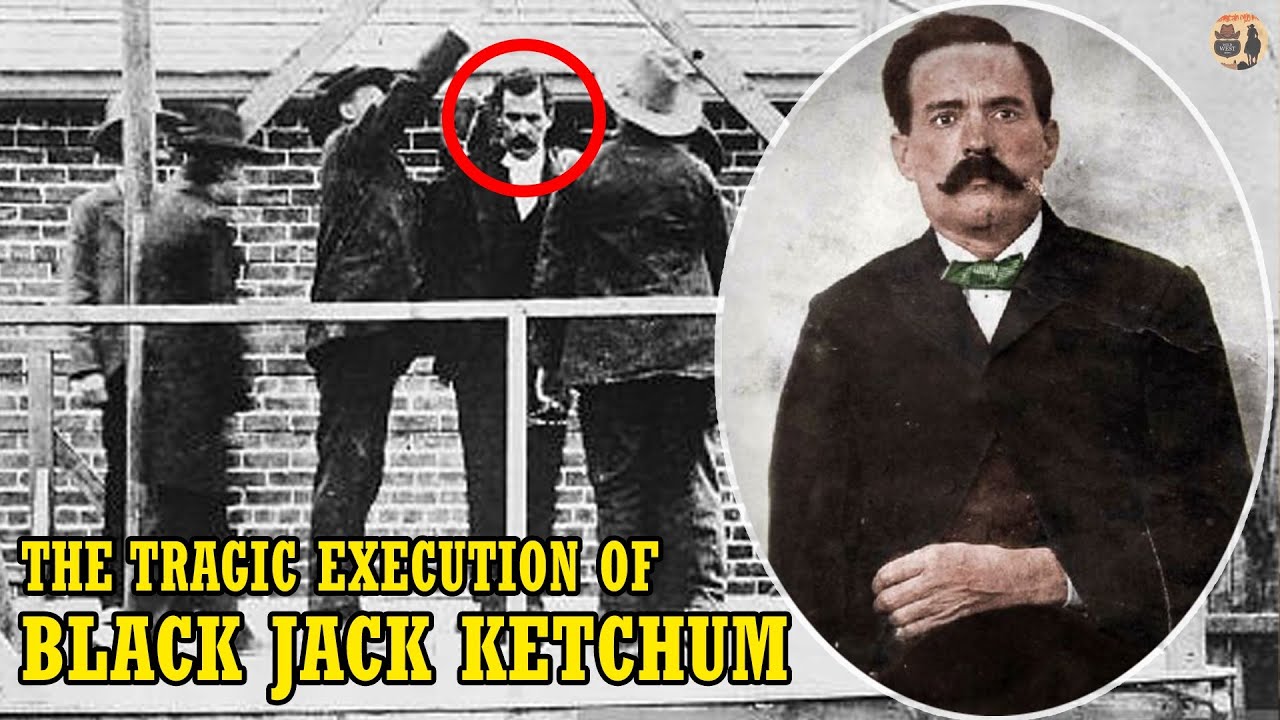 Thomas Edward Ketchum, better known to history as Black Jack, was born on October 31, 1863, in the rustic setting of San Saba County, Texas. Tragedy struck Tom’s life early when his father, Greenberry Ketchum Senior, died when Tom was only five years old. Having already lost a loved one, the Ketchum family found themselves facing another profound grief when Tom’s mother, Temperance Katherine Wike Ketchum, lost her sight before passing away when Thomas was just ten years old.
Both parents are buried at China Creek Cemetery in San Saba County, Texas, their graves marking the beginning of a family story steeped in both hardship and notoriety.
Thomas was the youngest of eight siblings, growing up in a family of six brothers and two sisters. Notably, his brother Greenberry Jr. had established himself as a famous and wealthy cattle and horse breeder, a man of considerable standing in the community.
Likewise, his older brother Samuel was married and raising a family with two children. However, their story took a different turn when Samuel abandoned his wife and children when his son was only three years old, a decision that would set a pattern of restless and reckless behavior for the brothers. As for Tom and Sam, they found cowboy jobs on various ranches scattered across the vast expanse of Western Texas, as well as in the northern and eastern parts of New Mexico.
Their adventurous lifestyle accustomed them intimately to the vast territories they traversed, as well as to the settlers and ranchers who considered these lands their own.
In 1892, a notorious group of criminals led by Tom, also known as Black Jack, along with his brother Sam and several accomplices, received word of the impending arrival of the Atchison, Topeka, and Santa Fe Railroad in Deming, New Mexico, with a large amount of wealth on board. The group devised a plan to carry out a daring train robbery near Nutt, New Mexico, a water station about twenty miles north of Deming. Executing their plan with precision, they successfully stopped the train and took control of the situation, earning about twenty thousand dollars during the heist.
The quick-witted conductor, however, escaped unobtrusively and made his way to Nutt, where he quickly sought help. Soon after, a team from Lake Valley, eighteen miles north, was dispatched to provide assistance. Unfortunately, by the time the squad arrived on the scene, the group had cleverly hidden themselves in a safe hiding place, allowing Black Jack to quickly flee into Arizona, leaving no trace of their whereabouts.
Then, on December 12, 1895, Tom and several associates shot and killed a neighbor named John N. Powers in Tom Green County, Texas. Tom eventually confessed to being involved in the murder, alleging that he received money to commit the act, a claim that added another layer of moral ambiguity to his already checkered career.
 After this incident, Tom and Sam decided to leave Texas and return to New Mexico. During their time there, the Ketchum Gang, composed of polite, wealthy cowboys and self-proclaimed outlaws, became popular with the locals. They often attended many dances, social gatherings, and establishments in northeastern New Mexico, such as Elizabethtown and Cimarron.
Notably, Lambert’s Inn, now known as the St. James, was one of the places frequented by these young men, where their polite demeanor attracted the women in attendance. Only after their arrest did the townspeople discover the true identities of these individuals and their connection to the notorious gang of outlaws led by Black Jack Ketchum, a revelation that shocked the communities that had welcomed them so warmly.
Leaving Texas in late 1895, the Ketchum brothers found work at Bell Ranch for a short time. However, in early June 1896, they abruptly quit their jobs, earning ranch loot before reappearing in Liberty, a small settlement north of present-day Tucumcari, New Mexico. On June 10th, during the night, they targeted a local store and post office run by Levi and Morris Hitt, initiating a robbery that would escalate into violence.
The Ketchum brothers then mounted their horses and fled towards the Pecos River, pursued by Levi Hitt and several others. A fierce gunfight occurred along the banks of the Pecos River, resulting in the catastrophic loss of life, mainly on the part of the pursuers. The Ketchum brothers then headed west to Arizona, occasionally joining forces with Butch Cassidy’s Wild Bunch, a notorious collection of outlaws who roamed the region with impunity.
Apparently, the Ketchum Gang showed audacity in train robberies between Folsom and Des Moines in this particular part of New Mexico. This area corresponds to the intersection of the old wagon road and the Southern and Colorado Railroad near the Twin Mountains. Their modus operandi involved stopping trains and dismantling mail and express wagons, then plundering them over a stretch of about a railroad mile and a half.
On September 3, 1897, Black Jack and his gang returned to commit another train heist, netting a substantial amount of approximately twenty thousand dollars in gold and four hundred forty thousand dollars in silver. After the successful robbery, they evaded capture by seeking refuge in a cave located south of Folsom, New Mexico, where they hid until the next day, their whereabouts unknown to the authorities who scoured the countryside.
On July 11, 1899, the gang carried out another attack, this time without the support of Black Jack. Setting up camp at the summit of Dry Canyon in northeastern New Mexico, Sam Ketchum, Bill Carver, and Elza Lay, known as William McGinnis, successfully seized about fifty thousand dollars from a train in Folsom, New Mexico. Quickly, a chase team was organized and tracked them to a hideout near Cimarron, New Mexico.
 In the ensuing gunfight, Sam was wounded and eventually captured, while the pursuers’ condition was even worse. Two members, including Sheriff Edward Farr, were killed, and another was injured. Sam’s injuries worsened, and he died on July 24, 1899, while imprisoned in Santa Fe.
He is buried at Odd Fellows Cemetery, a final resting place for a man who had once been a respected rancher before turning to a life of crime. Elza Lay, on the other hand, was arrested on August 16th and later had to appear in court. He was found guilty of killing Farr and received a life sentence, spending his remaining years behind bars.
Meanwhile, Bill Carver escaped and joined the ranks of the infamous Wild Bunch, continuing his life of outlawry far from the reach of New Mexico law.
Unaware of the fate of his brother Sam, Thomas Black Jack Ketchum embarked on a last-ditch attempt at a train robbery on August 16, 1899. Hidden away in a cave south of Folsom until nightfall, he prepared to carry out his plan. As the train approached, Black Jack intended to board the train from the hidden side of the baggage car, with the aim of forcing the train to stop, allowing him to separate the express and mail carriages from the rest of the train.
However, Black Jack’s best-laid plans ultimately failed. The train conductor, Frank Harrington, saw Tom approaching the moving train. He recognized Black Jack, quickly grabbed a shotgun, and hit Black Jack’s right elbow, nearly cutting off his arm.
Tom fell on his back beside the rails, continuing to run. The train stopped at the next station, reported the robbery, and sent a request to law enforcement to search for a seriously injured man near the scene.
The next day, a team showed up and found Tom by the tracks, badly injured. He was transported to medical facilities in Trinidad, Colorado, and his right arm had to be amputated to save his life. He was restored to health and then sent to Clayton, New Mexico Territory, for trial.
 At the trial, he claimed innocence, but the judge found him guilty and sentenced him to death by hanging. The execution was reportedly delayed because of rumors that the old gang might go on a rescue mission to free Tom, a constant threat that kept the authorities on edge. To address these concerns, a final decision was made, and preparations were made for the hanging, scheduled for 8:00 a.
m. on April 26, 1901.
The impending execution drew huge attention, leading to the closure of shops while local pubs remained open for crowds. People from far and wide flocked to witness the momentous event, and local lawmen even sold tickets for spectators to see the Tom doll hanging from a stick, a macabre souvenir of the occasion. However, the town of Clayton had little experience with hangings, leading to a debate about the appropriate length of the rope.
To test its effectiveness, a two-hundred-pound sandbag was attached to the noose and dropped through the trap the night before the scheduled date of hanging.
At 1:15 p. m. , Thomas Black Jack Ketchum was taken to the scaffold.
While his hood was being adjusted, Ketchum exclaimed, “Goodbye, please dig my grave very deep. All right, hurry up.” Finally, Sheriff Garcia launched two decisive axes, severing the rope and causing Tom to rush straight into the trap.
Unfortunately, the inexperienced executioners forgot to remove the sandbag used for the testing, which caused the rope to stiffen. When Black Jack fell, his head was instantly severed, only saved from rolling away by the black hood attached to his shirt. Within minutes, a doctor declared him dead and proceeded to sew his head back on the torso before burying him at Clayton’s Boot Hill at 2:20 p.
m. In the 1930s, his remains were moved to the new cemetery in Clayton, where Black Jack rests to this day, a permanent fixture in the town’s history.
Black Jack Ketchum is famous as the only individual ever hanged in Union County, New Mexico. Furthermore, he is the only person in the history of the state to receive the death penalty for assaulting a train, a distinction that underscores the unique nature of his crimes. His life, marked by tragedy from an early age, serves as a poignant reminder of the thin line between respectability and outlawry in the Old West, and his death, marked by a gruesome execution, has cemented his place in the annals of American folklore.


