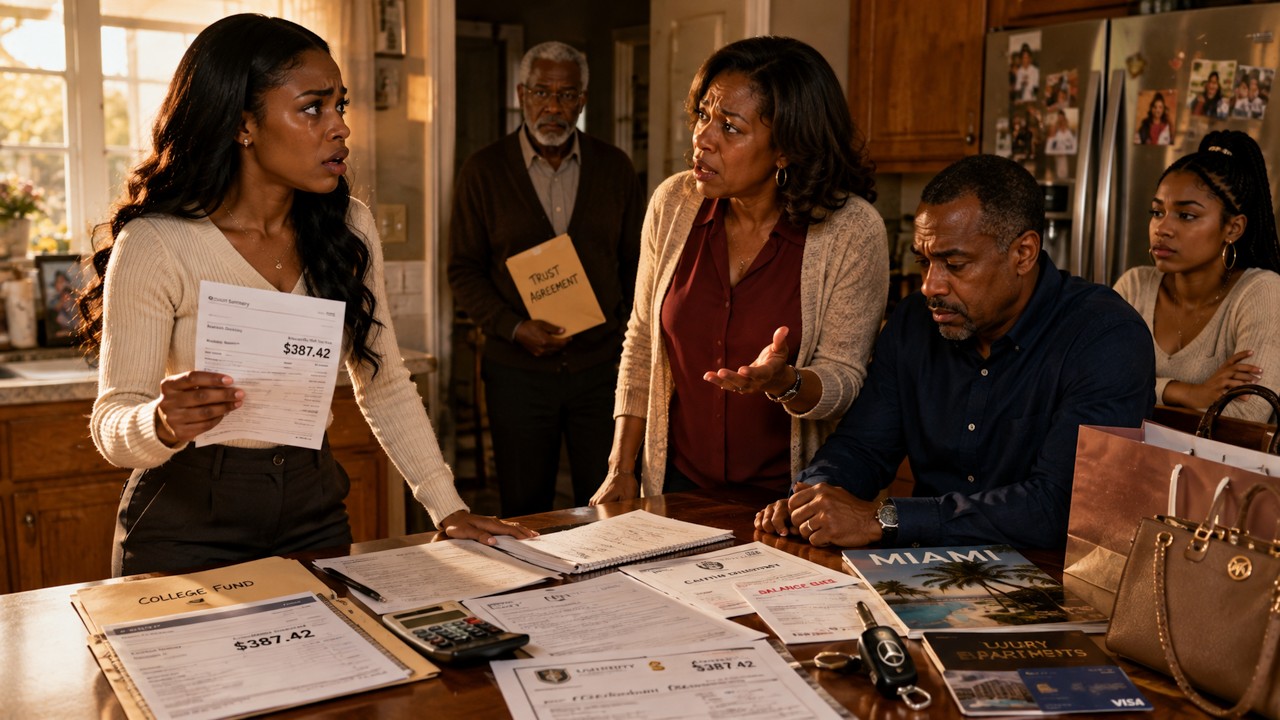
“$387. 42? Where did the rest of it go? What happened to my college fund?
”
My father’s voice crackled through the phone. “We had to use some of it. ”
“How much? ”
A long pause.
“Most of it. ”
I logged into my college account expecting to see the $75,000 I’d watched grow since childhood. Instead, there was less than four hundred dollars left. I confronted my parents that same evening, and my mother didn’t even try to deny it.
“Your sister needed it more than you did,” she said. My sister, Madison, had spent my entire college fund on a luxury car, an upscale apartment, a trip to Miami, and credit card bills she’d piled up along the way. My parents had authorized every withdrawal, watching my future disappear one purchase at a time. I sat in that kitchen feeling like the floor had genuinely disappeared beneath me.
My father looked at me calmly and said, “You’re smart. You’ll figure something out. ”
“You didn’t spend that money because Madison needed it,” I told them, my voice steadier than I expected. “You spent it because you knew I’d be the one who could live without it.
”
I walked away without waiting for a response. For as long as I can remember, I’ve wanted to become a doctor. I studied relentlessly, earned strong grades, worked part-time jobs throughout high school, and applied for every scholarship I could find. I was the responsible one, the quiet one, the daughter who never asked for expensive things.
Madison was two years younger, charming and impulsive, and my parents excused every one of her mistakes with “she’s young. ”
Whenever I had a need, I was reminded that I was “the mature one. ” That phrase meant: your needs matter less because we trust you to survive without them being met. Madison got a new phone the moment her old one showed any wear.
I was told I didn’t really need one. When her car broke down, my father paid for the repairs without hesitation. When I needed a modest fee to attend a regional science competition, my mother told me to look for school assistance instead. I absorbed it all quietly, telling myself it was just the ordinary texture of having a sibling.
The week my university acceptance letter arrived should have been purely joyful. I had worked toward this for years. Then the financial office requested my remaining tuition payment, the portion beyond what my scholarships covered. I dialed my father’s number, my hands unsteady, some instinct warning me this wasn’t a simple mistake.
“We had to use some of it,” he admitted. “How much? ”
“Most of it. ”
My mother took the phone.
“Your sister was going through a difficult time. ”
I pieced together the full picture over the following days. Madison had spent my future over roughly eight months—a luxury vehicle, a deposit on an upscale apartment, months of rent, shopping, Miami, paying down her credit cards. My parents had signed off on every single transaction, never once telling me.
In the weeks that followed, I seriously considered abandoning my dream of medical school. I applied for every additional scholarship I could find, took extra shifts at work, and researched community college as a more realistic starting point. Madison barely acknowledged what had happened. She posted photos from her new apartment on social media, captioned, “Finally living the life I deserve.
” I stared at that caption for a long time, feeling a specific, quiet kind of pain I’ve never fully found words for. One evening, I sat at my desk with three browser tabs open: one for community college enrollment, one for an emergency scholarship application, and one, almost torturously, still displaying the medical program I’d been accepted into. I called my best friend Priya and tried to explain without breaking down. She listened quietly, then said, “None of this is your fault, Liv.
I need you to actually hear that. ” I didn’t fully believe her in that moment. It would take Grandpa’s intervention before I genuinely started to. Grandpa had always been a quiet, observant presence in our family.
One evening, not long after the truth came out, he found me sitting alone on his back porch, watching the sunset. “How much did they tell you they took? ” he asked. “$75,000.
”
He paused. “That’s not what they told me. ”
I felt a jolt of confusion. Grandpa explained that when I was born, he had created something separate from the college fund—a formal family education trust, set up specifically in my name, with conditions attached.
It required me to enroll in an accredited university or pursue a qualifying program before the funds could be accessed. My parents had never controlled it. He had structured it so deliberately that neither of them could access or redirect it, because he had suspected, even years earlier, watching the early signs of favoritism, that a moment like this might arrive. Then he handed me an envelope he’d apparently been holding for years.
Inside was a copy of the original trust agreement, along with a letter written in his own handwriting, dated long ago. It read simply: “If you’re reading this, they finally did it. ”
I asked him why he’d never told me directly years earlier. “If I told you when you were younger,” he said, “you might have relaxed and assumed the safety net was already there.
I needed you to build your own foundation first. The trust was always meant to be a floor beneath you, not a hammock. ”
A few days later, Grandpa called the entire family together—my parents, Madison, and me—around the same kitchen table where I’d first learned the truth. He placed the trust documents on the table and explained calmly that the $75,000 had been legally mine, meaning my parents had no right to redirect it toward Madison’s expenses.
Then he explained the second trust, the one he personally created, designated exclusively for me, structured so Madison could never access it. “What do you want to do? ” he asked me directly. I sat with the question for a long moment.
“I want my education. ”
Grandpa smiled, the first genuine smile I’d seen from him since this ordeal began. “Then that’s exactly what you’ll have. ”
In the months that followed, the natural consequences unfolded on their own.
My parents had to confront what they’d done, no longer able to frame it as a misunderstanding. Madison began to understand she could no longer rely on my future being sacrificed to fund her lifestyle. She called Grandpa in tears after having to sell the car, asking if he might cover the difference. He told her no, gently but firmly, explaining that this lesson wasn’t his to interrupt.
Without my parents bailing her out, the apartment and car became burdens she couldn’t sustain. She sold the car, moved into a more modest place, and took a full-time job—something she’d never had to seriously consider before. I enrolled in university that fall, using the trust funds to cover what my scholarships didn’t. I remember the first day of classes clearly, sitting in a crowded lecture hall, feeling a settled relief I hadn’t experienced in months.
The years that followed weren’t easy. There were countless late nights, exhausting clinical rotations, and student loans I still needed to take on. Medical school costs extended well beyond what even a substantial trust could fully cover. One night during my third year of residency, I stood alone in a hospital break room at nearly 3:00 a.
m. , so tired I could barely form coherent thoughts. I called Grandpa because I needed to hear a familiar voice. He picked up on the second ring.
“You don’t have to convince me you’re strong,” he told me. “I already know. I just want you to remember you’re allowed to be tired, too. ”
I carried that call with me through the rest of residency.
Eventually, after years of sustained effort, I graduated and became a physician. A few years after I established my own medical practice, my mother visited me, older now, carrying herself with a hesitant uncertainty I hadn’t seen from her before. “I spent your childhood believing you didn’t need me because you were strong,” she admitted. “I was strong because I had to be,” I told her.
She cried quietly, and I let the silence exist between us. I didn’t tell her everything was simply forgiven. Instead, I said honestly, “I don’t know if we can go back to what we were, but we can decide what happens next. ”
Our relationship has been slowly rebuilding on more honest terms ever since, though I won’t pretend the years of favoritism disappeared from how I understand my childhood.
There are still moments when an old memory surfaces and the hurt feels almost as sharp as it did that first week. But those moments come less often now. For years I believed my parents had taken $75,000 from me—a devastating but quantifiable loss. What I eventually understood was that what they had actually taken was something harder to measure: my belief that being the responsible daughter meant I had to quietly accept being treated as the least important one in my own family.
Grandpa passed away peacefully a couple of years after that family confrontation. I was fortunate enough to be with him during his final weeks, able to tell him directly how much his quiet, decades-long faith in me had meant. He simply smiled, that same familiar smile from the day he told me I would have my education after all, and said he’d always known I would find my own way—trust or no trust—but he was glad he’d been able to make the path a little less brutal. Sometimes the person who seems most silent in a family isn’t unaware of what’s happening around them.
They’re simply waiting, patiently and deliberately, for the exact right moment to finally speak.