The restaurant was draped in birthday decorations, and I was still smiling when my husband slid a white envelope across the table. I thought it was a card. I opened it. Divorce papers.
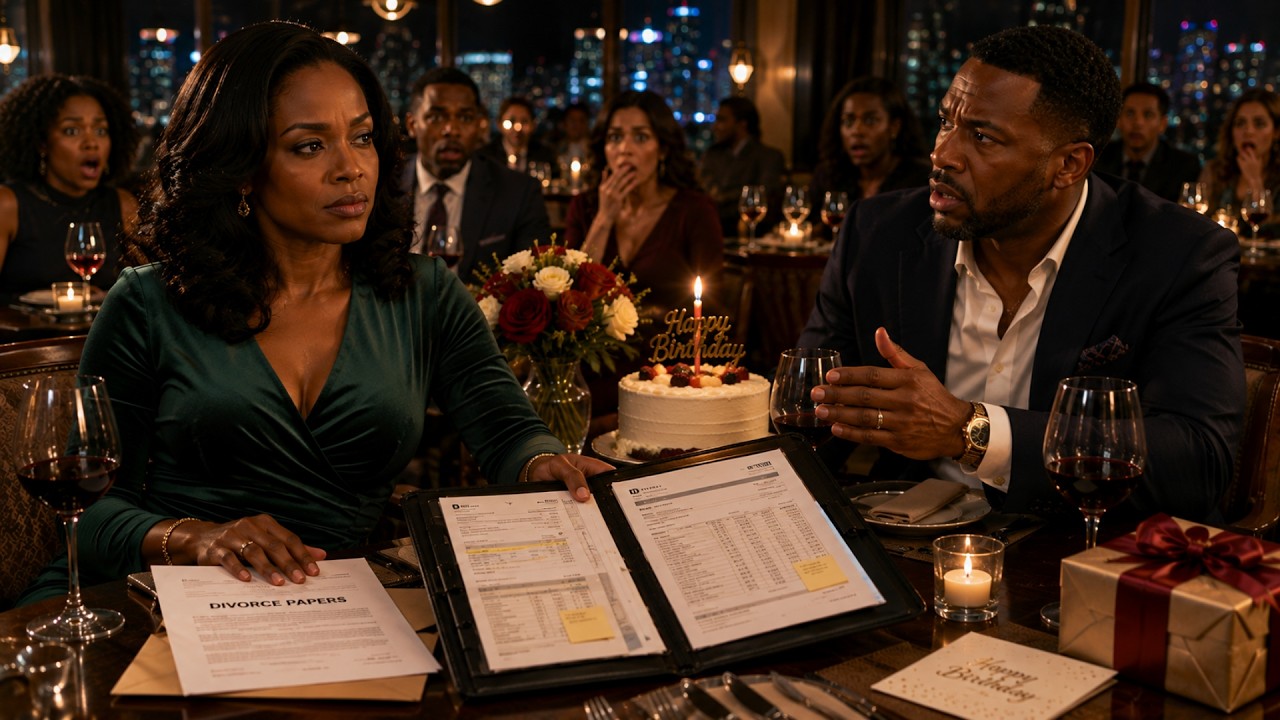
“Happy birthday,” Daniel said, almost casually. “I thought you deserved to know the truth today. ”
I didn’t cry. I didn’t scream.
I just looked at the paper in front of me and asked one question. “Are you sure you want me to sign these? ”
He gave me that same confident smile I had fallen in love with fifteen years earlier. “I’ve already made my decision.
”
I closed the folder slowly. “Then I guess it’s time you saw mine. ”
My name is Rachel Morgan. I’m thirty-six, a senior financial analyst, a career built on noticing patterns other people miss.
I never imagined I would need those exact skills to protect myself inside my own marriage. To understand why my response looked nothing like Daniel expected, you have to understand what had been quietly unfolding for months before that birthday dinner. Daniel is thirty-nine, a successful regional sales executive, charming, image-conscious, always aware of how things looked to everyone around us. From the outside, our marriage looked perfect.
A beautiful home, two solid careers, nice vacations, warm family dinners. For most of those fifteen years, I genuinely believed we were the couple other people assumed we were. Then, over the final year, things started shifting. Daniel began guarding his phone, angling it away from me at dinner, keeping it face down on the nightstand.
He came home later, his explanations about client meetings growing vaguer. Unexplained expenses appeared on our shared credit cards. He grew emotionally distant, and his gentle jabs at my spending felt disproportionate. I didn’t accuse him of anything.
For most of my adult life, my instinct has been to give people the benefit of the doubt. I didn’t want to become the suspicious wife, constantly questioning her husband without cause. I remember one evening when Daniel came home nearly two hours later than he texted, blaming traffic that didn’t match his route. I chose not to press.
I told myself that questioning every small inconsistency would erode the trust I still wanted to believe we shared. The first concrete clue appeared as a hotel charge on our shared account, a charge I couldn’t connect to any trip we had taken together. Daniel explained it away easily, mentioning a client meeting that had run late. I accepted it, but something felt off.
A few weeks later, another similar charge appeared, along with restaurant expenses I couldn’t account for. Then I noticed an unfamiliar woman’s name on a reservation confirmation that had been forwarded to our shared email by mistake. I didn’t confront him. Instead, drawing on my professional instincts, I began quiet, methodical documentation.
Over the following months, that documentation revealed something far more serious. Daniel had opened a separate account I didn’t know existed, gradually transferring portions of our shared marital funds into it. I found records suggesting he had already consulted a divorce attorney. I remember the evening I discovered that separate account, sitting alone at the kitchen table long after he went to bed.
My hands were shaking as I traced transfers dated across several months, amounts substantial enough that they couldn’t be explained away. I sat there for nearly an hour, understanding that whatever I chose to do next would shape everything. I also overheard a conversation between Daniel and his brother. Daniel was quietly preparing his own family, describing me as increasingly difficult, carefully constructing a narrative where he would appear as the reasonable, patient party.
Discovering this didn’t turn me into someone determined to fight dramatically. Instead, I decided to keep gathering information quietly. I needed to protect myself financially and legally before revealing how much I understood. Which brings us to my birthday.
Daniel had planned an evening that appeared to be genuine care. He made reservations at an upscale restaurant where we had celebrated previous anniversaries, presented me with flowers, seemed warmer than he had been in months. I remember allowing myself a small, cautious hope. That hope dissolved when he slid the white envelope across the table.
He clearly expected tears, anger, maybe desperate pleading. Instead, after confirming what I suspected, I looked at him calmly and asked, “Did you bring the original? ”
“What? ” He was visibly confused.
“The original financial disclosure,” I clarified. I watched his confidence waver for the first time that evening. He hadn’t anticipated being questioned. I reached into my own bag and pulled out a folder.
Not divorce papers. Bank statements documenting the account transfers. Hotel records connecting specific dates to charges he had explained away. Copies of emails I had preserved.
And most significantly, a copy of a financial agreement he had signed years earlier, establishing clear expectations about how jointly held assets would be handled. What Daniel hadn’t understood was that I had noticed the first suspicious transfer months earlier, long before the hotel charge or the misdirected receipt. Once I noticed, I consulted my own financial attorney, someone entirely separate from his process. Through that consultation, I discovered something far more significant.
A substantial amount of protected marital funds had been transferred into an account connected directly to the woman Daniel had been seeing. The money trail, the affair, the financial misrepresentation were all documented. But I hadn’t used any of it yet, choosing instead to wait until I could protect myself completely. Tonight, sitting across from him, surrounded by decorations that felt cruelly ironic, I finally revealed what I knew.
“You wanted today to be the day you ended our marriage. Fine. But you don’t get to rewrite why it ended. ”
I explained that I was prepared to sign his documents only once complete, accurate financial disclosures were made, ensuring the settlement reflected reality, not his curated version.
I wasn’t fighting to keep him. I was fighting to protect myself from a divorce built on his deception. I handed him a formal letter from my own attorney stating plainly that I was already aware of the hidden account, the transferred funds, the affair, and his attempt to position himself as the wronged party. I watched something shift in his expression as he read.
He understood that I wasn’t surprised. He was. His composure collapsed. “Rachel, wait,” he said, his voice carrying a desperation I had never heard from him.
“We can work this out. You misunderstood. I didn’t mean for this to happen. ”
“Which part?
” I asked calmly. “The affair? The money? The lies you’ve been telling your family about me?
Or the fact that you chose my birthday to hand me divorce papers you’d been planning for months? ”
He couldn’t answer. In the weeks that followed, Daniel’s carefully constructed story collapsed under the weight of documented evidence. The financial investigation confirmed everything.
His own family, once the real details emerged, reacted with genuine shock. Several relatives reached out to apologize. I remember a conversation with his mother, someone I had always liked, calling me nearly in tears when she learned what he had done. She admitted she had believed his one-sided account.
The woman Daniel had been seeing also discovered that he had misrepresented the state of our marriage. That information ended their relationship almost immediately. The divorce proceeded through proper legal channels, more complicated than Daniel had anticipated given the required financial disclosures. I didn’t emerge suddenly wealthy, but the consequences felt earned and proportional.
There were still difficult weeks, moments when the weight of ending a fifteen-year marriage threatened to overwhelm me. I leaned on my sister and a small group of close friends. Daniel lost more than his marriage. He lost the trust of his family.
His professional reputation suffered, given how small our circles were. He lost a meaningful portion of his financial security. He lost the relationship he had hoped to replace me with. And he lost control over the narrative he had so carefully constructed.
Months later, I heard through mutual acquaintances that Daniel had grown more guarded and less confident in professional settings. I, meanwhile, gained genuine financial independence, emotional freedom, and a renewed sense of self-respect I hadn’t realized I was missing. Several months after the divorce was finalized, Daniel reached out and asked to meet. One final conversation.
“I thought you would fight for us,” he said. “I did,” I told him. He looked confused. “I fought for the woman I was before I met you,” I explained.
“The woman who kept forgiving things she shouldn’t have, who gave you the benefit of the doubt again and again. But I stopped fighting for a marriage that you had already abandoned long before you handed me those papers. ”
That conversation represented the emotional resolution I needed. I didn’t leave feeling triumphant.
I left feeling entirely at peace with who I had become. Since the divorce, I’ve built a life that feels my own. I moved into a smaller, comfortable place that reflects my taste. I started traveling again, taking a solo trip to a destination I had wanted to visit for years.
I remember standing on a small balcony, watching an unfamiliar sunset, feeling an uncomplicated peace that didn’t depend on anyone else’s approval. I called my sister that evening to tell her how good it felt. She said she hadn’t heard that lightness in my voice in years. I reconnected with friendships I had unconsciously allowed to fade.
I’ve become more confident, not because I won some contest, but because I stopped measuring my worth by whether Daniel had chosen to stay. For years, I believed the worst thing my husband could do was ask for a divorce. I was wrong. The worst thing he gave me was the quiet, persistent belief that I needed to keep proving my worth to someone who had already stopped protecting what we had built.
The divorce papers didn’t end my life. They ended a version of it where I kept making generous excuses for someone who had stopped extending me the same basic respect. Daniel expected tears, anger, desperate pleading. He never expected silence, carefully documented evidence, and a woman who understood that losing him wasn’t the same as losing herself.
Sometimes, the real consequence isn’t losing the person who hurt you. Sometimes, it’s realizing you never actually needed them to choose you in order to feel whole. That realization became the actual gift that birthday eventually gave me.