“I’m not Dad. ”
That was all I texted back after Darren demanded $68,000 for his house renovation. He claimed I “owed it to the family,” as if I hadn’t been paying for everything on my own since I was nineteen. As if I hadn’t quietly covered Mom’s hospital bills when she broke her hip.
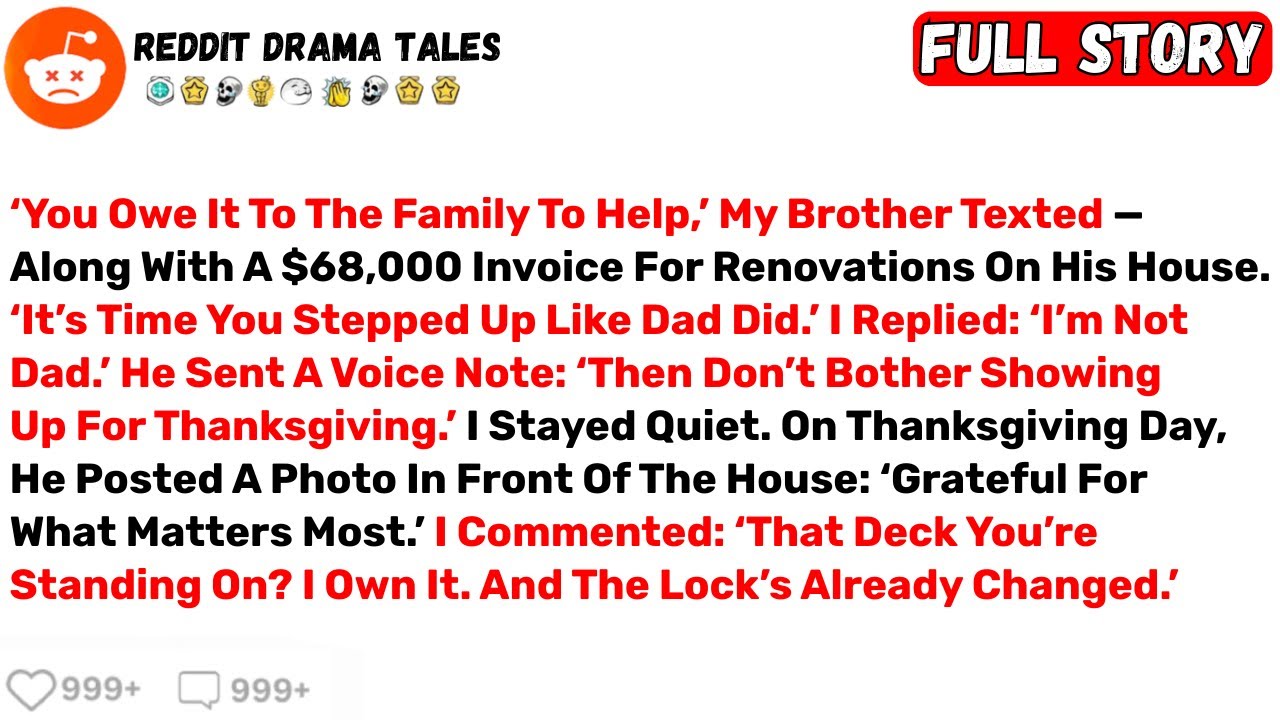
As if he hadn’t spent his whole life conning people while our parents bailed him out. An hour later, he sent a voice note, his voice smug and slightly slurred. “Don’t bother showing up for Thanksgiving. ”
I listened to it twice, letting the casual threat sink in.
He wasn’t just uninviting me. He was reminding me that in his world, family meant people who paid him, and I’d just failed the test. Nobody else texted. Not Mom.
Not our cousin Jenny. Silence, as if Darren had spoken for everyone. Thanksgiving morning, I cooked a small meal for one in my own kitchen. Turkey breast, mashed potatoes, green beans.
I didn’t even slice the pie until the next day. Around four in the afternoon, I opened my phone and saw Darren’s post: a glossy photo of him and Mom standing in front of his newly renovated house. He held a wine glass. She was mid-laugh.
The caption read, “Grateful for what matters most. ”
My eyes drifted to the deck. The one I’d built with Dad twelve years ago, on the rare weekend Darren actually showed up to help before leaving halfway through because he “had a thing. ” The one I’d quietly purchased from Dad before he passed, with a legal easement that crossed onto adjacent land.
Darren had wanted to bulldoze it last year for a hot tub plan that never materialized. I stopped him with paperwork. He’d been furious. Now he was posing on it.
Toasting from it. I clicked the comment section and typed: “That deck you’re standing on? I own it. And the locks are already changed.
”
Then I closed the app and waited. Darren replied within five minutes. “Real classy, Alex. This is why no one wants you around.
” His buddies piled on with laughing emojis, guys I hadn’t seen since high school. I didn’t reply. Then the family group chat lit up. Darren called it “Family Core.
” He wrote: “Let’s all appreciate how Alex ruined a perfectly nice post with his bitterness. ”
Jenny replied cautiously, trying to smooth things over. Darren twisted it, claiming he only asked if I wanted to contribute, like Dad used to. Classic rewrite of history.
I stayed quiet. Two days later, Mom called. She started soft. “Hope you had a nice little Thanksgiving.
” Then she got to the point: “Darren is really hurt, Alex. You embarrassed him in front of everyone. ”
I told her he’d sent me an invoice. That he’d told me not to come.
That I wasn’t the one making things complicated. She went quiet, then said, “I know your father would have helped. ”
That snapped something in me. I told her Dad wouldn’t have sent an invoice or blackmailed me with Thanksgiving.
She called it uncalled for. I said what was uncalled for was pretending Darren hadn’t demanded money and thrown a tantrum when he didn’t get it. She hung up after saying we should take some space. The next week, I got an envelope with no return address.
Inside was a “Shared Family Home Renovation Contribution Agreement” – a professional-looking contract demanding $16,800 from me, $5,000 from Jenny, $2,000 from Troy. Darren was to contribute nothing, since he was “managing the project. ” At the bottom was a line for my signature. I laughed.
It was surreal. Jenny called. She’d gotten one too. Then she dropped the bomb: Darren had convinced Mom to co-sign a deed transfer after Dad passed, claiming it would help with taxes.
She signed without telling anyone. And Darren was planning to take out a new loan against the house, expecting the signed letters as proof of income. Jenny suspected he was planning to flip it – to sell Mom’s house. She didn’t know.
I barely slept that night. The next morning, I started drafting something bigger than a letter. I pulled out the file folder of land documents Dad had passed on to me years ago. The deck.
The easement. The clause protecting my ownership. I wasn’t going to shout. I was going to make it clear that Darren’s script was about to hit a major rewrite.
Then the storm hit from an unexpected angle. Mom called, her voice sharp and cold. “I can’t believe you’re trying to sabotage your own family’s financial future. Darren showed me the paperwork you sent him.
He told me you threatened to take back part of the property. ”
I was frozen, holding a chisel in one hand. Then Darren’s voicemail came through, smug and triumphant. “Guess Mom finally knows what kind of snake you are.
You want to play legal games? Fine. But when she signs the quitclaim deed next week, you’re out for good. ”
My heart sank.
He’d convinced her to sign over her share of the house. I called her. She didn’t answer. I texted, begging her not to sign anything.
No reply. Jenny picked up immediately. She was already driving to Mom’s. “He told her it’s just a formality, that it’ll help him refinance.
She thinks she’s getting out of his way. ”
“He’s not refinancing,” I said. “He’s selling. ”
“I know,” Jenny whispered.
“But he’s got her thinking you’re out to ruin everything. ”
That week was hell. I couldn’t focus. I drove to Mom’s place with flowers, calm voice ready.
She opened the door with her arms crossed, barely looked at me. I sat at the dining table and tried to explain. “He’s not keeping the house, Mom. He’s flipping it.
He’s planning to use your signature to leverage ownership. ”
“He told me you’d say that,” she interrupted flatly. “That you’d twist everything. ”
Her voice hardened when I pushed back.
“Darren’s not perfect, but he’s trying. He’s been here. You haven’t. ”
That hit harder than I expected.
I stood up. “You’re right. I haven’t been here. I’ve been working quietly, paying for things without being asked, building a life without demanding applause.
But maybe that’s why no one ever noticed. ”
She didn’t respond. I left the flowers on the table and walked out. That was the lowest I felt.
Worse than when Dad passed. It wasn’t just betrayal. It was being erased, as if everything I’d done quietly and responsibly was invisible. That night, I sat in the dark, wondering how I’d become the villain in my own family.
But something shifted the next morning. I woke up, showered, and opened the drawer of old documents from Dad. Among the receipts and maps, a folded, yellowing note caught my eye, written in Dad’s blocky handwriting: “To Alex, for when I’m not around to explain it myself. ”
My hands trembled as I unfolded it.
It was short. “I gave you the outer parcel and deck rights for a reason. Not just because you helped build it, but because I know you won’t let it be exploited. I trust you to protect what matters.
Not just the land, but the memory. ”
That was all it took. I grabbed my laptop and called a property attorney I’d worked with years ago. I sent him the easement and ownership paperwork.
He called back the next morning. “Legally, he can’t do anything to that section of land without your written consent. If he tries to include it in a sale, that’s misrepresentation. He’d be liable.
And if she signs that quitclaim, we can contest the valuation if there’s evidence she was misled. ”
I hung up and got to work. Through the attorney, I drafted a formal cease-and-desist letter, notifying Darren and any future buyer that the deck and surrounding land were separate, not to be included in any title or renovation scope. I attached Dad’s easement and the zoning laws.
I had it notarized, mailed, and emailed to Darren, the county property office, and his contractor. The contractor called me the next day. “Just want to double-check your name is on this easement? ”
“Yes.
”
“And you’re not authorizing the deck to be altered, removed, or repurposed? ”
“No. ”
A long pause. “Okay.
That changes things. ”
By the end of the week, Darren’s contractor backed out, citing “unforeseen legal complications. ” The permit office triggered a review after my formal inquiry. Darren’s renovation stalled dead in the water.
Then Jenny sent me a screenshot. A Craigslist listing for “Charming family home, recently updated. ” Seller: Darren’s made-up LLC. The description boasted a “spacious backyard deck, perfect for hosting.
”
He was still trying to sell my property. I wasn’t mad. I was calm. Calculating.
I knew Darren’s pattern: inflate, spin, deny, bail. And he was in deeper than anyone realized. The house was already half-gutted and on the market. I needed to set a trap he’d walk into willingly.
After hours of searching, I found the same listing on Facebook Marketplace, this time with photos angled to crop out the deck. Under agent contact: Darren J. King Family Real Estate Group LLC. No license, no real group, just him and a familiar email address.
I created a throwaway email under a generic name. “Interested in the property. Would love a walkthrough. ”
He replied in ten minutes.
Typical Darren. “It’s a hot listing. Serious buyers only. ”
I responded as Sam, an out-of-town investor looking for a long-term rental.
Darren loved investors. Fast money, no fuss. We scheduled the walkthrough for Saturday at 11 a. m.
Now I needed someone to play Sam. I called in a favor from Greg Wallace, a former co-worker in property compliance who owed me for covering his department years ago. He laughed when I pitched the plan. “This is petty.
I love it. I’m in. ”
Saturday morning, I parked two blocks away. Greg wore a mic in his shirt collar.
I had my laptop open, live audio streaming to my headphones. At 11:03, Greg knocked. Darren answered with fake charm. “Hey, you must be Sam.
Come on in. ”
They made small talk while Darren bragged about appliances that weren’t installed. Then the tour moved to the backyard. Greg: “Nice deck.
Is that included in the parcel? ”
Darren: “Yep. Fully part of the property. Just needs a little staining.
”
Greg: “County records show a separate parcel line. ”
Darren paused. “Oh, yeah. Well, that’s just a technicality.
My family owns the land. It’s all in the family. ”
Greg pushed: “So, if I included the deck in a financing appraisal, that’s fine? ”
Darren: “Yeah, totally.
It’s part of the living space, you know. ”
Boom. A lie on record. Misrepresenting property ownership to a prospective buyer.
I submitted the audio to my attorney that afternoon. He grinned. “Want to make this really fun? ”
“Always.
”
We sent the audio to the listing platforms with a legal notice of misrepresentation. Then we filed a complaint with the zoning office for attempted inclusion of protected land in a sale. By Tuesday, the listings were gone from both Facebook and Zillow. At 6:21 p.
m. , Darren called. I didn’t answer. His voicemail was tense.
“I don’t know what you think you’re doing, but this is my house. You’ve made your point. Just stop before things get worse. ”
I sent it to the attorney.
Jenny, finally seeing how deep he was digging, went to visit Mom again. She didn’t argue or accuse. She just explained that Darren had lied about refinancing, that he’d listed the home for sale before the deed was transferred. Mom agreed to pause the transfer.
That pause was all I needed. I’d already filed a notice of intent to enforce easement rights with the county. If Darren tried to relist without removing the deck and redrawing boundaries, it would be flagged instantly. He was boxed in.
Couldn’t finish renovations, couldn’t list, couldn’t sell. And Mom now had a lawyer, courtesy of Jenny and me. Darren sent one more rambling email, half threats, half desperate pleas. Accused me of ruining the family.
Said Dad would be ashamed. Said I was tearing everything apart over “some stupid patio. ”
I didn’t reply. A week later, he made his final desperate move.
Jenny called in a panic. “He posted it on OfferUp. Says it’s an off-market opportunity for investors with vision. Says the deck is being gifted with the property.
”
Greg called the buyer, a guy named Nick from out of town who’d already given Darren a deposit. “You sure that deck comes with the house? County records show a separate parcel. There’s a lis pendens on the property.
You didn’t see that? ”
Nick went quiet. Greg sent him the public filing and the easement paperwork. Just like that, Nick ghosted Darren.
No sale. No cash. Two days later, Mom called. Her voice was quiet this time.
“I think I made a mistake. He told me you were trying to take the house, that you hated him, that you were bitter. And I believed him. Now I see a son who protected his father’s legacy, who didn’t ask for anything, who just wanted fairness.
”
She admitted she hadn’t read a single document Darren gave her. She cried. Apologized for doubting me. I didn’t rub it in.
The point was she saw it now. The next day, she initiated a reversal of the quitclaim process. Since the transfer hadn’t been fully recorded due to a clerical delay, the revocation was filed just in time. Darren lost access to her share.
He was livid. He emailed everyone a long manifesto about betrayal and legacy. Accused me of weaponizing Dad’s death. Accused Jenny of being a traitor.
Accused Mom of being senile. My lawyer laughed. “Let him sue for defamation. All it’ll do is get him deeper in the mud.
”
But I wasn’t done. There was still the deck. It wasn’t just wood and nails. It was a memory, one of the only weekends Dad, Darren, and I had worked side by side.
Darren had tried to demolish it, sell it, claim it, lie about it. So I reclaimed it. Literally. I paid a local contractor to install a fence around the deck, tall enough to make a point.
On the gate, I mounted a small plaque: “Private property. Access restricted. ” The fence didn’t block Darren’s section of the yard. But it sent a message.
This is mine. And you don’t get to use it anymore. A month later, Darren’s renovation dream was dead. The house sat half-gutted.
No buyers, no permits, no contractor. The bank had issued him a short-term loan for the initial work, expecting repayment after the sale. With the house unsellable, he defaulted. They put a lien on the property.
Within three months, the bank listed it for foreclosure. Darren lost the house. But more than that, he lost the story. The one where he was the leader, the provider, the one carrying Dad’s legacy forward.
In the end, all he carried was debt and empty promises. I drove by once after the bank repossessed it. Boarded windows. Overgrown lawn.
The deck still standing untouched behind the fence. A week later, I took the fence down. Not because I gave up, but because I didn’t need it anymore. The point had been made.
The memory was safe with me. I left a final note on the kitchen counter the day they started auctioning off the interior fixtures. Just a simple one: “You always said I never stepped up. Turns out I did.
You just never noticed. ”
Darren didn’t attend the auction. Mom came by the following weekend. We sat on the deck, coffee in hand, watching the sun set behind the trees, the same way we used to with Dad.
She was quieter now, humbler. But there was peace in her eyes I hadn’t seen in years. “I’m proud of you,” she said. I didn’t need to hear it.
But it still meant everything. That night, I stood alone on the deck and looked out across the yard. Just quiet grass, fading light, and the echo of a battle I hadn’t wanted but refused to lose. Because sometimes standing your ground doesn’t look like shouting or slamming doors.
Sometimes it looks like a fence. Sometimes it looks like silence. And sometimes it looks like winning. He tried to inherit the legacy.
But I built it board by board. And I never let go.