“Naomi, we need to talk about these records. ”
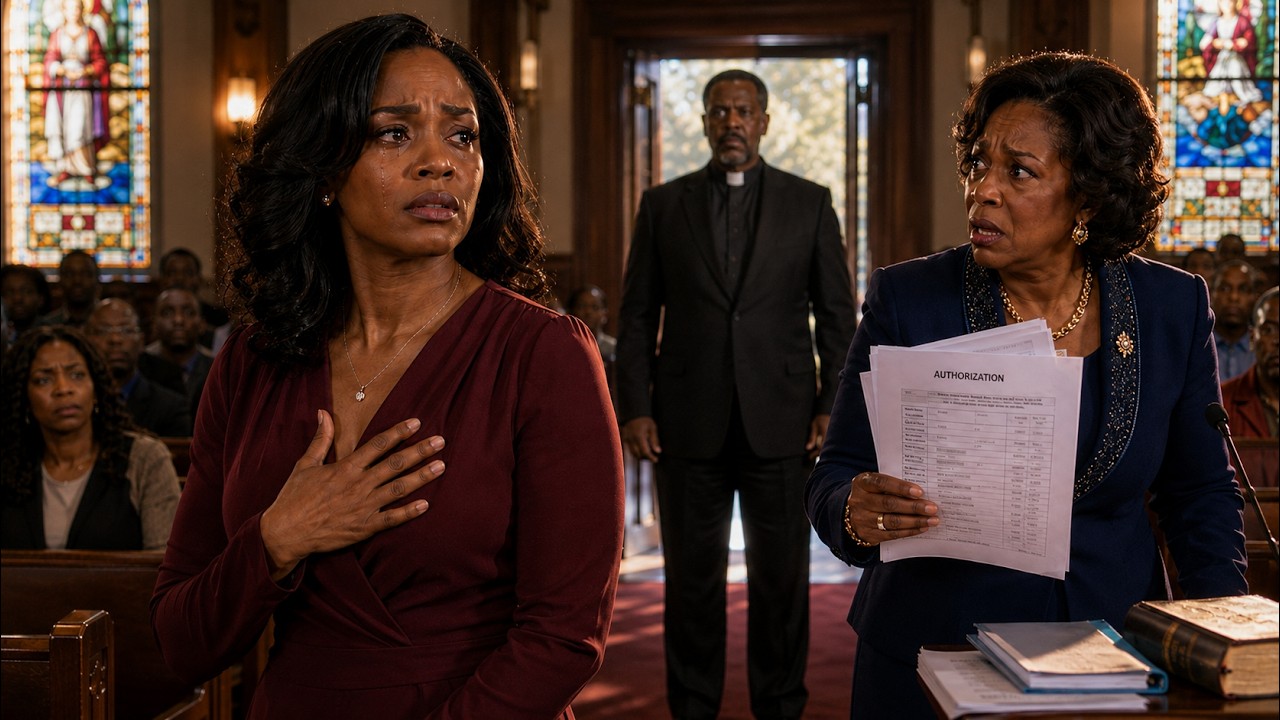
I barely recognized Evelyn Grant’s voice, all business and no warmth. She stood in front of the congregation, about two hundred people, holding printed documents. “Everyone deserves to understand what happened.
”
My heart dropped. I glanced at the empty pastor’s chair. Pastor Brooks had been gone for six weeks, and nothing about this moment felt safe. “We didn’t want to do this publicly,” Evelyn said, loud enough for the sound system to carry, “but the congregation deserves to know where the money went.
”
I had served this church for twelve years. I arrived early to set up chairs. I walked elderly members to their seats. I organized the food drives every November.
And now, people who had hugged me last Sunday were looking at me like a stranger. Someone behind me whispered, “I knew something wasn’t right. ”
Evelyn laid out the accusation: thousands of dollars missing from the community assistance fund, with my digital signature on several authorization forms. I tried to explain.
My voice shook. “I never authorized those payments. ”
Nobody listened. I thought about Pastor Brooks, about the day he pulled me aside before his medical leave.
“Keep everything documented,” he had told me. “Every dollar, every receipt. ”
I did exactly that. I kept records so meticulous that I could account for every transaction I’d ever made.
But that didn’t matter in that moment. Evelyn announced that I was removed from every volunteer position until the matter was resolved. I looked at her. “I didn’t take that money.
”
Her response has haunted me ever since: “Then you should have nothing to fear. ”
I gathered my things and walked out of the sanctuary before the service even ended. I drove home in a dull, disbelieving silence that I haven’t fully recovered from even now. My name is Naomi Carter.
I’m thirty-eight years old. I’ve worked as an elementary school counselor for over a decade. I’ve been a member of that church for twelve years—longer than almost anything else in my adult life. I’m the quiet one.
The one who serves without needing recognition. Pastor Daniel Brooks led the church for nearly fifteen years. He was steady and thoughtful, the kind of pastor who showed up at hospitals in the middle of the night without being asked. He once told me, “Naomi, you have a gift for serving people without needing anyone to know.
” That comment meant more to me than I could express at the time. Later, when almost everyone had forgotten who I really was, it became a memory I clung to. When Pastor Brooks announced his extended medical leave, he asked me privately to continue overseeing the community assistance program in his absence. I accepted without hesitation.
What I didn’t know was that someone else also had access to the same financial systems I used. That access would become the foundation of everything that followed. A committee of five members, chaired by Evelyn Grant, took over day-to-day decisions during Pastor Brooks’s absence. Evelyn was respected, influential, and deeply invested in the church’s public reputation.
Our relationship had always been cordial but not close. Within the first couple of weeks, Evelyn started quietly changing procedures. She insisted I stop making certain purchases directly and instead route requests through a new committee approval process. She changed how receipts had to be submitted.
Emergency payments, the kind that used to move quickly when a family needed help right away, now had to wait for committee sign-off. I was uncomfortable, but I didn’t push back forcefully. I’ve never enjoyed conflict. I told myself these were reasonable administrative adjustments during a transition period.
A few weeks into this new structure, I noticed something that genuinely unsettled me. A payment appeared in the system under my digital authorization that I hadn’t approved. I had no memory of initiating it. I brought it directly to Evelyn’s attention.
“It’s probably just an accounting error,” she said, her tone suggesting the matter was closed. Looking back, I know that was my mistake. I didn’t push harder. I didn’t insist on a more thorough investigation.
I trusted the process, and more specifically, I trusted the people running it. That trust proved costly. About a month later, the church discovered that several thousand dollars was missing from the community assistance fund. The committee launched an internal investigation, and within days, it identified several transactions carrying my digital authorization as the primary source of the missing funds.
Evelyn’s reaction was immediate. She assumed almost instantly that I was responsible. I later learned, through a committee member who grew uncomfortable enough to share details privately, that Evelyn had said during a closed-door meeting, “If this becomes public, people will stop trusting us. ” Someone had suggested I be quietly asked to step away without any public announcement.
But Evelyn decided against that quieter path. She wanted the matter addressed publicly, in front of the full congregation. I believe she genuinely thought public accountability would demonstrate the committee’s integrity and protect the church’s reputation. The Sunday it happened started like any other.
I arrived early, helped set up chairs, greeted people as they filed in. No indication of what was coming. Partway through the service, Evelyn asked me to stand. I remember the confusion I felt, unsure what was happening.
Then, in front of everyone, the committee presented their accusation. I noticed a woman I had personally helped through a difficult financial stretch the previous winter quietly shift her body away from me, refusing to make eye contact for the rest of the service. Evelyn read through the accusation methodically, citing amounts and dates, holding up printed documents she claimed showed my authorization. I tried to explain that something was clearly wrong with the records.
No one seemed interested in hearing my explanation. When I said, “I didn’t take that money,” Evelyn’s cold reply came instantly: “Then you should have nothing to fear. ”
The isolation that followed was its own kind of suffering. Phone calls stopped.
A close friend of nearly ten years quietly unfollowed me on social media. A woman I had driven to chemotherapy appointments told me over the phone, her voice apologetic but firm, “I don’t know what to believe anymore. ”
I went home that evening and cried harder than I had in years. Not entirely because of the accusation—painful as that was—but because of everything it seemed to have erased in an instant.
Years of quiet, consistent presence apparently meant nothing the moment a printed document with my name appeared. I seriously considered walking away from the church entirely. But something stubborn in me refused to let the story end with me quietly disappearing under suspicion I knew to be false. About a week after the public accusation, sitting at my kitchen table, I decided to prove my innocence methodically, using the same careful documentation habits that had always defined my work.
I spent the following days going through every record I had access to: receipts, emails, bank confirmations, my volunteer schedule. Buried within all that careful cross-referencing, I found the first genuine crack in the committee’s story. Several of the suspicious transactions had been made on Sunday mornings at precise times that, according to my calendar and the church’s own service schedule, corresponded exactly to times I had been physically present in the sanctuary participating in worship. I was nowhere near a computer.
I dug further and found photographs taken by other church members during those exact services. They clearly showed me seated in the congregation at the precise times these transactions had supposedly been authorized under my digital signature. I brought my findings to a friend outside the congregation who worked as an accountant. She agreed to review the situation more thoroughly.
Over the following weeks, she uncovered far more than my simple alibi. She discovered that my authorization credentials had been copied and reused to create transactions I had never initiated. She traced several suspicious payments to a device that didn’t belong to me, but rather to someone with direct access to the committee’s shared financial systems. Most significantly, she found that a portion of the missing funds had been directed to a small company connected to a close relative of one of the committee members.
She also found signs that original transaction records had been altered after the fact. What had started as an accusation against me alone had become something considerably larger. But I didn’t rush to publicly accuse anyone. I wanted to be absolutely certain before bringing anything forward, understanding all too well from painful experience how damaging premature accusations can be.
About six weeks after that devastating Sunday, Pastor Brooks returned from medical leave. He walked into the church unannounced on an ordinary weekday afternoon. He immediately asked where I was, clearly expecting to see me involved. Nobody answered directly at first.
That uncomfortable silence told him something significant had happened. Once he learned the basic outline, he asked to review the financial records himself. Evelyn tried to explain, walking him through the same evidence she had presented to the congregation weeks earlier. Pastor Brooks noticed something almost immediately that troubled him deeply.
No one on the committee had contacted him at any point during his medical leave before deciding to publicly accuse me, despite my years-long direct working relationship with him on this program. That omission alone made him deeply suspicious of how superficial the entire investigation had been. He reached out to me directly and asked to meet. When I explained what I had uncovered, along with introducing him to the accountant, he asked to review everything in detail.
Together, they went through the evidence methodically: the altered records, the device information, the trace to someone other than me, the connection between the missing funds and a committee member’s relative. The picture that emerged was undeniable. I had not stolen anything. My credentials had been manipulated without my knowledge.
The committee’s original investigation had been rushed, poorly conducted, and driven more by a desire to protect the church’s public image than by any genuine commitment to finding the truth. Pastor Brooks called a special church meeting shortly afterward, making clear that attendance was strongly encouraged, particularly for those who had been present during the original accusation. I remember walking back into that sanctuary, feeling a complicated mixture of vindication and lingering hurt. Pastor Brooks stood at the front.
He didn’t raise his voice or dramatize things. He simply explained what the investigation had found. “We accused a woman before we had the courage to find the truth. ”
That single sentence landed across the room with a weight that felt almost physical.
Evelyn attempted to defend the committee’s original decision, repeating the same explanations about protecting the church’s reputation. But the evidence Pastor Brooks laid out, methodically and without any dramatic flourish, made further defense impossible. The authorization logs. The payment records tracing back to a device that wasn’t mine.
The connection between the missing funds and a relative of a specific committee member. The altered original records. Piece by piece, in front of the same congregation that had watched my public humiliation weeks earlier, the actual truth settled into the room. Pastor Brooks then invited me to speak.
I could have used that moment to dismantle Evelyn publicly. I chose not to. Instead, I told the congregation, as steadily as I could manage, “What hurt wasn’t losing my position. It was realizing how quickly people believed the worst about me.
”
I paused. “But I’m not standing here because I want anyone embarrassed the way I was. I’m standing here because the truth deserves the same audience the accusation received. ”
Several people lowered their eyes.
Some seemed moved. Others looked clearly uncomfortable confronting their own role in how quickly they had distanced themselves from me. The consequences that followed were significant. Evelyn stepped down from her leadership position shortly after that meeting.
The committee member’s relative, whose diverted funds had been traced, faced a formal investigation that resulted in financial restitution and his removal from any position of financial responsibility. I didn’t experience much satisfaction watching these consequences unfold—only a tired relief that the truth had finally been established clearly enough that no one could reasonably continue doubting it. Pastor Brooks used the incident to confront deeper structural weaknesses. New financial controls were implemented across every program, requiring multiple signatures and independent verification for any payment above a modest threshold.
Regular independent audits became standard practice. The church established a clearer process for handling accusations, one that required a genuine investigation and an opportunity for the accused person to respond privately before anything could be brought before the full congregation. I didn’t immediately return to my previous responsibilities. For a while, I genuinely questioned whether I wanted to return at all.
The fear that trust I had spent over a decade building could evaporate again sat heavily on me for weeks after the truth had come out. When I shared this fear with Pastor Brooks, he didn’t minimize it or rush me toward forgiveness. He told me something that has stayed with me since: “You don’t owe this church your trust. We have to earn it back.
”
That framing mattered enormously. It placed the responsibility for rebuilding exactly where it belonged—on the institution and the people who had failed me, not on me to simply move past what had happened for everyone else’s comfort. I did eventually return several months later. Working alongside Pastor Brooks, I helped design a new community outreach program built around the transparent financial procedures the church adopted in the aftermath.
Procedures that ensured no single person’s authorization—mine included—could ever again be quietly manipulated without multiple layers of verification catching the discrepancy immediately. That new program has grown to serve considerably more families than the original fund ever did, built on a foundation of accountability that hadn’t existed before the crisis forced the church to examine its own weaknesses. Looking back now, months removed from that terrible Sunday when I stood in front of two hundred people and heard my name attached to money I had never touched, I understand something about what actually happened. The accusation didn’t destroy me.
It revealed with uncomfortable clarity who in my life actually knew me well enough to withhold judgment, and who was willing to believe the worst the moment a more dramatic story became available. For weeks after that Sunday, I believed the worst thing that happened to me was being humiliated in front of people I trusted for over a decade. I understand now that I was wrong. The worst thing would have been allowing their judgment, however swiftly and unfairly it arrived, to become my own judgment of myself.
Pastor Brooks didn’t give me back my reputation that day. The truth did that on its own, once it was finally given the chance to be heard as clearly and as publicly as the original accusation had been. I learned something during those difficult weeks that I hope stays with anyone who has ever been misjudged by people who should have known better. When people judge you without knowing the truth, you don’t always have to fight your way out of their opinion through anger or confrontation.
Sometimes, you simply have to stand still, patiently and honestly, long enough for the truth to finally catch up to where you’ve been standing all along. Consequences don’t always arrive loudly with shouting or dramatic confrontation. Sometimes, they simply walk quietly into the room exactly when the truth finally does.