A woman on the Platte River Road, 1852. Her hands are cracked to the knuckle as she plunges fabric into a pot of boiling lye. The smell is wood ash, rendered tallow, and sweat that has not met a full bath in six weeks.
The dress she is scrubbing is the same one she gave birth in eleven days ago. She will wear it again tonight.
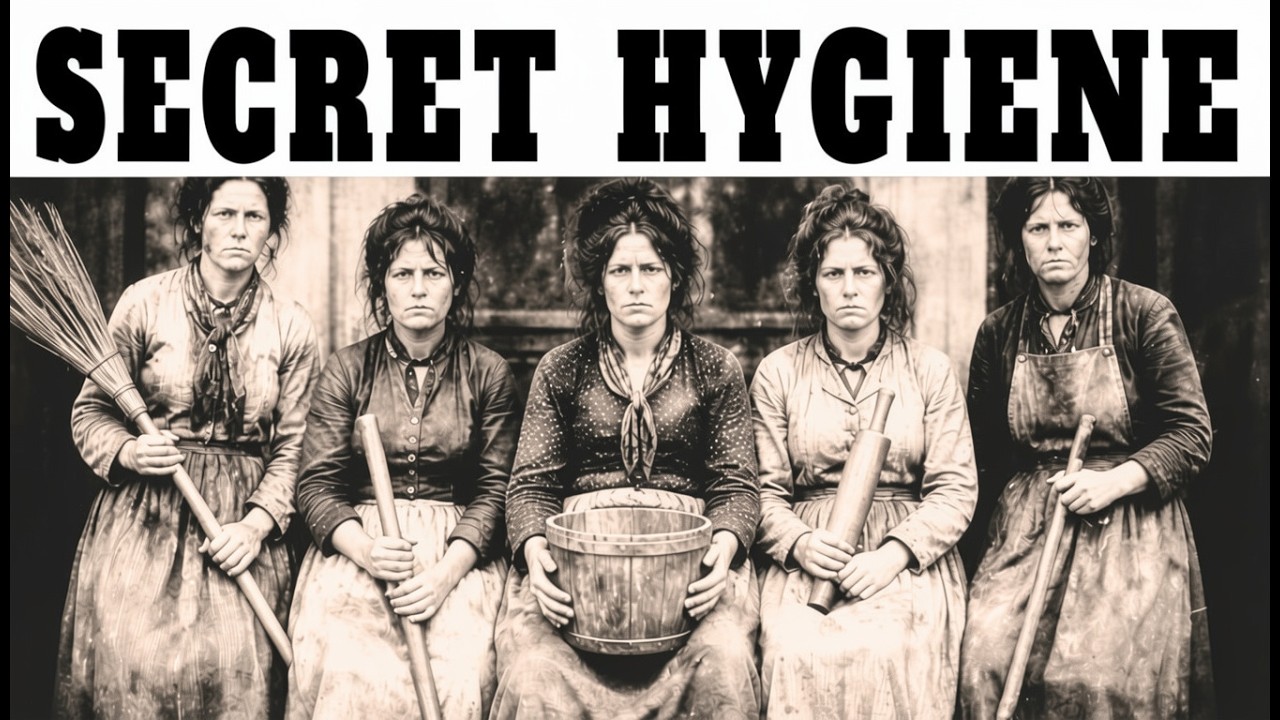 Hollywood gave pioneer women fresh calico and clean braids. The truth smelled different. Of all the hygiene horrors these women endured, which one actually killed the most of them?
It is not the one you would guess. Hold that question. By the end of this list, the answer will land somewhere you do not expect.
These women wrote it all down. In diaries, in letters home, in the margins of household manuals. And almost none of it made it to the screen.
Let me set the world. The Overland Trails of the 1840s through the 1860s. The Kansas and Nebraska homesteads of the 1870s and 1880s.
A woman’s day began before dawn. Water hauled, fire built, food prepared, children fed and dressed. All of it finished before the sun cleared the tree line.
The average family ran six to eight people living in a one-room cabin or a wagon box ten feet long and four feet wide. We are not going to the movies for this. We are going to the diaries these women kept.
The domestic manuals they packed alongside the flour and the salt pork.
No running water. No sewage. Soap made by hand from animal fat and hardwood ash.
A single dress worn for weeks. The nearest doctor, if one existed at all, a full day’s ride or more. These were the conditions.
Every item on this list grew straight out of them.
Number 15. What did a frontier woman’s smile actually look like by the time she was 35? Martha Ballard, a midwife in rural Maine, recorded tooth extractions in her diary.
No anesthetic. A pair of common pliers. The patient held down by her own family.
Catherine Beecher’s 1841 manual recommends salt and charcoal rubbed on teeth with a rag or a chewed twig. Nothing else. Tooth decay was nearly universal.
Abscesses went untreated until they burst or killed. The daguerreotypes that survived show women barely past 20 with teeth already missing. Hollywood casts them with full white smiles.
The camera is lying before the first frame rolls.
Number 14. The real reason pioneer women wore their hair pulled tight and covered. It was not modesty.
It was containment. Lydia Maria Child’s 1832 manual and Catherine Beecher’s 1841 guide both recommend kerosene combed through the hair to 𝓀𝒾𝓁𝓁 lice. Lard smeared on the scalp and wrapped overnight to suffocate them.
Narcissa Whitman wrote about the difficulty of even basic hair care on the overland journey. Hair washing with water happened once a month or less. That tight braid under a bonnet was not a fashion choice.
It was a woman holding a losing line against creatures that never stopped coming.
Number 13. A woman in the dark in January walking 30 yards to a hole in the frozen ground. That was the outhouse.
On the trail, there was no outhouse at all. Amelia Stewart Knight wrote about it in her 1853 diary. She described the humiliation of finding privacy on open prairie with hundreds of wagons in the train.
Women formed circles with their skirts to shield each other. Chamber pots served in winter. Open ground served in summer.
When dysentery struck, even those small dignities collapsed. Every Western grants its frontier women a closed door and a moment alone. Most of them never had either.
Number 12. You may have heard the old saying, do not throw the baby out with the bathwater. That was not a joke.
It was a real warning. Catherine Haun crossing the plains in 1849 described bathing in rivers when the train stopped. No privacy, livestock upstream.
On the homestead, Saturday night meant one tub, one pot of heated water. Father first, mother second, children oldest to youngest. By the last child, the water was gray.
Today, 99% of American homes have running water. In 1870, not a single homestead on the Kansas plains did.
Number 11. Lice did not visit. They moved in.
 They lived in the bedding, in the seams of every garment, in the children’s hair. Lydia Allen Rudd’s 1852 trail diary mentions them so often they become background noise. Mattresses stuffed with prairie grass were breeding grounds.
Frontier hotels were notorious. Period newspapers carried complaints from travelers who woke covered in bites. Women fought this war every single day with boiling water and kerosene.
They never fully won. The clean bedrolls you see in Westerns are a lie.
Number 10. Monday was wash day. And wash day was the most dangerous day of a frontier woman’s week.
Catherine Beecher documented the full ordeal. Water hauled and heated over an open fire. Lye soap that ate the skin raw.
Clothes beaten on rocks and wrung by hand for hours.
A full wash for a family of eight ran from sunup to sundown. Burns were common and serious. On the trail, women sometimes washed in alkali water that blistered their hands down to raw flesh.
Laundry was not a chore. It was a day-long physical ordeal with real injury risk. And the clothes in Westerns are always clean.
That silence erases the most grueling labor of frontier womanhood.
Number nine. Think about what a pioneer woman was actually wearing against her skin. A chemise, the only layer that touched the body.
Over that, stays or a corset. Petticoats, a dress, an apron. Drawers as we know them did not become common for women until the middle of the century.
The outer dress might go weeks between washings. Sweat, blood, food, dirt, smoke, all soaked into fabric that could not easily be cleaned. Susan Magoffin, crossing the Santa Fe Trail in 1846, described her clothing falling apart on her body.
Most frontier women owned two dresses. Some owned one. The movies dressed them like they had a wardrobe.
They did not.
Number eight. The soap that cleaned your clothes and took your skin with it. Lydia Maria Child published the recipe in 1832.
Hardwood ash lye mixed with rendered animal fat. The process itself could scar you. Lye is caustic.
Rendering fat over an open fire is a burn waiting to happen.
The resulting soap stripped every oil from the skin and cracked the hands that used it. It was the only soap most frontier women ever touched. Imported Castile soap existed, but on the frontier it was expensive and almost never available.
There is not one scene in any Western where a woman makes soap. The foundational act of frontier cleanliness is invisible in the myth.
We are halfway through this list now and I have not yet named the one that killed the most of them. Stay with me.
Number seven. Every pioneer woman of childbearing age dealt with this every single month. And it appears in almost no diary, no letter, no novel, and not one frame of film ever made.
The silence itself is the evidence. Menstruation is almost never mentioned directly in frontier women’s writings. The taboo was that complete.
What survives are scattered references to being unwell in private letters. Instructions in domestic manuals for making rags. On the trail, there was no running water, no privacy, no reliable way to wash those rags.
Women bled through their clothing and kept walking. Staining patterns on surviving period garments confirm it.
This is the single most universal female experience of the frontier. No Western has ever acknowledged it, not once. The deepest cut Hollywood made was not a lie.
It was a silence. They pretended half the human body did not exist.
Number six. Remember this number. I am going to ask you to come back to it.
 Contaminated water was the single deadliest hygiene failure on the American frontier. The Oregon-California Trails Association estimates that 20 to 30,000 immigrants died on the overland trails between 1840 and 1860.
Cholera, a waterborne disease, was the leading killer. One in ten who started the trail did not finish it. John Snow proved in London in 1854 that cholera spread through water.
But the immigrants had no way to know. They drank from streams where dead oxen lay upstream. They filled cooking pots from creeks where hundreds of camps had dumped their waste.
Lydia Allen Rudd, 1852, recorded passing grave after grave along the Platte. Cholera dead buried shallow or not at all. The living drank from the same water that ran past the dead.
Cholera could 𝓀𝒾𝓁𝓁 in hours. A woman healthy at breakfast could be gone by nightfall. And the movies show pioneers scooping water from every sparkling stream.
Mark number six. We are coming back to it.
Number five. When the knife slipped or the child fell, what did a frontier woman reach for? Turpentine poured straight into the wound.
Spider webs pressed into cuts to slow the bleeding. Poultices of bread and milk. Poultices of cow dung, which introduced infection directly.
Burns treated with lard, which trapped the heat and made the damage worse.
These women were not foolish. They used what they had and what they had been taught. But germ theory did not exist in common knowledge.
The cure was often the killer, and no one alive could have told them why.
Number four. The jar on the cellar shelf that could 𝓀𝒾𝓁𝓁 a family between Sunday dinner and Monday morning. Home canning spread across the frontier in the second half of the 1800s, but the science of safe preservation lagged far behind the practice.
Botulism from improperly sealed jars appeared in period medical records.
Meat went bad in salt brine. Milk soured within hours during summer. Ergot in badly stored grain poisoned entire households.
The woman who stocked the pantry bore the blame when something went wrong. She was working without a map. One bad seal on a canning jar.
One warm afternoon in the root cellar. And the food she had worked all harvest to preserve became the thing that killed her family.
Number three. The Oregon Trail was not an adventure. It was a graveyard with a direction.
By some trail historians’ calculations, there was a grave every 80 yards from the Missouri River to the Willamette Valley. Cholera, dysentery, typhoid. All hygiene driven.
Amelia Stewart Knight wrote in 1853 of passing seven new made graves in a single day. Lodisa Frizzell, 1852, described the smell of decay streaming from shallow graves along the trail. The women did the nursing.
They wiped fevered children with dirty rags. They buried them in graves they dug with their own blistered hands. And then they walked on.
We are close now. But the deadliest truth on this list is not in the number one spot. I told you at the start, the answer is not where you expect it.
Number two. The smallest crosses along the trail and what they do not tell you about why they are there. Frontier child mortality was staggering.
In some regions in trail years, between 25 and nearly 50% of children died before the age of five. The causes were overwhelmingly tied to hygiene.
Diarrheal disease from contaminated water. Infant dysentery, what they called the summer complaint. Measles and whooping cough ripping through crowded trail camps.
Diaper cloths washed in the same compromised water. Amelia Stewart Knight, eight months pregnant on the trail, recorded one child’s illness after another in a steady, quiet hand.
Today in the United States, fewer than seven children in a thousand die before age five. On the frontier, it could be 250 or more. The small graves in every frontier cemetery are not accidents of fate.
They are the direct consequence of conditions no one in Hollywood has ever been willing to show. The woman who buried her child and walked on the next morning is the toughest human being in any Western ever made, and she is never in the frame.
 Number one. She survived the trail. She survived the winter.
She survived the labor itself. And then the hands that delivered her baby killed her. Childbed fever.
Puerperal fever. A bacterial infection carried into the birth by unwashed hands, unsterilized instruments, contaminated rags.
In 1847, Ignaz Semmelweis proved it at the Vienna General Hospital. Doctors walking from autopsy rooms straight to the delivery ward without washing their hands were killing mothers at rates reaching one in three. Oliver Wendell Holmes argued the same thing in America in 1843.
The medical establishment attacked him for it.
On the frontier, conditions were worse. Deliveries on dirt floors, attended by neighbors whose hands had just come from the barn or the field. No antiseptic.
No understanding of germ theory for decades to come. Martha Ballard, midwife, documented hundreds of deliveries and maternal deaths in her diary.
The timeline was always the same. The baby arrives safely. The mother smiles.
48 hours later, the fever begins. Chills. Rising heat.
Abdominal pain that becomes agony. Within a week, she is dead. The infection came from the hands that were trying to help her.
This is the cruelest truth on the list. The thing that killed pioneer mothers was not the wilderness, not the weather, not the distance. It was human hands during the most vulnerable moment of their lives.
And it was preventable by knowledge that already existed and was being ignored. The movies show the baby born, the mother whole, the family together. They never show what came three days later.
So, why did Hollywood erase all of this? Not one truth, all of it. The smell, the blood, the lice, the dying.
The answer is a paper trail. The Hollywood Production Code was enforced from 1934 to 1968. It restricted depictions of childbirth, bodily functions, and anything the sensors deemed indecent.
Frontier women’s bodies were classified as unsuitable for the screen.
Then, the genre did the rest. John Ford did not film history. He filmed mythology.
Monument Valley had wardrobe departments. The real Platte River road had mud, blood, and women in rotting dresses who had not bathed in a month. Every clean version became the reference for the next.
By the time the revisionist Westerns arrived in the 1960s, they revised the gunfights. They left the women untouched.
The myth-makers were not ignorant. They made a choice. They chose the version that was easier to look at.
So, here is my answer to the question I asked you at the start. The deadliest hygiene truth on this list is not number one. Childbed fever was devastating, cruel, and preventable, and it deserved every word we gave it.
But, the truth that killed the most pioneer women, the most pioneer everyone, was number six. Contaminated water. Quiet, invisible, everywhere.
Cholera alone killed more people on the Overland Trails than violence, accidents, and conflict combined. It did not come from a doctor’s unwashed hands. It came from a creek that looked clean and was not.
The most ordinary act of the day, filling a pot with water for the family supper, was the deadliest thing a pioneer woman did. And in every Western ever filmed, the water is always clear.
We remembered the dramatic deaths. We forgot the quiet ones. The woman who boiled water over a fire she built herself, who fed her children, buried the one who did not make it, and walked another 15 miles the next morning.
She is the entire frontier, and she never got a single frame.
Today, you turn a handle and clean water comes out. You do it without thinking. She would have wept.