Bonnie and Clyde became two of the most famous outlaws in American history, but the real story behind the duo is far stranger than the legend. From little-known details about their personal lives to surprising facts about their crimes, photographs, and the final manhunt, the factual record contradicts the myth in significant ways. One of the most persistent misconceptions is that Bonnie Parker and Clyde Barrow belonged to the era of the Old West. Historically, they operated in a completely different period.
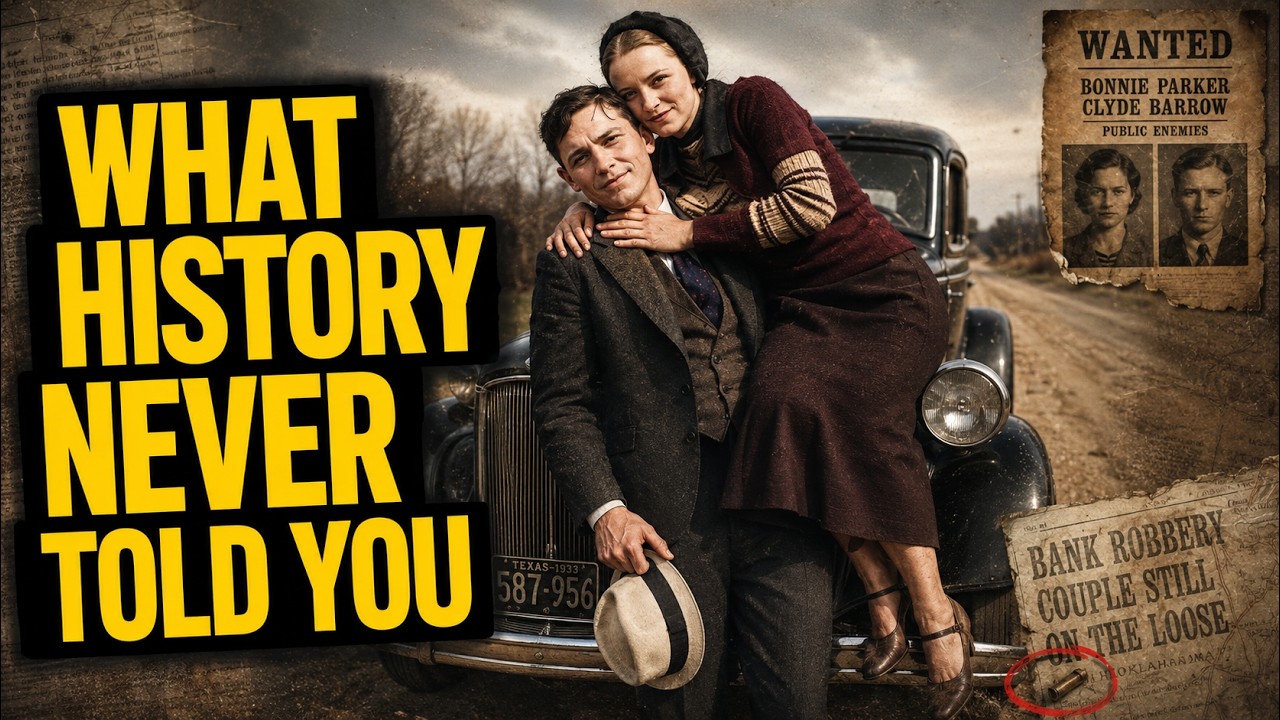
Clyde Barrow was born in Texas in 1909, and Bonnie Parker was born there in 1910. Their wave of crime unfolded mainly between 1932 and 1934, decades after the classic frontier era had ended. Instead of horses, stagecoaches, and 19th-century lawmen, their world revolved around cars, highways, telephones, newspapers, and increasingly coordinated police agencies. They were Depression-era criminals, part of the same period that produced nationally known figures such as John Dillinger, who were labeled public enemies.
The automobile fundamentally changed what outlaws could do. Old West outlaws were limited by the speed of horses and railroads, but Bonnie and Clyde could cross county and state lines quickly, often leaving local law enforcement behind before word of a crime even spread. Another detail often lost in simplified retellings is that Bonnie Parker never became Clyde Barrow’s wife. Before meeting Clyde, Bonnie had married another young man named Roy Thornton in 1926, while still a teenager.
Although the marriage failed, Bonnie never divorced him. Thornton eventually went to prison, and Bonnie remained legally married to him throughout the years she spent traveling with Clyde. Her personal history also contradicts her later outlaw image. According to the Texas Handbook, she was a strong student who enjoyed reading and writing poetry.
Before her involvement with the Barrow gang, she worked at a café in Dallas. She met Clyde in January 1930 when she was 19, and their relationship quickly became intense, though Clyde was soon arrested. Bonnie helped him during one early escape attempt, but he was recaptured and sent to prison. He was released on parole in February 1932, and the criminal partnership that made them famous began to take shape.
Even when newspapers across the country presented Bonnie and Clyde as the nation’s most notorious crime couple, she was still legally Mrs. Roy Thornton. Some of the most famous photographs of Bonnie and Clyde were never meant to become public. In the spring of 1933, Clyde, Bonnie, Clyde’s brother Buck Barrow, Buck’s wife Blanche, and W.
D. Jones were staying in an apartment above a garage in Joplin, Missouri. Their behavior drew attention from neighbors, and local officers came to investigate. The confrontation ended with two lawmen killed and the gang escaping.
They left behind personal belongings, including an unprocessed roll of film. When the film was developed, police and newspapers suddenly had clear images of the fugitives standing together. One famous photograph showed Bonnie with a cigar and a gun. Those images helped turn regional criminals into national celebrities.
W. D. Jones later said he was the one who gave Bonnie the cigar for the photo, which was meant as a pose rather than evidence of her smoking habit. Bonnie and Clyde were not major bank robbers.
Historical accounts show that the Barrow gang frequently targeted grocery stores, gas stations, small businesses, and other places offering relatively limited cash. The Texas Handbook describes them as small-time criminals compared to the major criminal organizations of the time and notes that the largest amount they obtained in a single operation was about $1,500. Their crimes were often chaotic and improvisational, and the stolen cars were essential to their constant need for transportation. There is also no serious evidence supporting a Robin Hood narrative.
Ordinary businesses and ordinary people could become victims. Their fame came less from financial success and more from their ability to stay on the run, their clashes with police, their photographs, and the enormous press coverage surrounding them. The name Bonnie and Clyde makes the story seem as though everything was the work of two people traveling alone, but for most of their criminal career, that was not the case. The group known as the Barrow gang changed members several times.
Early partners included Raymond Hamilton, followed by W. D. Jones. In 1933, Clyde’s older brother Buck Barrow joined after his release from prison, and his wife Blanche traveled with them as well.
Henry Methvin later became another important partner. Newspapers typically used their names as shorthand for the whole gang, even when several people were involved in a single incident. Clyde was clearly the central organizer, but the Barrow gang was not a stable team with the same members from start to finish. A small piece of ordinary evidence helped bring federal investigators into the manhunt.
At the time, the organization now known as the FBI was called the Bureau of Investigation and had far more limited authority than it does today. Many of the crimes linked to the Barrow gang were state or local matters. The federal connection grew through stolen cars crossing state lines. Investigators examining a series of stolen Ford vehicles in 1932 and 1933 found an abandoned vehicle containing a medicine bottle.
They traced it to a pharmacy in Nacogdoches, Texas, and learned the medicine had originally been prescribed for Clyde Barrow’s aunt. Further investigation linked the Barrow family to the bottle and another stolen vehicle. On May 20, 1933, a federal warrant was issued for Clyde Barrow and Bonnie Parker. The medicine bottle helped establish a legal and investigative link that brought another agency into the case.
Clyde Barrow was closely associated with Ford cars, especially the V8 models of the early 1930s. In April 1934, the Ford Motor Company received a handwritten letter allegedly sent by Clyde Barrow to Henry Ford. The writer praised Ford cars and claimed to prefer them whenever possible. The document is held by the Henry Ford Museum and described as attributed to Clyde Barrow, but the museum also notes that handwriting analysts have questioned whether Clyde actually wrote it.
The letter reflects something real about the era: new powerful cars changed criminal pursuit, allowing fugitives to cross multiple jurisdictions quickly. By early 1934, Bonnie and Clyde had been fugitives for a long time, but a single event dramatically increased the pressure around them. On January 16, 1934, several prisoners escaped from the Eastham State Prison Farm in Texas in an operation connected to Clyde and Bonnie. Five prisoners escaped, including Raymond Hamilton, who had previously traveled with the Barrow gang, and Henry Methvin, who would become part of the final months of Bonnie and Clyde’s flight.
A prison guard was fatally wounded during the escape. The head of the Texas prison system, Lee Simmons, turned to Frank Hamer, a former Texas Ranger with a long career in law enforcement. On February 1, 1934, Hamer was appointed as a special investigator for the prison system specifically to pursue the couple, working alongside former Ranger Maney Gault. Hamer’s approach involved patiently studying the fugitives’ movements and contacts rather than waiting for them to stay in one place long enough for an ordinary arrest.
Only four months passed between the Eastham escape in January and the final ambush in May. One of the easiest mistakes to make when discussing the Barrow gang is to take the total number of deaths and assume Bonnie personally committed those killings. The FBI’s historical summary states that Bonnie and Clyde were believed responsible for 13 murders, along with robberies and other crimes, but this does not prove that Bonnie personally carried out each killing. Her exact role in individual acts of violence remains one of the most disputed parts of the story.
Clyde and several male members were directly linked to deadly confrontations. Bonnie was unquestionably involved in the criminal lifestyle, but historians have questioned the popular image of her constantly using weapons and personally killing lawmen. The dispute became particularly important after the deaths of two Texas Highway Patrol officers near Grapevine on April 1, 1934. A dramatic eyewitness account portrayed Bonnie as one of the shooters, and newspapers widely published that account.
Later evidence complicated the story. Henry Methvin claimed involvement in the shooting, and historian Jeff Guinn has argued there is no reliable evidence Bonnie ever killed anyone herself. Other historians have been less willing to fully absolve her. The safest historical statement is that her direct responsibility for specific killings remains disputed.
The final manhunt is often reduced to Frank Hamer alone, but the ambush that ended the fugitives’ run involved a group of six lawmen from Texas and Louisiana. Hamer was the central figure, with Maney Gault beside him. Dallas County deputies Ted Hinton and Bob Alcorn also participated, along with Bienville Parish Sheriff Henderson Jordan and Deputy Prentice Oakley. By May 1934, investigators had focused heavily on the couple’s connections in Louisiana, especially their relationship with Henry Methvin and his family.
Law enforcement eventually learned enough about their expected movements near Black Lake and the rural roads around Bienville Parish to set an ambush. Before dawn on May 23, 1934, the officers took positions near the road outside the towns of Gibsland and Sailes, Louisiana. Bonnie and Clyde later arrived in a stolen Ford. The officers opened fire, killing both fugitives at the scene.
Bonnie was 23 years old, and Clyde was 25. Their deaths did not end public fascination with them. Crowds gathered quickly, and the press treated the event as a major national story. A final difference between myth and reality: Bonnie and Clyde were not buried together.
Both bodies were returned to Dallas, but their families arranged separate funerals. Clyde was buried with his brother Buck at Western Heights Cemetery, while Bonnie was first buried elsewhere in Dallas and later reinterred at Crown Hill Memorial Park. The separation is striking because nearly every version of their story since has permanently linked their names together.