It is just after dawn on a September morning in 1988, and a 40-acre field somewhere in rural Minnesota is not what it looks like. From a helicopter overhead, or from a road half a mile away, it looks like corn, ordinary Midwestern corn, chest-high and green. But push aside the first two rows and step through. The corn ends, and behind it, in tight, disciplined rows that stretch farther than you can see, is marijuana, shoulder-high and heavy with resin.
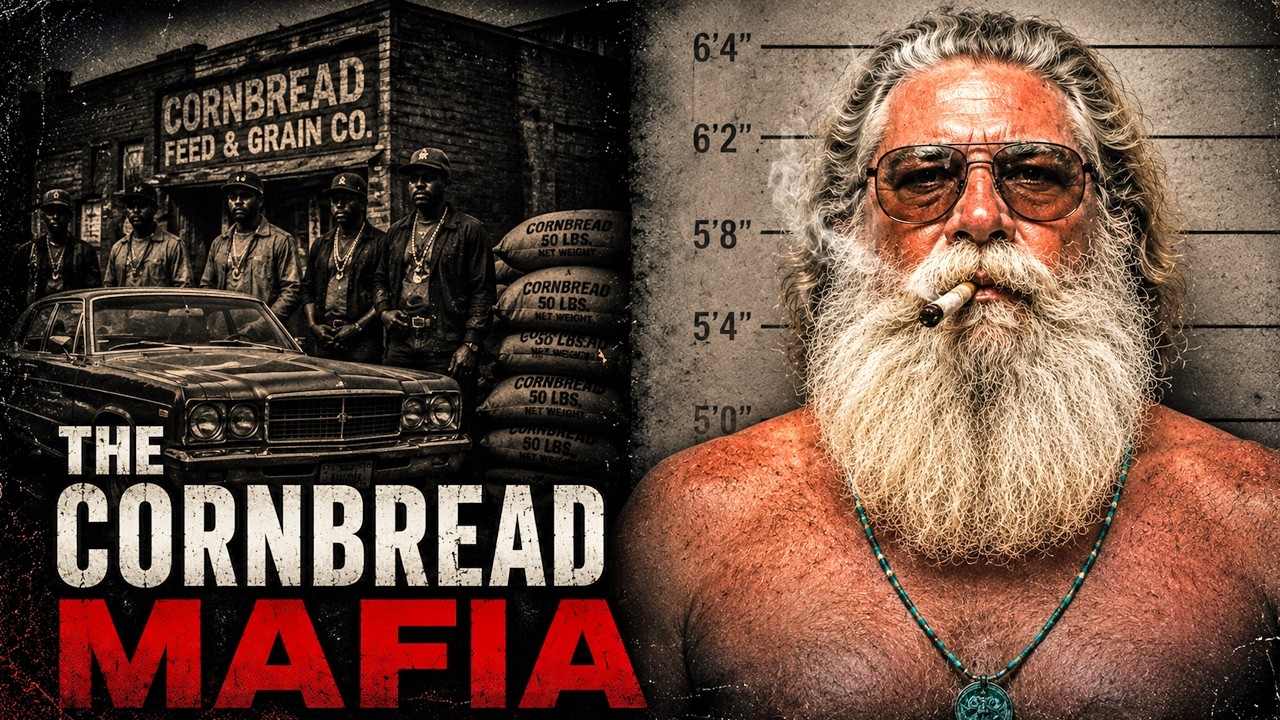
Enough of it to fill a semi-truck. Enough of it to send the four men working it that morning to federal prison for the rest of their working lives. In the space of four growing seasons, 70 men from three small Kentucky counties produced 182 tons of marijuana on 29 farms across 10 states. It was the largest domestic marijuana producing organization in the history of the United States.
Not a Colombian cartel, not a Miami syndicate, but rural Kentucky men in worn boots with green-stained hands. They did it without a single killing. And when the raids came, not one of these men talked. Facing decades in federal prison, 70 men stayed silent, and the question the government never fully answered was why.
The story begins in Marion County, Kentucky, in the late 1960s. This is farm country, tobacco country, a place where Catholic churches sit on every third crossroads and the priest baptizes, marries, and buries you. It is here, in a little town called Raywick, that a farm boy named Johnny Boone is watching his family’s tobacco allotment shrink for the third year in a row. Boone is in his 20s, married, Catholic.
He is a farmer whose crops do not pay anymore. By the early 1970s, Boone and a few of his neighbors have started growing something else in the hollows. Later, when interviewers asked former Cornbread Mafia men why they made the jump, the answer was almost always the same. As one participant put it, they did not see any other way to make money at home.
Tobacco was dying. The land was not going to feed families anymore. And marijuana grew wild in Kentucky hollows almost by itself. These men were not gang members.
They were altar servers, choir members, men who took their kids to catechism. The same close-knit Catholic culture that taught them to protect their family and keep their mouths shut became the operational backbone of a criminal network the Drug Enforcement Administration would spend a decade trying to break. By 1977, Boone and his neighbors realized the Kentucky hollows were getting crowded. Local sheriffs were starting to pay attention.
If they wanted to grow real weight, they could not stay in Marion County. Between 1977 and 1980, Boone and his circle began to reach outward to Illinois, Missouri, Nebraska, and Minnesota. They leased farms under false names or through straw owners. They picked land at the ends of gravel roads, land next to rivers backed by forest, invisible from any main highway.
The organization had no letterhead and no meetings. What it had was trust, the kind of trust you can only build in a place where everybody’s grandmother knew everybody else’s grandmother. Crews of four to eight men were assigned to each farm. They lived on site in trailers or old farmhouses from April to October.
When the season ended, they drove the money back home to Kentucky. By 1984, the network had roughly 20 to 30 farms scattered across 10 states, fields ranging from 10 to 40 acres of marijuana interplanted with corn and soybeans. The Kentucky men had gone from growing dime bags in the hollows to running one of the most sophisticated agricultural operations in the American Midwest. And nobody knew they existed.
There were no shootings, no bodies, no informants, just quiet men in old trucks driving quiet roads tending quiet fields. From Lebanon, Kentucky, the operation’s heart, the farms radiated outward like spokes on a wheel. Minnesota, 700 miles north. Nebraska, 800 miles west.
Michigan, Missouri, Illinois, Indiana, Tennessee, Kansas. Crews would drive 18 to 20 hours in pickup trucks and vans. They shaped their fields like natural clearings. They planted marijuana between rows of legitimate crops.
From 500 feet up, it looked like corn. From a mile up, it looked like nothing. The workdays were brutal. April planting, June through August maintenance, weeding, thinning, fertilizing in Midwestern heat.
By harvest in September and October, crews were putting in 18 and 20-hour days, cutting stalks with knives, hanging plants in barns to dry, moving finished product in horse trailers at night. Somewhere in the early 1980s, Johnny Boone sat down with his inner circle and made a rule. As former members described it, it was not a speech. It was a quiet, unshowy decision.
Boone laid out the code. Nobody talks. Nobody informs. Not for a plea deal, not for a reduced sentence, not to save your own skin.
If they catch you, you do your time. According to those close to him, Boone framed it in a way that would echo for the next 30 years. We are farmers, not gangsters. Farmers do not rat.
What Boone was doing was borrowing the deepest structure of rural Catholic life, loyalty to kin, refusal to break faith, and mapping it onto a criminal enterprise. It was brilliant. It was also going to cost each of them decades of their lives. The code would hold 70 men over a hundred eventual arrests.
Not one would give up the man above him. The first cracks came not in Kentucky, but in the flat fields of the American Midwest. Between 1985 and 1987, arrests began cropping up in state after state. Four men here, six men there, always working a large marijuana grow, always polite when the cuffs went on, always with driver’s licenses that read the same three Kentucky counties.
Eventually, an analyst pulled the arrest reports together and saw the pattern. Every one of these farms traced back to Marion County, Kentucky. An agent later described the moment of realization in an interview years afterward. The Kentucky men, he said, were better at growing marijuana than most legal farmers were at growing corn.
Their fields were meticulously tended. Their plants were healthier than the neighboring cash crops. This was not a gang. This was an agricultural corporation.
An illegal one. By 1987, federal agencies had begun treating the scattered cases as one investigation. They made a tactical choice that would change everything. They would time the raids for harvest, catch the men in the fields, and take the whole crop.
It is 5:30 in the morning somewhere in rural Minnesota, September 1988. A crew of four Kentucky men are climbing out of a farmhouse trailer with coffee in their hands and knives on their belts. They never make it past the porch. From the tree line, from the ditches, from behind the barn, federal agents step out, weapons up.
The Kentucky men do exactly what the code says to do. They get on the ground. They do not fight. They do not run.
And they do not say a single word. Over the next 18 months, similar raids unfolded in Illinois, Indiana, Tennessee, Michigan, Nebraska, Missouri, and Kansas. Same pattern. Same silence.
Same Kentucky driver’s licenses. And in every single case, when the interrogations began, the same thing happened. Nothing. Federal interrogators have leverage no state cop has.
Federal charges, mandatory minimums, 20 years, 30 years, 40 years dangling over a man’s head. The standard playbook that had cracked mafia families and biker gangs was to lay out the sentences and wait for the man across the table to start naming names. It almost always works. It did not work on the Cornbread Mafia.
Man after man was shown the same paperwork. Talk to us. Give us the names above you. Man after man looked back at the agent and said nothing.
The federal agents were up against not a criminal code, but a religious one. These men had been raised in a Catholic community where informing on your cousin was a moral impossibility. James Higdon, who later wrote the definitive book on the Cornbread Mafia, described this dynamic as the intersection of the authority of the church and the largest homegrown marijuana syndicate in American history. Two systems of loyalty.
When they collided in a federal interrogation room, the church won every single time. The government did not need confessions. They had the plants, the farms, the lease documents, the vehicle registrations, and the surveillance photos. They just needed to charge the men together as a conspiracy and let the federal sentencing guidelines do the rest.
The federal offensive unfolded across roughly 18 months from mid-1988 through the end of 1989 in a rolling series of raids timed to hit farms at harvest, when crews were on site and barns were full of drying plants. It happened in 10 states simultaneously. The choreography across 10 state lines required federal agencies to coordinate surveillance and strike teams with military precision. 182 tons of marijuana.
That is the weight the government would eventually count. That is what 70 men in three Kentucky counties produced with their own hands. As the raids intensified, the silence began to work in the government’s favor. Because when nobody talks, the prosecutors do not have to bargain.
They can stack the maximum charges on every single defendant because there are no cooperators to reward. Had they broken ranks and turned on Boone or on each other, the federal government would have handed out 5-year and 10-year deals. Because they did not, the sentences ran 20, 25, 26 years. By the spring of 1989, over 60 men were in federal custody.
Wives were losing husbands. Mothers were losing sons. Courthouses in Louisville, St. Louis, and Minneapolis were filling with Kentucky families who had driven a full day to see a loved one in shackles.
Marijuana is a plant. It has to grow and be harvested at a specific window, usually September and October in the American Midwest. The government knew, to within a 2-week margin, exactly when every Cornbread Mafia farm would be most vulnerable. When the Kentucky crews arrived for the harvest, the agents were already there, waiting in the tree line.
The scenes described in court documents and interviews are almost surreal. A crew of six men walks out of a farmhouse in Nebraska at dawn carrying knives and drying racks and walks into a semicircle of federal agents with rifles raised. There is no fight. There never was a fight.
The Kentucky men drop the tools, get on the ground, and let themselves be cuffed. Then they say nothing. By the end of 1989, the government’s count was staggering. 70 men indicted, 29 farms raided, 10 states involved, 182 tons of marijuana destroyed or seized, and a code of silence so absolute that federal prosecutors had never encountered anything like it.
At a federal press conference in June 1989, prosecutors gave the network a name. Cornbread Mafia. It was intended as a serious label. Newspapers ran with it.
Wire services picked it up. The men themselves hated it because it fed a caricature of the gangster and the violent criminal. That was never who they were. They were farmers.
But the name stuck. Back in the interrogation rooms, one of the most remarkable acts of collective resistance in the history of American drug enforcement was playing out. 70 men facing decades of federal prison were offered the exact same deal. Tell us who is above you, and we will cut your sentence in half.
One by one, the Kentucky men said no, not with defiance or speeches, just quietly. They asked for their lawyers. They said the words their fathers and grandfathers had taught them. No comment.
If a single defendant had cracked, one man out of 70, the entire code would have collapsed. The whole network was one weak man away from unraveling. That weak man never showed up. The consequences were devastating.
Bobby Joe Shoemaker would serve 26 calendar years in federal prison. Other core members would serve 15, 20, 25 years. Four or five of the inner circle would collectively serve nearly a century of prison time. By the time most of them came home, the world had moved on without them.
Over the next two years, from mid-1989 through the end of 1991, trials and sentencings rolled forward in federal courtrooms in a half dozen states. By the end of 1991, more than 100 men, most of them from Lebanon, Kentucky, had been arrested. Mandatory minimums stacked on top of conspiracy charges produced sentences of 10, 15, 20, 25 years and longer. Some judges, according to later accounts, expressed private discomfort at the length of the sentences they were required to impose.
But federal sentencing guidelines had removed most of their discretion. Johnny Boone, the man the government would call the godfather of grass, was among those swept up. In one later case, following a period as a fugitive, he was sentenced to 57 months. His mythic status was already sealed.
He had built the operation. He had set the code. Back in Kentucky, families bore what the men could not. Wives raised children alone.
Mothers drove hundreds of miles to prison visits. Fathers died while sons were still incarcerated. The Catholic parishes of Marion County, the same parishes that had shaped the code of silence, now became the emotional infrastructure for families in crisis. Priests visited prisoners.
Congregations pooled money. Tommy Lee, a major player sentenced during the sweep, was released from federal prison around 2006 and took a job as a truck driver. Jimmy Beckett, released in 2007, went back to legitimate farming. His younger brother, a former participant released in 2011, took perhaps the most unexpected path.
He got a job as a law clerk and paralegal at the law office of a local Kentucky attorney, a man who had spent decades outside the law now working within it. Bobby Joe Shoemaker served 26 calendar years in federal prison. He was released in 2016, decades after his arrest. He came home to Marion County, quiet, private, and deeply changed.
The marijuana laws he was imprisoned for violating had, by then, changed almost beyond recognition. There is a quote from one of the former Cornbread Mafia men, sometimes attributed to Bobby Joe Shoemaker, sometimes to one of his peers, that has become the emotional core of the entire story. He said in a documentary interview, “Four or five of us guys spent close to a century in prison together over marijuana, something that’s legal today. ”
Across a decade of operation, across 10 states, across 70 men, across 200 tons of marijuana, there is no record of the Cornbread Mafia ever killing anyone, not a rival, not an informant, not a witness.
Their weapon was silence, and their sentence was measured in decades anyway. Growing marijuana in most of the states where they were arrested is now regulated, taxed, and in some cases celebrated as a small business success story. The exact same plant that took 26 years of Bobby Joe Shoemaker’s life is now a career path being taught in agricultural extension programs. James Higdon framed the story as a collision between the authority of the church and the largest homegrown marijuana syndicate in American history.
He understood something the federal prosecutors did not. This was never really a drug story. It was a story about rural America, about Catholic communities, about the collapse of the small farm economy, about what men do when the land that fed their grandfathers stops feeding their children. The name Cornbread Mafia has outlived every one of the men who wore it.
It is now a brand. Legal hemp companies use it in marketing. Podcasts have retold their story. Documentaries have interviewed the survivors.
Most of the men, in the tradition their fathers taught them, simply keep quiet and let the world talk. Come back to that Minnesota field, to the dawn in September 1988, to the 40-acre grow that looked like corn from the road, and to the four men in worn boots who were about to be cuffed on a farmhouse porch. Now you know their names. Now you know their code.
Now you know why they never spoke. And now you know that the plant they lost their lives for is today being sold on the shelves of stores their grandchildren walk past every day.