Hollywood has taught generations to picture Wyatt Earp and Doc Holliday drawing their pistols with perfect technique, aiming calmly before firing with deadly precision. But real gunfights in the Old West were faster, messier, and far more dependent on instinct than anything the movies suggest. The way those men actually handled and aimed their weapons reveals how different frontier combat was from the polished showdowns seen on screen. The philosophy of the slow draw.
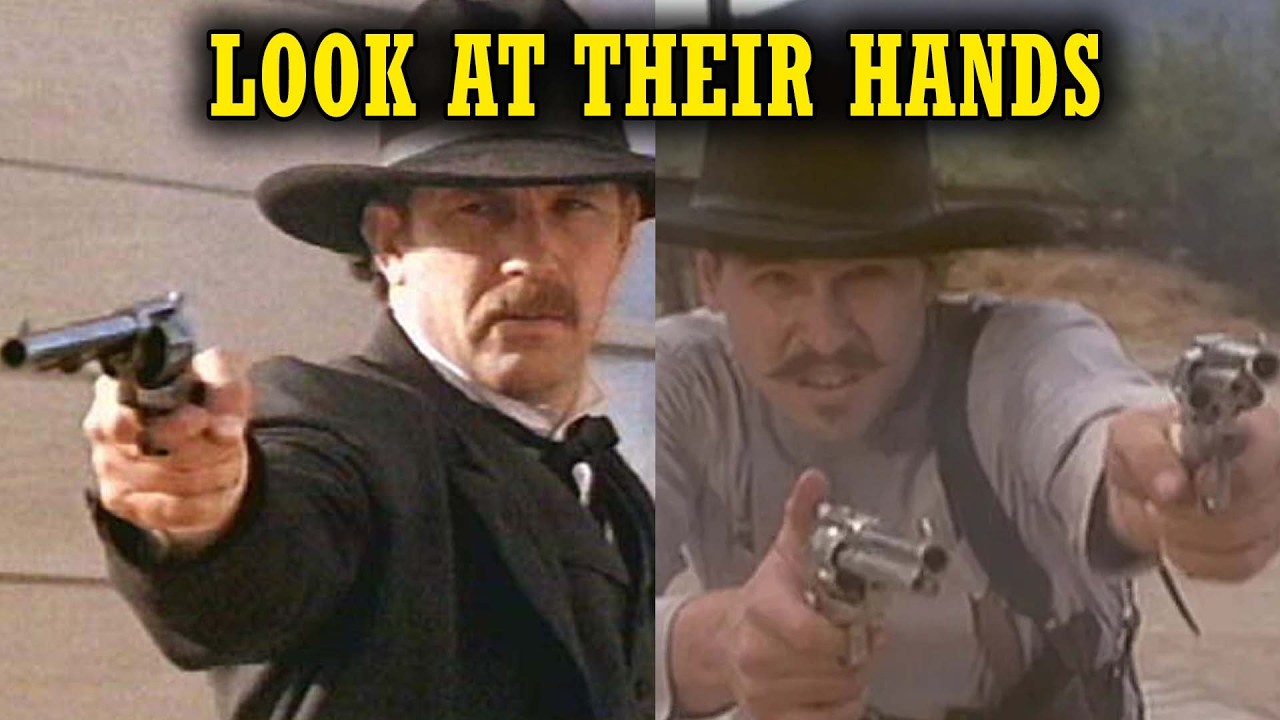
Walk into any classic movie theater or settle in for a quiet weekend at home, and Hollywood tells the same story about the American West again and again. Two figures face each other on a dusty street at noon. Tension builds. Then, in a fleeting moment, one man reacts faster than the other.
That speed settles everything. The idea that the fastest hand always wins became one of the defining myths of the Western genre. But if you had stood in Tombstone, Arizona, in 1881 and described that scene to Wyatt Earp, he likely would have rejected it entirely. For Earp and the few lawmen of his era who survived repeated armed confrontations, the movies’ obsession with pure speed was not just wrong—it was a mindset that got people killed.
Real frontier law enforcement followed a completely different logic, often summed up in a phrase attributed to Earp: “Take your time, but do it quickly. ” On the surface, the saying sounds contradictory. In practice, it reflected a calculated, disciplined approach to conflict. Biographers who spoke with Earp late in his life, including Stuart Lake, who conducted lengthy interviews with him in the late 1920s, noted that Earp placed pure speed at the bottom of what actually mattered in tense confrontations.
According to that account, Earp believed the worst mistake an inexperienced person could make was acting too hastily. Under real pressure, the body does not respond the way people expect. Heart rate spikes sharply, vision narrows, and fine motor coordination deteriorates. Anyone trying to move as fast as possible in that state is prone to confusion, getting equipment caught on clothing, or acting prematurely and missing the target entirely.
Earp’s advantage, according to this account, was not superhuman reflexes. It was unusual emotional steadiness under pressure. The idea was that being first to act mattered less than being accurate in the aim. While opponents rushed and lost control of their movements, Earp was said to remain deliberate, steady, unhurried, and precise.
Historian Casey Tefertiller, author of “Wyatt Earp: The Life Behind the Legend,” studied this pattern in Earp’s career. Tefertiller’s research suggests Earp’s ability to maintain composure and emerge from dangerous confrontations unharmed was the product of this deliberate approach, not luck or raw speed. The pattern he describes is one in which hasty opponents lose accuracy because of their urgency, while Earp remains in control of the situation. The comparison often drawn is to a skilled craftsman.
A carpenter who rushes a cut ruins the material. A hunter who reacts too quickly misses the target. Earp was said to treat confrontations not as a display of heroics but as a task requiring complete focus and precision. Where an inexperienced observer might see raw speed as the essential skill, the more experienced view emphasizes steadiness instead.
Earp’s reputation for surviving dangerous situations in Wichita, Dodge City, and Tombstone rests on this interpretation—not on being the fastest with a gun, but on discipline, clarity of mind, and the patience to act accurately rather than hastily. The hip-shooting myth and the reality of sighted aiming. Classic Westerns love a particular skilled shot: a gunman draws his revolver, holds it at waist level, and hits a distant target down the street without ever raising the weapon to eye level. Sometimes, for extra flair, the actor fan-cocks the hammer with his free hand, turning a single-action revolver into something like a rapid-fire automatic weapon.
It is a striking image on screen. It makes the moment dramatic and the character larger than life. But given the actual equipment of the 1880s and the basic principles of ballistics, this style was not just impractical—it was a guaranteed miss. To understand why real shooters like Wyatt Earp avoided this approach, it helps to look at the weapons themselves.
The standard sidearm of that era, the Colt Single Action Army in . 45 caliber or the Smith & Wesson Schofield in . 44, was a heavy piece of equipment. An empty Colt weighed about 2.
5 pounds. Firing a black-powder cartridge from it produced a large cloud of smoke and a strong upward and backward recoil, far more intense than what shooters face today. Firing from waist level without raising the weapon to eye level eliminates any real reference point for aiming. Even a slight deviation in wrist angle could send the shot completely wide of the target, even at close range.
Historians and firearms experts who have studied the period generally concluded that firing without aiming in this manner often resulted in shots veering toward the ground, nearby buildings, or unpredictable directions. Given the high cost of ammunition and the time-consuming process of reloading, this kind of inaccurate shooting was considered by experienced frontier figures to be both wasteful and dangerous. So how did lawmen of that era actually aim their weapons under pressure? They raised the gun to eye level.
Court testimony and other historical records from the period, including accounts related to the famous Tombstone incident, indicate professional shooters deliberately used their sights. Earp reportedly extended his arm and raised the weapon to his line of sight, using the rear notch and front blade to align his target before firing, treating the process with the same precision a marksman uses with a rifle. One detail here often confuses casual readers of frontier history. Some famous shooters were known to file down or smooth the front sight blade on their revolvers.
This has sometimes been misunderstood as evidence that these men never aimed at all, that they abandoned using the sights entirely. The real explanation is more practical. Holsters in the 1880s did not resemble the low-slung, open style popularized by costume designers decades later. Real holsters were carried higher and designed to protect the firearms from weather and damage.
Because lawmen like Earp often wore heavy coats, wool, canvas, or long dusters depending on the season, the sharp front sight blade could easily snag on fabric or leather during a rapid draw. Filing the blade down to be smoother solved that problem, allowing the weapon to clear the clothing without catching. The shooter continued to use the remaining length of the barrel to assist with aligning the shot. The modification was not about abandoning accuracy.
It was about removing a practical obstacle to using the weapon effectively. Doc Holliday’s psychological aim. Mention the name “Doc Holliday” to any Western enthusiast, and a familiar image comes to mind: a slender figure in an elegant coat spinning a polished revolver with smooth style. Hollywood has long portrayed John “Doc” Holliday as the model of the romantic ideal gunfighter, a man with exceptional reflexes and dazzling instinctive skill under pressure.
In these portrayals, his reputation rests on physical speed. The real historical picture is quieter and, in many ways, more impressive. Holliday’s effectiveness in tense confrontations may not have depended on hand speed as much as on what was happening inside his body and how that reality shaped his state of mind. To understand this, it helps to start with his health.
Born in Georgia and trained as a dentist, Holliday was diagnosed with advanced progressive tuberculosis, a disease known at the time as “consumption. ” In the late nineteenth century, that diagnosis was a death sentence. When Holliday moved west to the dry climates of Texas and Arizona, he was not chasing Western legend. He was hoping the air would ease his condition.
By the time he was working alongside Wyatt Earp in Tombstone in 1881, the disease had advanced significantly. Contemporary accounts describe him as gaunt, underweight, and suffering from severe coughing fits. He was fully aware that his remaining time might be limited. This circumstance is believed to have given Holliday something unusual: a notable absence of fear in highly stressful situations.
Most people facing danger undergo an acute physiological stress response: the instinct to flinch, crouch, or react impulsively. This reaction is widely understood to be one reason many found it difficult to maintain accuracy in confrontations of that era. Sudden movement and panic hindered control. Holliday, according to many historical accounts, handled these situations differently.
Because he was already facing a fatal illness, he reportedly showed little concern for his personal safety in dangerous confrontations. This mindset is described as giving him extraordinary composure under pressure. Newspaper coverage from the period, including reports in the Tombstone Epitaph and the Nugget after the events of 1881, noted his calmness in tense moments. Some accounts describe him as remaining remarkably steady even amid chaos, which historians connect to the absence of the flinch response that affected many others.
Alongside his composure, Holliday was known for preferring practicality over showmanship. While popular images focus on revolvers, historical records indicate that at the critical moment he used a different weapon—a shotgun—reflecting his preference for reliability over appearances. On October 26, 1881, as the Earp party approached the OK Corral area, Wyatt Earp handed Holliday a short-barreled shotgun that had been concealed under his coat. Historical accounts indicate Holliday was not interested in a theatrical duel.
He preferred a method that reduced uncertainty in close-quarters confrontations. When things escalated, Holliday reportedly used the shotgun decisively rather than relying on a revolver. Holliday’s historical reputation was not built on cinematic flair. It reflected the reality of a man facing serious illness who approached danger with an unusual degree of calm.
Not because he was heroic in the conventional sense, but because his circumstances had reshaped his view of risk. The OK Corral: a fight in a tight space. Ask most people to describe the gunfight at the OK Corral, and they will describe something like a Hollywood scene: two rival groups facing off across a wide, sunlit street, a tense pause, and an exchange of gunfire from dramatic distance. But the municipal records of Tombstone, Arizona, along with the sworn testimony from the coroner’s inquest in late October 1881, paint a completely different picture.
The real event was not a distant showdown. It was a chaotic, point-blank confrontation that happened in a space so tight the participants were nearly within arm’s reach of one another. First, the location itself is often misunderstood. The confrontation did not actually happen inside the OK Corral.
It happened in a narrow vacant lot on Fremont Street, between C. S. Fly’s photography studio and a nearby rooming house. Historical studies and modern site reconstructions estimate the lot was only about 15 to 18 feet wide.
When the two groups met around 3:00 p. m. on that cloudy Wednesday, they were standing less than 6 feet apart. Imagine a narrow alley or doorway crowded with eight armed, tense men.
That is closer to the physical reality than any wide, open street. There was no room for elaborate movement and no space for those dramatic quick-draw scenes associated with Westerns. When the first shots were exchanged, most likely between Wyatt Earp and Billy Clanton, the scene quickly became confused. The black-powder ammunition of that era produced thick, heavy smoke.
Within moments, the narrow lot filled with it, obscuring visibility almost immediately. The sound in that enclosed space between two buildings was so intense that surviving witnesses later gave conflicting accounts of exactly what happened and in what order. Under conditions that chaotic and with such poor visibility, precise aiming in the traditional sense became difficult. Accounts suggest that in the confusion, men largely fired in the direction of their opponents rather than tracking specific targets with precision.
This is part of why Doc Holliday’s weapon choice that day mattered. According to testimony from the Spicer hearing, the legal inquiry that followed the incident, Holliday was carrying a 10-gauge Wells Fargo short-barreled shotgun concealed under his coat. Wyatt Earp had given him the shotgun partly because the long gun could be a strong deterrent when facing armed men. Once the exchange began, however, its practical effect quickly changed the situation.
At close range, estimated at about 4 feet in most accounts, Holliday used the shotgun against Tom McLaury, and the confrontation ended almost immediately for McLaury. Holliday set the shotgun aside, drew his revolver, and continued participating in the rest of the exchange. The entire event lasted about 30 seconds, during which roughly 30 shots were fired in a very small space. By the time the smoke cleared, Billy Clanton and the McLaury brothers had suffered fatal wounds, including Frank McLaury, who was hit in a way that ended the fight for him almost instantly.
Virgil Earp was wounded in the leg. Morgan Earp was wounded across the upper back, while Doc Holliday suffered a minor injury to his hip. Wyatt Earp was the only participant to emerge from the fight without any injuries. Historical accounts do not attribute this to his superior speed.
They attribute it to his calm during those tense seconds. He was said to be carefully aiming and maintaining his balance while the situation around him descended into chaos. The Buntline lie and practical frontier tools. Visit a souvenir shop in Tombstone today or flip through twentieth-century pulp stories, and you will likely find Wyatt Earp depicted with an unusual weapon: the “Ned Buntline Special,” a single-action Colt with a barrel length of 12 to 16 inches and a detachable shoulder stock.
Popular legend says this massive revolver was a personal gift from dime novelist Ned Buntline. Films like “Tombstone,” the Hugh O’Brian television series, and many older Westerns treated this weapon as an essential part of Earp’s identity, giving him almost legendary long-range accuracy. It is a memorable piece of folklore, but from a practical and historical standpoint, most evidence suggests the Buntline revolver was largely fictional and thoroughly impractical, a weapon any experienced lawman would have avoided. To understand why, it helps to think about how a revolver was actually drawn from a holster.
A standard single-action Colt with a 4. 75-inch barrel clears the holster quickly, requiring only a short lift of the hand. In contrast, a revolver with a 16-inch barrel requires nearly a full arm’s length draw to clear the holster and would likely snag on a long coat before it was ready to use. The long barrel also shifts the revolver’s balance significantly forward, making it harder to hold level and slowing the process of bringing it onto target.
For someone whose style depended on a smooth, controlled draw and steady aim, a muzzle-heavy weapon like the Buntline would have hindered that goal rather than supported it. So what was Wyatt Earp most likely carrying that October evening on Fremont Street? Historical researchers, based on the Spicer hearing records, point to a more conventional weapon: most likely a Smith & Wesson Model 3 Schofield with a 7-inch barrel or a civilian single-action Colt with a 4. 75-inch barrel, not the legendary long gun.
These more modest barrel lengths reflect practical thinking. A barrel between 4. 75 and 5. 5 inches balanced speed and accuracy well; it was short enough to clear a holster or coat pocket smoothly and long enough to provide a usable sight line when raised to eye level.
These were working tools, not decorative pieces. There was another practical reason lawmen like Earp preferred standard-weight revolvers, and it had nothing to do with marksmanship. In frontier towns, a marshal’s primary job was keeping the peace, not resorting to force. When someone became unruly or dangerous in a saloon, lawmen often used a restraint technique called “buffaloing,” using the weight and balance of a standard revolver to physically subdue a person quickly and safely without firing a shot in a crowded place.
A standard-length, well-balanced revolver worked reasonably well for this kind of close restraint. A long, slender barrel would have been unwieldy and prone to damage under that kind of use. In the end, practical lawmen of that era chose their equipment based on reliability and function rather than appearance. A compact, balanced revolver that cleared a coat smoothly and could be aimed quickly served their purposes far better than an oversized, innovative weapon.
The Buntline Special remained a colorful part of Western legend, but historical records point instead to more modest, standard equipment among the lawmen who actually worked the frontier. How Hollywood invented the fake gunfighter persona. To trace how the disciplined, realistic style of frontier conflict gave way to the flashy myth of the lightning-fast draw, the story does not begin in Tombstone or Dodge City. It actually begins decades later on the sunny streets of Los Angeles in the 1920s.
There, an elderly man in his seventies could often be found on the sets of early silent films, talking with directors and spending time with young actors. That man was Wyatt Earp. In the final years of his life, Earp lived in Los Angeles, drawn to the growing film industry. He became a familiar presence on the productions of early Western filmmakers like Allan Dwan and befriended leading cowboy actors William S.
Hart and Tom Mix. Earp hoped these filmmakers would accurately portray his experiences, conveying the harsh reality of frontier law enforcement as he had lived it. Instead, his involvement helped start something completely different: a gradual reshaping of the very approach he had followed. As directors like John Ford began staging gunfight scenes in early Westerns, they faced a practical challenge.
Realistic firefight scenes did not look good on screen. A careful, deliberate draw, with a brief pause to align the sights before firing, looked slow and undramatic on film. Cinema, especially silent film, thrived on visible movement and building tension, and accuracy did not capture an audience’s attention the same way. To make these scenes more visually appealing, filmmakers and early prop designers began moving away from historical accuracy.
Holsters were redesigned to sit lower on the leg and open at the top, a style that did not exist in the 1880s, solely to allow for faster, more visible draws in front of the camera. Actors were directed to fire from hip level so their faces would remain visible. Hammer fanning became a stylistic staple because of its appealing appearance on screen. Increasingly, speed became the accepted visual symbol of heroism.
By 1931, when Stuart Lake published the famous Earp biography “Frontier Marshal,” just two years after Earp’s death, this dramatized version of events had already taken hold in the public imagination. Lake’s narrative mixed real history with exaggeration, crafting a story that suited a Depression-era audience looking for larger-than-life characters. By the 1950s, television Westerns multiplied rapidly. Shows like “The Life and Legend of Wyatt Earp” starring Hugh O’Brian introduced audiences to the fictional Ned Buntline Special, cementing the image of Earp as a superhuman gunslinger.
By the era of Sergio Leone’s spaghetti Westerns in the 1960s, and even in later films like 1993’s “Tombstone,” these dramatic techniques—firing from the waist, hammer fanning, and super-fast draws—became accepted as historical fact, even though they bore no relation to real frontier confrontations. For those interested in the more realistic version of this history, the truth may be more compelling than the myth itself. The men who worked as lawmen on the frontier were not distinguished by superhuman physical speed. What set some of them apart, according to many historical accounts, was composure: the ability to remain controlled and deliberate in highly stressful situations rather than relying on instinct alone.
The real story of Wyatt Earp and Doc Holliday was not about who could draw faster. It was about who could remain calm amid complete chaos. That is a harder and quieter skill than what Hollywood credited them with, and it is also deeply human.
The next time you watch a classic duel scene, you will know the truth hiding behind the legend.