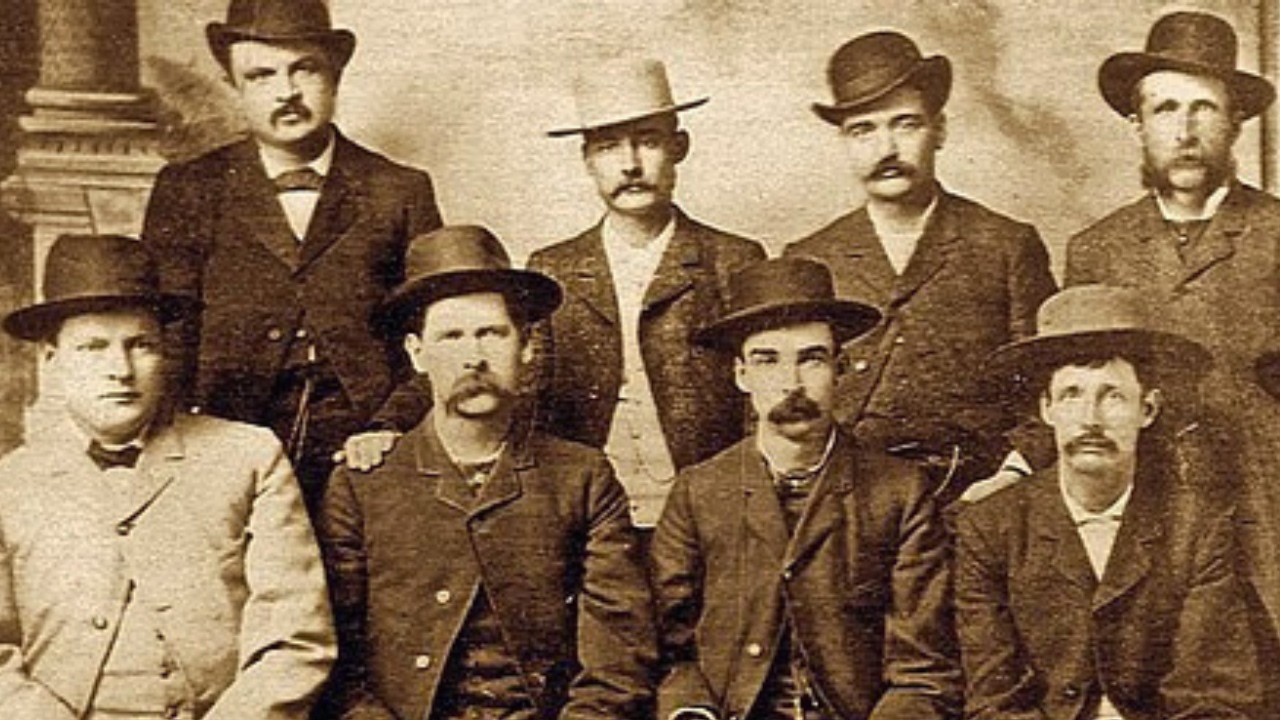
On the morning of February 14, 1929, seven men stood against a brick wall inside a garage on Chicago’s North Clark Street. Their hands were raised, and their faces pressed toward the cold masonry. Two men in police uniforms had just ordered them to line up. It looked like a routine shakedown, the kind that happened in the city every week.

Nobody panicked. Some were annoyed. One still held a wrench. But the uniforms were stolen.
The badges were fake. And in about 90 seconds, every man against that wall would be torn apart by automatic gunfire. It was not a battlefield. It was a one-story brick garage in the middle of a residential neighborhood, where children were walking to school three blocks away.
That shooting lasted less time than it takes to boil an egg. Two Thompson submachine guns and a shotgun fired roughly 70 rounds into seven men standing shoulder to shoulder at a distance of less than 10 feet. One of those seven men survived for a few hours. Detectives found Frank Gusenberg on the floor with 14 bullet wounds, still breathing.
Rushed to a hospital, he was asked who had done this to him. His answer has haunted criminal investigators for almost a century. The man who was supposed to be the eighth victim, the actual target of the entire operation, was not inside the garage. Bugs Moran, leader of Chicago’s North Side Gang, had spent years publicly mocking the most dangerous gangster in America.
He saw the police entering, and he walked away. This is the story of the Saint Valentine’s Day Massacre. How one man’s taunts brought an empire’s fury down on his own people, and how a crime scene on a winter morning changed American history. The story begins with Dean O’Banion, an Irish-American florist on Chicago’s North Side who ran a legitimate flower shop and an entirely illegitimate bootlegging empire.
He was charming, devout, sang on Sundays, and had no moral difficulty with murder on weekdays. In November 1924, three men walked into his flower shop, shook his hand, and shot him dead. The men were associates of Johnny Torrio and his young protégé, a 25-year-old former bouncer from Brooklyn named Al Capone. By 1929, Capone controlled most of the South Side’s bootlegging, gambling, and prostitution.
He opened soup kitchens and donated to charities. Reporters photographed him smiling at baseball games. He told anyone who would listen that he was just a businessman giving the people what they wanted. Behind that smile was an organization responsible for dozens of murders.
The man who replaced O’Banion after a bloody chain of succession was George Bugs Moran. Born in Minnesota to French immigrant parents, Moran was a street brawler since childhood, in and out of reformatories and jails. He refused to deal in prostitution because he considered it immoral, but bootlegging and killing were perfectly acceptable. And he had one particular hobby that would cost his men their lives.
He mocked Capone publicly, called him the beast, hijacked his beer trucks, and made it personal. By 1928, the bodies had been stacking up for four years, and Capone decided it was time to end it in one stroke. The plan he approved, or that his lieutenants designed in his name, was elegant and ruthless, depending on one simple insight. Moran’s men trusted police uniforms.
The man tasked with designing the massacre was Jack Machine Gun McGurn, a 26-year-old born Vincenzo Gibaldi, a former professional boxer who had traded the ring for the Outfit’s inner circle. He carried a Thompson submachine gun as casually as other men carried briefcases. McGurn’s plan was built around a single piece of bait, a shipment of hijacked old Log Cabin whiskey offered to Moran at a cut rate. The delivery point would be a brick garage at 2122 North Clark Street, the SMC Cartage Company warehouse, a spot Moran’s men used regularly.
Capone, meanwhile, would be nowhere near Chicago. He traveled to his estate in Miami, Florida, days before. On the morning of the massacre, he would be sitting by the ocean with witnesses who could swear he had been there all week. The men summoned to the garage that morning were the backbone of Moran’s operation.
Peter Gusenberg, about 40, and his younger brother Frank, both career enforcers who had survived drive-bys and ambushes for years. James Clark, real name Albert Kachellek, Moran’s own brother-in-law and second in command. Adam Heyer, the gang’s accountant and business manager. Albert Weinshank, a bootlegger who bore physical resemblance to Moran himself, same build, same style of brown overcoat and hat.
Then there were two men who did not belong in this story at all. John May was a mechanic, mid-30s, with seven children at home. He fixed cars, Moran’s cars, yes, because the money was there and he needed it. On that morning, he was underneath a sedan doing his job.
His dog, a German Shepherd named Highball, was chained to a tire nearby. May had no stake in this war. He was just a man trying to feed his family who happened to work in the wrong building. The seventh man was Reinhard Schwimmer, a 33-year-old optometrist who had lost his license and become fascinated by the gangster lifestyle.
He was not a criminal. He was a hanger-on, a thrill-seeker who wanted to be close to the action. He got closer than he ever imagined. Here is where the story pivots on a single human decision.
Bugs Moran is supposed to be at the garage by 10:30. He is late. Some accounts say he was at a rooming house across from the garage. Others place him walking down Clark Street.
What matters is what he sees. A black 1927 Cadillac sedan, the kind Chicago police drive, is parked near the entrance. Two men in police uniforms are walking toward the garage door. Behind them, two or three men in civilian suits and fedoras.
Moran stops. A police bust is an inconvenience, not a death sentence. He turns round. He walks away.
Another Moran associate, Ted Newberry, also sees the police and stays away. The trap that was built to kill Bugs Moran catches everyone except Bugs Moran. The seven men inside the garage, seeing what they believe are police officers, do exactly what anyone would do when cops walk in during Prohibition. They put their hands up.
They turn to face the wall. They cooperate. That compliance is what kills them. The men in the stolen uniforms are now inside.
The door closes behind them. No one on Clark Street thinks anything is wrong. The morning is bitterly cold, with temperatures below freezing and snow dusting the rooftops. The Lincoln Park neighborhood is waking up.
Shopkeepers opening doors. Children heading to school. Inside, the men have been arriving since mid-morning. Peter and Frank Gusenberg are among the first.
James Clark follows. Adam Heyer, Reinhard Schwimmer, and John May, who is already at work underneath the car. Albert Weinshank walks through the door, wearing a brown overcoat and a hat, roughly Moran’s height and build. Some historians believe this is the moment the massacre becomes inevitable.
A lookout stationed outside, mistaking Weinshank for Moran, signals the hit team. The target is inside. Go. Whether this is true or fabricated after the fact has never been proven, but the coincidence is chilling.
The man who looked like Moran died in Moran’s place. The whiskey shipment does not exist. The deal is a fiction invented by McGurn’s men. The fake officers push through the garage door, sharp and commanding.
The seven men react the way any bootlegger in 1929 Chicago would. You put your hands up. You cooperate. You let them search.
You get out later. The officers order them to line up against the north wall. The men comply. Peter Gusenberg steps to the wall, Frank beside him.
Clark, Heyer, Weinshank, Schwimmer, and May, pulled away from the car with greasy hands, all line up. Behind them, the sound of coats being unbuttoned. Two of the plainclothes men pull Thompson submachine guns from beneath their overcoats. A third produces a shotgun.
The weapons are leveled at the backs of seven unarmed men standing less than 10 feet away. The first trigger pull sends a . 45 caliber round into the line. The second Thompson joins a fraction of a second later.
The shotgun booms between the bursts. Inside the enclosed brick garage, the noise is beyond description. Brick dust explodes from the north wall as rounds slam into the masonry. Outside, witnesses hear what sounds like a car backfiring over and over.
They will not call the police. The men along the wall have no chance to react. At less than 10 feet, those heavy slugs hit with enough force to drive a man off his feet. The first burst lasts perhaps10 to20 seconds, emptying most of the 50-round drum magazines.
The noise stops. The garage fills with smoke and brick dust. Six men are down. But the shooters are not finished.
The gunmen step forward, methodical as a factory foreman. For those still alive, at least one was, the first volley would have left ears ringing. The second burst is shorter, more deliberate. They fire into individual bodies, ensuring no one is left alive.
This is not rage. This is procedure. Total trigger time is under2 minutes, some estimates put it under60 seconds. In that span, roughly70 .
45 caliber rounds and several shotgun shells are fired into seven men. The wall behind them is pockmarked with dozens of impact craters. Some of those bullet holes are preserved today in bricks behind glass at a museum in Las Vegas. When it is done, the garage floor is dark with what the men have left behind.
Then comes the most audacious part of the operation. The two men in police uniforms holster their sidearms. The plainclothes shooters conceal the Thompsons again. The officers draw their weapons on the civilians and march them out of the garage at gunpoint.
To anyone watching, this is the end of a police raid. Two cops have just arrested two suspects. Nobody intervenes. The four or five men climb into the black Cadillac and disappear northward on Clark Street.
The entire operation has taken roughly10 to12 minutes. Chicago’s North Side Gang has been decapitated. Inside, only silence remains, until a German Shepherd named Highball, chained to a truck tire, begins howling into the smoke-filled air. The first person to sense something is wrong is a neighbor who heard the gunfire and noticed the garage go quiet too suddenly.
Police arrive shortly after 11:00. Six of the seven men are dead or dying, but one, Frank Gusenberg, is still breathing. Officers rush him to Alexian Brothers Hospital. Detectives follow.
They have one living witness. Frank Gusenberg, with14 bullets in his body, is still conscious. He knows who shot him, and he knows why. In a hospital room surrounded by detectives, Sergeant Thomas Loftus leans in.
“Who did this to you, Frank? Who shot you? ” Gusenberg looks at him. With nothing left to lose, he could name his killers.
He says, “Nobody shot me. ” Some versions record it as “No one shot me” or “I am not going to talk. ” The words vary. The meaning does not.
Frank Gusenberg chooses the code over justice. He dies early that afternoon, three hours after the shooting. The last survivor takes his secrets with him. A thousand miles south, in Florida, Al Capone plays the role of innocent businessman.
He expresses shock and offers sympathy. He has witnesses who can testify he has been in Miami for days. Nobody believes him. Everybody knows.
But knowing and proving are two different things, and Capone has built his empire on that gap. Back in Chicago, Jack McGurn has his own alibi. A showgirl named Louise Rolfe testifies that McGurn spent the entire night and morning of February14th in a hotel room with her. The press dubs her “the blonde alibi.
” Her testimony helps McGurn avoid conviction. McGurn walks free. The photographs hit newspapers the next morning. Bodies against a wall.
Dark stains on concrete. A dog chained to a wheel in a room that looks like a slaughterhouse. Chicago editorial writers call it the most shocking gangland slaying in the history of the city. The word massacre, usually reserved for wars, now attaches itself to Valentine’s Day.
Calvin Goddard, a pioneering forensic ballistics expert, is brought in to examine the evidence. His conclusion is devastating. The recovered casings and bullets could have been fired only from two specific Thompson submachine guns. Those Thompsons surfaced 10 months later, 200 miles away.
In December1929, Fred Killer Burke, a World War I veteran suspected of being one of the shooters, kills a police officer in St. Joseph, Michigan. Police find an arsenal including two Thompsons at his farmhouse. Goddard tests them.
They match. Burke goes to prison for the officer’s murder, not the massacre, and dies there in1940. Seven men dead. Zero convictions.
The massacre’s true impact had nothing to do with prison sentences. It had to do with what happened next. It did not send Capone to prison. No one was ever convicted for those killings.
The massacre’s power was political. It horrified the public so completely that it gave federal authorities the cover they needed to go after Capone. What they had was not a murder charge. It was an accountant.
In1931, Al Capone was convicted of income tax evasion. The most notorious gangster in America, brought down by bookkeeping. The men suspected of pulling the triggers fared no better. Fred Burke died in prison.
Fred Goetz was shot dead by fellow criminals in1934. Gus Winkler was gunned down in1933. Jack McGurn, the alleged architect of the massacre, was gunned down in a Chicago bowling alley on February14th, 1936. Valentine’s Day.
Exactly seven years later. A comic Valentine card was found near his body. No one was ever charged for his murder, either. Bugs Moran never recovered.
His organization collapsed. He slid into small-time robberies and petty fraud. He was eventually arrested for bank robbery. He died of lung cancer in Leavenworth Federal Penitentiary in1957, broke and largely forgotten.
The garage at2122 North Clark Street was demolished in1967, but the north wall, the bullet-scarred brick, was not destroyed. The bricks were removed, numbered, cataloged, and eventually sold. They were reassembled behind glass at the Mob Museum in Las Vegas. Today, tourists stare at the bullet holes.
The masonry has outlasted every man who stood on either side of it that morning. Onthe morning of February14th,1929, seven men stood against a brick wall because they thought they were being arrested. Less than2 minutes of trigger time later, six were dead. The seventh lasted3 hours.
When detectives asked who did this, Frank Gusenberg kept the code. The target was not there. The killers were never convicted.
And the wall, pockmarked and stained, the only witness that cannot lie, is still standing