The Sundance Kid remains one of the most enduring mysteries of the American Old West, a figure whose life is still clouded by speculation more than a century after his supposed death. Known primarily as Butch Cassidy’s loyal partner in the Wild Bunch, his legacy raises questions that historians have never been able to fully settle. Was he simply a devoted accomplice, or was he a far more dangerous figure who helped shape the outlaw legend? His story is built on bold escapes, conflicting reports, and rumors that stretch far beyond the American frontier.
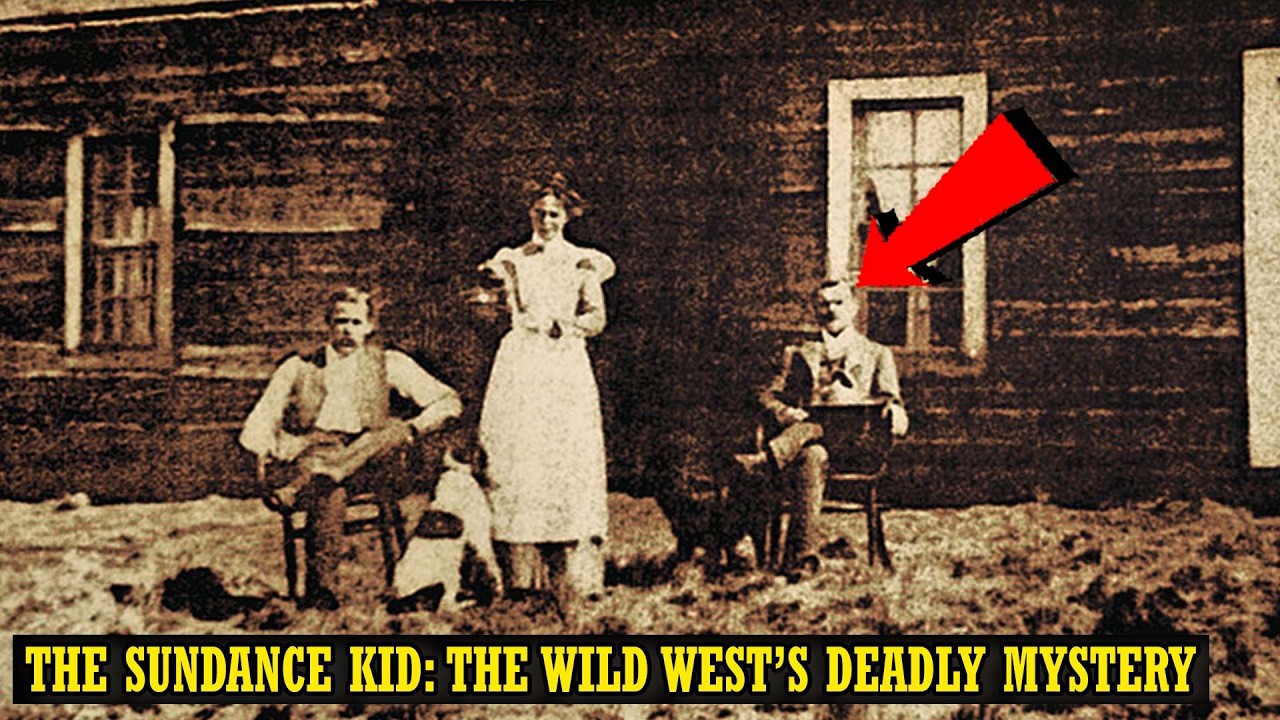
Before he became the Sundance Kid, he was Harry Alonzo Longabaugh, born in Montclair, Pennsylvania, in 1867, the youngest of five children. At 15, he headed west with his cousin George to help settle a homestead near Cortez, Colorado, where he worked as a ranch hand and developed the horse skills that would serve him for years. By 1886, he drifted north and found work at the N-Bar-N Ranch in Montana Territory, but the brutal winter of 1886–1887 forced layoffs, and he moved on. In 1887, while passing through the Three V Ranch near Sundance, Wyoming, he made a choice that would define his life: he stole a horse, a saddle, and a firearm from a cowboy.
Authorities caught up with him in Miles City, Montana, and Judge William E. McGinness sentenced him to 18 months in jail. It was during this period that he adopted the name the Sundance Kid, a reference to both the Wyoming town and his youthful departure from home. After his release, he returned to cattle work, eventually landing at the vast Bar U Ranch in Canada’s Northwest Territories.
He briefly co-owned a saloon in Calgary before disputes with his partner drove him back to Montana, where he resumed work at the N-Bar-N. By the early 1890s, he was implicated in cattle and horse theft across Montana and Canada, and suspicion later tied him to a train robbery in 1892 and a bank robbery in 1897. Around this time, he became linked with the Wild Bunch, the outlaw crew led by Butch Cassidy, born Robert LeRoy Parker. Although remembered today as quick with a gun, Longabaugh’s reputation was often overshadowed by fellow gang member Kid Curry, whose deadly encounters with lawmen were well known.
Sundance was reported to have been present during a confrontation near Hole-in-the-Wall, Wyoming, and was thought to have wounded two pursuers in that clash. The Wild Bunch left a trail of violence, with five law officers killed by gang members, largely attributed to Kid Curry. Wanted posters spread nationwide, with rewards reaching as high as $30,000. During this period, Longabaugh and Logan used a log cabin in Old Trail Town, Cody, Wyoming, as a base while planning a robbery in Red Lodge, Montana.
The relentless pursuit of Pinkerton detective Charlie Siringo and his men kept constant pressure on the gang. By the dawn of the 20th century, Butch Cassidy and the Sundance Kid were running out of options, and they made a bold decision to disappear. In February 1901, the two men, joined by Sundance’s companion Etta Place, slipped out of New York aboard the British steamer Herminius, bound for Buenos Aires, Argentina. Cassidy traveled under the name James Ryan, posing as Place’s brother.
The trio sought a quieter life in Patagonia, purchasing a 15,000-acre ranch on the east bank of the Rio Blanco near Cholila, where they built a four-room log cabin at the base of the Andes. Evidence of their new life comes from a letter written by Cassidy on August 10, 1902, describing their household of three, with 300 cattle, 1,500 sheep, and 28 horses. That letter, preserved today by the Utah State Historical Society, offers a rare glimpse of Cassidy not as an outlaw but as a man trying to reinvent himself. The peaceful life, however, did not last.
On February 14, 1905, two English-speaking outlaws robbed the Banco de la Nación Argentina in Río Gallegos, nearly 700 miles south of Cholila. Though never confirmed, many believed the mysterious pair were Butch Cassidy and the Sundance Kid, and the incident created ripples across Patagonia. Word of the crime raised suspicions, and their carefully built cover as respectable ranchers began to unravel. By May 1, 1905, the trio chose to sell their ranch, a move almost certainly designed to avoid capture.
Pinkerton agent Frank Dimaio knew they were in Patagonia, though harsh winters and deep snow had kept him from closing in. Local politics also played a role, with Governor Julio Lezana issuing an arrest warrant for the fugitives. The trio benefited, however, from an unlikely ally: Sheriff Edward Humphreys, a Welsh Argentine official reportedly captivated by Etta Place, quietly warned them of the danger. Acting on that information, they abandoned Cholila and fled north to San Carlos de Bariloche, where they boarded the steamer Condor and crossed Lake Nahuel Huapi into Chile.
By the end of 1905, they cautiously returned to Argentina, but the dream of living as ranchers was gone. In August 1905, the man known as the Sundance Kid was living under the alias Frank Boyd in the Chilean port town of Antofagasta. On August 21, an encounter with local authorities turned deadly, and a police officer lost his life. For decades, this episode went largely unknown until 2022, when digitized issues of the Antofagasta newspaper El Industrial brought the story back to light.
Sundance was taken into custody but released on a bond so steep that in today’s value it would equal nearly $80,000. With the discreet assistance of the US vice consul in Antofagasta, he managed to escape, crossing into Argentina and then onward into Bolivia. Later that same year, on December 19, 1905, Butch Cassidy, Sundance, Etta Place, and an unidentified male accomplice struck again, this time at the Banco de Italia in Villa Mercedes, about 450 miles west of Buenos Aires. Their haul amounted to 12,000 pesos.
From there, the group made a daring retreat across the Andes Mountains into Chile. By mid-1906, the strain of outlaw life began to show, and Etta Place, exhausted by years of constant movement, chose to step away. In June 1906, Sundance accompanied her back to San Francisco, a decision that effectively removed her from the saga. Her disappearance from the historical record after this point has only deepened the mystery around her.
Meanwhile, Cassidy attempted something unusual for his career: honest labor. Adopting the name James Santiago Maxwell, he found work at the Concordia tin mine in the Santa Barbara range of the Bolivian Andes. By the time Sundance returned from the United States, the two men were once again side by side, but in an entirely new role. Instead of planning robberies, their main responsibility at Concordia was guarding payroll shipments for the mining company.
Two of the West’s most famous outlaws were now employed to protect the very kind of money they once pursued. In late 1907, the pair traveled east into Santa Cruz, Bolivia, a frontier town on the vast grasslands. Their continued movement suggests they were still searching for stability, holding on to the idea that they might one day live as legitimate ranchers rather than fugitives. On November 3, 1908, a payroll courier for the Aramayo Francke and Cia mine was traveling near the remote town of San Vicente, Bolivia.
Along the way, he was intercepted by two masked Americans, whom many would later believe were none other than Butch Cassidy and the Sundance Kid. Three days later, the mysterious strangers were reportedly seen again inside San Vicente, checking into a modest boarding house owned by minor Bonifacio Casasola. Suspicion grew when the men were spotted with a mule branded with the Aramayo Company’s mark, an unmistakable clue linking them to the missing payroll. Casasola discreetly notified a nearby telegraph officer, who relayed the information to the Abaroa cavalry regiment stationed not far away.
Captain Concha dispatched three soldiers, and local authorities, including the police chief and the town’s mayor, joined forces to respond. By the evening of November 6, the boarding house was quietly surrounded. As the authorities closed in, the occupants resisted, sparking a standoff that stretched late into the night, punctuated by bursts of gunfire echoing through the narrow streets. Then, in the early hours of the morning, around 2 a.
m. , a silence fell over the house. Witnesses recalled hearing a man cry out three times, followed by two shots from inside. The meaning of those sounds would be debated for generations.
When dawn broke on November 7, 1908, local authorities cautiously entered the small boarding house. Inside, they discovered the lifeless bodies of two men. Each showed multiple wounds to the arms and legs. One, thought to be Harry Longabaugh, had a single wound to the forehead.
The other, believed to be Butch Cassidy, bore a similar mark at the temple. The official report speculated that Cassidy may have acted to end Sundance’s suffering before turning the gun on himself, a theory that has been debated ever since. The police quickly identified the pair as the same men responsible for the Aramayo payroll robbery, but authorities never confirmed their true identities. There were no fingerprints, no photographs, and no eyewitnesses who could say with absolute certainty that these were indeed Butch Cassidy and the Sundance Kid.
The two men were buried quietly in the San Vicente Cemetery, but over time, the exact location of their resting place was lost. In 1991, American forensic anthropologist Clyde Snow led a team to San Vicente to solve the mystery. Excavations were carried out, but none of the remains uncovered matched the DNA of Cassidy’s or Longabaugh’s living relatives. In 2017, a fresh investigation shifted attention to Good Springs, Nevada, where some believed Cassidy had secretly lived out his final years, but DNA testing once again failed to establish any connection to the outlaw’s family line.
Among the many survival stories that emerged, one of the most intriguing centered on Harry Longabaugh. According to local accounts, he may have quietly resettled in Duchesne, Utah, living under the assumed name William Henry Long, who passed away in 1936. In December 2008, Long’s remains were exhumed and subjected to modern DNA testing. Anthropologist John McCulla reported that the DNA did not match samples obtained from a distant relative of the Sundance Kid, and the story could not be confirmed.
The life of the Sundance Kid remains one of the Wild West’s greatest puzzles, a story of loyalty, daring escapes, and unanswered questions that still spark debate more than a century later. Was he truly lost in Bolivia, or did he slip back into America under another name? That mystery is what keeps his legend alive.